
Buy a supplier-checkout marketplace software asset
Separate digital asset offers for a defined operator purchase.

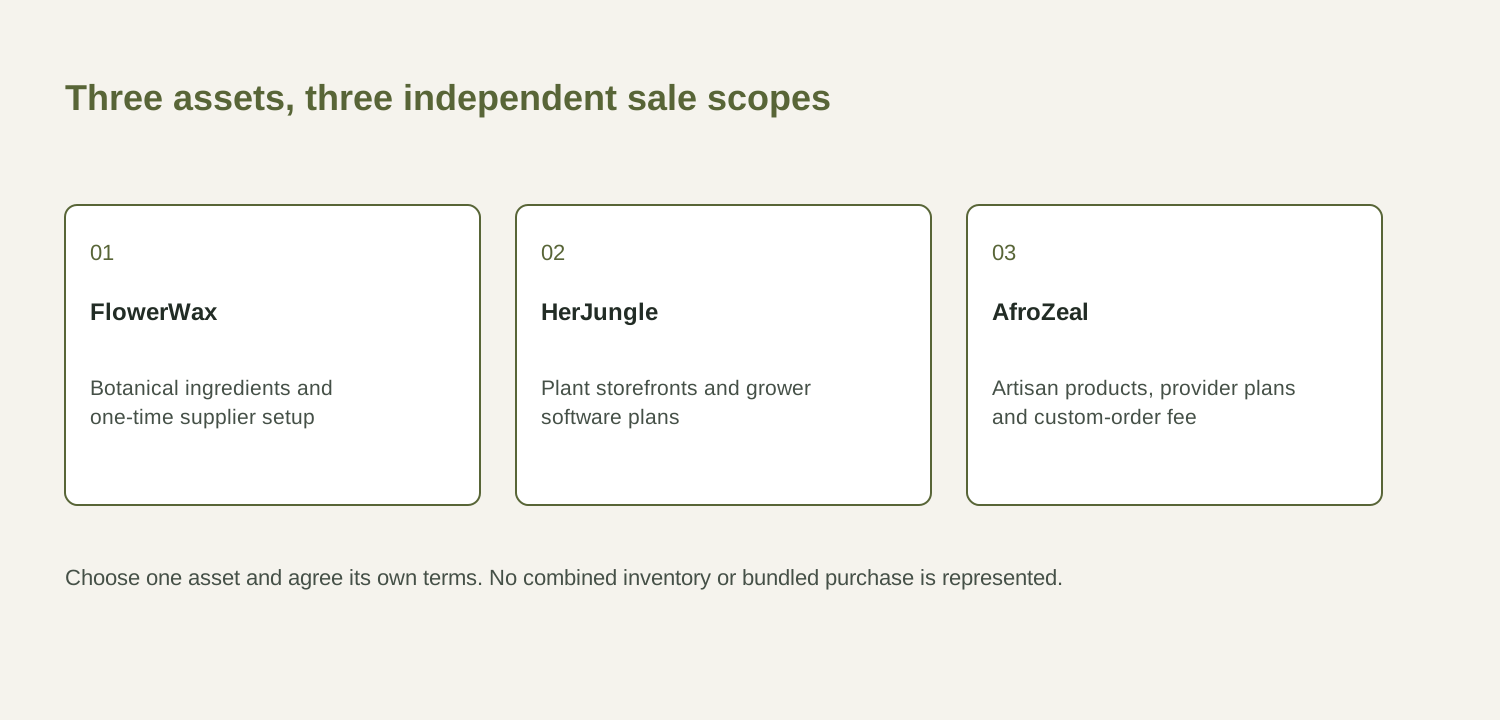
Acquire a supplier-checkout marketplace asset through its own listing. Choose FlowerWax, HerJungle or AfroZeal and accept seller accounts, orders and payouts.
Acquire one supplier-checkout marketplace software asset with a defined order, seller account and money flow. FlowerWax, HerJungle and AfroZeal are separate available product offers. They are not a bundled business or an included supplier network. This purchase brief is for an operator whose main acceptance condition is a dependable transaction between a customer and an independent seller.
Open the individual sale that matches the intended catalogue: FlowerWax botanical ingredient marketplace, HerJungle grower marketplace or AfroZeal artisan marketplace. Confirm each listing's current availability, asking terms, disclosures and transfer scope independently.
The products are presented as starter assets, without represented verified customer networks or commercial income. Their public previews and sample records show the application surfaces. They do not supply evidence of supplier contracts, fulfilled orders or future demand. A buyer should make an offer for the selected digital package and explicitly accept its account, checkout and handover boundaries.
The supplier-transaction scope being purchased
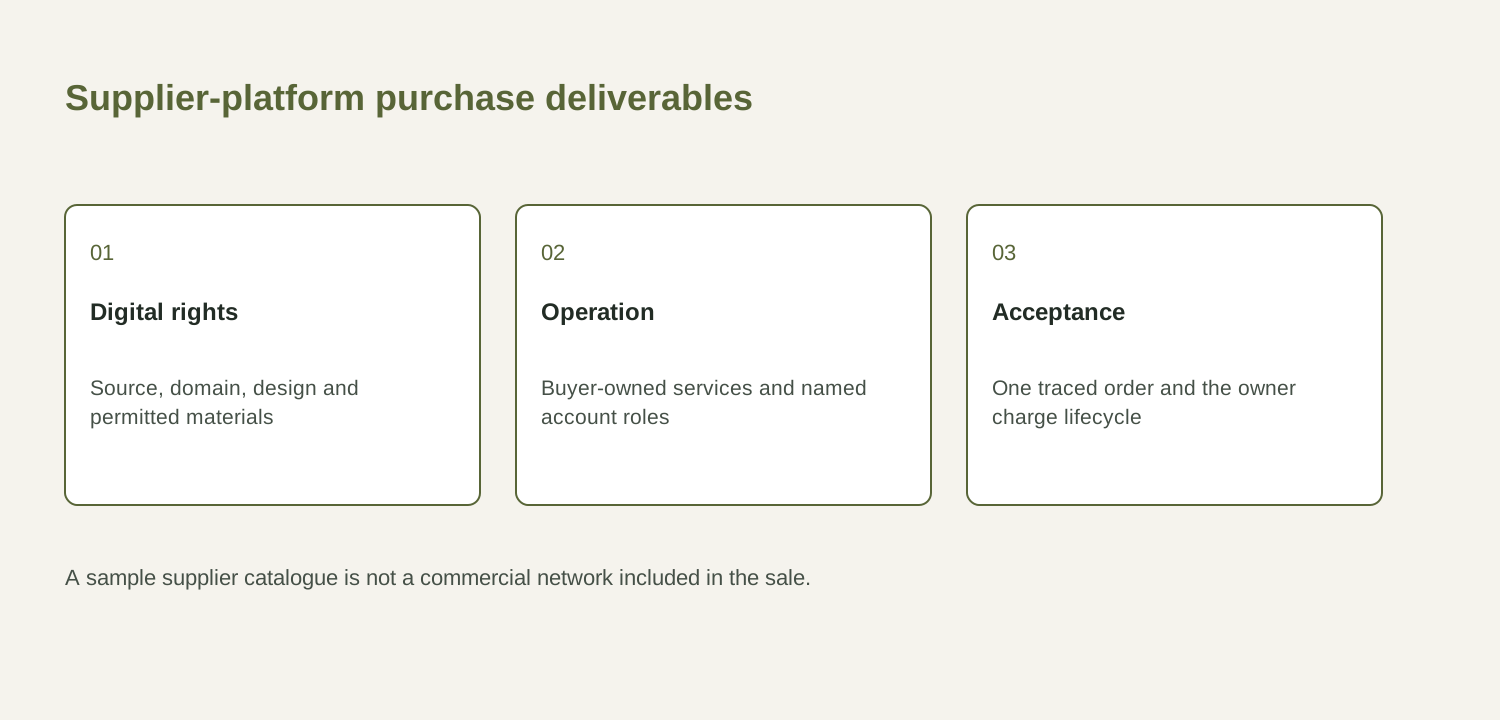
The defining purchase is a product in which independent sellers maintain an offering and receive the relevant order proceeds. The buyer acquires the platform application and becomes responsible for its operation. This differs from buying the sellers' stock or their companies. The asset inventory should identify source, domain, design and documentation, with any genuine commercial relationships listed separately.
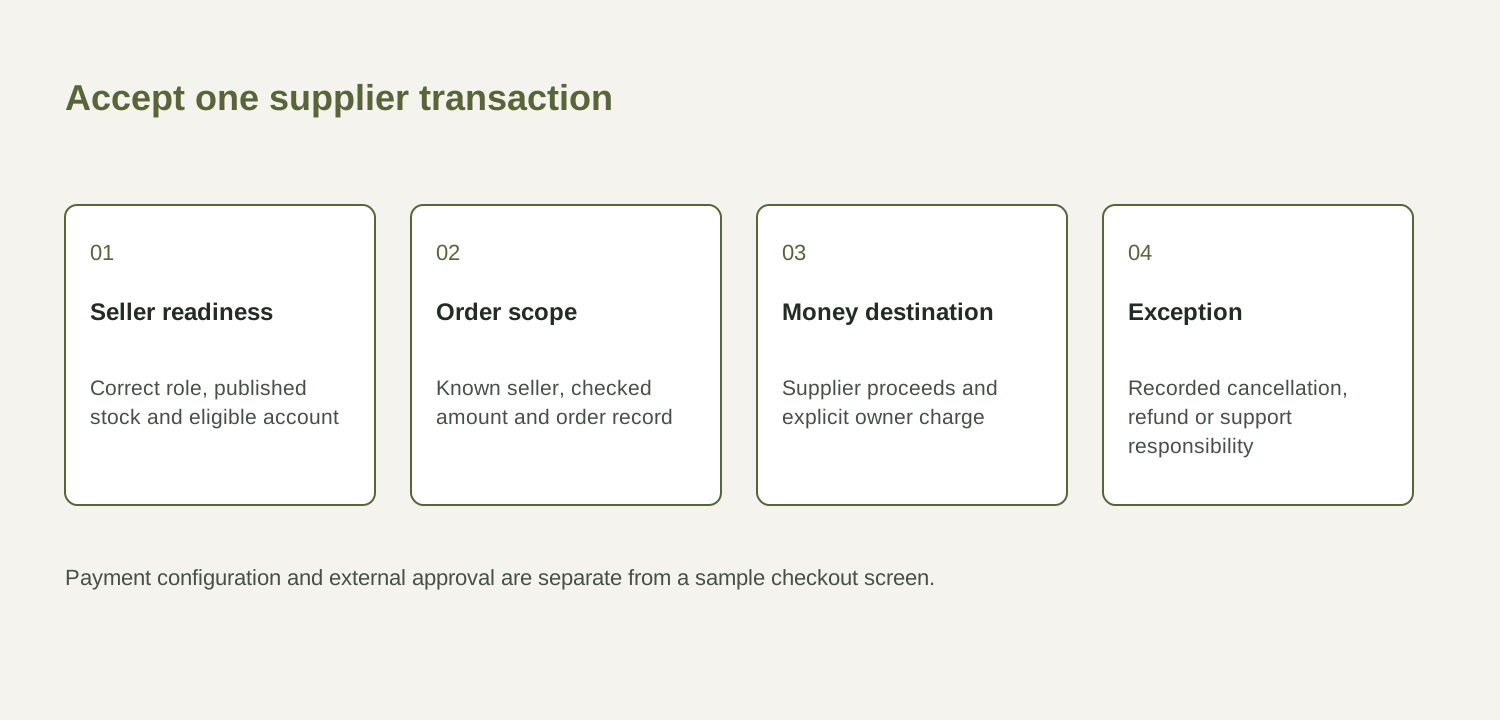
Begin the transaction discussion with one representative order. Identify the customer, seller, product, amount and destination of the money. Use that same example throughout the seller walkthrough. A consistent order trace reveals whether account readiness, checkout, order records and owner charges belong to the delivered scope.
A marketplace can look complete while an important part of that chain is still conditional. The seller's payment account may be in a test environment, a sample supplier may not have completed onboarding, or a public catalogue may contain demonstration stock. Those states should be recorded plainly. The acquisition can still proceed if the required corrections and external approvals are clearly assigned.
FlowerWax as the supplier setup-fee asset
FlowerWax focuses on botanical ingredients, including floral waxes, essential oils, botanical butters and carrier oils. Its documented product includes supplier storefronts, product management, a same-supplier cart, customer orders and payment foundations. The owner revenue feature included today is a configurable one-time supplier setup fee.
That fee must be accepted separately from ingredient orders. A supplier pays for opening its storefront, while ingredient checkout concerns the customer and connected supplier. Monthly seller plans and promoted placement are not included owner revenue features in the documented product. If the buyer wants them, their billing, access and expiry behaviour needs an additional agreed scope.
Inspect the FlowerWax asset entry and its technical handover document. Ask for an onboarding-fee trace and a separate sample ingredient order. The purchase should identify which records prove each charge and what remains to configure under buyer-owned services.
HerJungle as the grower-plan asset
HerJungle is a rare-plant marketplace foundation with grower storefronts, catalogue and inventory tools, orders, seller plans and connected payment setup. Its checkout uses one grower per order. Physical plants, a nursery operation and signed grower relationships are separate from the software asset and cannot be inferred from sample catalogue records.
The owner model includes configurable seller subscriptions. The plant order and the seller software charge have distinct purposes. Ask the seller to demonstrate plan access independently from a plant checkout, including the resulting account states. A configured recurring price does not establish a paying grower base.
Review the HerJungle product package and technical guide. The acceptance example should identify the plant quantity, grower and payment destination. Stock conflicts and the single-grower boundary belong in the written order test, alongside the source and domain transfer conditions.
AfroZeal as the artisan-commerce asset
AfroZeal connects independent African fashion designers and artisans with product discovery, provider storefronts, customer checkout and owner controls. The documented foundations include provider plan configuration and a managed custom-order workflow. The current Artisan Pro plan described in source is zero-priced and configurable, rather than evidence of paying subscribers.
The stored custom-order workflow has a configurable concierge fee documented at twenty-two percent. That is not a universal commission on every ordinary catalogue order. Ask the seller to show the current commercial mechanism and keep the product sale, provider software plan and managed custom request separate in the acceptance record.
Use the AfroZeal asset entry and listed documentation as scope references, then confirm the actual current guides through the seller. Accept a representative catalogue transaction and the custom-request path only where included in the agreed purchase. Any represented artisan relationships require evidence separate from the demonstration storefronts.
Seller account readiness as a closing condition
A seller account can have several states: signed in, assigned a role, carrying a storefront, eligible to publish and ready for payment. Record which states the application maintains and which depend on an external provider. The buyer needs to understand the complete state required before allowing a genuine seller to accept an order.
Use a newly configured sample seller rather than only an already prepared demonstration account. Follow the required information, publication and payment steps. Record the result at each stage and the action that moves it forward. This gives a practical acceptance condition for the onboarding service the future operator will offer.
An external account identifier is not proof of payout eligibility. Ask the seller to show how the current application checks the relevant provider state in the agreed environment. If a required approval cannot be completed during the sale review, state it as a remaining condition. Do not replace that uncertainty with a promise that every supplier can receive funds immediately.
One order and its verified amount
The order trace should use a representative product and quantity. Record the displayed amount, the amount submitted to checkout and the order record retained afterward. Ask which values the backend checks. A public success message is useful context, but the accepted workflow should connect it to the payment and order states used by the application.
Change a product price after the sample item has entered a cart and inspect the result. The buyer should know which price rule applies and how the customer learns about a change. A completed order should retain an understandable amount. Any required correction needs a specific acceptance condition rather than a general promise of secure checkout.
Also leave a test checkout unfinished and return to the account. Inspect whether an order exists, its payment state and any stock or access effect. This is a purchase acceptance exercise, not a commercial sale. Use suitable fictional data and an agreed payment test environment, then repeat relevant checks after buyer-owned configuration is in place.
The owner charge beside supplier proceeds
Write the owner charge and supplier proceeds on separate lines in the acceptance record. FlowerWax's setup fee, HerJungle's seller plan and AfroZeal's configurable plan or managed custom-order mechanism do not have the same commercial meaning. The buyer should accept the selected product's actual charge instead of applying one generic marketplace commission assumption.
For each included charge, identify its payer, trigger, amount configuration and resulting access or service. Then identify where a customer order's proceeds go. These facts support the operator's accounting and customer promise. They do not require inventing a growth forecast or treating the gross value of supplier goods as platform income.
If the future model differs, scope the change. Adding subscriptions involves plan states and failure handling; adding a transaction fee changes money allocation and seller communication. Code ownership allows future work, while the current sale must identify the implementation being delivered. Keep that distinction in the offer and the accepted release.
| Asset | Documented owner charge | Customer order | Acceptance caution |
|---|---|---|---|
| FlowerWax | One-time supplier setup fee | Ingredient purchase from one supplier | No included recurring seller plan |
| HerJungle | Configurable grower subscription | Plant purchase from one grower | Demo plants are not acquired physical stock |
| AfroZeal | Configurable provider plans and managed custom-order mechanism | Artisan product commerce | Current zero-priced plan is not paying-subscriber evidence |
Order ownership across two sellers
Use two sample suppliers in the selected application. Give them clearly different products and follow one order for each. Inspect their account views and attempts to change the other supplier's records. The buyer needs a specific ownership boundary for catalogue, order and payment-related information before accepting the marketplace product.
The platform owner may have broader administrative controls. Ask which actions are available and which remain within a supplier account. Record the intended permissions rather than treating all access as one administrator login. This helps the buyer operate support without confusing ordinary seller authority with platform control.
Use fictional records for these checks. Real customer information is unnecessary to establish account isolation. If the intended launch requires staff teams within a supplier business, request evidence of those roles or scope the additional work. A two-sided marketplace description alone does not establish every multi-user permission system.
Cart boundaries and combined-order exclusions
FlowerWax and HerJungle have documented single-supplier or single-grower checkout boundaries. Test the response when the customer chooses a product from another storefront. The public flow should make its actual order rule understandable before the customer pays. Record the behaviour in the acquisition scope.
Do not infer a combined supplier basket from a catalogue containing several storefronts. A combined purchase needs order splitting, shipping responsibilities, payment destinations and exception rules. If that capability is essential, state the required scenario and request a bounded implementation agreement before treating it as part of the asset.
For AfroZeal, inspect the actual implemented product checkout and provider transfer arrangement rather than importing the other products' cart rule. Each application has its own documented foundation. The acquisition brief supports a transaction-centred purchase, while the final acceptance must remain specific to the selected software and its release.
Fulfilment accountability after software transfer
Payment routing does not pack ingredients, dispatch a plant or fulfil an artisan product. Identify the seller's responsibility and the platform owner's support role. The buyer should know what order information the application stores and how the responsible party updates the customer after payment.
Inspect the current order statuses and the accounts permitted to change them. Use a sample delay, cancellation or damaged-delivery enquiry to determine what record the operator can retrieve. A refund or dispute process should not be assumed merely because the application has a payments screen. Record the available functions and any required manual process.
Genuine supplier recruitment remains a launch task unless supported relationships are expressly included. A buyer might begin with a small permitted catalogue and a limited service area. That is a valid operating choice when it is stated clearly. The public promise should match the seller network and fulfilment process the buyer can actually operate.
Account transfer and payment-provider ownership
The purchase schedule should identify the services needed for frontend hosting, identity, backend data and payments. Agree which accounts transfer through provider-supported processes and which the buyer configures under its own ownership. Private credentials and connected seller account details require a controlled handover rather than publication in public files.
After configuration, repeat the accepted seller and order tests in the intended environment. A working transaction under a seller's account does not establish the buyer's merchant approval or bank settlement. Record what is complete, what is tested and what remains an external approval or live-account task.
International website access also differs from international payout support. Identify the launch markets and actual account requirements rather than promising universal supplier onboarding. The software offer can remain international in audience while its accepted operating scope is precise about the account configuration being delivered.
Catalogue and media rights included in an offer
Ask for an inventory of the images, descriptions and brand material supplied with the application. Distinguish demonstration records from genuine supplier content. The buyer needs to know what it may retain publicly and what must be replaced before real orders are offered.
Any represented supplier agreements should have their own scope and transfer evidence. A logo or sample storefront does not establish permission to trade with that business. Physical inventory is another separate asset. The purchase agreement should not blur source ownership, content rights and commercial supply relationships into one unsupported statement.
Prepare a small permitted catalogue for acceptance and record who keeps it accurate. Botanical pack units, living plant quantities and artisan product descriptions create different operating needs. The buyer's chosen platform should be accepted against its own sample products, with catalogue preparation and any import changes included in the launch budget.
Order amendments during the acquisition rehearsal
A supplier transaction may need a correction after the customer starts checkout. Use a fictional example to inspect the current actions for changing quantity, removing an unavailable product or cancelling a pending request. Record which account may perform each action and the resulting payment and order states. Accept the behaviour actually delivered in the chosen application.
Do not assume an amendment changes a payment that has already completed. Ask the seller to distinguish an edited catalogue record from a stored order and a payment-provider operation. The buyer needs to understand where the application retains the original amount and how the customer learns about an agreed correction. Any missing workflow can be stated as a bounded transfer condition.
These examples should use the selected platform's own rules. An ingredient order and a plant order may have different catalogue data, while an artisan custom request follows another commercial path. The purpose is not to combine their functions into one imagined product. It is to accept a concrete purchase with an understandable operating boundary.
Testing failure without inventing a refund feature
Choose an agreed failed-payment scenario in a suitable test environment. Inspect what the customer sees, what the supplier sees and whether stock or access changes. A declined or abandoned checkout should leave a record the operator can understand. Write the observed result rather than assuming a conventional ecommerce response.
Next ask the seller to demonstrate the available cancellation or refund actions, if any. Identify the application role, payment-service operation and customer communication involved. If an action remains manual in the provider account, document that fact. A purchase offer should not advertise automatic refunds simply because a payment integration exists.
The buyer must also know who handles the unusual case after transfer. The supplier may control fulfilment, while the platform owner can investigate a payment or account state. Name the responsible party and the evidence it can retrieve. That operating decision belongs beside the software acceptance, so a successful normal transaction does not conceal an unresolved support promise.
Account closure and catalogue withdrawal
Ask what happens when a sample supplier stops selling or loses publication eligibility. Inspect the storefront, active products and existing order views. The buyer needs to know whether customers can still identify their supplier and whether an authorised operator can retrieve the order record needed for support.
Then separate the public catalogue decision from the platform's own charge. A cancelled HerJungle seller plan, a FlowerWax storefront closure and an AfroZeal provider change need the selected product's actual account policy. Do not apply a single billing rule across three independent applications. Record the current result and any policy the buyer must implement before launch.
Use fictional supplier and customer records for these demonstrations. They establish system state, rather than the commercial retention or churn of a real network. Any represented existing relationships remain separately evidenced assets. The purchase can close on the delivered account lifecycle without claiming that a sample supplier is an active trading business.
A transaction-centred delivery schedule
Put the selected asset's source and domain transfer, buyer-account setup and order acceptance into an agreed sequence. Identify which checks depend on external account approval and which the seller can complete directly. A support period should have a stated start point, particularly when service configuration continues after source access is granted.
Retain a short record for each accepted state: seller readiness, catalogue publication, checked checkout amount, supplier order and owner charge. If a correction changes one state, repeat the affected test. This creates a specific delivery finish point without requiring an unsupported promise that the whole marketplace is already operating commercially.
Documents for the selected marketplace transaction
Use the current individual Flippa listing for availability and asking terms. Request the source and domain inventory, current user guide, technical guide and a seller-led walkthrough. Keep the resulting release reference with the accepted account and transaction examples. No other asset is automatically included because it appears in this brief.
Agree the technical support period and its start date in the transaction. The stored product materials describe handover assistance, while the current agreement controls the actual scope. Name any additional billing, catalogue or logistics changes with observable completion conditions. This makes the transfer review practical for both buyer and seller.
- Choose one named asset and confirm its current sale status.
- Accept a fresh supplier account through its required publication and payment states.
- Trace one customer order and a separate owner charge.
- Record seller isolation, cart boundaries and exception responsibilities.
- Agree source, domain, service accounts, content rights and support deliverables.
- Repeat the relevant tests under buyer-controlled configuration before launching real trading.
Supplier-platform acquisition acceptance tool
Record evidence for the one application selected, rather than ticking features from three different products.
Submit an offer for a specific supplier platform
The closing condition is a named application, its agreed rights and domain, the accounts the buyer will control and the transactions accepted. The buyer can acquire a focused software foundation without pretending it includes physical stock, guaranteed orders or a commercial supplier network.
Discuss the selected package through FlowerWax, HerJungle or AfroZeal on Flippa. Retain the scope and release evidence with that separate purchase. The other products remain independent offers with their own terms.
Explore the products discussed
Explore related acquisition offers