
Beauty marketplace for sale: acquire HitByGlam
Digital asset purchase, included software and agreed transfer.
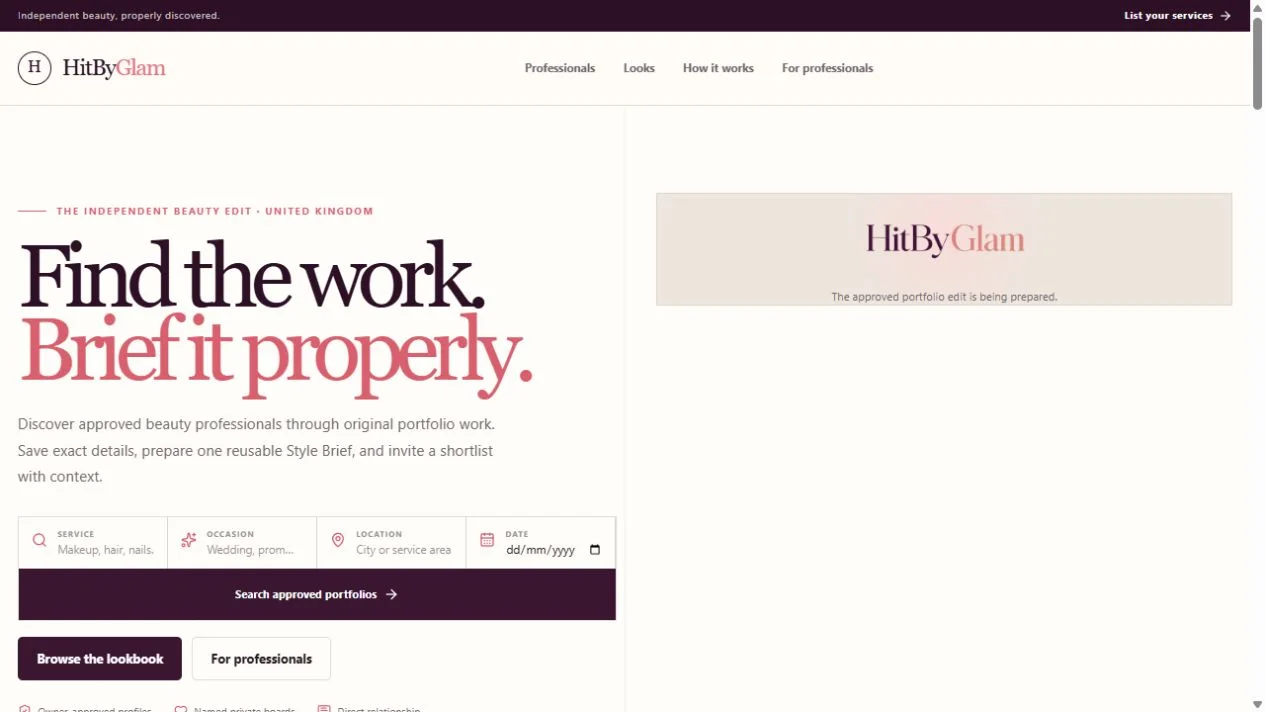
Acquire the HitByGlam beauty marketplace software asset, including portfolio discovery, private style briefs, professional plans and agreed handover.
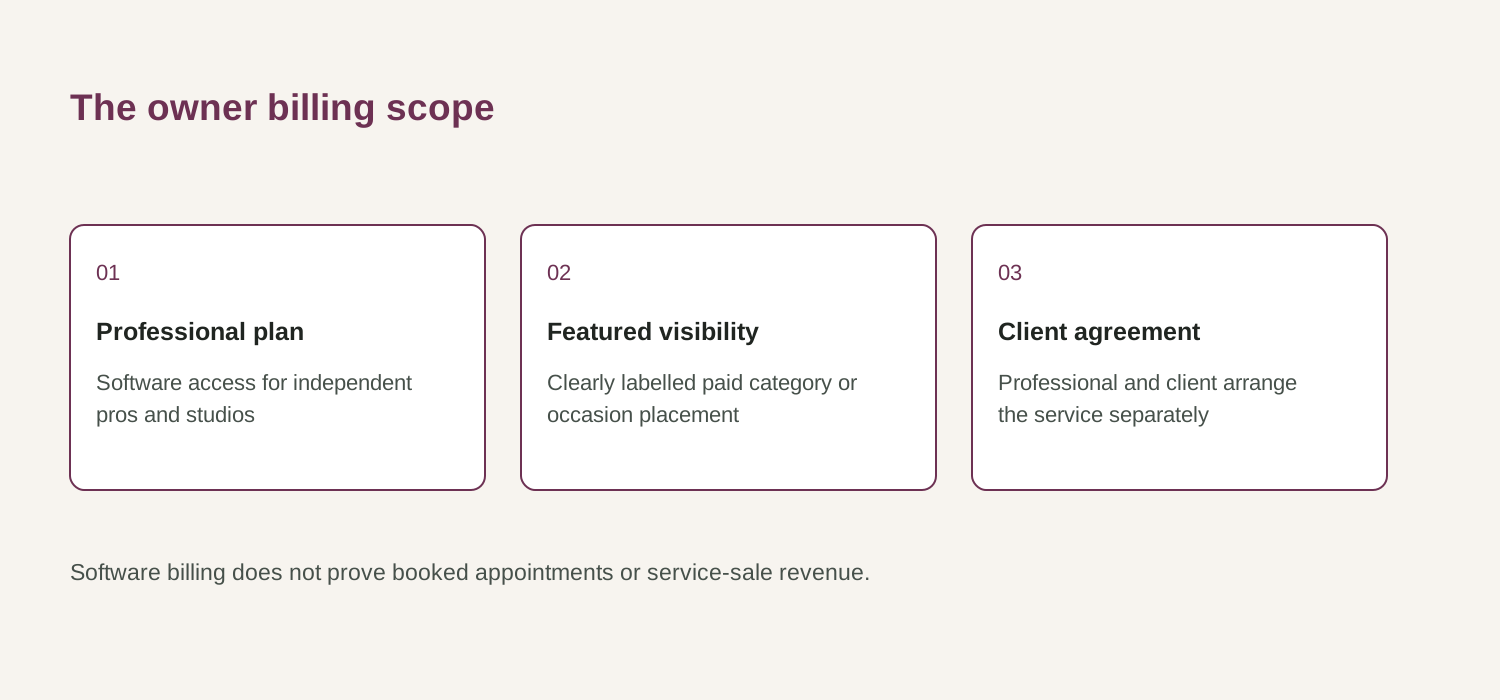
Acquire HitByGlam as a beauty-professional discovery and lead-management software asset. The package connects portfolio-led discovery, professional storefronts, private inspiration boards, reusable Style Briefs and an enquiry workspace. Its owner billing model is professional software plans and clearly labelled featured visibility. Appointments, deposits and beauty-service payments remain outside the platform.
View the HitByGlam sale and send an acquisition offer on Flippa. Inspect the asset package and technical handover document before agreeing the rights, accounts and acceptance conditions.
HitByGlam is a starter digital product with no represented revenue or paying-customer history. Its current public website includes a portfolio empty state. That describes the current surface and does not establish an active professional network. The purchase concerns the application, domain and agreed transfer; professional recruitment and launch operations remain buyer responsibilities.
The HitByGlam application offered for acquisition
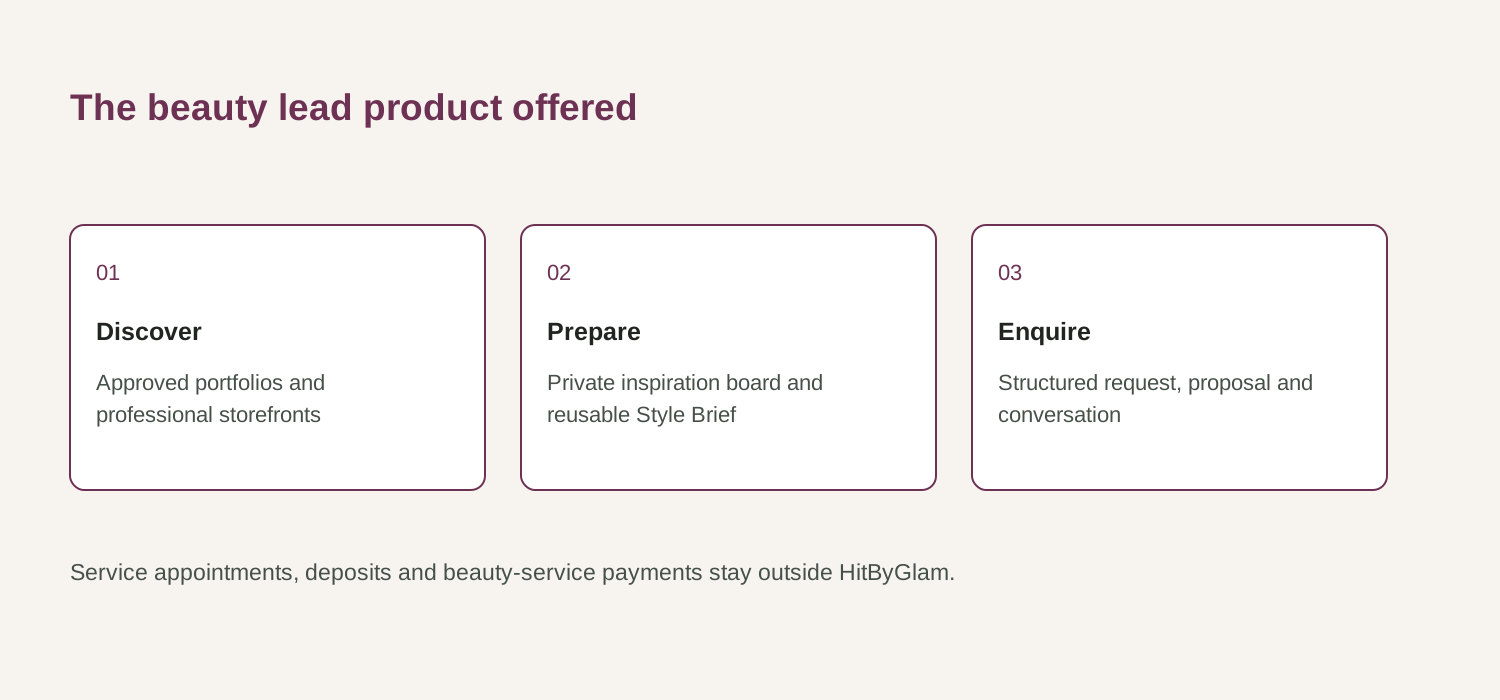
The product focuses on the path from visual discovery to a structured professional enquiry. A client identifies a look, collects inspiration and prepares a brief. A professional presents portfolio work and service information, then handles requests, proposals and conversations in a workspace. The platform owner administers the marketplace and its software charges.
This scope suits a buyer who wants to own a focused discovery product and shape its market. An operating salon, employees, equipment and contracted service revenue are separate assets. They are included only when expressly itemised. The digital purchase should identify its deliverables clearly enough that neither party needs to infer them from the appearance of the homepage.
Request a current release walkthrough alongside source and documentation access. The public site is one part of the package; the professional workspace and owner functions also need acceptance. Record the demonstrated state and any agreed corrections before preparing an offer. A completed product foundation can have value without being presented as a trading beauty business.
Portfolio and storefront assets in the sale
Inspect the information a professional can publish, the portfolio images it can maintain and the controls applied to public visibility. A marketplace owner needs to understand those actions before selling access to genuine professionals. The acceptance should use representative sample material and the same publishing process intended for launch.
Ask one professional account to edit an item, its description and a public profile detail. Observe the result after any required approval or publication step. Record which fields the professional controls and which belong to the owner. An additional approval, staff role or portfolio field should be a named requirement if the buyer needs it.
Content rights belong in the purchase schedule. Identify the brand files and demonstration material delivered with the application, then distinguish those assets from future professionals' work. The buyer should know what can remain public and what must be replaced. A photograph appearing in a sample storefront does not establish permission to use a genuine professional's portfolio.
Private boards and the reusable Style Brief
The client product includes private inspiration boards and reusable Style Briefs. These features preserve the details of a desired look and connect them with a professional enquiry. For the asset buyer, the acceptance concern is the connection between the saved material, the selected recipient and the resulting request record.
Create a sample board, save a brief and reopen it. Inspect which details remain available and which material can be carried into an enquiry. Then follow an authorised sample request to a professional account. Retain the record identifiers and participants so a collection of attractive but disconnected screens cannot substitute for the delivered workflow.
Use another client account to inspect the privacy boundary. Private material should stay within the intended account and sharing context. Fictional records are sufficient for this check. If the proposed launch needs collaborative boards or extra sharing rules, put those changes into the agreed scope rather than assuming every collaboration feature is already included.
Enquiries, proposals and professional responses
The documented lead workspace includes requests, proposals, messaging and follow-up. Trace a request from the client's preparation stage into the professional response and later conversation. Refresh the pages and return through account navigation so you can see whether the record remains understandable after the original action has finished.
Inspect the professional's daily work list. Ask which requests require attention, which have responses and which status changes are available. A buyer who needs response deadlines, staff assignments or extra notifications should record those specific requirements. A broad product label does not establish every operational action required by the future business.
An enquiry is a lead record. It should not be valued as a completed appointment or paid service. A client may accept a proposal and arrange the engagement elsewhere. Keep this distinction in the purchase scope, financial assessment and later public offer. The asset's defined model is discovery and professional software access.
| Area | Evidence to accept | Work after acquisition |
|---|---|---|
| Portfolio discovery | Owned professional content and publishing behaviour | Recruit professionals and secure permitted portfolio work |
| Private preparation | Saved board and reusable brief with correct access | Provide suitable client guidance and support |
| Lead workspace | Request, proposal and conversation trace | Define the professional response service |
| Platform charges | Software-plan access and labelled featured placement | Configure prices and buyer-owned billing accounts |
| Beauty engagement | Outside the service-payment scope | Client and professional arrange their agreement |
Professional software subscriptions included in the model
The paid software foundation includes independent professional and studio-oriented plans. Inspect the configured prices, limits and access rules in the current product. An editable plan is a software capability. It does not establish that customers currently pay that amount or that a particular price has been accepted by the intended market.
Trace plan selection and suitable test checkout in an agreed environment. Inspect the resulting professional access and related owner records. Then examine cancellation and failed-payment behaviour. The buyer should understand the actual billing lifecycle before offering recurring software access under its own operation.
Historical revenue represented in a transaction would need independent evidence. For this starter purchase, evaluate the delivered application, domain, documentation and agreed handover work. Keep future subscriptions separate from current results. The existence of a checkout button is enough to identify a product path, but it does not prove an operating subscription business.
Featured visibility inventory to inspect
Clearly labelled Featured Pro visibility is another documented owner product. Inspect the category or occasion placement, its purchase path and the period it remains active. The buyer needs to identify exactly what a professional receives when paying for visibility, including the label shown to the public.
Use an authorised sample placement for acceptance. Check the public result, the professional's record and the expiry behaviour. Ask what happens when its category changes or the associated content loses approval. Those states affect the product you can sell after purchase and should be understood before launching paid inventory.
A placement does not guarantee enquiries or appointments. The commercial promise should state the visibility delivered, with any desired reporting or inventory changes included as specific development work. This keeps the acquisition and its later pricing connected to observable product behaviour rather than an unverified marketing outcome.
Service agreements and payment exclusions
HitByGlam's payment integration serves software subscriptions and visibility products. Client appointments, service agreements, deposits and beauty-service payments sit outside that documented scope. Confirm this boundary before making an offer so the purchased product fits the business you intend to operate.
Ask the seller to show the current endpoint of a proposal and the communication retained for each participant. Record any status stored by the platform. An appointment checkout or deposit collection promise should appear only when separately agreed, implemented and accepted. Source ownership makes changes possible; it does not make those changes delivered.
Adding service booking would introduce availability, charging, cancellation and settlement rules. It would be a separate product change. Keep the current acquisition tied to the existing portfolio and lead workspace, with any expansion described through concrete requirements and acceptance conditions in the transaction.
Owner administration included with the product
The owner area covers professional approvals, marketplace content, taxonomy, software billing, content management, reports and privacy operations. Request demonstrations of the controls needed for the intended launch. The buyer should know which changes are available through the delivered interface and which require application development.
The application uses a separate owner area alongside member identity. During handover, confirm administrative credentials, session handling and removal of former operator access. Keep private account material in the agreed handover channel. It has no place in publicly served source files or buyer-facing public pages.
Accept several small owner changes: a professional approval, a taxonomy edit and a plan configuration check. Retain the visible results and release reference. Additional moderation teams or delegated staff permissions should be named requirements if needed; a broad dashboard description does not establish every permission a future operation may need.
Two-professional account isolation before transfer
Use two sample professional accounts to inspect ownership of storefronts, portfolios, enquiries and messages. Edit one account's content and verify the other cannot change it. The same acceptance exercise should identify which records the owner can administer and which records remain within the intended professional or client context.
A separate fictional client account can confirm the private board and brief boundary. Genuine private customer content is unnecessary for the demonstration. Capture the result as a purchase record, including any access rule requiring correction. This gives the transfer a measurable condition rather than a general assurance about private accounts.
Technical isolation does not choose the buyer's content and support policy. Assign responsibility for reviewing submissions, answering complaints and helping professionals maintain their storefronts. The platform provides tools for those tasks. A software acquisition does not automatically provide the people who will perform them.
Domain, brand and catalogue rights to acquire
List the domain, source repository, current design and documentation in the asset schedule. Request an inclusion and rights statement for photographs, fonts, icons and sample copy. Any material with separate terms should be identified before the buyer relies on it in a public launch.
The current portfolio empty state is an honest part of the available public surface. It does not establish an active professional catalogue. Recruiting suitable professionals and publishing permitted work remain launch tasks. Include those tasks in the offer assessment and avoid valuing a demonstration record as a contracted commercial relationship.
If genuine professional or customer relationships are represented in the transaction, ask for their scope and supported transfer arrangements separately. A profile, logo or dashboard number is not evidence of an agreement. The asset inventory should distinguish the delivered application data from any independently supported business relationships.
Buyer-owned operating services for HitByGlam
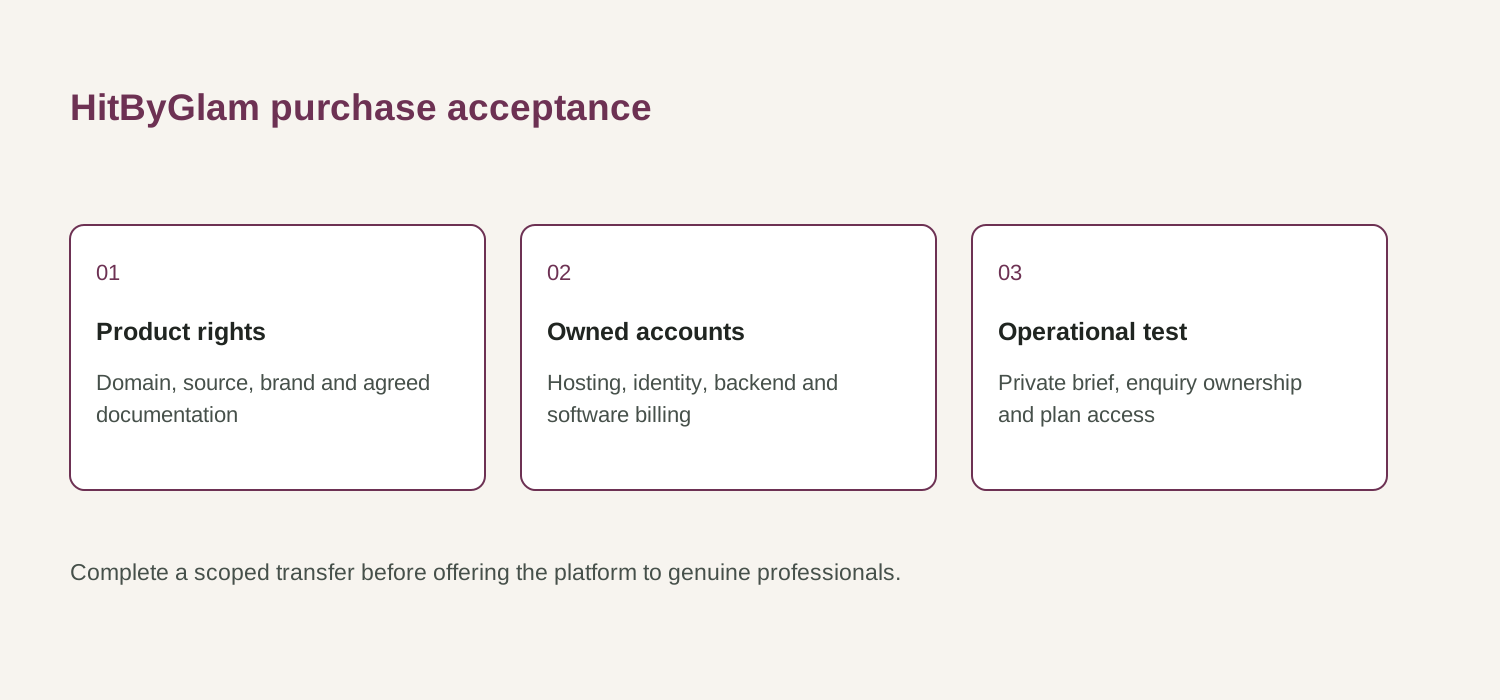
The product requires frontend hosting, member identity, backend data and functions, and software billing configuration. Use the technical handover document to identify the current requirements. For each service, record the intended account owner and whether the provider supports a transfer or requires a buyer-created account.
Configure the services under buyer control and rotate private credentials through the appropriate account interfaces. Verify the public site, member sign-in, professional workspace and owner access afterward. The repository is one deliverable; the buyer also needs a reproducible route from the delivered files to the running product.
Repeat relevant software-plan and visibility tests in the buyer's payment environment. These checks establish behaviour under that configuration. They do not establish a bank payout, a past paying audience or approval of every merchant account. Retain the accepted scope and avoid presenting an account setup step as historical financial evidence.
Launch costs beside the asking terms
Use the current Flippa terms as the acquisition-price input. Keep operating services, configuration, catalogue preparation and additional development on separate budget lines. Request current service requirements from the documentation instead of assuming an application purchase removes ongoing infrastructure charges.
Professional recruitment and support also require an owner. Record who checks portfolio permissions, handles questions and maintains useful categories. A buyer can choose a narrow launch market and a limited catalogue, but that choice should be explicit. The public offer should match the actual operating capacity.
Expected subscriptions and visibility sales remain conditional. A plan price is an option, and future demand depends on the buyer's launch. The delivered software can be assessed without inventing a growth forecast. Financial representations need their own evidence and should be read in the current seller disclosures.
Documents for a specific beauty-marketplace offer
The stored sale material describes up to thirty days of reasonable technical handover support. Confirm the current scope and start date. Specify the source, domain, configuration questions and accepted corrections covered. Any additional work should have defined account roles, data and visible completion conditions.
- Request the current source, domain and documentation inventory with the asking terms.
- Accept the private brief, enquiry and professional response trace.
- Record the plan, featured placement and cancellation behaviour demonstrated.
- Agree content rights, buyer-owned service setup and former operator access removal.
- State the support dates and completion conditions for additional changes.
Retain a release reference with this record. If the product changes before handover, revisit the affected acceptance item. That gives both parties a practical description of the product being purchased and the work that must finish for transfer acceptance.
A professional onboarding rehearsal in the acceptance record
Choose a fictional independent professional whose service details resemble the first audience the buyer intends to recruit. Ask the seller to start with a fresh account and show the route to a public-ready storefront. Record the required profile information, image preparation, plan selection and approval steps. This exercise establishes the current onboarding product rather than a claim about the speed at which genuine professionals will join.
Use the rehearsal to identify who supplies each input. A professional may own its portfolio but need help preparing images; the platform owner may need to approve a category or service area. Put those responsibilities beside the software steps. If a key action happens outside the application, describe the manual action and its owner in the launch scope.
Then repeat a smaller part of the process with the second sample professional. This checks whether the product behaves consistently for another user and reveals any setup step hidden in the seller's existing demonstration account. The purchase does not need an invented adoption forecast. It needs a clear route for an authorised professional to obtain the access being sold.
Acceptance of changes to professional services
After publishing a sample storefront, change a service description, package or availability signal through the delivered professional tools. Inspect the public result and any effect on existing enquiries. A new client and a client with a saved brief may encounter different information, so record how the product presents the current professional offer.
The buyer should also inspect content removal. Ask what happens to a published portfolio item that the professional removes or the owner no longer approves. Determine whether an older enquiry retains enough context for its participants to understand the discussion. If a retained snapshot or a different history rule is essential, specify it as an acceptance requirement rather than assuming it exists.
These tests do not require genuine customer enquiries. Fictional records make the result easier to trace and avoid unnecessary disclosure. They also keep the purchase evidence honest: the software has demonstrated a state change, while a commercial professional relationship remains a separate matter to establish during the buyer's launch.
Private-record exports and support responsibility
Ask the seller to show the export and retrieval actions currently available for professional and client records. A buyer needs to know what can be retrieved through the interface and what requires a technical operation. Document the relevant fields and account permissions, particularly for private briefs and conversations that may be needed to investigate a support request.
If the planned operating service requires an export that is not included, define the dataset and the authorised role before agreeing additional work. Avoid turning source access into a promise that every reporting function already exists. The current product scope and a future development capability are different parts of the acquisition discussion.
Finally, name the person or team who will answer account and content questions after transfer. The software provides an interface, while the buyer supplies an operating service. An explicit support responsibility makes the launch budget more useful and helps keep paid professional plans aligned with what the new owner can actually deliver.
A written finish point for the beauty software transfer
Before payment and transfer, agree which release and sample workflow constitute acceptance. The list should identify professional publishing, private brief access, an enquiry response and the owner billing configuration. If the seller corrects an item, repeat that affected check in the delivered environment and retain the new result.
This record keeps the transaction specific without expanding the package into a different product. A buyer can accept a focused lead-management application while separately planning recruitment and content work. The agreed price and support scope should refer to that delivered digital asset rather than to assumed future appointments.
HitByGlam acquisition acceptance tool
Mark an item when its evidence is available or its condition is included in the purchase agreement.
Submitting the HitByGlam asset offer
The offer should identify the application demonstrated, the domain and rights listed, the operating accounts the buyer will control and the handover work included. Keep remaining catalogue and recruitment tasks visible. A specific accepted package gives the transaction a clear finish point.
This purchase concerns portfolio discovery, private preparation, enquiries and owner software billing. It does not represent salon payroll, guaranteed appointments or an established professional network. A buyer who wants the defined scope can discuss the current terms through the listed transaction channel.
Open the HitByGlam acquisition listing on Flippa to confirm the asking terms and submit an offer tied to the agreed delivery.
Explore the products discussed
Explore related acquisition offers