
Buy a paid-listing business for your niche publication
Acquire a professional, supplier or event product with a clear advertiser order and reader promise.
A worked purchase case for a publisher acquiring HitByGlam, FruitKiwi or WebinarTo as an individual listing business. Define the advertiser order, paid label and observed delivery before buying.
Buy a marketplace website as a paid-listing extension when you want to add an owned professional, supplier or event product to an existing publication. Codeblix offers separate assets including HitByGlam, FruitKiwi and WebinarTo. The purchase should fit what your advertisers will actually receive, with a clear separation between a paid position and an editorial recommendation.
In this worked case, the prospective buyer already runs a niche publication. That publication, its audience and its advertiser relationships are illustrative buyer inputs, not assets included in these sales. The applications do not provide an automatic newsletter integration, advertising server or guaranteed lead volume. The buyer is choosing one independent listing product and the operating promises around it.
Request a listing asset that belongs beside your publication
- Request HitByGlam's portfolio and professional-discovery package for a beauty-focused publication considering professional profiles and labelled visibility.
- Contact Codeblix about buying FruitKiwi for a produce-industry publication considering supplier discovery and promoted listings.
- Request WebinarTo's directory and host-software package for an event-listing extension, using the current public directory and a seller walkthrough to inspect the intended offer.
The current Flippa listing owns price, availability, represented financials and transfer terms for each asset. WebinarTo's public event directory currently renders cards and discovery controls. Inspect that presentation separately from the signed-in host, registration and paid-placement workflows you want demonstrated. Sample events do not establish a commercial audience, paying advertisers or attendance history.
The authoritative HitByGlam, FruitKiwi and WebinarTo pages retain the individual product boundaries. The external-service-payment acquisition case explains the wider enquiry and contract separation. This publisher case centres the advertiser's order and the publication's credibility, rather than re-covering the underlying service handoff.
Make the advertiser's order the object of this purchase case
Consider a fictional beauty-industry newsletter whose operator already communicates with professionals and readers. The operator is considering HitByGlam as a separate professional-discovery product. Before buying, they need to decide what a professional would purchase: a platform plan, a clearly described featured position, or a separate publication service the operator arranges outside the application.
Those items should not be merged into “promotion” without detail. A software plan may provide defined product access. A featured position concerns a location in the product. A newsletter mention would belong to the buyer's existing publication process unless a specific integration or service has been agreed. Owning the application does not automatically connect these promises.
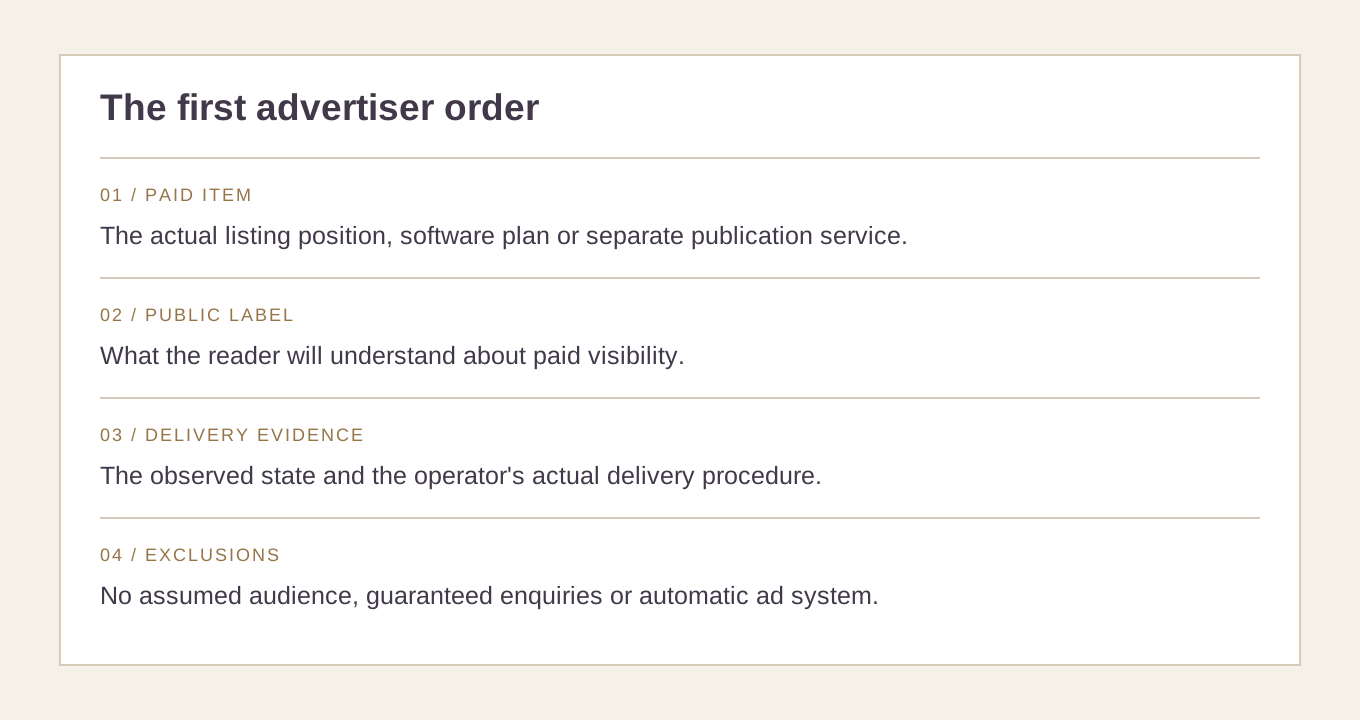
Write an advertiser order before writing an acquisition offer. It should identify the item the publisher wants to sell and what evidence will show delivery. If the intended order requires a placement or control the current application cannot demonstrate, the buyer should identify the gap. The application can be a useful foundation without already being a complete advertising operation.
Keep the publication's existing audience outside the seller's claims
The hypothetical buyer may have an audience that makes a directory extension worth considering. That is their own starting point. It is not evidence of traffic, advertisers or revenue transferred with HitByGlam, FruitKiwi or WebinarTo. Evaluate any current audience representation through the individual sale and its supporting evidence.
The publisher can bring its own knowledge of readers and advertisers to the buying exercise. Use that knowledge to choose a listing object people in the niche can understand: a professional portfolio, supplier presence or event entry. The acquisition question is whether the existing product supports the item the publisher wants to sell.
Keep a simple evidence file for the first advertiser. Separate the actual application preview, the publisher's own audience evidence and the proposed order. That lets staff describe the new product accurately and use each source for the claim it supports.
Use three paid products with three different delivery boundaries
| Potential product in the publisher's business | What the order must describe | What it must not imply |
|---|---|---|
| Professional visibility around HitByGlam. | The actual profile or featured position offered through the demonstrated product, with its software access separated. | A confirmed beauty appointment, paid service deposit or verified professional outcome. |
| Supplier visibility around FruitKiwi. | The promoted supplier/listing scope and the separate sourcing conversation it may support. | Guaranteed RFQs, produce availability, settled invoices or a supply contract. |
| Event visibility around WebinarTo. | The specific listing or featured-event scope, after the buyer has inspected a working current implementation. | Video streaming, paid ticket sales, a transferred attendee base or a working current public directory. |
| A newsletter or editorial service the buyer also offers. | The buyer's own publication arrangement, schedule and delivery record. | That buying any of these assets includes an automatic newsletter connection or editorial endorsement. |
The buyer should choose the product that matches their publication and desired advertiser relationship. There is no reason to acquire all three merely because they can be discussed under the word “listing.” Their audiences, record types and operating work differ. A distinct paid product is more useful than an undefined promise to promote anything everywhere.
Inspect HitByGlam as a professional profile product, not a salon booking desk
For the fictional beauty publisher, begin with a professional who supplies authorized portfolio material and a service description. Ask the seller to demonstrate the professional profile and the actual visibility or plan controls. The publisher needs to understand what is editable, what is public and what the paid product provides in the current implementation.
Then inspect the reader's enquiry route. HitByGlam supports visual discovery, Style Briefs and professional enquiries. It does not provide beauty appointments, deposits or payments for the professional's service. A publisher should not advertise a featured profile as a secured booking channel or imply that the platform takes responsibility for the resulting beauty service.
Prepare the first profile release with the professional's authorized portfolio material and an agreed description. Use the current honest public preview to inspect presentation, then ask the seller to show the relevant professional and owner controls. The buyer can build a useful first-release procedure around those tools.
Inspect FruitKiwi around supplier exposure and the next sourcing step
A produce-industry publisher would ask a different advertiser question. Its potential customer may want a supplier presence and promoted visibility to relevant buyers. FruitKiwi includes supplier profiles, sourcing requests, quote comparison, messages and software-plan or promoted-listing models. The buyer should inspect the particular visibility product they intend to operate.
Ask the seller to show a supplier's software access and the promoted listing as two concrete items. Locate the public page or position and inspect how the operator observes the delivered state. Use that demonstration to write the advertiser's order and the delivery record your publication will keep.
The produce transaction remains outside the platform's invoice and payment scope. A promoted supplier should not be presented as guaranteed to have stock or to win an RFQ. The publication can sell a defined visibility product while making the supplier's own offer, commercial representations and fulfilment obligations clear.

Treat WebinarTo as a conditional event-listing acquisition
An event-focused publication might want a directory and host-software extension. WebinarTo's documented scope includes event listings, registrations, capacity, waitlists, host tools and featured-event possibilities. It does not stream the event or sell paid tickets. Hosts supply authorized live or replay links.
The current public directory offers a concrete place to inspect an event-listing presentation. Read an event card and the available search, topic, date and timezone controls with your publication's reader in mind. Then ask the seller for a current host walkthrough and state the advertiser-order and placement behavior required for the publisher's acquisition.
For the event order, name the listing and its public information, then identify the host's authorized external live or replay link. The publisher can inspect the event's directory presentation and the host workflow in the seller-led demonstration. Keep the event's actual delivery with the host while defining the visibility product the publication supplies.
Choose a visible label before selling a visible position
A publisher's paid product can affect how readers interpret the page. Decide how the actual placement will be identified and ask which label or presentation controls the product currently supports. Do not assume an advertising disclosure system or a particular policy implementation from a featured-position name.
For the worked beauty example, use a clear paid-placement description alongside the publication's own editorial policy. The publisher decides what it will accept and who is responsible for that decision. Inspect the current product presentation and include any essential label or approval requirement in the acquisition discussion.
Keep the paid order and any editorial decision in separate records where your operation requires that distinction. A professional may pay for an offered listing product without obtaining the publisher's endorsement. If the desired publication model needs additional labels, approval states or audit records, identify the requirement before purchase instead of treating it as a delivered feature.
Build a placement specification without assuming an ad server
Which item will appear on your first advertiser order?
For any selected item, write a plain order sentence: what will be provided, where the customer can inspect it, when the operator will check it, and what is excluded. The tool does not create inventory inside the software. It helps define the business product that the acquisition needs to support.
Rehearse a rejected advertiser before collecting an ambiguous payment
Use a fictional advertiser who supplies unsuitable or unauthorized material. Ask the seller to demonstrate the product's actual publishing and approval controls. Which information can the operator change or reject? What does the advertiser see? If the application does not provide the exact approval state you need, identify the manual procedure or additional scope.
Now examine the separate commercial order. What did the advertiser purchase, and what happens if the proposed material cannot be published? The answer must fit the operator's actual terms and payment behaviour. Do not infer an automatic refund, credit or rescheduling feature from the presence of a plan checkout.
This scenario is important because the publisher is selling something more specific than an account. The software may supply useful controls, while the operator still needs a clear decision and communication process. A paid position should not be improvised after money has been collected for a vague promise of promotion.
Rehearse the end of the order as carefully as its first day
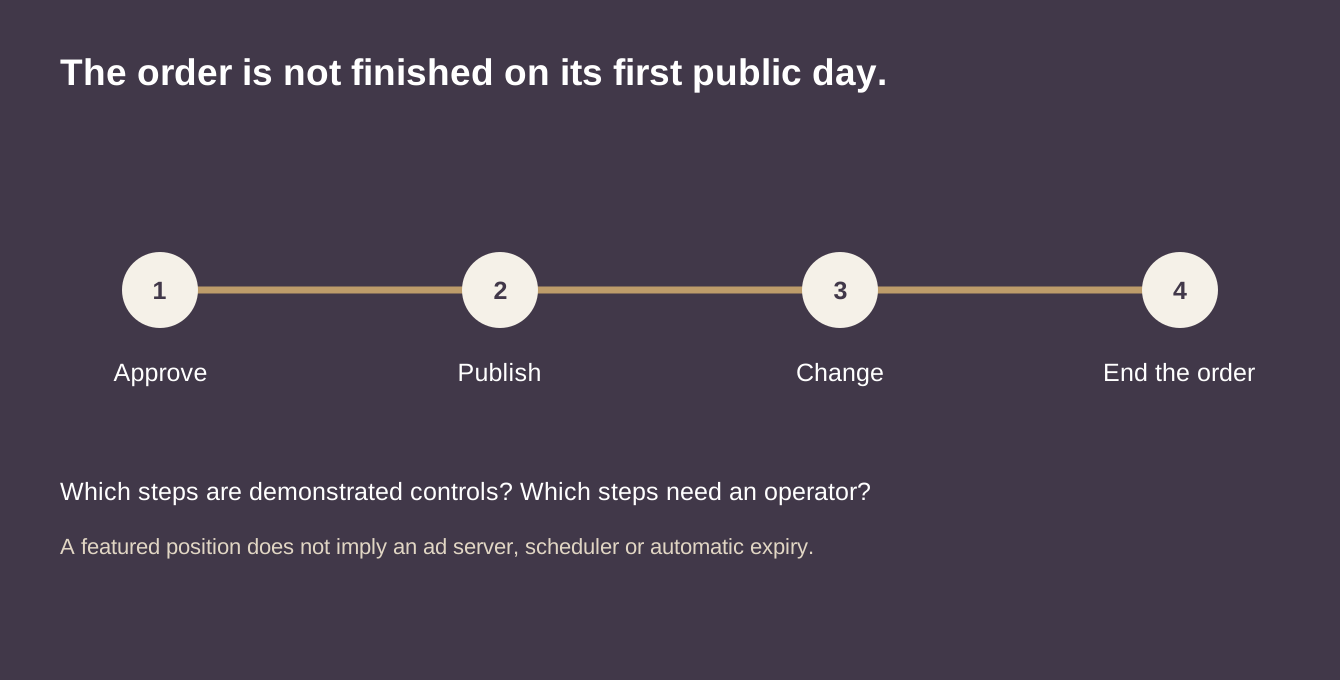
Suppose the publisher offers a visibility period in its advertiser terms. Ask how the selected application represents that period, if at all. Does a supported control end the placement, does an operator need to act, or is the intended order different from the product's current feature? Do not assume timed expiry or an advertising scheduler.
Use a seller-authorized example and inspect the state after the agreed change. Name the person who checks the final position and records the completed delivery. Keep the ordinary profile, featured item and software plan identifiable so staff can handle the correct product.
The publisher can choose a manageable manual service where appropriate. The important purchase condition is knowing what the application supplies and what the operator must do. That makes the first advertiser order deliverable without claiming a complete ad-management platform.
Keep delivery evidence smaller than the results you cannot prove
A publisher may be able to record that an approved listing appeared in an agreed position. That is not the same as proving an impression count, lead count, sale or professional outcome. Ask which analytics the selected product actually provides and keep any advertiser report within that evidence.
The publisher can keep a small delivery record containing the agreed item, observed URL, check date and relevant change. Use actual product analytics only where available and understood. If the publication supplies its own separate service, record that delivery under the publication's own arrangement.
For the first order, choose a delivery promise you can observe. If your commercial model requires measurement or attribution not currently implemented, make that a condition or separately scoped requirement. An honest limited report is more useful than an unsupported performance guarantee.
Complete one first advertiser order from approval to delivery
For an illustrative first order, the fictional beauty publisher chooses one professional who supplies authorized portfolio photographs and an agreed service description. The order identifies the featured item the seller has demonstrated, the visible paid-placement wording and the operator who will check it. The publication's own newsletter mention, if offered, is written as a separate line with its own delivery owner.
Suppose the publisher chooses a seven-day visibility arrangement for this illustration. Seven days is the fictional publisher's order period, not a claimed built-in duration control. Before offering it, the buyer confirms how the demonstrated application can support the arrangement and which steps the operator will manage manually. The professional can then approve a plain description of the purchased item.
At release, the operator checks the approved material and the actual public position, then records the URL and check date in its own order notes. This is evidence of the defined delivery state. A second staff member can read the order and locate the same item, making the procedure repeatable.
If the professional later supplies a replacement photograph, staff apply the demonstrated publishing or approval procedure and record the agreed change. When the visibility arrangement ends, the named operator follows the demonstrated method for ending or changing that item and checks the resulting public state. The ordinary profile and software account are handled according to their separate scope.
This complete order is the buying test. The publisher asks the seller to demonstrate the required controls and identifies any remaining work before making the offer. The purchase now concerns a manageable advertiser product with an observable lifecycle, rather than a broad promise of promotion.
Keep a changed profile from becoming a changed advertising agreement
A professional or supplier may edit a profile after the publisher accepts an order. Ask the seller to demonstrate the actual publishing controls and the operator's visibility into that change. The application may have a useful approval route, a direct edit path or another delivered arrangement. The buyer should understand it rather than infer an approval system from the word “curated.”
Now consider the order: did the publisher accept a particular description or merely provide the defined profile service? What material must the advertiser supply, and who checks that the public content fits the publication's policy? These are operating choices to make around the real software. Do not imply that the application automatically verifies professional credentials, product claims or media rights.
If the publisher requires an extra approval step, identify whether it can be handled through demonstrated controls, an ordinary manual procedure or additional work. A clear limited process can be suitable for a first advertiser. A feature that is essential but absent should remain a purchase condition, not an invisible assumption.
Use the first advertiser order to test ownership of the new product
Have a hypothetical staff member who did not attend the seller demonstration read the proposed order and locate the public item. Can they distinguish the ordinary profile, the featured position and a separate newsletter mention? Can they identify what should happen when the order changes or ends? The answer shows whether the buyer has a manageable product, not whether the application can guarantee attention.
Keep this rehearsal small and authorised. Use fictional material or content whose owner has permitted the test. Avoid presenting test advertisers as real paying customers or sample directory records as publication partners. The new owner should be able to explain the same boundary in its own sales material after transfer.
Finally, ask which part of the rehearsal the application actually performed. The publisher may have supplied a manual schedule or an existing newsletter process. That is acceptable when it is intentional and accurately described. It should not be attributed to the acquired source code in a later customer promise or business-sale description.
Keep the paid period and software account distinct in support
An advertiser may continue using a professional, supplier or host account after a particular visibility arrangement ends. Ask the seller how the selected application's actual plan and promotion states relate. The publisher should not assume that ending one item ends every relationship, or that renewing a plan necessarily renews an independently agreed placement.
Use the order to identify the item being discussed when a customer asks for help. A question about access to the software is different from a question about a paid position or a newsletter mention. The operator's support response should name the correct product and the evidence relevant to it. Any connection between those products should be demonstrated or expressly agreed.
This distinction also helps the buyer choose a manageable first commercial offer. They may initially sell one clearly defined product rather than several overlapping promises. Expanding later is a business choice; the current acquisition should support the item the buyer is actually prepared to deliver.
Buy the listing product your publication can deliver honestly
The acquisition offer should explain the first advertiser order and the actual controls required to deliver it. Name the selected asset, the customer type and the placement or access scope. Ask for the source, domain and documents for that individual transaction, keeping any separate publication service outside the assumed software package.
- Choose one advertiser and one paid item appropriate to your publication.
- Separate product access, featured visibility and your own publication services.
- Inspect the actual location, label and publishing control.
- Rehearse unsuitable material and the end of an agreed order.
- Name any manual procedure or unresolved feature requirement.
- Agree the individual acquisition against that defined business product.
The buyer can build a meaningful paid-listing extension without claiming that the seller transfers advertisers or guarantees leads. What matters is a clear advertiser promise, an understandable reader presentation and a delivery procedure the publisher can actually run.
Request the current HitByGlam, FruitKiwi or WebinarTo package with your advertiser order attached. The online business collection offers a wider shortlist if another customer relationship fits your publication better.
Explore the products discussed
Explore related acquisition offers