
Side business for sale: buy software around the service hours you can own
Request a platform whose customer commitments fit your available working routine, with separate offers for professional discovery, fee tracking and webinar hosts.
Buy a software foundation to operate alongside existing work. Request HitByGlam, Macro-Manage or WebinarTo's current sale package, then match the customer workflow with named support and technical owners.
Buy a software foundation you can operate alongside existing work. Request the current individual sale package for HitByGlam, Macro-Manage or WebinarTo through Codeblix's Flippa listings. Each supports a different customer relationship, and each needs an owner after transfer. Confirm availability, price, financial evidence and the agreed assets in the relevant sale conversation.
The purchase is a starter software asset, not a promised stream of side income. The buyer chooses an audience, completes configuration and provides the service around the product. The useful question is which customer commitments fit the people and hours you can reliably provide. A site being online does not make those commitments disappear.
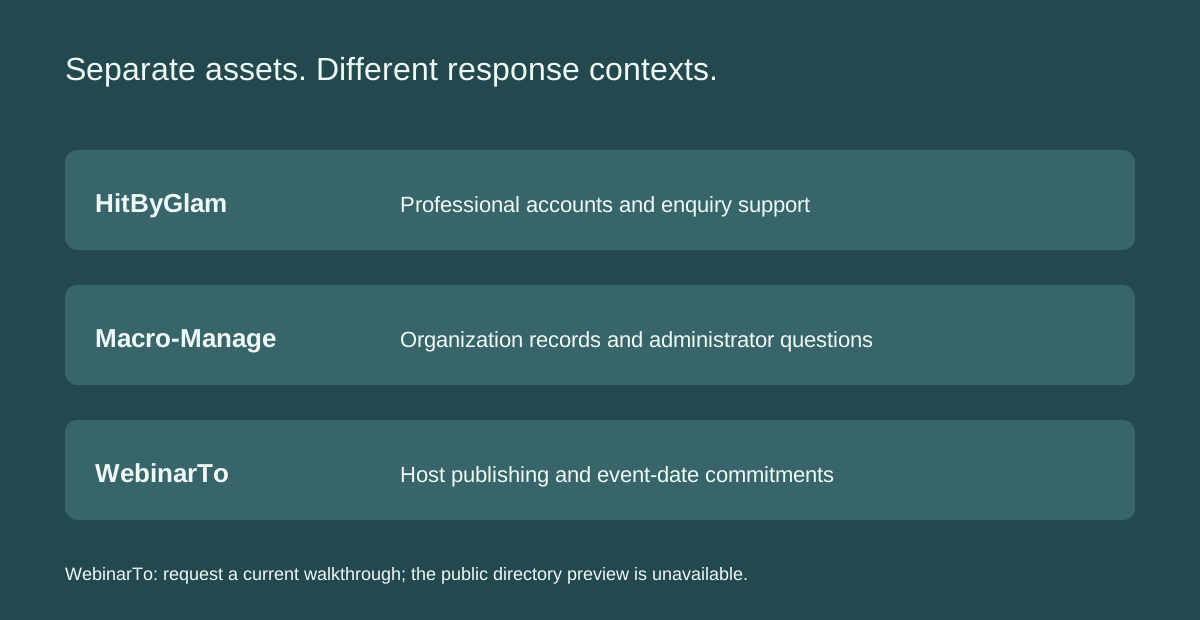
This acquisition brief focuses on response timing and ownership capacity. HitByGlam supports beauty-professional discovery and enquiries. Macro-Manage supports organization fee tracking. WebinarTo supports a webinar directory and host workspaces, with its public directory preview currently unavailable. Ask for the current deployment package and a seller walkthrough for WebinarTo rather than relying on a working public directory.
Buy the customer promise that fits your working routine
A side-business purchase can fail to fit long before technical features become the issue. A buyer may understand the application but have no dependable time to answer its users. Another may have regular administrative time but no one to maintain the deployment. Name those constraints before making an offer.
Start with the promise you intend to make to customers. A professional discovery platform needs a clear account and enquiry experience. A fee-tracking product needs users to understand their organization records and controls. An event directory needs hosts to understand publishing and registration, including the effect of a fixed event date. The timing of questions differs even when all three products use online accounts.
Do not treat a particular operating model as automatically low effort. A small number of users can still ask difficult questions. A quiet period can be followed by a problem when the owner is unavailable. Decide how questions are received, who can respond and what technical help is available. The product purchase should match that routine.
| Asset | Customer relationship | A timing question for the buyer | Seller evidence to request |
|---|---|---|---|
| HitByGlam | Professional profiles, discovery and enquiries | Who helps a professional with an account or enquiry question? | Show the professional and enquiry workspace views |
| Macro-Manage | Organizations using fee records | Who responds when an administrator cannot reconcile a record? | Show the documented organization and fee workflows |
| WebinarTo | Hosts publishing events and managing registrations | Who handles a host issue before a scheduled session? | Request a current walkthrough and deployment package |
These are three separate offers. The table does not create a bundle, a common licence or a fixed workload estimate. It helps choose which seller conversation to begin. The new owner still needs to test the particular workflow and agree the transfer package for that asset.
Write a response window before an earnings goal
Someone buying a side business may begin with an income target. For a software foundation, a more immediate purchase question is whether the service can be supported within the buyer's actual schedule. A forecast cannot answer who will help a customer on a day when the owner has other commitments.
Write the times when you can reliably examine requests and the person who covers an urgent problem. Do not publish a response promise that depends on hours you cannot provide. If a contractor or partner will help, establish the scope and cost before relying on that help in the acquisition plan.
Use your own timetable. No standard number of weekly hours proves that a product will be manageable, because the actual workload depends on users, configuration and the service offered. A buyer with an existing customer network may have a different starting point from someone who must build that network after transfer.
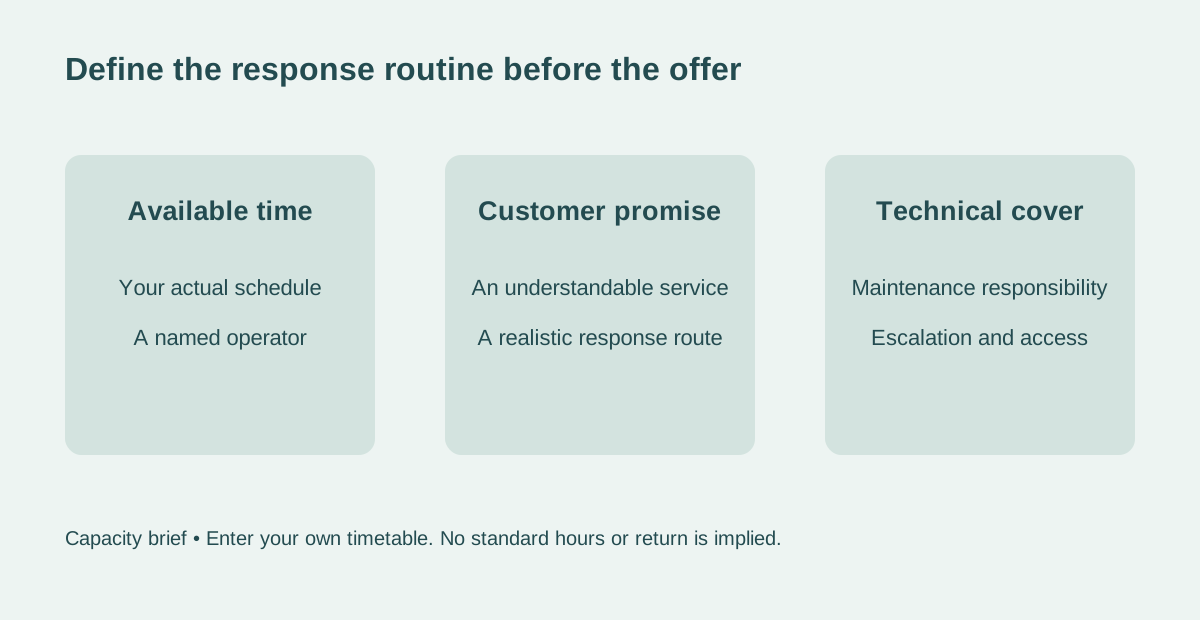
- Write when the responsible operator can check customer requests.
- Identify the issues that require technical help.
- Name the person who can act when the usual operator is unavailable.
- Keep customer promises within that capacity.
- Record the cost of any external support you intend to use.
If you cannot assign a response routine, revise the initial customer offer before buying. You may choose a narrower audience or arrange help. The sensible next action is to resolve the ownership gap, not to assume that software automation will cover a service commitment nobody has accepted.
Acquire an enquiry platform with the professional's work kept separate
HitByGlam is relevant to a buyer who wants to operate a beauty-professional discovery and lead-management product. The documented foundation includes professional storefronts and portfolio-led discovery, with professional plans and featured visibility as commercial routes. Beauty appointments, deposits and service payments are outside the platform's role.
That boundary changes the acquisition brief. The owner is purchasing the discovery and software service, not a beauty salon's appointments or the delivery of a treatment. The buyer should still understand the professional's account experience, the enquiry workflow and the operator controls. An external service payment does not remove the platform's own support responsibilities.
Ask the seller to demonstrate what a professional sees and how an enquiry appears in the relevant workspace. Use a fictional enquiry and ask which actions are handled in the application. If your intended customer offer needs appointment scheduling, deposit collection or salon payroll, treat those as separate requirements rather than assuming they form part of the asset.
A buyer with contacts among local professionals might have a clear first audience. That is the buyer's potential advantage, not an existing network automatically included with the source. Request actual commercial evidence for any customer or revenue claim you rely on. Base the offer on the documented product and the transfer package actually being sold.
Acquire a record-based product with an administrator to serve
Macro-Manage offers a different relationship: organizations use software to track fees. The intended platform income comes from monthly or yearly organization plans. A buyer familiar with classes, clubs or similar administration may find that customer problem easier to understand than an unrelated consumer marketplace.
The owner should ask for the actual organization roles, fee records and payment-recording workflow. Follow one fictional record through the relevant views. Ask which controls are present and which changes require technical work. Do not infer a complete accounting system or universal payment collection from a fee-tracking feature.
The support routine should match the administrators you intend to serve. A user may ask about a record, an account setting or a change in an organization's workflow. Decide who can examine the issue and how it is escalated. The buyer should understand the product well enough to distinguish an operating question from a requested new feature.
For a side-business purchase, this can be a useful fit when the buyer already understands the administrative context and can provide a dependable response routine. It can be a poor fit when nobody on the buyer's side understands the records or wants to support organizations. Request the demonstration before deciding which situation applies to you.
Acquire an event product with fixed dates in the service
WebinarTo is a webinar directory and host workspace. Its intended commercial routes are host plans and featured event placements. Attendee registration is free. The product does not stream or record video, sell webinar tickets or handle host payouts; hosts provide authorized session or replay links from their chosen service.
The current public directory preview is unavailable. A prospective buyer should request the current deployment package and a seller walkthrough through Flippa. That limitation belongs in the purchase brief. Do not make a customer promise around a public route you have not seen working in the agreed buyer-controlled setup.
Event dates create a particular ownership consideration. A host question before a session may need a different response routine from a general request to edit profile copy. Ask the seller to show event publishing, registration and the relevant host controls. Then decide who will handle host support around the service you intend to offer.
If your plan depends on live streaming, paid tickets or host payouts, keep those requirements separate. Buying a directory foundation is not the same acquisition as buying a video streaming service. Request the asset that matches your actual offer, and define any additional work before agreeing the price.
Choose the first seller enquiry by your operating advantage
Request HitByGlam's asset package. Ask for the professional profile and enquiry journey, and confirm the platform-plan and featured-visibility configuration. Keep professional service delivery outside your platform promise.
Request Macro-Manage's asset package. Ask for organization roles, the fee workflow and payment records. Decide who will answer the administrator questions associated with your customer offer.
Request WebinarTo's current deployment and walkthrough. Resolve the unavailable public directory preview and inspect the host workflow before making a launch commitment around event dates.
The result is a next action, not a return forecast. If none of these roles fits, compare the other available online businesses with your schedule and skills in front of you. A product you can operate is a more useful candidate than one chosen only because its category sounds attractive.
Price the help you will actually need after transfer
A purchase price can be affordable while the ongoing work is not. Identify the technical and service tasks you cannot perform yourself, then ask for a defined scope from the people who would handle them. Hosting, external accounts, maintenance and support should have owners as well as numbers in a budget.
Do not count your own time as unlimited simply because it does not appear as an invoice. A buyer with another job still needs time to read requests, maintain records and decide on product changes. Write the recurring tasks beside the actual people who will perform them. If a task has no owner, it remains an acquisition gap.
| Retained work | Evidence for the purchase plan | Decision before making an offer |
|---|---|---|
| Application deployment | Technical documents and the buyer team's capability | Self-managed setup or separately agreed help |
| Routine maintenance | Required services and an actual support arrangement | Named technical owner and spending authority |
| Customer responses | The chosen product's ordinary user questions | A service routine the team can maintain |
| New requirements | A separate specification and quote | Whether the change is essential before launch |
Keep this plan independent of hypothetical sales. The current sale should establish any commercial performance that exists. The budget should show whether you can own the foundation and complete the agreed launch work even when customer acquisition takes effort and time.
Accept the asset in the environment you will control
Request the domain, source, documentation and other included materials in writing. Ask which external accounts the buyer must own and which configuration steps are included in the sale. A working seller demonstration is useful context, but the new owner's operation depends on the buyer-controlled deployment.
Agree one acceptance exercise for the chosen product. A fictional professional enquiry, organization fee record or host event can make the workflow concrete. Follow the same record through the relevant account views. Confirm the external boundaries and record any remaining tasks. For WebinarTo, include the current preview limitation in that agreement and ask to see the agreed directory route working before relying on it.
- Request the individual product's current sale scope and financial representation.
- Read the user and technical documents linked from its marketplace page.
- Assign domain, hosting, repository and service-account ownership.
- Agree the ordinary workflow to be demonstrated after transfer.
- Record unresolved configuration and separately scoped changes.
- Confirm who will handle technical and customer questions after acceptance.
The acceptance plan does not need to pretend that every future situation can be automated. It should identify the delivered foundation and the operating procedures the buyer will supply. That gives the new owner a practical starting point without confusing a product transfer with an established staffed business.
Use a handover note that survives a busy week
A side-business owner may move between the software project and other responsibilities. Keep the important handover information easy to find: account owners, required services, the agreed product workflow and the route for technical help. Another responsible operator should be able to understand the note without recreating the entire purchase conversation.
Include the actual boundaries of the customer offer. For HitByGlam, keep discovery and platform enquiries distinct from beauty-service payments. For Macro-Manage, describe the demonstrated fee workflow rather than claiming every administrative function. For WebinarTo, keep the directory and host workspace separate from streaming, tickets and payouts.
Also record who can approve changes. An optional feature should not become an urgent expense because a user asks for it. The owner can assess whether the request fits the product, whether it requires development and whether it belongs in the current service. A clear decision route helps keep the side business within the capacity the buyer planned.
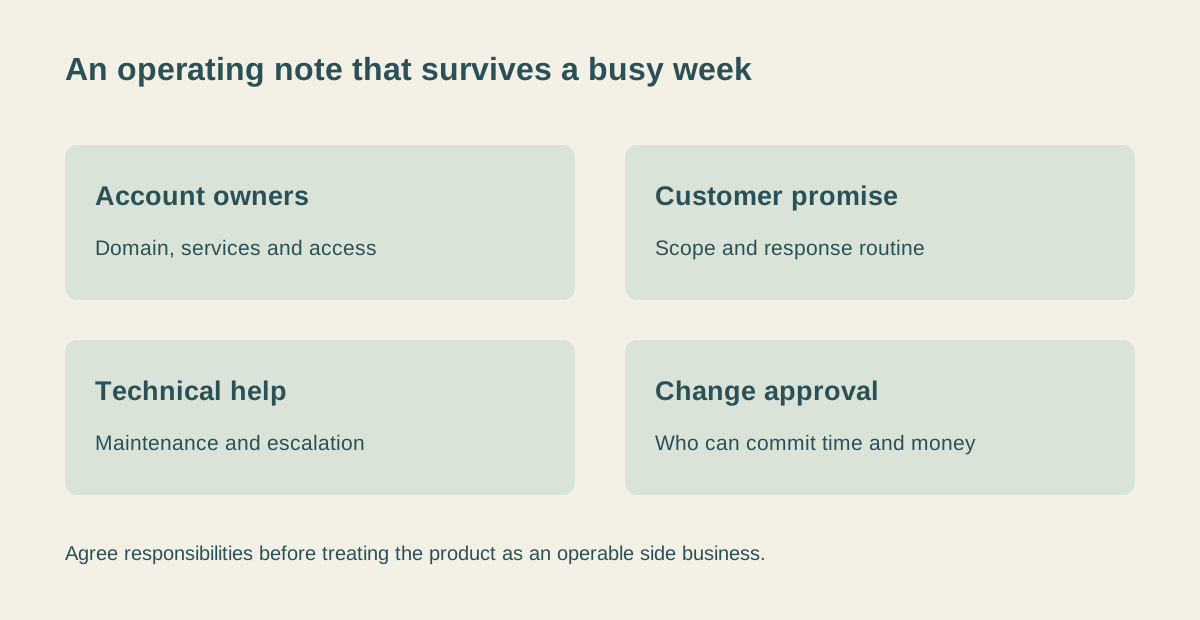
If the project is shared with adult family members or a partner, use the same note to assign cover. Participation can be shared, but the customer should not have to discover that nobody knows who can act. Purchase a foundation whose real responsibilities your team is prepared to accept.
Run one absence scenario before you request transfer
Consider an ordinary day when the usual owner cannot work on the project. A professional wants to clarify an enquiry, an organization administrator has a fee-record question or a host needs help with an event page. The product may still be online. The ownership question is who can understand and act on the request.
Use that situation as a purchase exercise. Write the customer request, name the person who would read it and identify the account or document they would need. If the response requires a technical change, name the person who can assess that change. If it can wait within the service promise, state how the customer will understand that timing.
| Fictional request | Responsible operator needs | Resolve before purchase |
|---|---|---|
| A professional asks where an enquiry appears | The demonstrated workspace route and the account's role | Whether the cover person can explain the platform's actual boundary |
| An administrator asks about a fee entry | The documented record view and escalation process | Who can inspect the issue without changing records unnecessarily |
| A host asks about a scheduled event | The event workflow and the relevant configuration notes | Who can respond before the service promise becomes unrealistic |
These examples do not establish an expected volume of support requests or a standard response time. They make the buyer's intended service concrete. A side-business plan is stronger when it can explain one ordinary exception without relying on the owner being continuously available.
If the exercise exposes a gap, decide how to close it. You may narrow the customer offer, arrange a cover person or obtain technical help. You may also conclude that another asset better matches your current capacity. Resolve the gap before making an offer that assumes the service is already operable.
Keep the first customer offer within the demonstrated product
A new owner can quickly expand a simple product idea into a large service promise. A discovery platform becomes an imagined appointment system. A fee tracker becomes an imagined accounting suite. A directory becomes an imagined streaming service. Keep those ideas separate from the asset you are actually requesting to buy.
Write the first offer using only the workflow the seller can demonstrate. Then identify the particular audience you can approach. A buyer who knows a group of professionals can ask for the account and enquiry controls relevant to that group. A buyer familiar with organizations can ask about the fee-record route those administrators need. A buyer with host contacts can request the current event workspace demonstration.
This gives the acquisition a commercial purpose without inventing product scope. The new owner can still commission additional features later, but the base purchase should be assessed independently. Ask for each essential requirement to be marked as implemented, configurable or separately scoped work.
It also makes the initial service easier to support. When the owner knows the product boundary, a customer question can be answered as a current feature question, a configuration issue or a request for new work. That distinction helps protect the time and budget set aside for the side business.
Make the offer conditional on a clear operating answer
Your purchase notes should identify the questions that would change the decision. Perhaps no one can maintain the deployment, a required route is unavailable or a central feature has not been demonstrated. Ask the seller for the missing evidence and decide whether the agreed package still fits your plan.
Do not substitute a low asking price for an answer to an essential question. The buyer needs an asset that can be transferred and operated within the intended service. A starter foundation can be valuable when its scope and remaining work are understood. It should not be treated as a staffed operation simply because the application has an attractive public page.
Proceed when another responsible person can read the purchase notes and understand what you will own, which service you will offer and who performs the work. That is a concrete basis for requesting terms from the seller and deciding whether to make an offer.
Request terms when the service commitment has an owner
Bring a focused message to the seller. Name the asset, describe your intended operator role and request the current package. Ask for the workflow central to your service and explain any setup help you need. This is more useful than asking whether the product can produce passive income.
Choose the individual seller conversation: request HitByGlam's terms, request Macro-Manage's terms or request WebinarTo's deployment package and terms. Confirm the current offer before committing. You can also compare the available SaaS acquisition collection with the same capacity brief.
Explore the products discussed
Explore related acquisition offers