
Buy an ecommerce software asset for an existing retailer
Separate digital asset offers for a defined operator purchase.
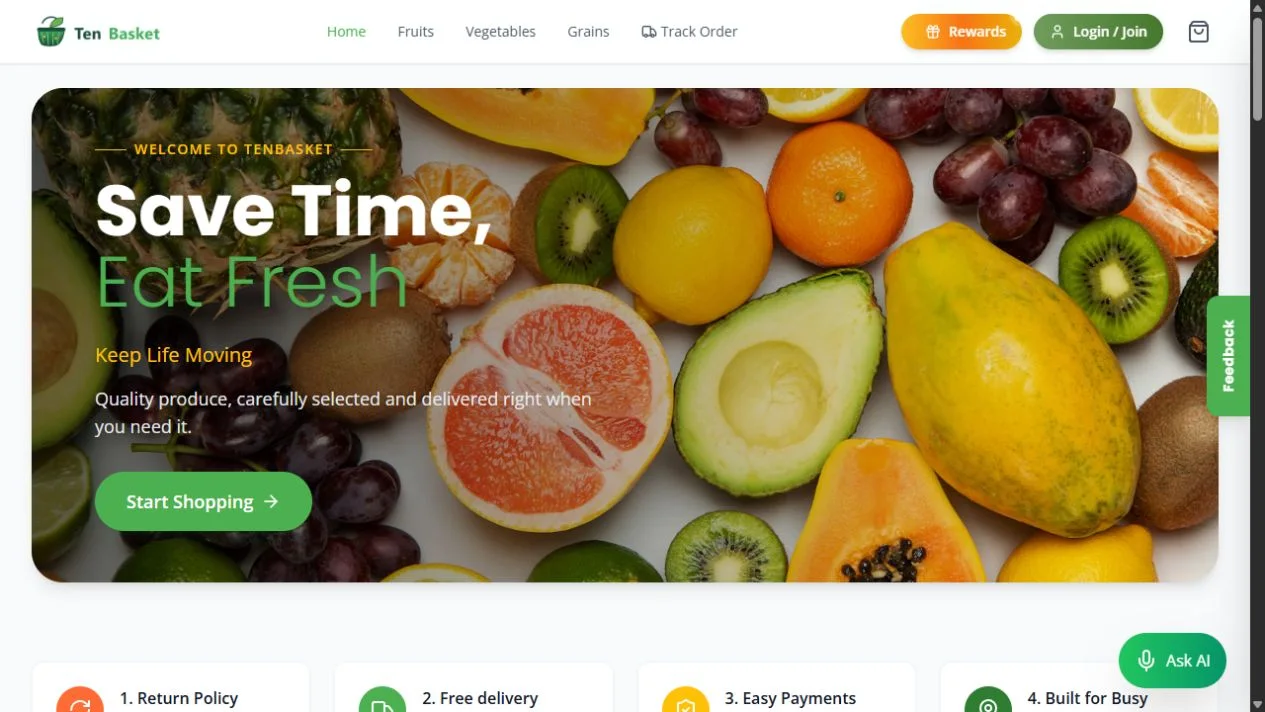
Acquire an ecommerce asset that matches your retail operation. Confirm owned stock or independent sellers, catalogue rights, fulfilment and order settlement.
Acquire an ecommerce software asset that matches the inventory and fulfilment capacity of an existing retail operation. TenBasket is a direct grocery storefront. HerJungle is a grower marketplace. AfroZeal is an artisan marketplace. They are independent sale offers with different seller and payment responsibilities. No physical stock, supplier contract or combined business is included merely because the applications appear in the same purchase brief.
Confirm the selected package through TenBasket, HerJungle or AfroZeal on Flippa. Each transaction has its own current availability, asking terms, disclosures and agreed transfer. The buyer should identify the application, domain, rights and setup work being acquired.
This brief concerns a retailer extending its operation with an owned digital product. Existing retail experience does not automatically provide an independent seller network, correct catalogue migration or payment readiness. All three assets are presented as starter products without represented verified commercial income. Accept the selected software against the retailer's actual stock and order responsibilities before committing to the purchase.
Inventory ownership in the retailer's acquisition scope
Name the legal and operational seller of the goods before discussing catalogue size. A retailer selling its own stock controls the product promise and fulfils the order. A marketplace may present products supplied by independent growers or artisans, with separate storefronts and payment destinations. The application purchase should match the business relationship the buyer intends to operate.
This distinction affects more than the appearance of a product page. It determines who edits quantity, who receives an order, who can correct a price and who answers a delivery complaint. An existing retail team may already perform those tasks for its own goods, while an independent supplier model requires a different account and support arrangement.
Write the selected operating model in the offer. The source asset and its demonstrated functions are the deliverables; the retailer's stock, premises and staff remain separate. Any represented supplier relationship or physical inventory included in the transaction needs its own evidence and transfer statement.
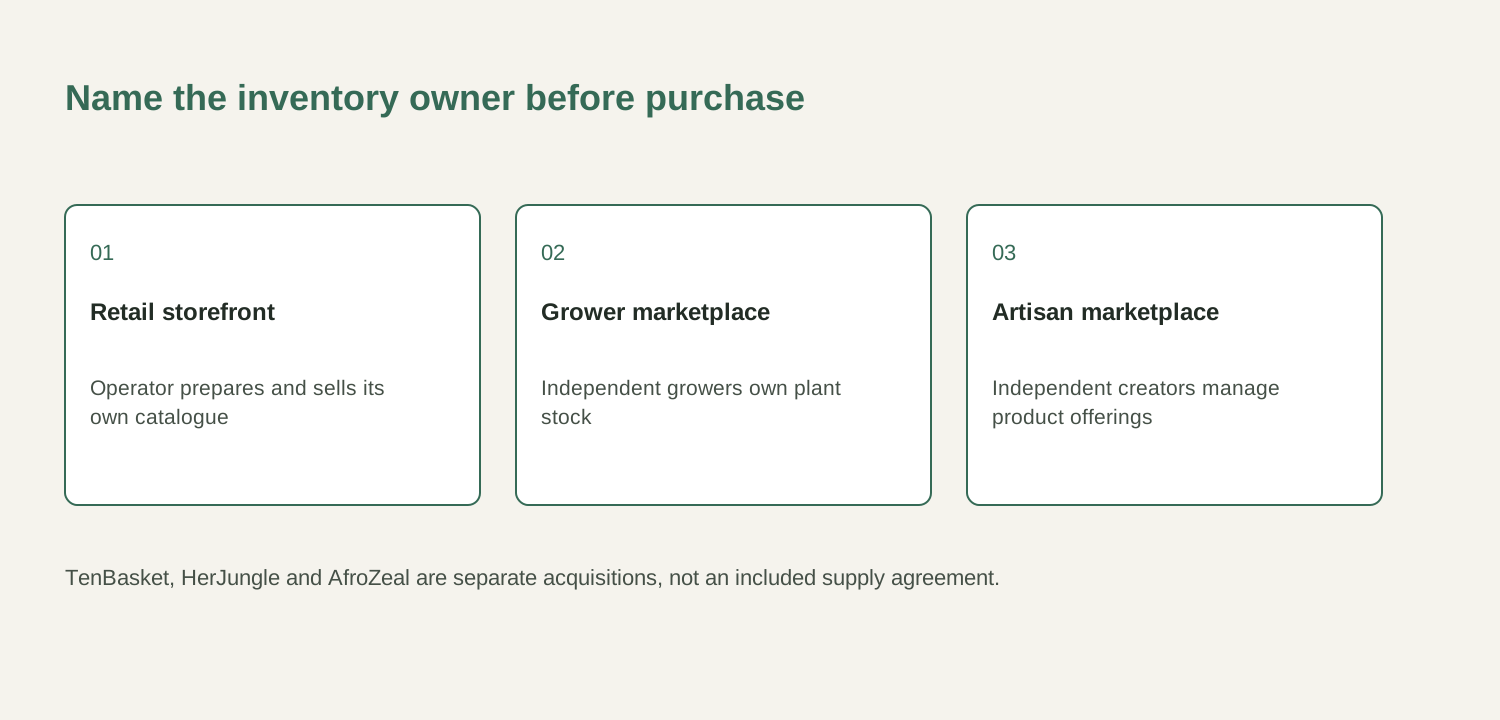
TenBasket as the direct-storefront purchase
TenBasket provides grocery discovery, categories, a cart, checkout, customer accounts, rewards, order history and owner catalogue and order controls. Its model is direct product sales. A retailer considering it should identify the goods it can lawfully supply and the delivery area it can actually serve.
The purchase does not establish a warehouse, a stock supplier or a delivery workforce. Demonstration products are interface material rather than evidence of a supplied grocery operation. The retailer should accept the software alongside its own catalogue preparation and fulfilment plan, keeping those resources separate in the transaction budget.
Read the TenBasket asset package and technical handover document. Ask for an order trace using a representative pack unit and quantity. Inspect the delivered Stripe and cash-on-delivery options rather than assuming that every retail payment or inventory process is already integrated.
HerJungle as an independent-grower purchase
HerJungle offers rare-plant discovery, grower storefronts, inventory, single-grower checkout, orders and seller-plan foundations. A retailer buying this application would be acquiring a marketplace product rather than simply a new skin for a single store. Independent grower accounts and their stock promises are central to the operating model.
The buyer should decide whether it intends to recruit genuine growers or commission a specific change for another arrangement. Do not infer included plants, nursery operations or signed supplier agreements from the sample catalogue. Any physical or commercial assets represented in a sale must be separately identified.
Inspect the HerJungle listing and technical guide. The acceptance example should include a plant stock change, seller isolation and the single-grower cart response. Those are more relevant purchase conditions than a large catalogue count without clear ownership.
AfroZeal as an artisan-marketplace purchase
AfroZeal provides artisan storefronts, product management, consumer checkout, provider payment setup and owner controls in an African-fashion marketplace product. Its documented foundation also includes configurable provider plans and a managed custom-order workflow. These functions should be accepted according to the selected product's actual release.
The current Artisan Pro plan described in the source is zero-priced and configurable. That is not evidence of an existing paying subscriber base. The stored managed custom-order fee is a separate commercial mechanism, rather than an assumed commission on every ordinary product sale. Request the current configuration during the purchase discussion.
Use the AfroZeal asset entry and technical handover material. For an existing retailer, the important condition is how independent artisan products, order records and settlement responsibilities will operate alongside the retailer's own business. No physical fashion inventory is implied by the software purchase.
The retailer's sample catalogue for acceptance
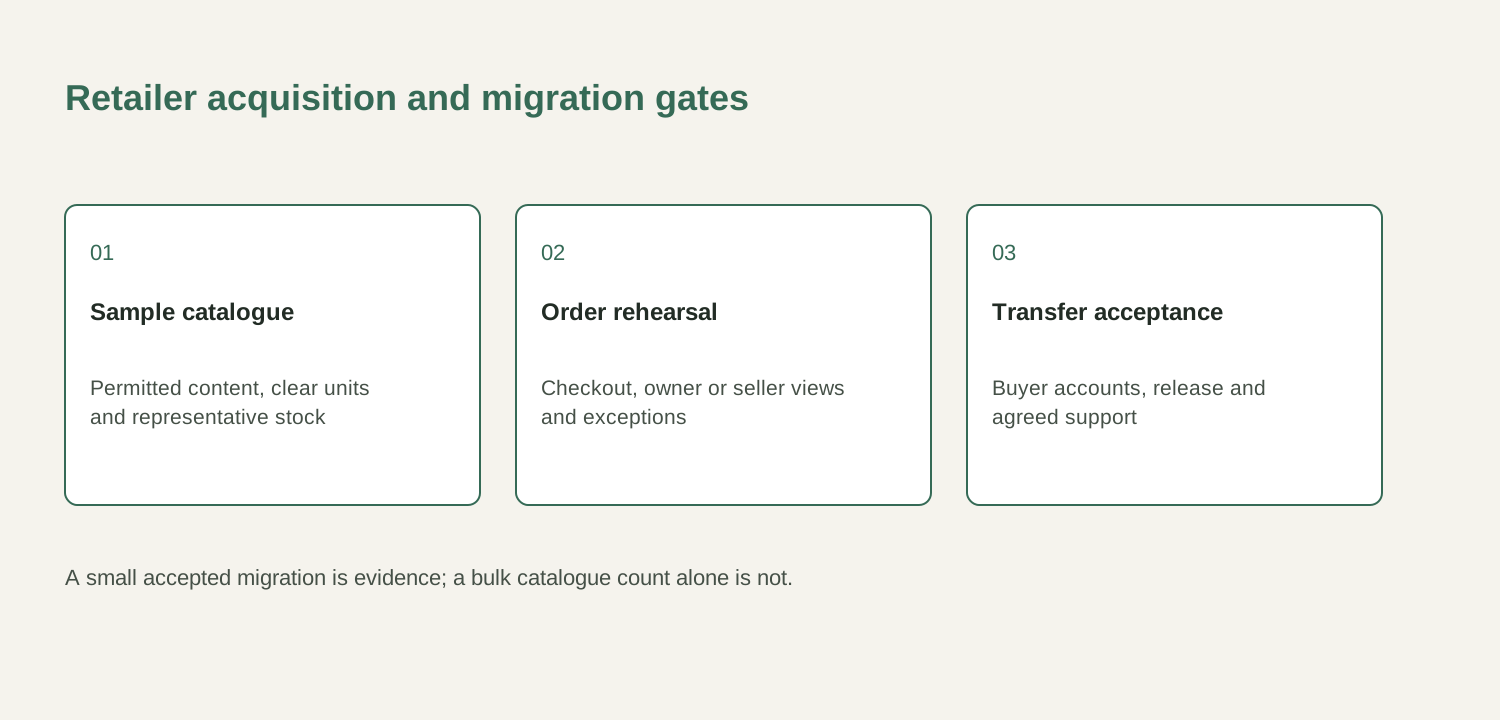
Prepare a small set of representative products the retailer has permission to publish. Include an ordinary item, a low-stock item and an item whose pack or size description could cause confusion. Use that sample to assess the selected application's fields and checkout rather than accepting a bulk record count as evidence of a completed migration.
Record the product identifier, unit, quantity, price and inventory owner for every sample. Then inspect the public page, cart and retained order. The same commercial item should remain understandable throughout the transaction. A photograph or short title alone is insufficient when staff need to pick and fulfil the correct goods.
Ask which import tools are currently delivered and which preparation must be manual. A source repository and demonstration catalogue do not establish a migration service. Any additional import work should name the dataset, fields, image process and correction method before its cost becomes part of the acquisition agreement.
Catalogue rights and the retailer's existing material
The retailer may own product photos and descriptions, while the software package supplies brand and demonstration assets. Keep those rights inventories separate. Confirm what the seller transfers, what retains separate terms and what must be replaced before launch. The application purchase does not automatically establish rights to every image in its sample catalogue.
For independent growers or artisans, the future operator needs permission to publish their material and a process for corrections. That is an operating agreement, not evidence supplied by a sample storefront. Ask the seller to demonstrate the available controls while defining the rights and support policy the buyer will apply.
If real supplier content is included in the sale, request a supported scope and transfer statement. The buyer should not rely on visual completeness as proof of a commercial relationship. Clear content rights make the catalogue migration a deliverable that can be accepted rather than an unresolved risk hidden behind a product count.
Stock updates across existing retail channels
An established retailer may already sell through a counter, another website or a warehouse system. Identify which system currently owns the stock record. The acquired application must either receive an accepted integration or have an explicit manual stock-allocation process. Two sites displaying quantities do not establish synchronisation.
During acceptance, change the sample quantity and inspect the current application result. If no external stock connection is included, record that fact. A limited first catalogue or reserved allocation may be an operating choice, but it should be understood by staff and reflected in the public availability promise.
Additional integrations need a concrete scope: product identifiers, update direction, failure handling and correction ownership. Owning source code permits such work to be commissioned; it does not make the integration present on the day of purchase. Keep the cost and acceptance condition separate from the delivered asset.
| Purchase input | Evidence to inspect | Responsibility to name |
|---|---|---|
| Product unit and description | Consistent page, cart and stored order | Retailer or independent seller preparing the item |
| Stock quantity | Change and competing request behaviour | System or person maintaining availability |
| Images and copy | Permitted material and publication controls | Content owner and correction contact |
| Catalogue migration | Accepted representative dataset | Importer, field mapping and error correction |
| Other sales channels | Actual integration or explicit allocation rule | Owner of the authoritative stock record |
The cash record attached to a retail order
A direct-storefront order and an independent-seller marketplace order can have different payment destinations. The buyer should record the payer, goods seller, amount and destination for the selected product. Do not treat gross customer order value as platform-owner income without inspecting the actual configured arrangement.
TenBasket's model is direct goods sales. HerJungle has seller software plans separate from grower plant orders. AfroZeal includes its own provider-plan and commerce foundations, with the managed custom-order mechanism separately described. The future operator must keep these records distinct in its purchase assessment and accounting process.
Use suitable payment tests and follow the event into the application record. A checkout success page does not prove a completed bank payout. Merchant approval, connected-account readiness and live settlement remain separate checks in the buyer's intended environment. State which results have been accepted and which remain conditions.
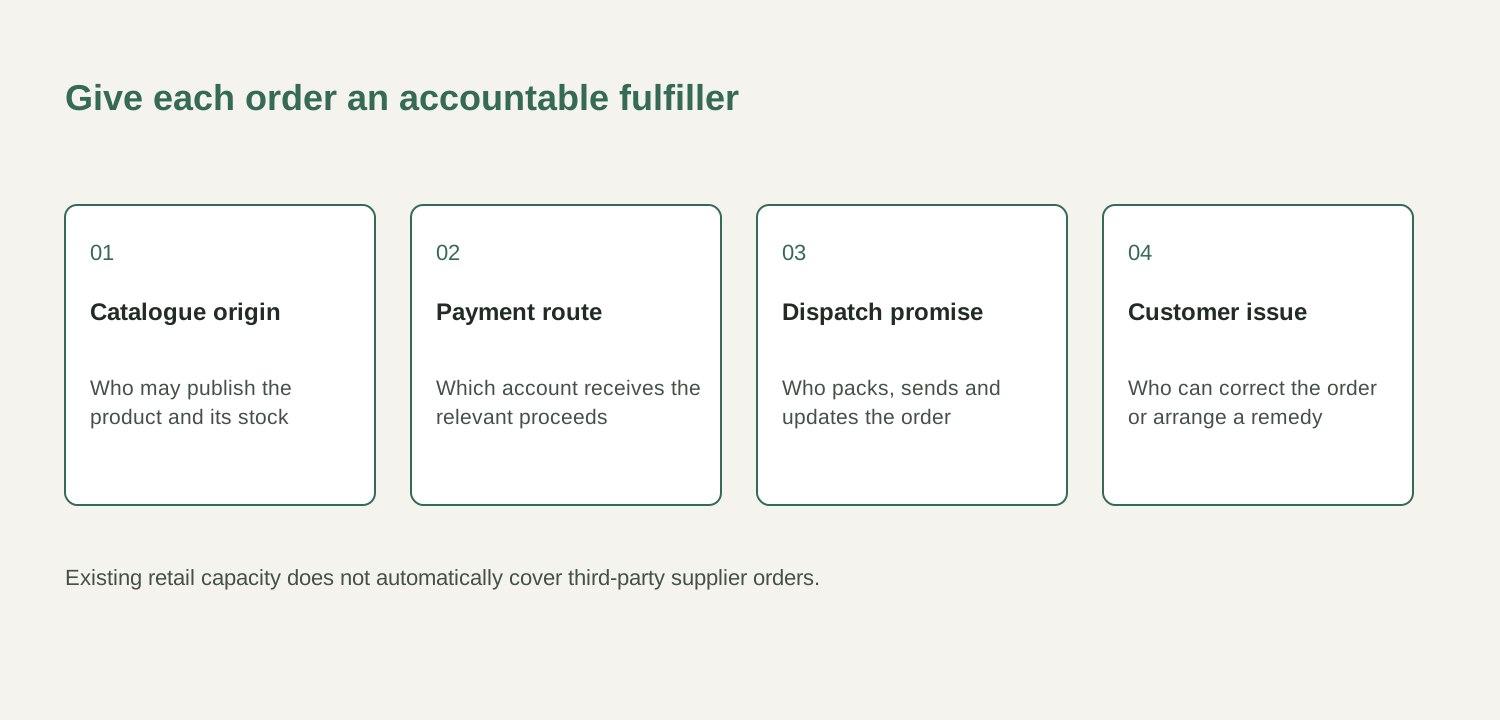
Checkout rules the retailer must accept
Trace a sample order from product selection into checkout and customer history. Inspect the stored amount and quantity, the selected seller where applicable and the account view used to fulfil it. Refresh the relevant pages and return through ordinary navigation so the buyer sees a retained record rather than a temporary confirmation screen.
Then leave a payment unfinished, change a catalogue price or attempt an unavailable quantity. Record the application's actual response. These scenarios identify the delivered checkout boundary and give required corrections a specific acceptance condition. Use fictional data rather than genuine private customer records.
HerJungle's single-grower cart should be accepted explicitly. AfroZeal's own checkout arrangement should be demonstrated rather than assumed to match it. For TenBasket, inspect its direct-storefront payment options and the resulting order states. A cross-asset brief does not combine three implementations into one promised checkout.
Fulfilment from an existing shop or warehouse
The retailer may already have staff, shelves and packing routines. Identify what information those staff need from the selected application to pick and dispatch an order. Check which fields, statuses and exports are currently available. An orders screen should be accepted against the actual handoff to fulfilment.
For a direct store, the retailer controls the goods promise. In an independent seller model, a grower or artisan may pack and send the item. Existing retail capacity does not automatically cover those suppliers' orders. Record who receives each order and who is responsible for confirming dispatch and answering the customer.
If the intended operation needs delivery schedules, carrier labels or warehouse integration, require evidence or additional scope. Do not infer those functions from product tracking language. The acquisition can still be suitable with a manual first process when that process is understood, staffed and reflected in the budget.
Returns and corrections for the selected model
Use a fictional unavailable or damaged-item scenario to inspect the current support record. Ask which role can correct an order and what happens to the payment. A retailer needs to know the application actions and any manual payment-provider step required. Do not promise automatic refunds without a demonstrated path.
For independent sellers, define who communicates with the customer and who supplies evidence about the goods. The platform owner may investigate an account state while the seller handles physical fulfilment. Name those responsibilities so the operating offer does not leave the customer moving between parties without an owner.
The actual return and service terms require decisions for the markets served. The software can support records and controls, but it does not choose the retailer's policy. Put the required implementation and communications into the launch scope and obtain suitable specialist advice where needed before taking real orders.
Staff and supplier permissions during migration
Ask the seller to demonstrate the roles the selected application currently provides. A retailer may need staff who can handle orders without changing prices or owner settings. A marketplace may also require separate grower or artisan accounts. Record actual delivered permissions instead of assuming a full workforce access system.
Use two sample seller accounts where independent sellers are part of the model, and inspect their access to each other's catalogue and orders. For the retailer's own staff, demonstrate the available roles and identify additional requirements. Private customer data is not needed to establish these account boundaries.
Administrative credentials and former operator access must also be accepted during handover. The buyer should know who can change the public catalogue, payment configuration and private owner settings. Keep sensitive account material in the controlled transfer channel, separate from the public source and product pages.
Customer records included in a software acquisition
A sample customer account or order count does not establish a transferable customer base. The starter product descriptions do not represent verified commercial customers or revenue. Any genuine data or relationships included in a sale require separate support, scope and an appropriate transfer process.
The retailer's existing customer information is another asset under its own control. Decide what, if anything, must move into the acquired application and what permissions and account processes apply. Do not assume a code purchase includes a ready-made customer migration or authorises every use of an existing database.
Use fictional or suitably prepared sample data for migration acceptance. Record the fields, account creation behaviour and correction process. A small demonstrably correct migration is more useful than an unsupported claim that every customer record can be imported automatically. Include additional data work in the agreed scope.
Domain, brand and storefront transition
The chosen asset comes with its own brand and domain scope. The retailer should decide whether to retain that identity or request a specific rebrand. Name the domain rights and materials transferred, then list any changes included in the asking terms. A temporary preview address is not automatically an asset the buyer owns.
If the storefront is to use the retailer's existing domain, agree the configuration and launch sequence. Branding, DNS, sign-in redirects and payment descriptors are different tasks. They should be accepted in the intended environment rather than combined into a vague statement that setup is complete.
Retain a release reference and a record of the accepted public routes. If the buyer keeps another retail website operating during transition, define which catalogue and checkout are authoritative. The software purchase should not disrupt the current operation through an undocumented switch of customer or stock responsibility.
Operating accounts and reproducible delivery
List the frontend hosting, identity, backend and payment services needed for the selected product. Use its own technical guide to identify current requirements. Agree which accounts transfer through supported processes and which are recreated under buyer ownership. Rotate private credentials as part of that controlled handover.
Request a reproducible build and deployment from the delivered source. Then inspect sign-in, catalogue edits, a sample order and owner access under buyer-controlled configuration. The repository is a digital asset; an accepted route to running it is another practical deliverable the retailer needs.
Payment approvals and service charges remain account-specific operating inputs. Obtain current provider terms rather than assuming every buyer has identical costs or access. A product can be acquired internationally while the accepted launch scope remains precise about the countries, currencies and account arrangements configured.
Price, migration work and the remaining retail budget
Keep the asset asking price separate from service accounts, catalogue preparation, stock integration and accepted development changes. Add staff time for order support and fulfilment. The retailer may already own some resources, but their capacity and cost should remain visible in the launch decision.
A configurable plan or checkout does not establish future profit. The buyer can assess the completed application work without an invented sales projection. Historical revenue represented in a transaction needs its own evidence; demonstration orders cannot supply it. Confirm the current seller disclosures before making financial representations in an offer.
Agree the handover support period, start date and included setup actions for the chosen asset. Catalogue imports and external retail integrations should have explicit datasets and acceptance conditions. This gives the acquisition a clear finish point and leaves the retailer with a realistic list of continuing responsibilities.
A retained order record for the retail team
Before accepting the transfer, ask a staff member to retrieve the sample order without the seller's assistance. The item, quantity, customer context and next action should be understandable from the records the application actually provides. This is a practical test of the chosen software's fit with the retailer's daily work.
If the exercise reveals a missing field or export, describe its purpose and authorised role in the agreed scope. A technical team can estimate a specific correction more usefully than an instruction to make the system retail-ready. Repeat the affected order test after any accepted change and retain the resulting release reference.
The existing retailer remains accountable for its customer promise. The software purchase should strengthen an operation the buyer can describe and staff, with independent supplier responsibilities clearly separated. That gives the domain and source transfer a commercial finish point rather than leaving operating readiness assumed.
Existing-retailer offer preparation steps
- Select one independent application and confirm the current listing and digital assets offered.
- Name the inventory owner and the party responsible for each order's fulfilment.
- Prepare a permitted sample catalogue and accept its units, quantities and price records.
- Trace checkout, money destination, order handling and exception responsibility.
- Agree stock-channel integration or an explicit first-launch allocation process.
- Accept source, domain, buyer-owned services, migration work and support dates.
Retailer ecommerce acquisition checklist
Use the record for the selected asset and the retailer's actual operation.
Make a retailer-specific software offer
Submit an offer for the application and rights you have accepted, with catalogue and account work named explicitly. Physical stock, supplier agreements and staff remain separate assets unless expressly included. The buyer's established retail experience supports its own operation; it does not turn a sample marketplace into a supplied commercial network.
Continue through TenBasket, HerJungle or AfroZeal on Flippa to confirm the selected package and current terms. Retain the purchase scope and accepted release with that separate transaction.
Explore the products discussed
Explore related acquisition offers