
Fashion website for sale: buy the AfroZeal marketplace foundation
Acquire an African fashion platform with artisan storefronts, shopping and managed custom-order enquiries.
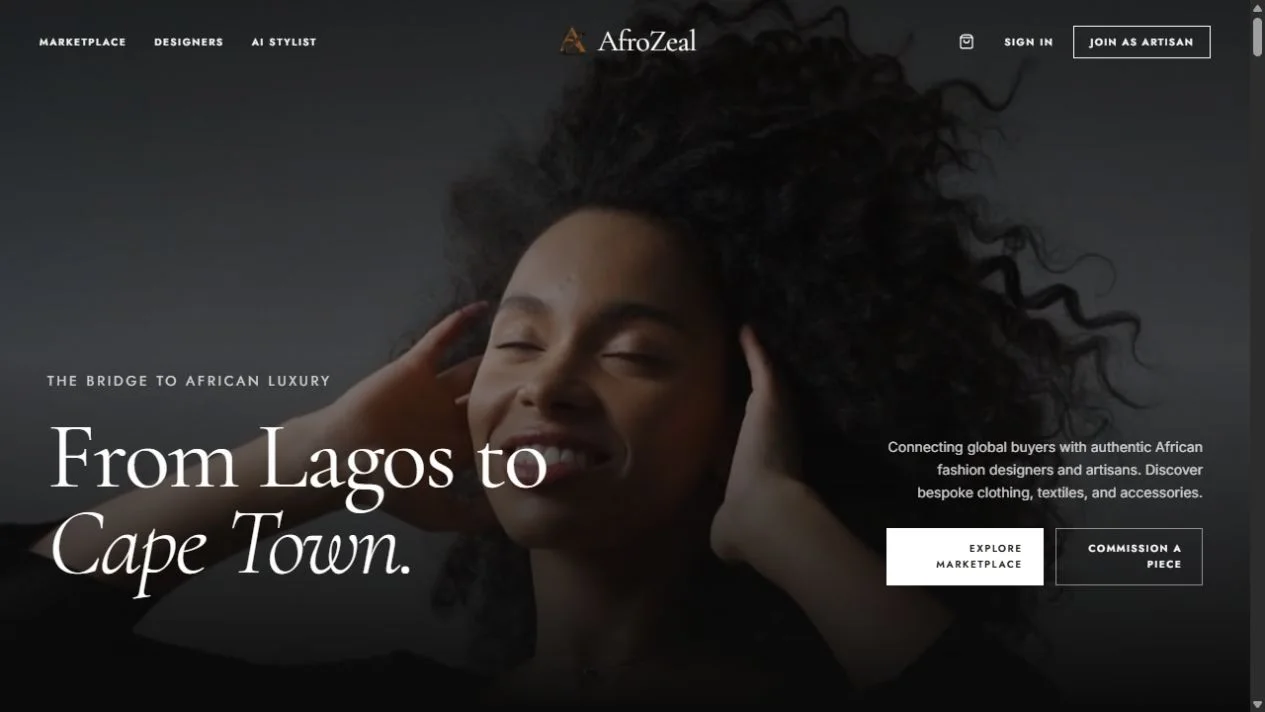
Buy AfroZeal's digital marketplace foundation. Request the domain, application source and handover documents, with provider plans and managed custom-order fees as the intended commercial routes.
Buy the AfroZeal African fashion marketplace foundation. Contact Codeblix through the current Flippa sale to request the domain, application source, documentation and agreed transfer package. The product brings together artisan storefronts, product listings, shopping and a managed custom-order enquiry route.
The acquisition is for a starter digital platform. It is not an offer to buy garments, a warehouse of fashion stock or an established artisan network. The new owner chooses the market, recruits providers, manages the product and completes the launch. Provider subscriptions and managed custom-order fees are the intended commercial routes; those capabilities are not evidence of existing paid activity.
If you are looking for a fashion website for sale because you want to own the platform behind the shopping experience, open AfroZeal's asset details. The purchase information below helps define the package, the customer relationships and the work to agree with the seller. Confirm current availability, price and financial evidence in the transaction discussion before making an offer.
Buy the platform behind an artisan's storefront
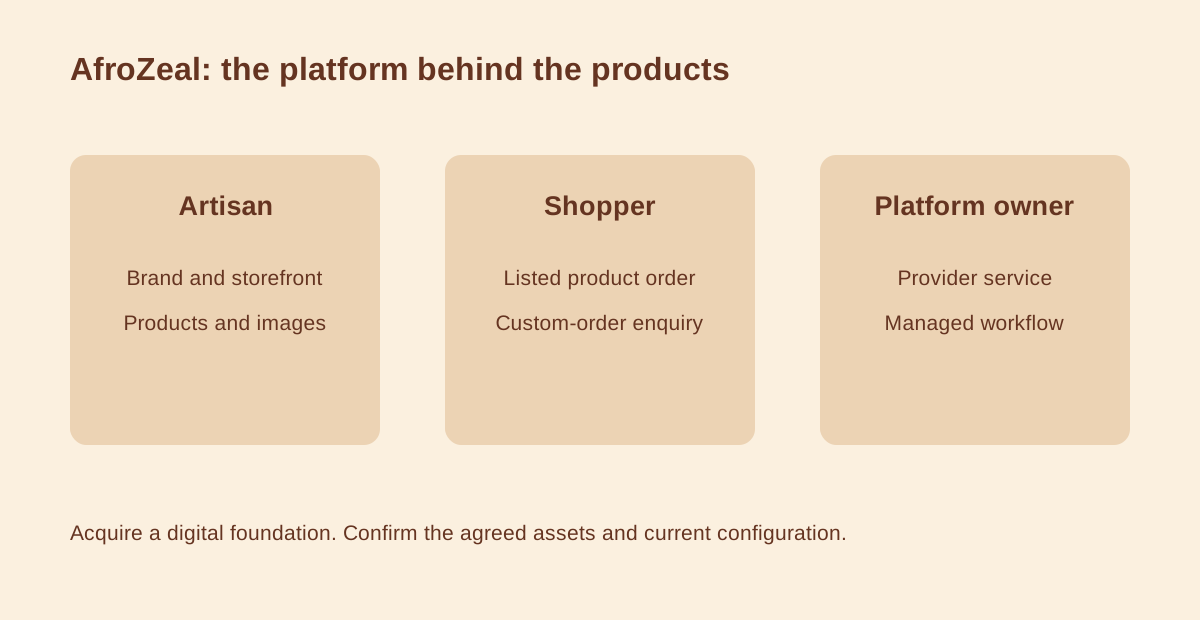
AfroZeal's documented provider storefronts give artisans a place to present their brand, products and images within a searchable fashion marketplace. The platform owner is buying the product foundation that supports that presentation. The owner must still decide which providers to approach and what service the platform will offer them.
A buyer who already works with designers, makers or fashion communities may have a clear starting audience. That relationship is useful only when the buyer can explain the service being offered. A storefront should have a practical purpose: presenting a maker's work, helping shoppers understand products and connecting the offer with an order or enquiry route.
Ask the seller to demonstrate an ordinary provider account. Follow the creation or editing of a product, the provider's brand presentation and the public view of the same information. Then switch accounts and inspect the owner controls relevant to that content. The purchase should establish who can change what and how the operator supports the provider.
Do not assume that a populated demonstration represents contracted artisans. Request evidence for any existing provider relationships included in the sale. If the asset is a starter, base your offer on the product and agreed assets rather than an imagined network. The buyer's launch plan should identify the first provider group and who will handle onboarding.
Two commercial routes sit in the same fashion product
AfroZeal combines ordinary product shopping with a managed custom-order enquiry route. The distinction matters for an acquisition. A listed product can be examined through its description, cart and checkout. A commissioned piece begins with a request that needs a clear service process before the parties can agree the work.
The documented platform model includes provider subscriptions and managed custom-order fees. Ask the seller which controls support those routes and how the current configuration works. If you plan to charge a different type of fee, confirm whether it is implemented or needs development. A future pricing idea should not be treated as part of the present asset without evidence.
| Route | Documented foundation | What the buyer needs to agree |
|---|---|---|
| Provider subscription | Provider participation in the marketplace | Plan controls, the offered service and account support |
| Product shopping | Product browsing, cart and Stripe checkout flow | Payment configuration and the provider's order responsibilities |
| Managed custom order | A Commission a Piece enquiry form | Enquiry handling, scope agreement and the relevant fee workflow |
Keep these routes distinct in your offer. You are buying software that can support the documented model, not a guaranteed level of transactions. The current sale records should establish any revenue or customer activity you intend to rely on. Ask for dated evidence rather than deriving an income estimate from the number of products shown in the preview.
Request AfroZeal's current asset list and commercial configuration. State whether provider plans, product orders or the custom-order route is the main reason for your purchase. That makes it easier to agree the demonstration and transfer scope around your intended offer.
Put one ready-to-buy product through checkout
Choose one hypothetical product for the seller demonstration. Use a clear item description, a stated selling unit and enough information to distinguish it from a custom commission. Follow that item from the provider's catalogue to the shopper's cart and the documented Stripe checkout flow.
Ask what the customer sees before submitting the order and what the relevant accounts show afterwards. Keep the same product and order throughout the demonstration. This makes the relationship between screens easier to understand and exposes any point where a manual step or additional configuration is required.
The buyer should also identify the external accounts needed for launch. Ask which payment settings are demonstration settings, which accounts the buyer must own and which provider setup steps apply. A payment integration in the source does not prove that every provider is approved or that the buyer's live configuration is complete.
- Inspect the product information a shopper relies on.
- Follow quantity and cart changes using the same item.
- Ask the seller to explain the current checkout environment.
- Find the submitted order in the relevant account view.
- Record the buyer-owned configuration required before launch.
If your intended market requires particular size options, delivery rules or return handling, request a demonstration of those exact requirements. Do not infer them from a fashion photograph or a familiar checkout button. Any essential missing behaviour belongs in a separately defined configuration or development scope.
Acquire the custom-order route with a clear service boundary
The Commission a Piece form supports managed custom-order enquiries. It should be assessed as an enquiry route, rather than assumed to automate the entire creation and delivery of a commissioned garment. A buyer needs to understand what the product captures and what the operator must do next.
Prepare a hypothetical request for a piece of clothing with a stated purpose and a few clear requirements. Ask the seller to show where the request is submitted, where it becomes visible to the operator and how the next action is organized. If a later step is handled outside the application, identify that boundary explicitly.
A custom order can involve discussions about design, materials, size, delivery and price. Those details must be agreed by the responsible parties. The platform owner should not promise automatic fulfilment simply because the product accepts an enquiry. Ask which parts of the process are present, which require a human response and which would need additional product work for your offer.
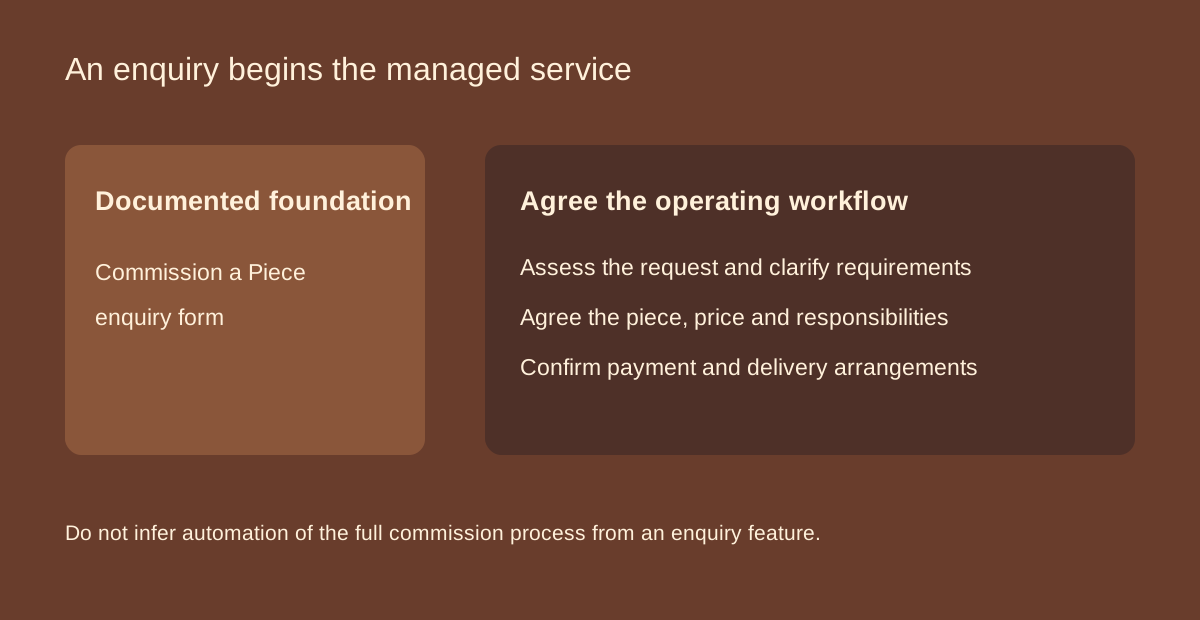
For the acquisition agreement, separate the demonstrated enquiry feature from any new commission-management requirements. If you need a particular approval sequence or document workflow, ask the seller to show it or quote it separately. This keeps the base purchase understandable and prevents an unagreed service idea from becoming an assumed software inclusion.
A provider plan needs a concrete offer to the maker
When a platform intends to charge provider subscriptions, the new owner must be able to describe what the provider receives. In AfroZeal, the discussion can begin with a storefront, product presentation and access to the documented marketplace workflow. The owner still needs to decide the service scope and support routine.
A prospective buyer might already have a fashion audience, a maker community or an agency serving independent brands. Those are possible advantages, not assets that should be assumed to transfer with the product. Write the first provider offer using capabilities demonstrated by the seller and contacts you can realistically approach.
Avoid making subscription value depend on guaranteed traffic or sales unless there is evidence and an agreement supporting that promise. A provider may find value in the product's tools, presentation or managed service, but the buyer must validate the offer in the chosen market. The sale should make clear whether any actual paid provider activity exists.
| Offer component | Question for the seller | Decision for the new owner |
|---|---|---|
| Storefront presentation | Which brand, image and product controls are available? | Set the content standard and onboarding responsibilities |
| Marketplace access | How do providers participate in the shopping workflow? | Describe the plan without promising unsupported demand |
| Custom-order service | Where does the documented enquiry route end? | Assign the people who manage the remaining conversation |
| Plan administration | Which settings and account states can the owner manage? | Identify launch configuration and any new requirements |
Bring this offer into the Flippa discussion. Ask the seller to connect each part with a screen or document. A concrete provider offer makes it easier to assess whether the existing asset fits your plan and which changes would need their own budget.
Select the acquisition role that matches your fashion contacts
Use the choices below to prepare your first purchase enquiry. The results describe the next evidence request for each role. They do not forecast income or establish demand in a particular country.
Request the provider storefront and plan demonstration. AfroZeal is a relevant digital foundation to inspect. Confirm the platform package and keep your provider recruitment plan separate from any sale claims.
Request the Commission a Piece journey. Establish what the form captures, where requests arrive and what your team would manage after submission. Scope any missing service workflow before purchase.
Clarify the acquisition category first. AfroZeal is offered as a starter marketplace foundation. Garment inventory, a physical shop and established commercial contracts should not be assumed to form part of that package.
If the platform role matches your plan, inspect the included AfroZeal assets and request the current offer terms. If you are comparing sectors, the online business collection offers other operating models. Keep your own audience and service responsibilities at the centre of that shortlist.
Product copy helpers do not replace catalogue ownership
AfroZeal's documented AI helpers support tasks such as product copy and styling. The acquisition conversation should establish the current scope of those helpers, their required external services and the buyer's configuration responsibilities. Ask for the specific demonstration rather than assuming a broader automatic merchandising system.
The platform owner and providers remain responsible for the content they publish. A product description needs to represent the item accurately. Images, names and brand materials need a clear inclusion and usage basis. Ask which materials in the demonstration are samples and which assets form part of the agreed transfer.
If these helpers are important to your provider offer, ask which service accounts the buyer will need and what happens when the relevant service is unavailable. Treat usage charges as part of the operating budget where applicable. Do not describe an assisted writing feature as a promise that the business runs itself or that content requires no checking.
A buyer who prefers manual catalogue preparation can still inspect the core storefront and shopping routes independently. The important purchase decision is whether the demonstrated foundation supports the service you intend to sell. Keep optional workflow preferences separate from essential acquisition requirements.
Read the package as an ownership transfer
Start with the AfroZeal user guide, then examine the technical handover. Use the documents to identify provider, customer and operator roles, along with the accounts and deployment work required after purchase.
Ask for a written asset list in the transaction discussion. It should identify the agreed domain, application source, documentation and other included materials. Clarify account ownership and transfer steps. If the deal includes setup or support, state its scope and completion conditions rather than assuming that all future changes are included.
- Request the current price, availability and exact acquisition package.
- Demonstrate one provider storefront and one product order journey.
- Inspect the custom-order enquiry route if it is central to your plan.
- List buyer-owned accounts, configuration work and separate development.
- Agree the transfer sequence and acceptance checks in writing.
A useful acceptance journey follows the same sample provider and product in the buyer-controlled environment. It can confirm catalogue presentation, the configured shopping route and the relevant operator views. Add the custom-order exercise if that route is part of your intended offer. The agreement should say what successful delivery means for the package being purchased.
Make room for the human work in a fashion platform
An artisan marketplace requires more than application maintenance. Providers may need help presenting products. Shoppers may need clarification. Custom requests may require a person to coordinate the conversation. Before buying, assign those responsibilities to people who can provide the service consistently.
A buyer considering the platform as a side business should define the hours and response routine that can actually be maintained. A custom-order service with a large promise may create more work than a small team can handle. Choose an initial offer that fits the people, contacts and technical support available after the acquisition.
For an adult-led family project, ownership can be divided into practical responsibilities: content preparation, provider contact, account administration and technical upkeep. The person responsible for the purchase should understand the whole service and control the business accounts. Educational interest is a reason to study the acquisition carefully, not evidence of a future return.
The same discipline helps an agency buyer. An agency may want to use the product as a foundation for a fashion client or a specialist marketplace service. State whether the transaction is for ownership of the offered asset and what further work the client needs. Do not assume a transfer grants unlimited rights to relicense every component; agree the actual package and rights with the seller.
Specify a first collection in the asset enquiry
A prospective platform owner can make the purchase conversation concrete by bringing a small, hypothetical artisan collection to the seller. Choose a handful of products you understand well enough to describe accurately. The collection is a demonstration brief, not a claim that those makers or products already belong to AfroZeal's network.
For each item, state the provider, the product information a shopper needs and whether the intended route is ordinary shopping or a custom enquiry. Keep the difference visible. A ready-to-buy item needs a clear listed offer. A commissioned piece needs a route for agreeing the work. If your planned collection requires both, ask to see both in the same walkthrough.
Then examine the provider boundary. Ask the seller to show one provider's product information and the relevant controls available to that account. Switch to another provider if that is part of the demonstration. Ask which details are isolated by provider and which are controlled by the platform owner. Record what you actually see, especially if the purchase depends on a particular administrative rule.
| Brief item | Ask the seller to demonstrate | Put in the offer notes |
|---|---|---|
| One artisan brand | The provider storefront and editable presentation | Included controls and content preparation responsibilities |
| One listed garment | Its product details, cart and checkout route | Required account setup and any essential catalogue changes |
| One custom piece request | The enquiry submission and operator view | The boundary between software and managed service work |
| One operator correction | The relevant owner control or technical task | Who handles the correction after transfer |
This gives the seller a bounded package to explain. It also gives the buyer a way to distinguish useful configuration from speculative development. If the collection can be represented through demonstrated features, the acquisition can be discussed around that foundation. If an essential part requires new work, ask for its scope and acceptance conditions before making an offer.
Agree what a successful fashion-platform handover includes
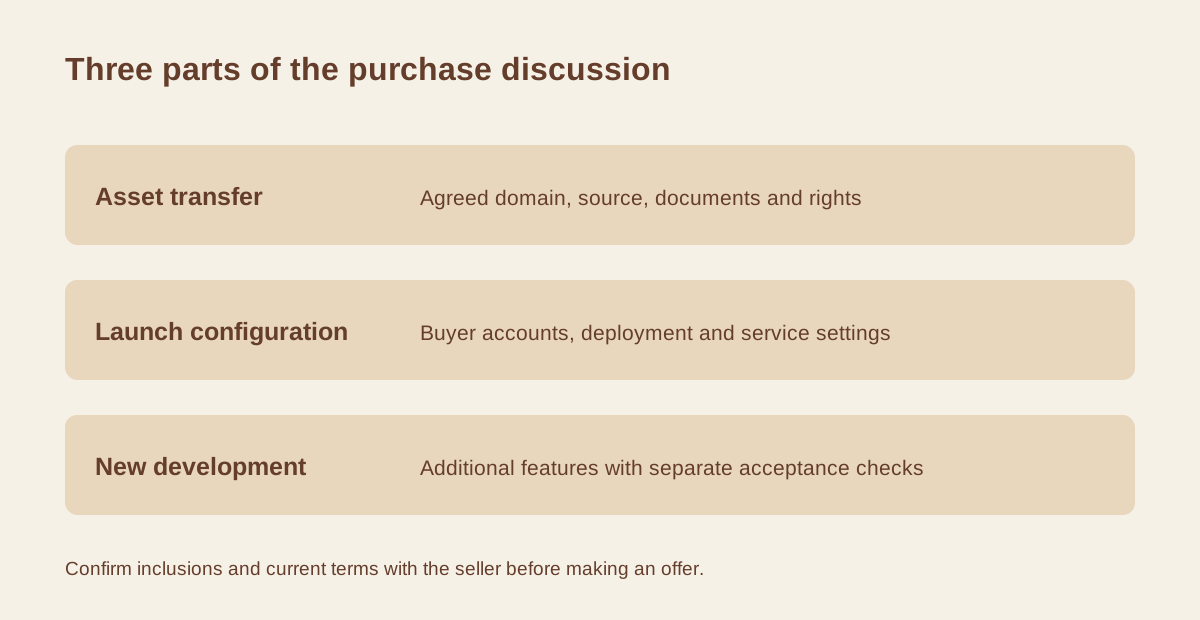
A domain transfer alone is not the same deliverable as a configured application. A source package alone is not the same deliverable as a managed launch service. Ask the seller to identify which deliverables are included in the current sale, and connect each one with a completion check that both parties understand.
For the application, the completion check can follow the agreed provider and shopper exercises in the buyer-controlled deployment. For documentation, confirm that the agreed user and technical materials are delivered. For service accounts, establish which ones the buyer creates and configures. For additional development, use a separate scope so its acceptance does not become confused with the existing asset.
Also identify the person who will receive the handover. A commercial buyer may involve a developer for deployment. A technical buyer may involve a fashion operator for the provider offer. Make sure the person responsible for each part can inspect the relevant material before acceptance. This is a practical way to buy a foundation your team can continue to operate.
Once the package is clear, use the current Flippa conversation to confirm price and terms. Keep any request for additional support or changes specific. The seller can then distinguish an offer for the advertised asset from a separate project request, and you can compare the total commitment with the resources available for launch.
Send an offer enquiry with the fashion package you want
Prepare a short message naming your intended operator role and the features central to the purchase. If you want provider subscriptions, request the storefront and plan controls. If you want a managed commission service, request the enquiry path and its current boundary. If you want to use the shopping flow, ask for the same item to be followed through the relevant account views.
Include questions about buyer-owned payment and external service accounts. Ask for the asset list and the current financial evidence. State any essential additional requirement clearly so the seller can distinguish the base transfer from new work. A focused enquiry gives both sides a concrete package to discuss.
Request the AfroZeal acquisition package on Flippa and confirm the current transaction terms with Codeblix. You can also open the AfroZeal marketplace listing for the linked product documents. Buyers seeking other subscription-based foundations can compare the available SaaS business collection before making an offer for the operating role they are prepared to own.
Explore the products discussed
Explore related acquisition offers