
Online grocery business for sale: acquire the TenBasket storefront
Request the grocery application, domain and handover package, then agree the checkout and order workflow you will operate.
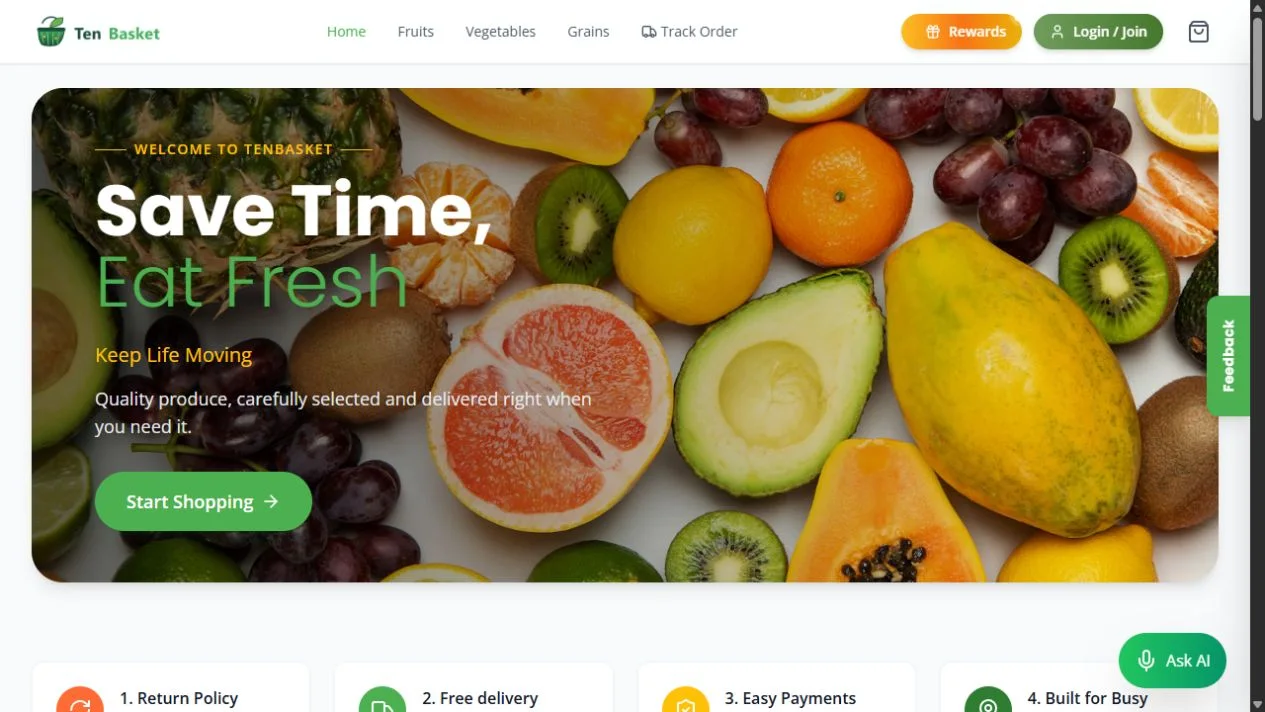
Buy a direct grocery storefront foundation with catalogue, cart, checkout, order history, tracking and rewards. Request TenBasket's current asset package and transfer terms from Codeblix through Flippa.
Acquire TenBasket's online grocery storefront foundation. Contact Codeblix through the current Flippa sale to request the domain, application source, documentation and agreed transfer package. The product includes a catalogue, cart, checkout, order history, tracking and customer rewards. The buyer chooses the goods and operates the store.
TenBasket is a starter grocery storefront offered through Codeblix and Flippa. The documented product includes a catalogue, cart, checkout, order history, tracking and customer rewards. Its business model is direct product sales. The buyer operates the store, chooses the goods and arranges the service behind each order.
The package is the digital store foundation. The public preview lets prospective owners inspect the storefront; it does not establish real shoppers, historical sales or a ready-made delivery operation. Request the current asset list and trading evidence in the sale discussion, then use the order acceptance details below to define your purchase.
Put one ordinary basket in the centre of the deal
Before looking at every setting, choose a small sample order that resembles the store you want to run. It might contain a packet of rice, a bottle of cooking oil and a fixed-size box of vegetables. Give each item an unambiguous name, unit and price. A simple basket is easier to follow through the system than a demonstration filled with dozens of products you do not recognize.
Ask the seller to show the same order from the shopper's view and the operator's view. Can the shopper understand the item, quantity and total? Can the operator find the order and identify what has been requested? Does the customer account show the order afterwards? What does the tracking experience communicate? Keep notes about the actual configuration rather than filling gaps with assumptions.
Use a second test to examine a change. Ask what happens when the customer changes a quantity or removes a product before submitting the order. Then ask which changes can be made after submission and how the customer is informed. A seller who demonstrates those boundaries gives you a stronger basis for the purchase than a feature list alone.
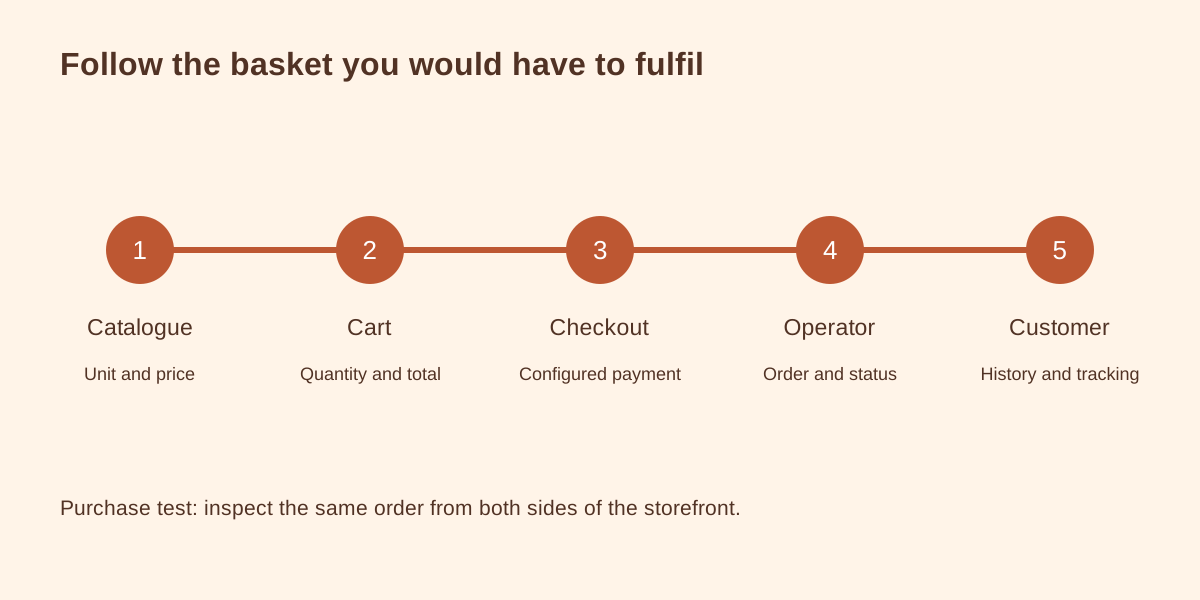
| View | Ask to see | Record before purchase |
|---|---|---|
| Product page | Name, image, unit and current price | Any catalogue fields you still need |
| Cart | Quantity changes and a clear total | How the store handles unavailable or changed items |
| Checkout | Customer details and the configured payment choices | Which choices will be enabled for your own launch |
| Operator account | The submitted order and its current status | Who processes it and where exceptions are handled |
| Customer account | Order history, tracking and relevant rewards | What the customer can actually see and do |
Open TenBasket's Flippa listing and request this five-view walkthrough. Ask for the current price, financial information and transfer package at the same time. The sample basket makes your questions concrete without implying that a single test establishes every operational requirement.
The catalogue is a retail decision, not just a content job
A grocery catalogue tells shoppers what you are willing to sell. The buyer should therefore examine more than the number of categories. Look at how products are named, how packs are described, how prices are presented and how quickly an operator can correct an entry. A catalogue that looks acceptable with sample content can still need substantial work before it matches your actual stock.
Fixed-pack groceries are a useful test case because the purchase unit can be stated clearly. A bag, bottle or box can have a defined size and listed price. If your plan depends on weighed produce or substitutions, add that requirement explicitly. Do not assume that a fixed-price catalogue includes variable-weight settlement, a scales integration or automatic substitution rules. Ask the seller to demonstrate any capability essential to your intended store.
Start your purchase brief with a small set of real products you could source. Write the product name, pack size, selling unit, proposed image source and the person responsible for updates. This is not a sales forecast. It is a check that you can populate and maintain the storefront you are considering buying.
| Range | Why a buyer may consider it | Question to resolve with the seller |
|---|---|---|
| Packaged pantry products | Clearly defined sizes and a manageable starting catalogue | Can product details and prices be maintained in the way your team needs? |
| Fixed produce boxes | A limited offer with a clearly stated pack | How will contents, availability and customer expectations be communicated? |
| A wide mixed grocery range | More shopping needs served in one store | Who will maintain images, prices and stock information across the range? |
| Variable-weight items | May match an existing shop's selling method | Does the implemented checkout support your precise pricing and settlement process? |
The right first range depends on your access to products and your operating routine. A buyer with an existing physical shop can inspect how the online catalogue would fit the current business. A first-time operator needs to establish sourcing and fulfilment as well as software ownership. Those are different starting positions, even when both buyers use the same storefront.
Checkout deserves a demonstration under the buyer's conditions
Payment options are part of the configured store. TenBasket's documented operations include cash on delivery where configured. That wording matters: a feature should be checked in the configuration you intend to run. Ask which payment services require buyer-owned accounts, which settings change at handover and how a successful order is recorded.
For a payment integration, request a clear explanation of test and live settings. A test transaction is useful for examining the workflow. It is not evidence of live sales. Before launch, the owner needs to complete the applicable account configuration and verify the agreed journey in the buyer-controlled environment.
For cash on delivery, examine how the order is identified and how the operator records its progress. Your fulfilment routine must connect the digital order with the actual delivery. Ask what the software handles and what the team does outside it. Do not count a payment option as operationally ready until you understand that full route.
- Ask which checkout choices are enabled in the current demonstration.
- Identify every external account you would need to own.
- Check customer contact and address information against your fulfilment needs.
- Review how order states are changed and shown to customers.
- Agree an acceptance test for your intended payment configuration.
This conversation is also where you should raise cancellation and refund needs. Ask to see the implemented controls rather than assuming that every scenario is automated. The new owner must decide how customers will contact the store, who can approve changes and what operational instructions the team follows. Put any essential missing capability into the development scope before you agree the price.
Repeat shopping begins with an understandable account
TenBasket includes customer accounts, order history, tracking and rewards. Those are worth inspecting because grocery retail often involves repeated purchasing decisions. A prospective buyer should still judge the implemented experience directly. A rewards feature is a product capability, not a promise of repeat orders or customer loyalty.
Ask the seller to show what a customer sees after placing the sample basket. Can they find the correct order? Is its status understandable? Where do rewards appear, and what rules govern them? What does the operator control? If your planned offer depends on a particular reward rule, request a demonstration of that exact rule.
Consider the support conversation as well. A shopper may ask about a missing item, an address detail or an order that has not arrived. The store owner needs a dependable way to identify the account and the order. Examine whether the present product provides the information your support routine requires. Additional helpdesk tools or communication integrations should be assessed separately if they are central to your plan.
A useful acquisition question is: would you be comfortable explaining this account experience to a shopper yourself? If you need several workarounds to explain an ordinary order, investigate them before buying. If the route is clear, record it as part of the handover so the new operator and any helpers share the same understanding.
Choose the owner role that matches your starting point
The selector below compares three common purchase situations. It does not calculate earnings or decide whether you should buy. It helps you choose the next evidence request based on the business you already have, or the work you are willing to take on.
Test the fit with your existing shop. Bring real product units, your order handling routine and payment requirements to the walkthrough. Identify the changes needed before the storefront can serve your customers.
Build the operating plan beside the software shortlist. Establish sourcing, order handling and delivery responsibilities. Review TenBasket as the storefront foundation and keep the food operation in your acquisition budget.
Compare a sourcing platform instead. FruitKiwi uses supplier plans and promoted listings. It supports a different relationship from TenBasket's direct retail model.
TenBasket versus a supplier network: keep the shortlist honest
A grocery ecommerce website and a produce sourcing marketplace can look related because both feature food. They are not substitutes for every buyer. TenBasket is a direct storefront. FruitKiwi connects produce buyers and suppliers through requests for quotes and comparison, with produce payments handled outside that platform.
If you want to sell a monthly software service to suppliers, TenBasket's direct product sales model should not be recast as a supplier subscription business. If you want customers to buy a grocery basket from your store, FruitKiwi's sourcing workflow should not be assumed to provide the same retail checkout. Compare each asset against the customer relationship you plan to operate.
The separate wholesale produce software purchase comparison follows that distinction through a restaurant and grower-network brief. It is a useful companion if you have food-sector contacts but have not chosen between the sourcing and retail roles. Once you choose, keep the detailed feature review focused on that role.

For broader alternatives, browse Codeblix's online business collection. Compare operating models before comparing visual styles. A store that fits your supplier access and customer-service capacity is a more useful candidate than one selected only because its catalogue looks familiar.
The documents should answer ownership questions
Read the TenBasket user guide with the sample basket in mind. Note the screens needed to manage the catalogue and orders. Then read the technical handover to understand deployment and configuration responsibilities. Questions that remain after reading should be raised in the sale discussion.
The transaction should identify the domain, source code, documentation and any other agreed assets. Ask about external services, account ownership and the order of transfer steps. If support is included, define its scope and duration in the agreement rather than assuming unlimited help. If a customization is essential, separate its cost and acceptance criteria from the base asset purchase.
A practical acceptance plan can be short. Deploy the agreed application in the buyer-controlled environment, configure the required services, create or inspect a product, place the agreed test order and verify the operator and customer views. Record the result and any remaining work. The purpose is to confirm the agreed deliverable, not to simulate an entire retail season.
- Write the asset list and identify the accounts the buyer will own.
- Confirm the product and order workflows essential to your store.
- Separate included setup from new development requests.
- Agree the transfer sequence and a clear acceptance journey.
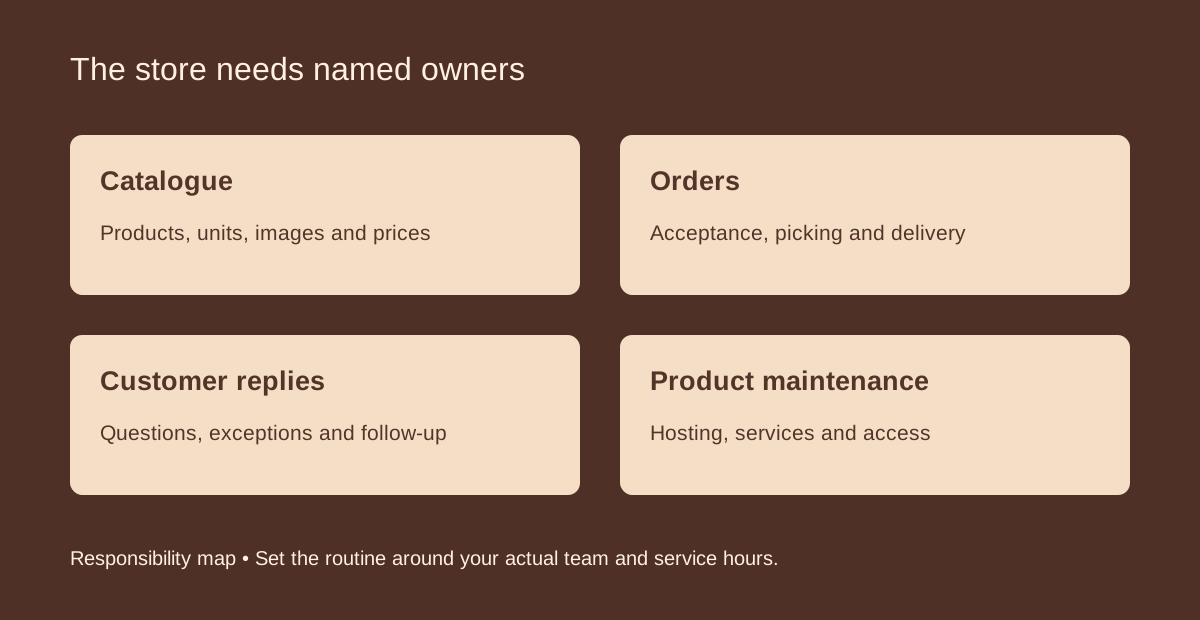
- Assign the people responsible for catalogue, orders and technical maintenance.
Financial and traffic claims should be assessed using the current evidence attached to the sale. A starter software asset should not be priced in your own plan as though a particular customer base or income stream has been established. Ask for dated evidence for any commercial performance you are relying on.
Set a workload limit before calling it a side business
Online ownership can fit alongside another job only if someone can reliably perform the required work. A grocery store may receive orders when the owner is unavailable. The buyer needs a service routine that matches the hours offered to customers. Decide who handles the catalogue, who processes orders and who responds when the fulfilment plan changes.
For a family ownership project, divide responsibilities in plain terms. One person might review product descriptions, another might handle the business accounts, and another might maintain the application. The person responsible for the purchase should understand the whole order journey and retain control of spending and access. An educational interest in business can be valuable, but it should not be treated as evidence that a store will earn income.
A manageable starting offer may be more useful than a huge catalogue. Choose a range you can source, describe and fulfil consistently. Test the product with that range before promising a wider service. If the asset requires more operational work than your team can provide, keep looking or revise the plan before making an offer.
This is also why a grocery storefront should be compared with your existing strengths. A shop owner may already have product knowledge and order-handling capacity. A developer may be comfortable with deployment but need a retail partner. A food distributor may have supply relationships but need to examine the household shopping experience. Your purchase brief should acknowledge both the strengths and the gaps.
A three-product pilot makes the purchase easier to specify
Before making an offer, prepare a small store brief using three products you could realistically source. Choose items with different presentation needs, such as a packaged staple, a bottled product and a fixed produce box. This is a purchase exercise. You are using it to examine the software and your readiness to operate it, not to predict customer demand.
For each item, write the selling unit and the wording a shopper needs to avoid confusion. A product title may be clear to a wholesaler but ambiguous to a household buyer. A photograph may show several pieces while the price refers to one pack. Bring those details to the demonstration and ask how the catalogue editor lets you communicate the intended offer.
Now follow the three products into a single basket. Check whether the order record retains the details needed for picking. Ask what happens if the operator must contact the customer about an item. Where does the store team find the relevant contact information? Which part of that conversation is handled in the product, and which part belongs to your external operating routine?
Finally, write a short instruction for the person who would process that order. If the instruction depends on a capability you have not seen, add it to the seller questions. If it depends on an outside process, identify its owner. The acquisition becomes easier to judge when the product journey and the human work can be described together.
- One clear selling unit for every item in the pilot.
- One person responsible for keeping those product details current.
- One agreed route for receiving and processing the order.
- One customer-contact routine for exceptions.
- One written list of changes required before launch.
A limited pilot also keeps the handover focused. It gives the seller a concrete set of screens to demonstrate and gives the buyer a repeatable acceptance journey. You can expand the catalogue later if the operating model supports it. The first purchase decision should be based on a store you understand well enough to run.
Agree the boundary between the asset and the launch service
Some buyers want the application and documentation because they can deploy it themselves. Others want help with configuration, catalogue preparation or a particular payment setup. State which kind of purchase you are discussing. The base asset, an agreed setup service and new development should have clear boundaries in the sale conversation.
For example, adding your own product information is a different task from building a connection to an existing stock system. Replacing branding is a different task from changing the order lifecycle. Ask for each essential item to be identified as included, configurable or separately scoped. This helps both sides judge the offer without treating every future idea as part of the transfer.
Also ask which materials are demonstration content. The buyer needs to know what can remain, what should be replaced and what rights apply to included assets. Do not launch with sample prices or contact details simply because they appear in the preview. Preparing a store for customers includes reviewing the content as carefully as the checkout.
When you review an agreed setup package, ask what the completion check will be. A useful completion statement might identify the buyer-controlled deployment, the configured checkout route and the sample order review. Avoid vague terms such as a fully finished business if the actual agreement covers software transfer and limited setup. The more concrete the scope, the easier it is to assess whether the current offer matches your needs.
Mark the checks that make an offer ready
When those answers are clear, review TenBasket's marketplace page and contact Codeblix through the current Flippa listing. Ask about the exact package you have examined and confirm current availability before making an offer. A good purchase conversation begins with a store you can describe, a workflow you have seen and an operating role you are willing to own.
Explore the products discussed
Explore related acquisition offers