
Fitness website for sale: buy WowGyms gym-pass marketplace
Acquire the digital marketplace foundation, then verify the pass and provider workflow.
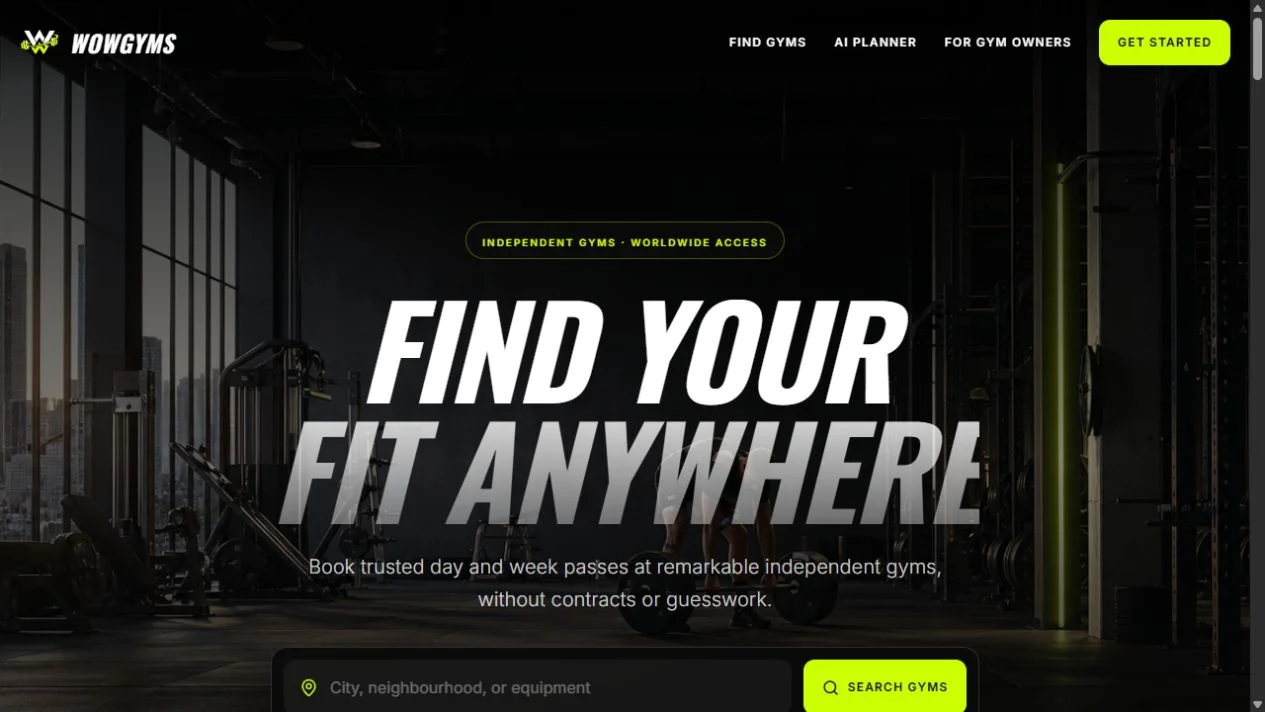
Buy WowGyms as a gym-pass marketplace software asset. Request domain and source terms, inspect booking and QR access, and separate provider plans from customer pass payments before making an offer.
WowGyms is a fitness website for sale through Codeblix, offered as an owned gym-pass marketplace foundation with its domain, application source and product documents to agree in the sale. The purchase is a digital software asset. It does not include a physical gym, a promised member base or a signed global network of venues.
The product connects gym discovery with daily or weekly passes, booking records, QR access tools and provider workspaces. Its documented source also includes platform plans, payment and payout foundations, and AI-assisted planning tools. A buyer should inspect the connected customer and provider journey before deciding what the package is worth to the business they intend to operate.
Contact the seller for the WowGyms marketplace package
Request the WowGyms source package and current sale terms on Flippa →
The WowGyms product listing links to the public preview and the current transaction. Read the user documentation and technical handover document before requesting a seller walkthrough. Use Flippa to confirm availability, price, financial representation and the included assets.
The intended buyer wants to operate a focused fitness access marketplace and can recruit or work with suitable providers. Demo gyms, example ratings and sample bookings explain the product; they do not establish real participation or commercial history. Ask Codeblix to separate the delivered software, demonstration content and any independently evidenced business assets in the offer.
Make the pass useful at the reception desk
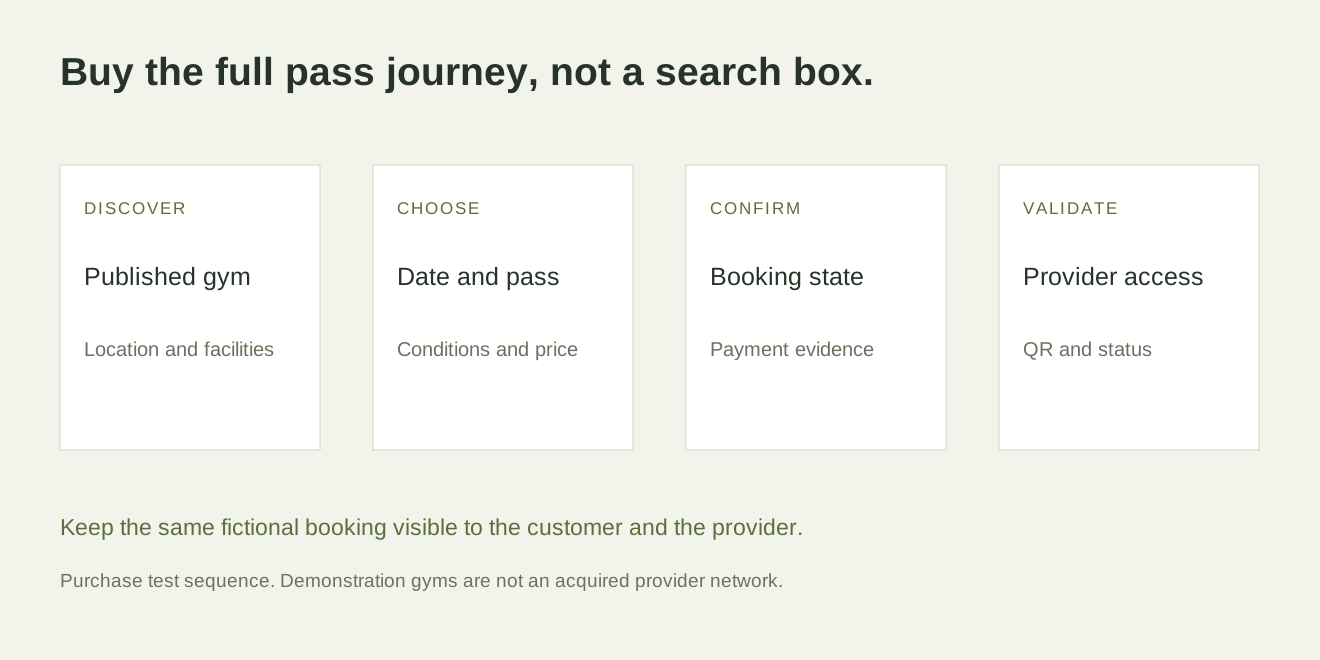
A customer may discover a venue online, choose a pass and receive a QR image. The real-world question comes later: will the gym recognise that booking and know what to do? The buyer should inspect the access procedure as carefully as the discovery page. A digital pass has limited value if staff cannot distinguish a valid booking from an expired, refunded or previously used one.
Ask the seller to show the customer booking and the provider's corresponding view. Use the same clearly labelled fictional test. Identify the pass type, the relevant date and the state that authorises access. If the product represents scan or validation tools, demonstrate the normal success path and one exception rather than looking only at the QR graphic.
Then write down the operational boundary. Venue staff may need training, a device or a documented fallback. The platform operator needs a contact route when a customer arrives with an unresolved booking. These are responsibilities the buyer will own or arrange. The source package can support the process without providing an existing venue agreement or a trained reception team.
Decide what kind of access business you intend to operate
A marketplace for short-term gym access differs from software for a single gym's long-term membership administration. It also differs from owning and staffing a fitness venue. WowGyms is relevant to the first model: discovery, provider storefronts and purchasable passes. A buyer needing payroll, equipment maintenance or a complete club-management system should name that separate scope.
Within the marketplace model, choose a first audience you can reach. Travellers may need a convenient pass near a temporary location. Local users may want flexible access without a long commitment. Independent providers may want a way to present passes to a different audience. These are possible customer propositions, not evidence of existing demand for the specific product.
The acquisition should support the offer you can actually operate. A narrower initial provider group can make onboarding and support more understandable than a broad claim of worldwide coverage. A domain and a directory interface do not create inventory rights. Ask which provider relationships, if any, are included and evidenced separately from sample data.
| Purchase | Primary operating job | What WowGyms represents |
|---|---|---|
| A physical gym business | Run premises, staff, equipment and member services. | Those physical assets and operations are not part of this software offer. |
| A gym administration system | Control one organisation's wider membership and operational work. | Do not infer a full club-management suite from pass and provider tools. |
| A gym-pass marketplace foundation | Connect customers with participating providers and support bookings. | This is the product model to inspect in the acquisition. |
Inspect a provider before treating it as available inventory
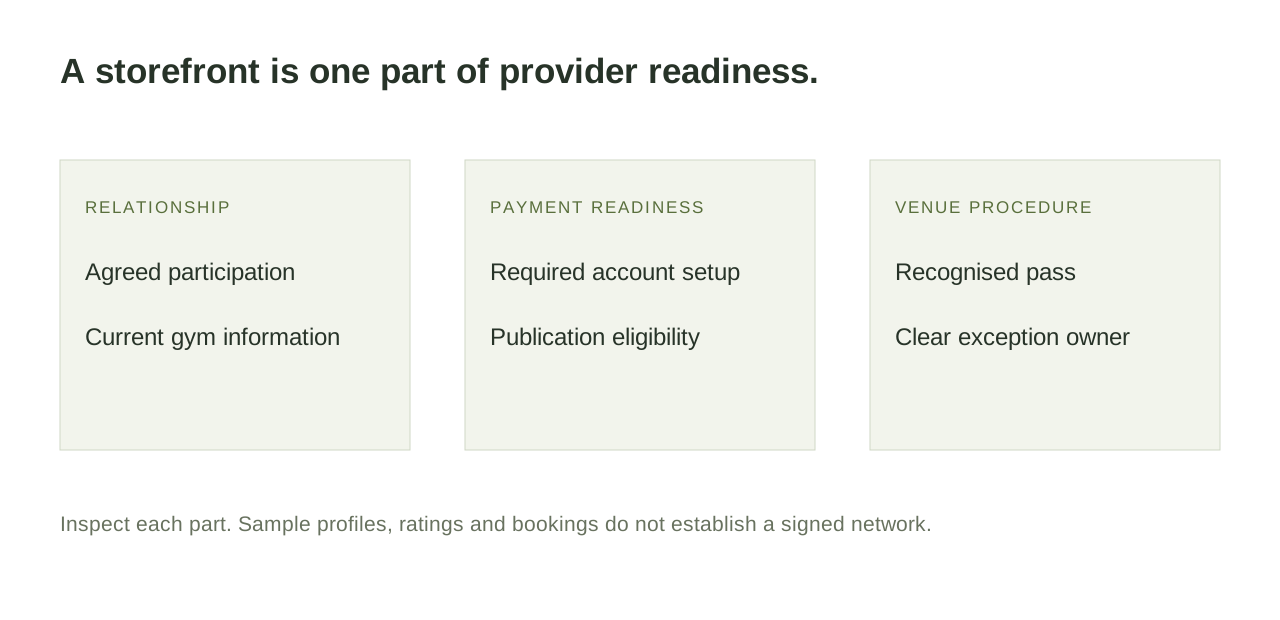
The documented provider tools include a storefront, pass management, publishing controls and payment-account onboarding. Ask the seller to demonstrate a new fictional provider from its initial profile to the point where it can legitimately publish. Identify which information is descriptive and which settings control whether a customer can book.
The current source documentation says storefront publication is gated on the relevant payment provider reporting that charges are enabled. That is a specific implementation boundary worth inspecting. It does not prove that every displayed demonstration gym has completed commercial onboarding or that live payouts have been tested. The acceptance discussion should separate the code path from real provider readiness.
Also request the buyer's process for maintaining information. Someone must keep opening information, facilities, equipment and pass conditions current. A venue relationship should establish who can make those changes and who responds when a customer reports a discrepancy. The application can store a storefront; the operator must ensure the public offer reflects the participating business.
Choose a date, then inspect every price and condition
A pass purchase depends on more than a title such as “day access”. The customer needs to understand the date, duration, conditions and price before committing. Ask the seller to show how a provider creates the available pass types and how those details appear in the customer journey. Check the ordinary path, then try an invalid or unavailable date under the seller's controlled test setup.
The source describes daily and weekly passes, price synchronisation and configurable peak pricing. A buyer should ask which settings are currently active and how a price is checked when a booking is created. Do not assume that a public card's starting price is the final total for every date. The system should make its actual behaviour and remaining configuration understandable.
Where the business needs specific conditions, write them into the offer and test plan. These might concern when a pass can be used, which facilities it includes or how the provider handles an unexpected closure. The software should not be sold as solving every physical access exception. Name the venue and platform responsibilities so the eventual customer receives a clear offer.
Two payment relationships need two sets of evidence
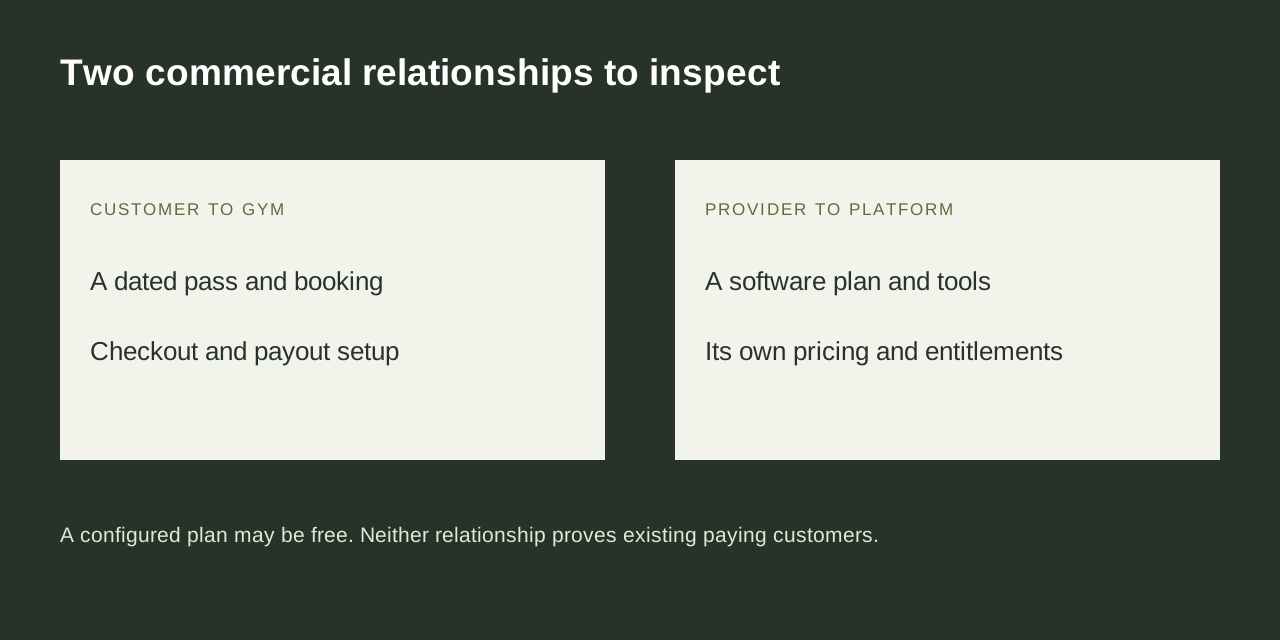
The customer pays for a gym pass through the marketplace booking flow. Separately, a provider can hold a platform software plan. Those relationships have different prices, account states and support questions. A buyer acquiring the business should be able to explain them without treating all payment activity as the same source of revenue.
The documented application includes Stripe Checkout, Connect and Billing foundations. Ask the seller to show the relevant payment and booking state in a controlled test environment, and to describe the configuration needed for buyer-owned services. A checkout redirect or a sample booking does not independently establish settlement, a successful provider payout or a complete live renewal lifecycle.
The implementation documents describe an initial provider plan that is free and editable through administration. Confirm the current configuration in the transaction. The ability to configure paid plans is an intended commercial route, not evidence that providers currently pay. Your own pricing decision should follow the delivered product and the customers you can serve, without inventing a represented subscription history.
The QR test should include an exception
A successful validation demonstrates one state. Ask what happens when the pass is presented outside its valid period, after a refund or under another booking state relevant to the implementation. The product's source includes booking records and validation tools; the buyer needs to see how those tools communicate a decision to the provider.
Do not invent an access-control hardware integration from a QR code. A provider using a browser to inspect a booking is a different setup from a gate or turnstile that reads credentials automatically. If your intended offer requires hardware, request the exact delivered integration or identify it as additional work. A clear human reception procedure may be entirely appropriate for an initial marketplace.
Retain a short record of the test: the fictional booking, its date and state, the customer view and the provider result. Explain what the operator should do when a scan fails but a customer believes they have paid. The best purchase evidence connects software states with an understandable next action rather than expecting venue staff to interpret an unexplained error.

Discuss refunds as an operating process before buying
The product includes refund-related code and booking tools. Ask the seller what the current implementation permits, which roles can act and how the booking state changes. Review any displayed policy against the actual configured behaviour. A policy page, a button and a confirmed payment-provider result are different pieces of evidence.
Use seller-authorised test data rather than creating an unnecessary live transaction. Follow the refund or cancellation case through the customer and provider views. Identify how the operator knows whether the requested action succeeded or remains unresolved. If the product requires a manual step, include it in the support procedure.
The buyer should also decide who handles exceptions such as a venue closure or an access dispute. These are real-world customer-service responsibilities. Do not assume that automated code eliminates them. Agree how the platform and provider will communicate, and avoid promising a broader service than the software and operating relationship can support.
Buy AI helpers for their demonstrated tasks
WowGyms includes documented Gemini-assisted tools for travel planning, a gym concierge and provider drafts or estimates. Ask the seller to demonstrate the task that matters to your first offer and identify the required external account. A buyer should understand how a recommendation relates to the published directory and what happens when suitable entries are unavailable.
Keep provider forecasting and campaign drafting in their proper category. A forecast is an estimate, not actual revenue. A campaign draft is text for the operator to assess, not proof that customers will return. This acquisition page does not include an earnings calculator or assume that an AI helper produces sales.
These features can remain secondary to the pass workflow. A buyer could choose to launch around clear gym discovery and booking first, then inspect and position the helpers carefully. Whatever the choice, the product offer should match the demonstrated functionality and the ongoing cost and responsibility of operating the required services.
Match the acquisition to your provider access
Before making an offer, name the people you would need to onboard. A buyer who already works with independent fitness providers has a different starting point from someone with no provider contacts. Neither situation proves success or failure. It changes the work that must be done after the software transfer.
Which provider relationship can you support first?
Use this decision to shape the seller walkthrough. You need evidence for the product you plan to operate, not a promise that every possible fitness market can be reached with the same launch.
Put support work beside the technical handover
The source foundation uses a web frontend, application backend, authentication, payment services and AI configuration. Ask for the repository and service inventory, and identify the buyer owner of each required account. The delivered instructions should let the person responsible for maintenance understand how the application is configured and updated.
The operational handover should explain the provider and booking records, the administration area and the procedure for investigating an unresolved customer issue. This is different from asking the seller to run the future business for you. Agree the scope of technical assistance and any remaining setup or minor corrections in the transaction.
- Confirm the domain, repository, documents and editable assets included.
- Assign buyer ownership of hosting, backend, authentication, payments and AI services.
- Use a fictional provider to inspect onboarding and publication eligibility.
- Follow one controlled booking through pass delivery and validation.
- Inspect a cancellation or refund exception using authorised test data.
- Record the venue-support and platform-support responsibilities.
A concrete offer names both the asset and its limits
Use one venue with two staff members in the acceptance exercise
A provider may be represented by more than one person. The owner sets up the storefront, while a receptionist handles the customer at arrival. Before buying, ask how the delivered role and account model supports the arrangement you intend to offer. Do not assume that every employee can receive a separate access level simply because the application has a provider dashboard.
Describe the intended procedure to the seller in plain language. One person needs to maintain the pass conditions; another needs to verify the booking. Ask which of those actions the current product supports and whether the same account or a different mechanism is required. If extra staff roles would be new development, keep them separate from the delivered package and decide whether the initial operating procedure is sufficient.
The test should also include a handover between shifts. The second person needs to identify the booking and understand its state without relying on a private explanation from the first. A platform can store the relevant information while the venue still needs training and a clear fallback. The buyer should know what they are promising to providers before marketing an automated reception experience.
Retain the short procedure as part of the acquisition file. It does not need to be a large operations manual. It should identify who checks the pass, what evidence they use and how an unresolved case reaches the appropriate person. That makes the product's real-world boundary visible alongside its code and screenshots.
Request a provider change after a booking has been made
Venues sometimes change their information after a customer books. Ask the seller what happens if a provider updates a pass description, changes a displayed price or pauses a storefront. Does the customer's existing booking retain the terms that were relevant when it was created? Which information appears in the provider's view? The source and walkthrough should provide an answer to the actual implemented behaviour.
A buyer should not infer a complete contract-history feature from the existence of a booking record. If your intended service requires a particular record of pass conditions, inspect it specifically. If the application instead relies on current storefront information, assess the implications with the seller and decide what additional procedure or development your launch requires.
This is a useful exception test because it joins three parts of the product: catalogue editing, booking data and customer support. A smooth initial checkout can hide the work needed when those parts no longer describe the same offer. The purchase should make that work understandable rather than leave it to the first customer complaint.
Keep participation, access and software pricing in separate documents
The relationship with a venue should state what the provider makes available and what the platform does for it. The customer-facing pass should state the access being purchased. The provider's software plan should state the platform tools or entitlements it receives. These subjects overlap operationally, but using one vague description for all three makes it harder to assess what the acquisition can support.
Ask Codeblix which editable documents or public content are included in the product package. Treat demonstration wording as a starting point for buyer configuration, not a universal answer for every provider or jurisdiction. If you need specialist commercial or legal wording, obtain it for your actual operation. The application does not turn a sample policy into an independently validated agreement.
A clear separation also helps the buyer discuss price without a revenue forecast. You can evaluate the source, required services, provider tools and support workload as delivered assets and responsibilities. You can then choose your own customer and provider offer after the transfer. Neither step requires treating sample bookings as income or a configurable plan as a proven recurring business.
Your final purchase note should describe the marketplace foundation, the demonstrated pass journey and the configuration still required. It should state whether any genuine provider relationships or customer records are included, with separate evidence for those claims. Keep sample inventory and proposed commercial routes out of that established-business column.
A useful negotiation note also names the person responsible for the first provider onboarding and the first customer support question. That might be the buyer, an employee or an agreed partner. If nobody is assigned, an otherwise attractive source package can arrive without anyone prepared to operate its most important workflow. The software seller can explain the delivered tools; the buyer still has to organise the business around them.
Ask that person to repeat the controlled booking exercise from the documents. They should be able to find the provider, choose the pass, understand the booking state and explain the reception procedure. Keep any configuration or access problem visible in the handover notes. A repeatable small test is a more useful acceptance artifact than a broad statement that the marketplace is ready for every city and venue.
Make an offer when the package and its remaining work are specific enough to discuss. You do not need a speculative forecast of memberships, pass sales or provider subscriptions. You need an understood asset list, a verified product journey and a practical owner for the work after the sale. Those are the terms that make this fitness software purchase concrete.
Bring unresolved questions to Codeblix before making the offer. A missing requirement may be manageable when its scope, cost and owner are clear. It is harder to assess when it is hidden inside phrases such as “automatic income” or “global network”. The purpose of this purchase page is to make a specific software acquisition reviewable without using those shortcuts.
WowGyms evidence to request
Contact Codeblix on Flippa to request the WowGyms purchase package. Compare other online businesses for sale if you want a different provider relationship or software model. Make the offer against the scope and evidence you can actually use.
Explore the products discussed
Explore related acquisition offers