
Buy a guest-service booking app for your hospitality business
Acquire an independent rental or gym-pass channel around a guest promise you can support.
A worked acquisition case for a guesthouse operator choosing FunRideBikes or WowGyms around arrival changes, provider entitlement and front-desk support. Request one individual asset.
Buy a guest-facing booking application when you want to own a digital service around the visitors your hospitality business already serves. Codeblix's FunRideBikes and WowGyms offers provide separate foundations for bicycle rentals and gym passes. The useful purchase question is which guest promise you can support with the application, your staff and the providers you actually arrange.
This is a worked buying case for an existing guesthouse operator. The guesthouse, guests and service conditions below are illustrative, not customers or relationships included in either sale. The buyer is considering one independent software asset. Neither offer supplies a hotel-management integration, a rental fleet, an established venue network or a combined accommodation-and-activity booking.
Request the guest-service asset you intend to operate
- Request the FunRideBikes domain and rental application package for an independent guest offer built around bikes, rental dates and the rental provider's handover.
- Contact Codeblix about acquiring WowGyms for an independent gym-pass offer built around dated access and the participating venue's validation procedure.
Each listing has its own current price, availability, financial representation and transaction terms. Tell the seller that you are evaluating the application for a guest-service channel attached to your existing operation, then ask for the corresponding product documents and a controlled walkthrough. Do not describe the request as buying a ready-made local activity network.
The authoritative FunRideBikes and WowGyms pages provide the individual package boundaries. The broader provider-booking acquisition case owns the general reservation-object and provider-chain decision. Here the central issue is the guest arrival, support and service promise that a hospitality buyer would put around one of those assets.
Start with the visitor who arrives after your activity plan has changed
Imagine an independent guesthouse whose front desk already answers questions about nearby exercise and cycling. A fictional guest expects to arrive on Saturday afternoon and leave on Sunday morning. The operator wants to offer an owned digital route to a useful local service. The challenge is not to put a generic booking button beside the room confirmation. It is to make a promise that remains understandable when the arrival time or provider's circumstances change.
In one illustrative path, the guest wants a bicycle during a defined rental period. The operator needs a real provider arrangement concerning collection, return and the selected period. In another, the guest wants access to a participating gym at a useful time. The operator needs a venue arrangement concerning the pass, its conditions and who checks it. Those arrangements are buyer responsibilities; the software sale does not establish them.
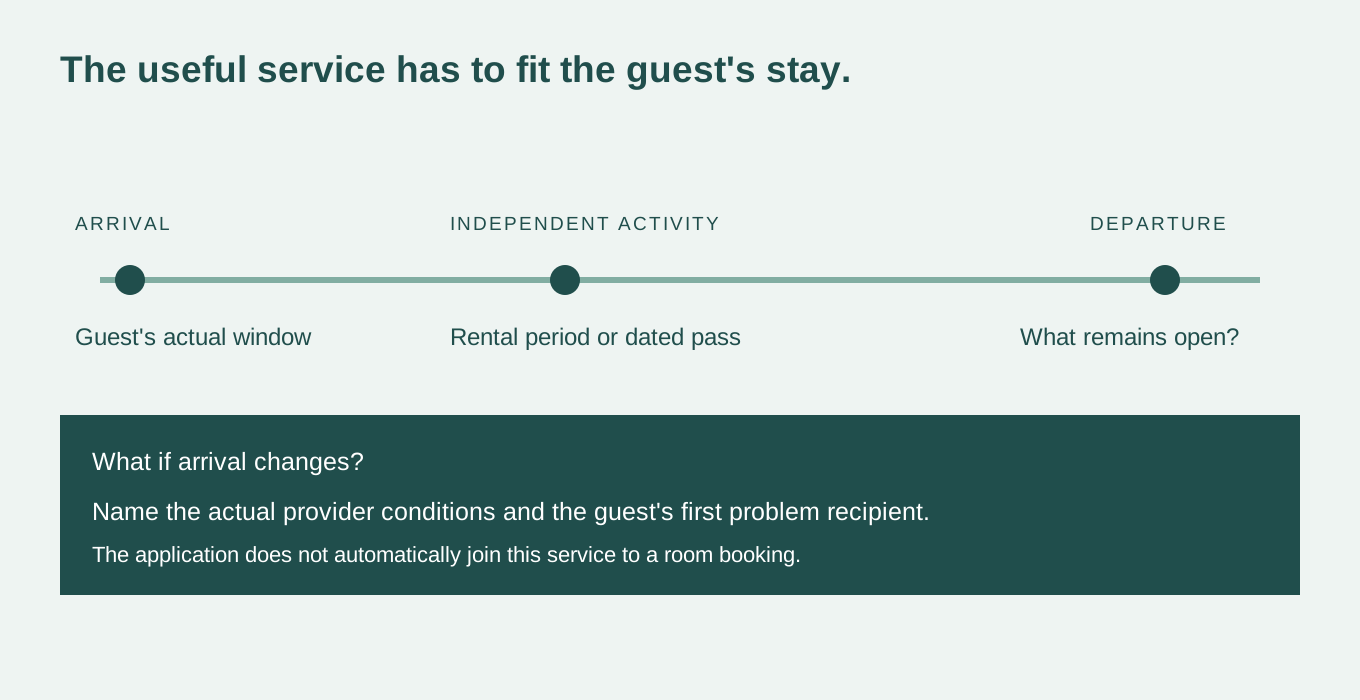
Now move the guest's arrival later. Will the proposed service still be useful? Who answers if the provider cannot fulfil the original plan? The answer might involve a supported application change, a manual conversation or an offer the operator decides not to sell. That is the buying decision: choose an application around a guest promise you can actually own, rather than assume the application supplies every local service condition.
Give the accommodation and activity promises separate names
The buyer may already control a room-booking process, guest messages and front-desk procedures. Buying a second application does not automatically join it to those systems. The guest should be able to understand when they are considering an independent activity purchase and which party is responsible for that service. Do not market a combined package unless the actual commercial and operating arrangement has been separately established.
| Guest-facing promise | Who must define it in this buying case? | What the software purchase does not establish |
|---|---|---|
| The accommodation stay and its communications. | The existing hospitality operator through its own arrangements. | A connection to a hotel reservation system or a shared guest account. |
| The bicycle rental period, pickup and return. | The buyer and the actual rental provider, supported by the selected application's delivered records. | A transferred fleet, an available bike or a staffed pickup point. |
| The gym pass and venue's admission procedure. | The buyer and the participating venue, using the delivered pass and validation workflow. | A signed venue network or automatic turnstile integration. |
| A late arrival, cancellation or service exception. | A named operator and provider procedure, consistent with demonstrated software behaviour. | That a room change automatically updates or settles the activity. |
This separation can make the service easier for guests to use. A clear independent activity page is better than wording that appears to include an entitlement in the room price when it does not. The buyer should choose what to offer and confirm the arrangement; this article is not a statement that the current products already implement a hotel package or referral scheme.
Buy the cycling channel only if the handover suits your guest window
FunRideBikes is relevant when the intended guest offer is a bicycle rental. Its source-backed foundation includes bike listings, rental discovery, dates and booking workflows. Its demonstration search shows sample inventory. A displayed bicycle is not proof that a particular guesthouse can obtain that bicycle locally or that the provider will accept a late pickup.
For this buyer, request a seller demonstration around a fictional guest with a particular rental period. Follow the ordinary catalogue and date controls into the relevant booking record. Ask what the customer sees about the selected period and the provider. Keep the actual collection and return procedure in the buyer's provider arrangement unless the demonstrated application explicitly supplies part of it.
For the worked operator, the first introduction can be a clear link in its ordinary guest information. The activity then has its own product page and booking route. Ask the seller to run that route from the linked catalogue through the relevant record, so the owner can write a useful arrival instruction around the delivered application.
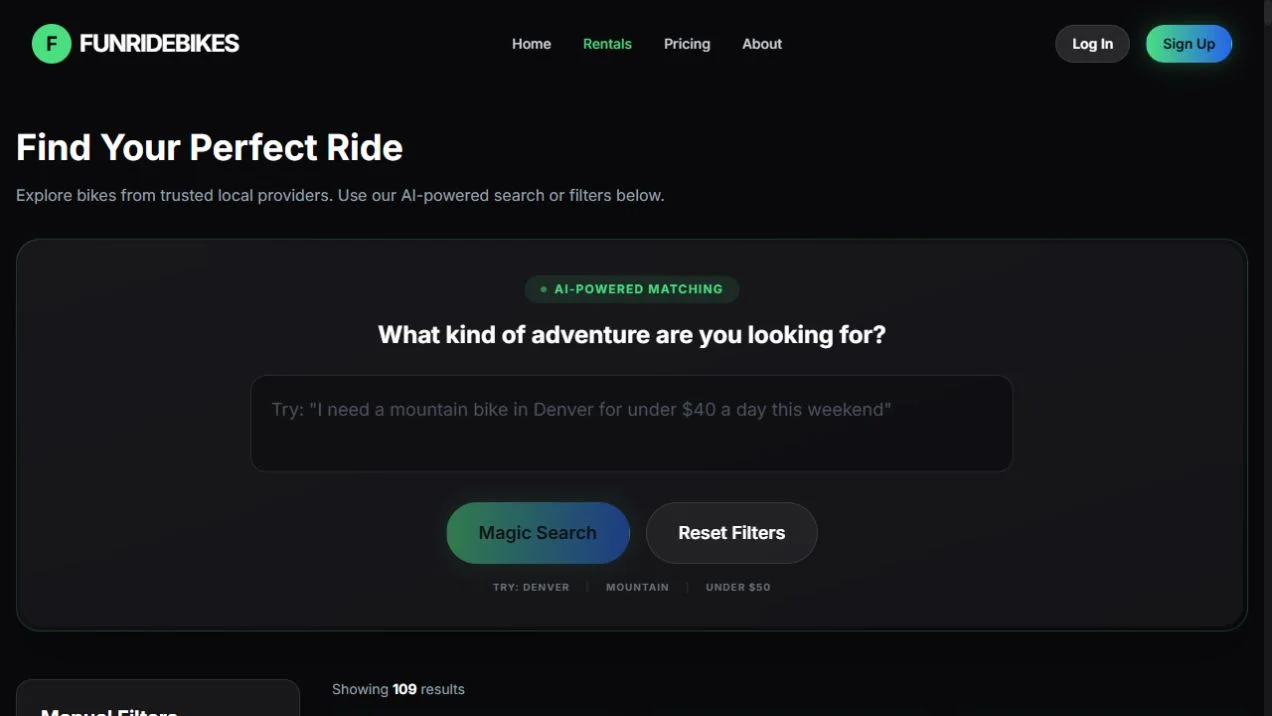
FunRideBikes also has Gemini-assisted search interpretation. Use the ordinary catalogue and date controls in the first guest exercise, then inspect the helper as another discovery route. This gives the buyer a practical way to explain the product to a guest: find the relevant rental, inspect the provider information and follow the selected booking path.
Buy the gym-pass channel only if a venue will recognise the pass
WowGyms is relevant when the proposed guest service is gym access through a participating venue. Its foundation includes provider storefronts, pass offers, booking and QR validation. The buyer must still establish the actual venue relationship and the conditions under which the guest will be admitted. Demonstration venues are not a transferred commercial network.
Use a fictional pass purchase for a guest who has a limited window before departure. Ask the seller to show the booking, the guest's access information and the venue-side validation. The operator can prepare a short venue instruction from that demonstration, naming the actual staff procedure that will recognise the pass.
Provider payment readiness is a separate current condition. WowGyms uses a publication gate tied to the required payment readiness, and demonstration payment references must not be mistaken for activated commercial accounts. The buyer should inspect the actual configuration and handoff for the chosen package without claiming that the guesthouse already has live settlement or a signed venue simply because the demo can show a pass.

Write the front-desk answer before promising the new service
The front desk is likely to receive a guest's first practical question. Write a short answer that names the independent service, how the guest proceeds and where a problem goes. It should fit the product and the buyer's actual provider arrangement. Avoid an answer that implies an activity is included in accommodation when the guest is making a separate purchase.
For the cycling example, the answer may need to identify the provider's collection instructions and the rental period. For the gym example, it may need to identify the selected venue, the pass date and the validation procedure. Do not invent fields or automation that the application lacks. Ask the seller which information is delivered through the product and decide what the operator must communicate separately.
Now ask a person who did not attend the seller walkthrough to read the answer. Can they distinguish the room booking from the activity? Can they identify who is responsible for the bicycle or access? Do they know which operator to contact? If the answer depends on explaining a private demo script, refine the service promise before buying an application around it.
Rehearse the arrival change with one named support recipient
Return to the hypothetical guest arriving later than expected. Work through the selected application and the agreed provider procedure using controlled data. Which facts change in the room process, which facts belong to the activity record, and which person must act? A change to one system should not be described as changing the other unless an actual supported connection has been demonstrated.
The application may support a relevant change, cancellation or refund path, or the case may need an operator decision. Ask the seller to show the exact behaviour that determines your purchase. If the current implementation does not supply the change you require, decide whether a manual process is acceptable or separate work is necessary. Do not turn “we will handle it” into a claim of built-in automation.
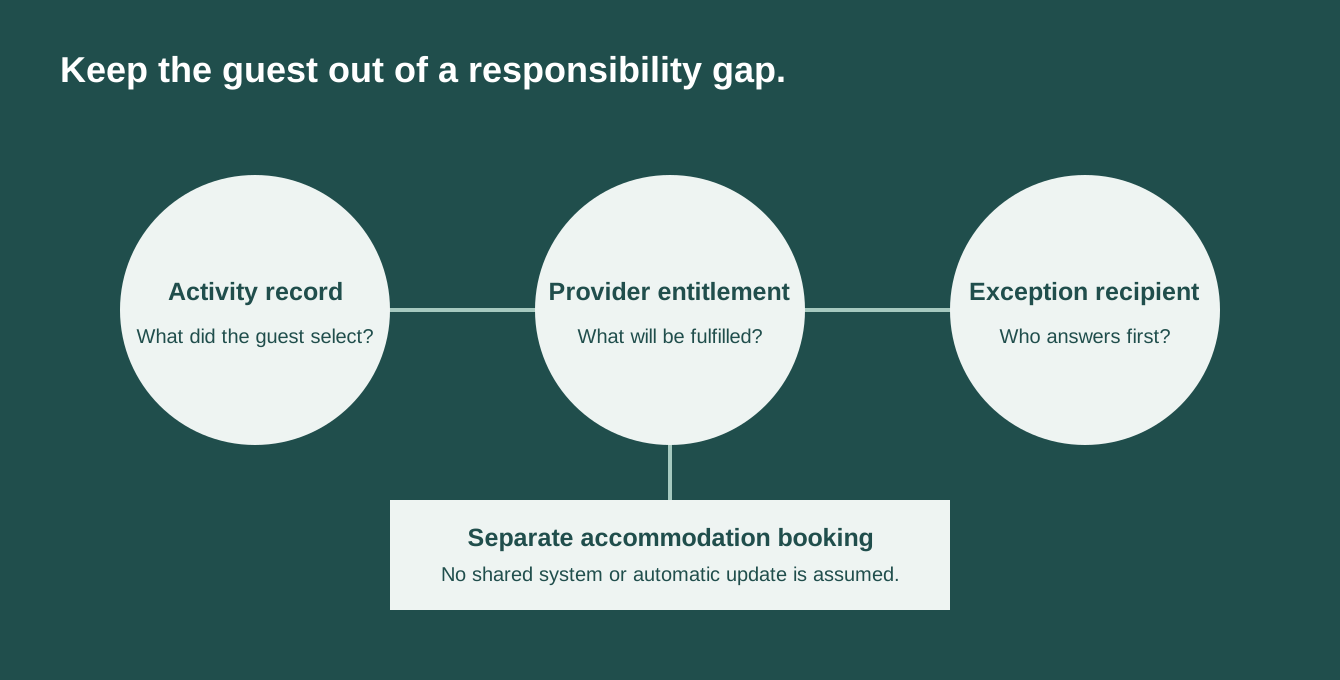
Name the first recipient for the guest's problem. If the front desk receives it, what information should staff obtain? If the provider receives it, what does the guesthouse need to explain? The buyer's support arrangement should not leave the guest passing between two parties who each think the other owns the issue.
Select the guest promise your existing operation can support
Which independent service can you explain to a departing guest?
The tool does not recommend that every guesthouse buy either product. It identifies the acquisition conversation that follows from a specific guest promise. If neither promise fits your operation, a different asset or no purchase can be the right outcome.
Decide what the hotel brand adds without pretending the software adds it
An existing hospitality operator may bring local knowledge, a front-desk relationship and a way to introduce guests to the independent service. Those are potential contributions of the hypothetical buyer, not included assets from the seller. Write them as buyer assumptions that need to be true for this case, rather than as evidence of what a stranger buying the same source code will receive.
For the first service, the buyer can bring its own local provider conversation and an ordinary guest-information process. The acquisition exercise joins those inputs to one application journey. The owner should be able to tell the seller which provider arrangement they are preparing and which guest question they want the product to answer.
A focused public activity page is a practical first channel. The owner can describe it clearly, the guest can choose whether to use it and the provider can understand the selected entitlement. Keep additional connections in a separately agreed scope while the first independent service is being evaluated.
Give the next shift the same service boundary
Give the next shift an ordinary instruction with the relevant activity reference and provider contact. The staff member should be able to identify what the guest selected, explain the next step and find the named recipient for an exception. Build that instruction around the access and records demonstrated in the selected application.
Use two fictional enquiries in the rehearsal. One guest asks how to access a pass they selected; another asks to change a rental after a late arrival. Have staff identify the product involved and the correct escalation. The aim is to test the buyer's operating procedure around the delivered software, not to invent an unseen support console.
If the desired staffing model requires new permissions, a shared support inbox or integration with an existing front-desk platform, record that requirement. The seller can clarify the delivered access model. The buyer can then decide whether the existing package is sufficient, whether agreed changes are needed or whether the service is too complicated for the intended operation.
Set purchase conditions around one real guest-service channel
The offer should name one asset and one guest-service outcome. Ask for the individual domain, source package and relevant documents, then identify the demonstrated journey that matters to this case. Keep the application's delivered behaviour separate from your own provider relationships, guest communications and support obligations.
An illustrative purchase condition might say that the buyer needs to inspect a dated pass through guest access and venue validation, with the current payment-readiness condition understood. Another might concern a rental record for a selected period and the provider information needed to arrange handover. These are different from a request for a generic booking platform with every possible hotel integration.
The offer can name a small, deliverable starting point: one independent activity route, one provider arrangement and a front-desk instruction the buyer can run. Include any essential additional work expressly. This keeps the negotiation tied to a guest service with a clear operating owner.
- Choose the independent service a guest can actually use within their stay.
- Name the real provider arrangement you will bring or establish.
- Inspect the corresponding customer record and provider entitlement.
- Rehearse a changed arrival through the software and your operating procedure.
- Write a front-desk answer and identify the first problem recipient.
- Make the offer against the individual delivered package and any expressly agreed additional work.
Introduce the independent activity in a useful arrival message
An illustrative arrival message could say: “If you would like to arrange a bicycle rental, this independent service page explains the available offer and its booking route. Your activity selection is separate from your room stay. Contact the front desk if you need help finding the provider's instructions.” The owner would adapt that wording to the real arrangement and demonstrated product.
Read the message beside the activity page during the seller walkthrough. The guest should move from a clear introduction to a clear product. Once they complete the relevant path, the activity's own record supplies the information staff use. This gives the buyer a concrete communication asset to prepare around the application.
For the pass version, the message should point to the selected venue and access product instead. The buyer can ask the seller to follow the same journey as a new visitor, then write the final wording from what is actually shown. A small amount of clear guest information can make the first service easier to operate.
Let the guest finish the service after the accommodation relationship changes
Consider another illustrative case: the guest checks out while a question about their rental or pass remains unresolved. Decide which contact they should use and what the former front-desk shift can still explain. The activity's responsibility should not disappear merely because the room stay has ended.
Ask the seller to show the customer information and access relevant to the selected asset. Keep the provider arrangement beside it. The buyer needs enough clarity to tell the guest how to reach the right operator, without assuming that the hotel can access every provider action or refund every separate transaction. Those permissions and payment responsibilities should be inspected, not invented.
The outcome may be a simple written contact procedure, provided it is consistent with the product and actual arrangement. A small hospitality buyer does not need to promise an enterprise concierge system to own a focused independent service. They do need to avoid a support gap that becomes obvious only after a guest has left.
Take one timed guest example to the seller
For illustration only, suppose a guest plans to arrive on Saturday at 16:30 and leave on Sunday at 11:00. The buyer's hypothetical rental provider agrees separately to a Sunday collection at 08:00 and return at 10:00. Those times are conditions of the worked provider arrangement, not a claim that FunRideBikes supplies hourly slots. The seller demonstrates the supported date and rental record; the operator prepares the collection instruction around it.
Now the guest reports that they will arrive on Sunday at 09:30. The front desk sends the question to the named rental contact, who decides whether the actual service can change. The operator checks the activity record and communicates the agreed next step. If a booking change is needed, the seller's walkthrough should establish the current control or required manual process. The buyer can see exactly which part belongs to the software and which part belongs to the provider.
For the alternative pass case, suppose a hypothetical participating venue permits the relevant access during the guest's remaining morning. The operator asks the seller to demonstrate a pass for the selected date, the information the guest receives and the venue's validation route. The venue's actual opening conditions are confirmed separately. The buyer can then compare which independent service it can explain and support within this guest window.
Use the example as a purchase attachment. It gives the seller a concrete journey to demonstrate and gives the hospitality owner a practical basis for choosing one asset. The next step is to request that individual source-and-domain package with the provider conditions and any essential additional work stated clearly.
Acquire the channel after the guest promise is understandable
The case for buying is strongest when the operator can explain what they want to own: an independent rental or gym-pass channel that serves their existing hospitality operation. That is a concrete purchase purpose. It does not require claiming that the seller supplies guests, local providers, accommodation integrations or guaranteed activity income.
Before making the offer, repeat the late-arrival question. Does the proposed service still have a clear entitlement, a responsible provider and a person who can answer the guest? If that answer is unresolved, keep it visible in the acquisition discussion. A useful application can support a well-defined service; it cannot make an undefined local promise true by itself.
Request the current FunRideBikes or WowGyms package with your guest scenario attached. For a wider purchase shortlist, browse the online business collection. Choose the asset whose delivered job fits the service your operation is prepared to provide.
Explore the products discussed
Explore related acquisition offers