
Buy a webinar website for your training company's free introductions
Request WebinarTo around one public invitation, a learner's place and your own teaching delivery.
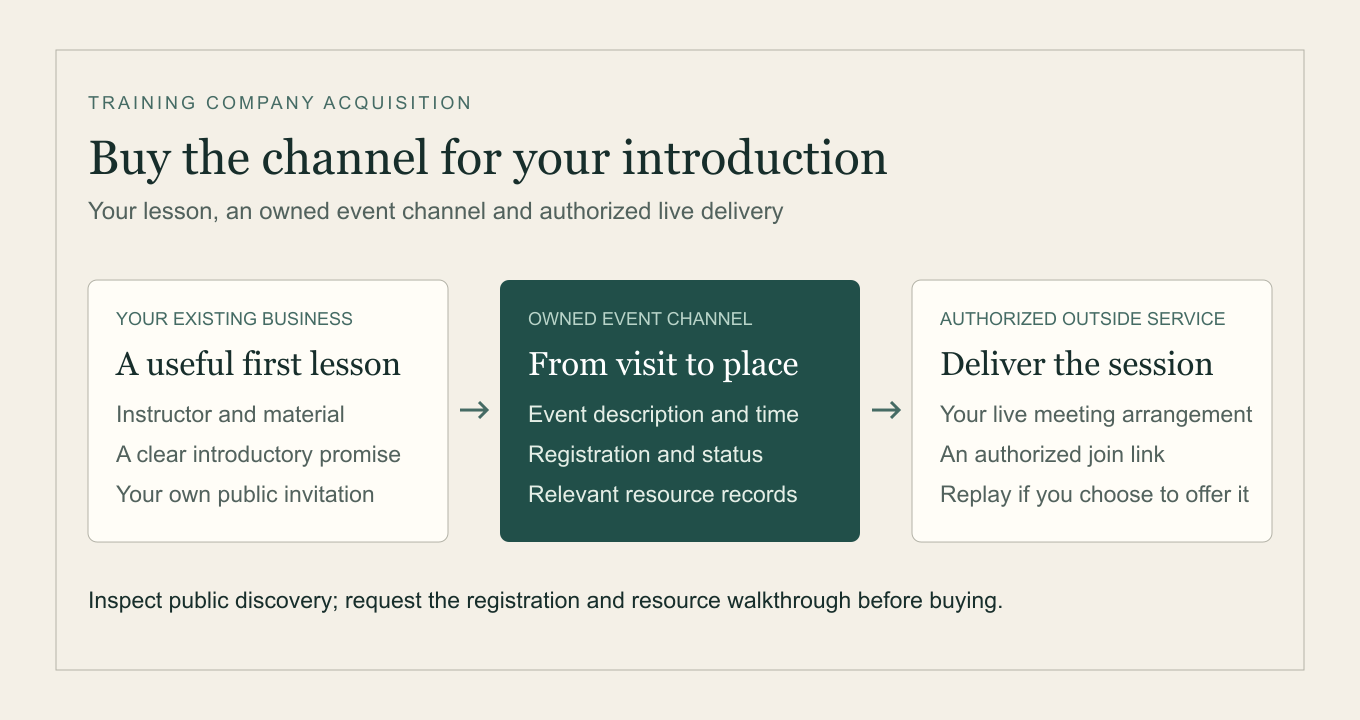
Acquire an owned introductory-event channel for an existing training company. Inspect WebinarTo's public event discovery and request the registration, waiting and resource workflows around your own free introduction.
Buy a webinar website when your existing training company wants to own the invitation, registration and resource channel for its own free introductory events. WebinarTo is an available application-and-domain acquisition to discuss with Codeblix. Bring a specific introductory session to the purchase conversation so the proposed asset serves a clear job.
This case uses a fictional training provider that already owns its teaching material, instructor arrangements and customer communication. It wants prospective learners to understand an open event, request a place and find the relevant session resources. The software purchase supplies a product foundation to evaluate alongside that existing work.
Request the acquisition around your first public introduction
Contact Codeblix for the current WebinarTo website, source and domain acquisition package. Describe the free introductory event your company would run, the learner's registration journey and the external service you intend to use for live delivery.
The public event directory currently renders event cards and discovery controls. Inspect the public invitation context, then request a seller-led walkthrough of the training company's proposed registration, delivery-link and resource tasks. The public interface check is separate from signed-in registration and payment testing. Visible sample events do not establish an included learner audience or commercial event operation.
The WebinarTo asset page and individual directory and host-software offer remain the authoritative product owners. Price, availability, represented financials and transfer terms belong to the current Flippa listing. This worked purchase case centres the training company's own public introductory-event channel.
Offer one useful preview of the teaching you already provide
Imagine the fictional Northfield Training company offers workplace learning through its existing business. It proposes a free introductory session called “Build a clear weekly work plan.” The instructor will demonstrate one practical exercise and answer ordinary questions about using it. That small promise can stand on its own for someone who has never bought a course.
Write the invitation from the learner's perspective. What will they attempt during the session? What should they bring? Who will deliver it? A concise outcome might be to identify a few priorities and leave with a draft weekly plan. These are Northfield's illustrative teaching choices, not educational outcomes guaranteed by the software.
This gives the acquisition a concrete purpose. Northfield is buying a channel for explaining and organizing that introduction, rather than buying an existing student base or an entire course-delivery institution. Its own instructor, lesson material and public invitation make the channel meaningful.
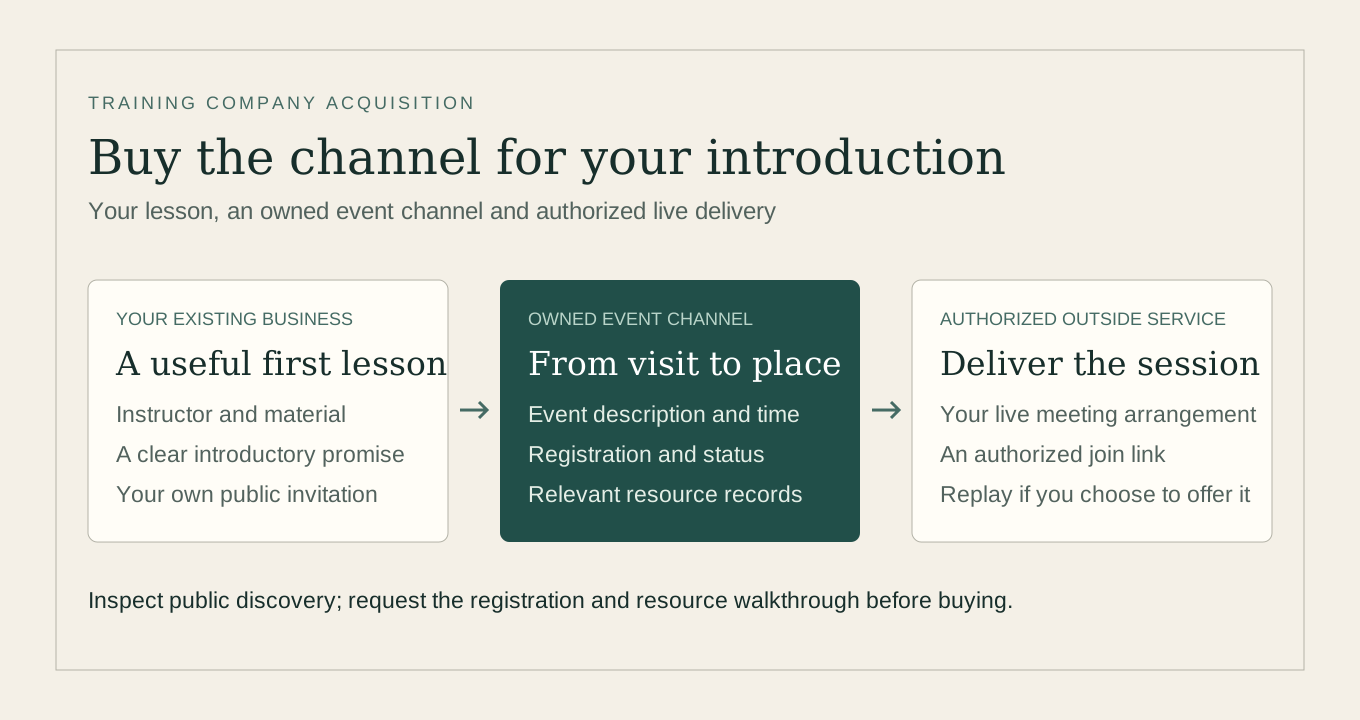
Let the invitation answer the visitor's first four questions
WebinarTo's documented event basics include a title, short and long descriptions, topic, language, level and learning outcomes. Use those fields to make the first event understandable before a learner creates an account. The public experience should explain what the event is, who it suits, when it happens and what registration means.
For Northfield's example, the description can identify the intended introductory level and the simple work-planning exercise. The language field should match the actual delivery. The learning outcomes can describe the planned exercise without presenting the session as an accredited qualification.
Ask the seller to show where those choices are authored, how they appear after publishing and how an ordinary correction reaches the visitor. A useful event page brings the company's offer into focus. The buyer can judge the product through a real publishing task instead of relying on the appearance of a generic event card.
Translate the instructor's appointment into one clear session record
The source supports sessions with a label, start and end times, a join URL and a visibility setting. Event settings include a timezone. For the purchase demonstration, choose a future fictional appointment and have the seller show the event information from both the organizer and learner views.
Suppose Northfield proposes a 45-minute introduction. The instructor needs a preparation window and an authorized external meeting service that can support the intended attendance. The displayed event time and the meeting service's appointment must describe the same actual session. The software records one part of that arrangement; the operator checks the whole promise.
Use a learner in another timezone as a practical reading exercise. Ask what time they understand, what they see after registration and where they find a correction. This is a better acquisition question than asking whether the product is merely “global.” The buyer needs an event that a person can attend at the right time.
Choose the size of the invitation before opening registration
Capacity is part of the offer, not simply a large number to place on a page. The training company should choose a first event size that its instructor and external delivery arrangement can handle. WebinarTo documents capacity settings and plan-linked limits; inspect the current controls and the organizer plan required for your intended use.
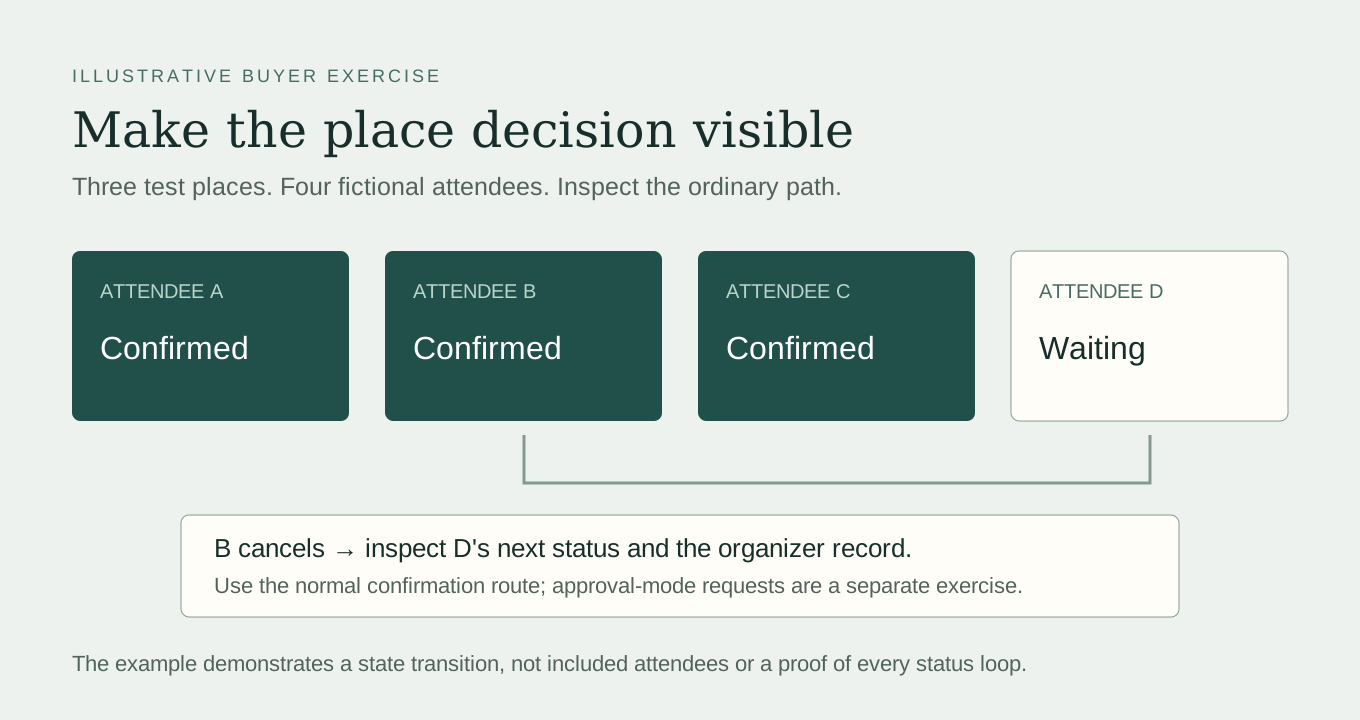
For a compact seller exercise, set a fictional capacity of three confirmed places. The small number makes the transition visible without needing a room of real participants. It is a test configuration, not a recommended commercial audience size or a claim about included attendees.
Distinguish the application registration capacity from the external meeting service's own access policy. The buyer should understand both before writing the invitation. An event record that accepts a place does not by itself alter another provider's meeting limit or guarantee that a learner can enter that service.
| Northfield's promise | Acquisition exercise | Buyer decision |
|---|---|---|
| A clear free introduction | Publish the title, learner level and two concrete outcomes | Can a new visitor understand the offer? |
| A limited event place | Use a small capacity and inspect ordinary overflow | Can staff explain confirmed versus waiting? |
| An accessible live session | Demonstrate the authorized external join route | Does the delivery arrangement fit the invitation? |
| Relevant follow-up material | Inspect a resource and its intended visibility | Who can find the promised material? |
| A separate next learning offer | Explain the company's existing contact route | Is the next commercial conversation clear? |
Watch a person receive a place rather than count a click
The documented registration path uses an authenticated attendee, the event's current published terms and required field checks. It records a registration status against the event. Ask the seller to demonstrate the first fictional learner from the public invitation through the resulting attendee record.
Northfield should read the actual consent statement and decide which details the introductory event genuinely needs. The source includes registration fields and a published consent version. A buyer can inspect those controls without treating every possible contact detail as necessary for a free session.
The distinction matters for the company's next action. A person has asked to attend a named introduction. Staff need to understand what that person agreed to and which record explains it. The purchase should leave Northfield able to describe that ordinary relationship in its own plain language.
Rehearse one overflow and one ordinary cancellation
Continue the fictional three-place exercise with four attendee accounts. With the normal confirmation route selected, inspect the first three confirmed registrations and the fourth waiting registration. The source includes a waitlist record and a cancellation path that can promote the next unpromoted entry.
Then have one confirmed attendee cancel through the demonstrated path and inspect the next waiting attendee's status. Record what the attendee view and organizer view actually show. This is an ordinary purchase exercise to observe, rather than a claim that every unusual sequence or repeated status change has been proven.
Northfield's staff can use the result to write a short response for someone asking whether they have a place. They should distinguish confirmed attendance entitlement, a waiting position and a cancelled request. The customer promise becomes understandable because the operator has seen the relevant records change.
Decide whether requests should be immediate or pending
WebinarTo's registration source distinguishes an approval-mode path from ordinary automatic confirmation and overflow. In approval mode, a new registration is recorded as pending. Northfield should decide which route fits the introductory offer before telling visitors what the registration button means.
A straightforward open introduction may call for the normal confirmation route. A different event could require staff to examine a request first. The invitation and staff response must match the chosen behavior. Demonstrate the intended route explicitly instead of mixing pending requests with an assumed immediate seat.
For acquisition purposes, the important outcome is a consistent learner explanation. Ask the seller to show the selected mode, a new registration and the organizer's relevant control. If the buyer's intended approval process needs more than the delivered path, place that additional scope in the transaction conversation.
Which introductory-event promise would your company buy this channel to make?
Make the outside meeting a visible handoff
WebinarTo does not stream video or sell event tickets. Organizers supply authorized live or replay links. That boundary fits Northfield's case when the company already knows how it will teach the introductory session and wants to own the surrounding discovery and event work.
The source controls the session join URL shown to confirmed registrants near the session start. Ask the seller to demonstrate the relevant event state and attendee view with an authorized test link. Then inspect the external service separately: the company must be able to deliver the session it advertises there.
During the walkthrough, read the handoff as a learner. Is it clear that the session opens in another service? What should a person do if they need help? Northfield can prepare its own concise instruction using the actual demonstrated route. It need not describe the purchased website as a video platform to give the learner a coherent experience.
Assign the worksheet a place in the learner's journey
The package includes resources with titles, URLs and visibility settings. For this example, Northfield can use its own weekly-planning worksheet. The buyer should have the rights to that material and supply a stable authorized link for the seller's demonstration.
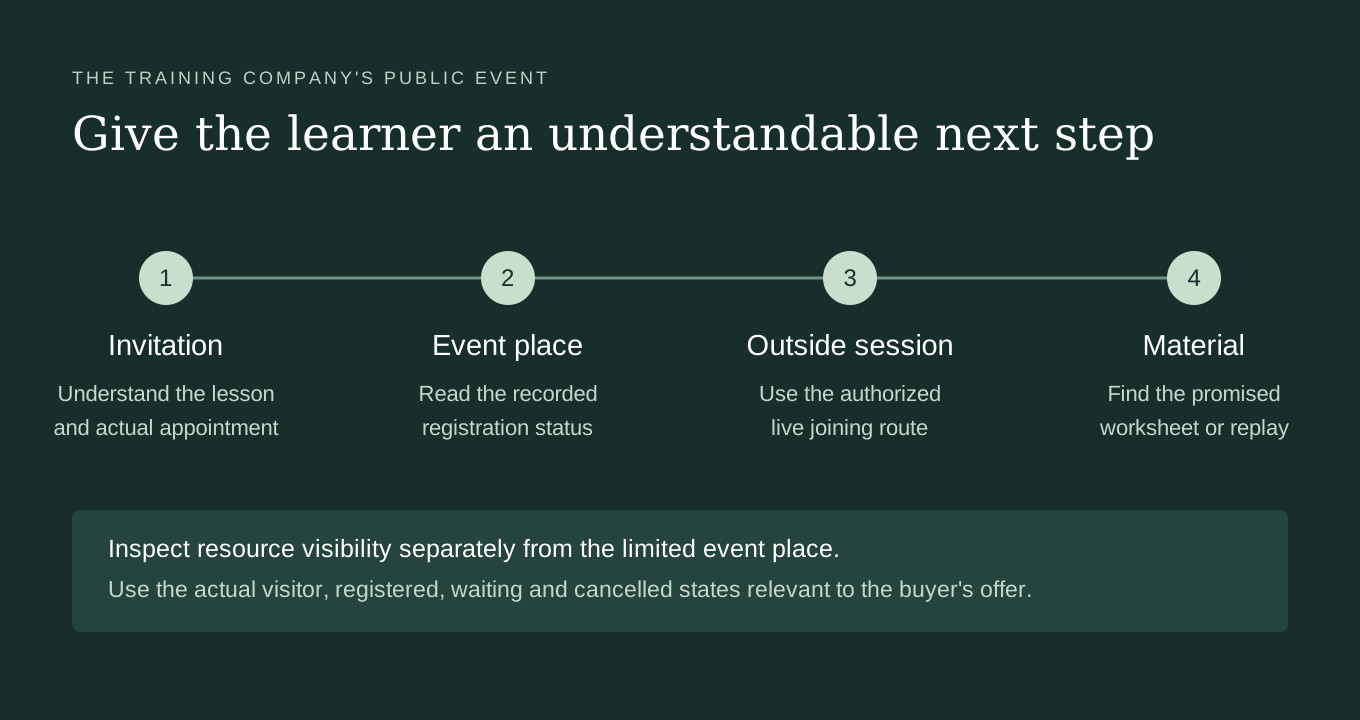
Ask where the worksheet appears to a visitor, a registrant and the organizer. The resource and event-room source have their own visibility behavior, so a limited event place should not be treated as proof of a particular resource access policy. Inspect the states that matter to the intended offer, including a waiting or cancelled registration if the worksheet is promised only to certain people.
The result should be a clear sentence Northfield can stand behind: what material is available, where a learner finds it and what registration state the actual product uses. That is a tangible purchase outcome, unlike a broad assertion that the website somehow manages an entire learning relationship.
Prepare the organizer for a learner who misses the session
People can register for a free introduction and later be unavailable. Northfield should decide what it will offer them before publishing. The source supports an authorized replay URL, optional availability dates and visibility settings. The company can inspect that route if it intends to provide a replay.
The replay is an external recording the organizer is entitled to share. Northfield must arrange the recording and any necessary permissions through its existing teaching and delivery process. Ask the seller to show how the replay record, timing and learner-facing link work with a fictional example.
Alternatively, the company may promise only the live session and a worksheet. Either offer can be explained clearly. The buyer should purchase against the promise it actually wants to operate, then use the corresponding demonstrated controls rather than collect features that have no role in its introduction.
Give the instructor a manageable question exercise
WebinarTo documents questions, moderation and polls in its event workspace. Northfield can ask the seller to demonstrate one short practice question and the organizer's view of it. This shows where the instructor or an assigned event operator can see and manage the relevant event work.
For the weekly-planning example, a fictional learner might ask how to choose between two priorities. The instructor supplies the teaching response. The software provides the documented question workflow; it does not supply professional judgment or turn that response into an assessed course outcome.
A small interaction is enough for a useful buying test. One visible question, one organizer action and one learner-facing result are more informative than a page full of sample engagement counts. Northfield can then decide whether that workflow belongs in its first event or whether the outside delivery service will handle the discussion.
Let an unfamiliar learner judge the invitation
Ask someone playing a fictional first-time visitor to read Northfield's event description without hearing the instructor explain it. Have them say what they expect to do, what preparation they think is required and whether the introduction appears suitable for them. This is a reading exercise for the buyer's own proposed content.
If the person expects a complete course or a professional certificate, revise the invitation in the demonstrated authoring workflow. The acquisition gives Northfield a product through which it can state a clear offer. The operator still chooses the words that make that offer understandable to an unfamiliar prospective learner.
Answer the waiting learner's worksheet question concretely
One fictional waiting attendee asks whether they can still use the planning worksheet. Northfield can choose its intended answer, then compare it with the actual resource behavior shown in the walkthrough. The test connects an ordinary customer question to the relevant application state.
If the company wants the worksheet to be broadly useful, an available public resource may fit its introductory purpose. If it requires a narrower audience, inspect that exact requirement before agreeing scope. The buyer's answer should follow the delivered behavior it has accepted, rather than infer resource access from the word “waitlisted.”
Read the session link back with the person delivering it
Before the fictional event opens, the instructor and event operator can compare the authorized external meeting appointment with the event record. Read the title, actual time and intended joining instruction together. Then have a confirmed test attendee inspect the demonstrated learner route at the appropriate event state.
This small rehearsal shows whether the company has assigned the handoff clearly. The instructor owns the lesson and outside delivery arrangement; the event operator owns the accuracy of the invitation and relevant record. Those two responsibilities meet at a specific learner action that the buyer can inspect before purchase.
Leave the free event with an honest next commercial step
The training company may hope an introduction helps prospective learners understand its wider services. That is its own commercial purpose, not a promised conversion rate or included buyer list. Keep the event invitation useful even when a person does not purchase anything afterward.
Northfield can prepare a clear existing contact route for questions about its separately delivered training. Staff should explain the next offer accurately and use participant information according to the actual event consent and the company's chosen process. Automatic email sequences or course sales are separate requirements unless specifically demonstrated and agreed.
This makes the acquisition outcome precise: the company owns a free-event product channel and operates it using its own teaching, authorized delivery and customer communication. The value to examine is that defined operating capability, with any additional work priced and accepted separately.
Write the first event operator's short run sheet
For the illustrative Northfield event, prepare a one-page run sheet that follows the learner's actual route. The instructor does not need a long software manual during a live introduction. An operator needs to know which published event is correct, where the confirmed registrations are and which outside session link will be used.
- Before opening: read the published title, outcomes, timezone and registration explanation.
- Before delivery: inspect the intended attendee states and authorized meeting arrangement.
- During the introduction: use the selected question process and deliver the promised exercise.
- After the session: inspect the worksheet or replay route actually promised to participants.
- For a learner's question: find the relevant event record before answering about their place or material.
Use the seller walkthrough to fill in the actual screens and actions behind this run sheet. The company can then decide whether its own staff can operate the delivered channel or whether it wants to commission defined training or additional changes as part of the acquisition.
Make a changed event understandable before inviting people again
A second introduction should be a fresh operating decision, even when the topic is familiar. Northfield can keep its teaching exercise while choosing an actual new time, instructor arrangement and capacity. The event's details should describe that occurrence clearly rather than leave learners guessing which session they requested.
Ask the seller to show an ordinary edit to the fictional event and inspect the resulting published information. The registration source checks the current publication version against submitted consent. A buyer should see what happens when a person submits against changed terms and how the actual interface explains the need to submit again.
The purpose is practical: Northfield's operator learns where the current promise lives. Its own communication process handles any additional notice it intends to give. Keep that process beside the actual website behavior so a future invitation remains consistent with the event people will attend.
Put the public invitation exercise into the purchase conditions
Send the seller the fictional title, intended learning level, small test capacity, authorized meeting link and one worksheet. State which registration route you want demonstrated and which learner states need inspection. Use the rendered public directory as the discovery starting point and define the account actions that belong in the transaction's acceptance exercise.
- Request the current individual source-and-domain package.
- Inspect the public directory and define the company's actual introductory-event invitation.
- Demonstrate event authoring, ordinary registration and the selected waiting or approval route.
- Inspect the external join handoff and relevant resource states.
- Match the demonstrated workflow to the company's first event run sheet.
- Confirm the exact transfer and any separately agreed remaining work through the seller.
This is a focused way to buy an event channel for an existing training company. The company brings the teaching and its own public offer. The package is evaluated through a learner's concrete journey from invitation to place, session and material.
Request WebinarTo's current acquisition package on Flippa. If the first customer job you want to own is different, compare the available online business assets before choosing the application to acquire.
Explore the products discussed
Explore related acquisition offers