
Buy an event-programme application for your association
Acquire WebinarTo around recurring programme authority, resources and organiser continuity.
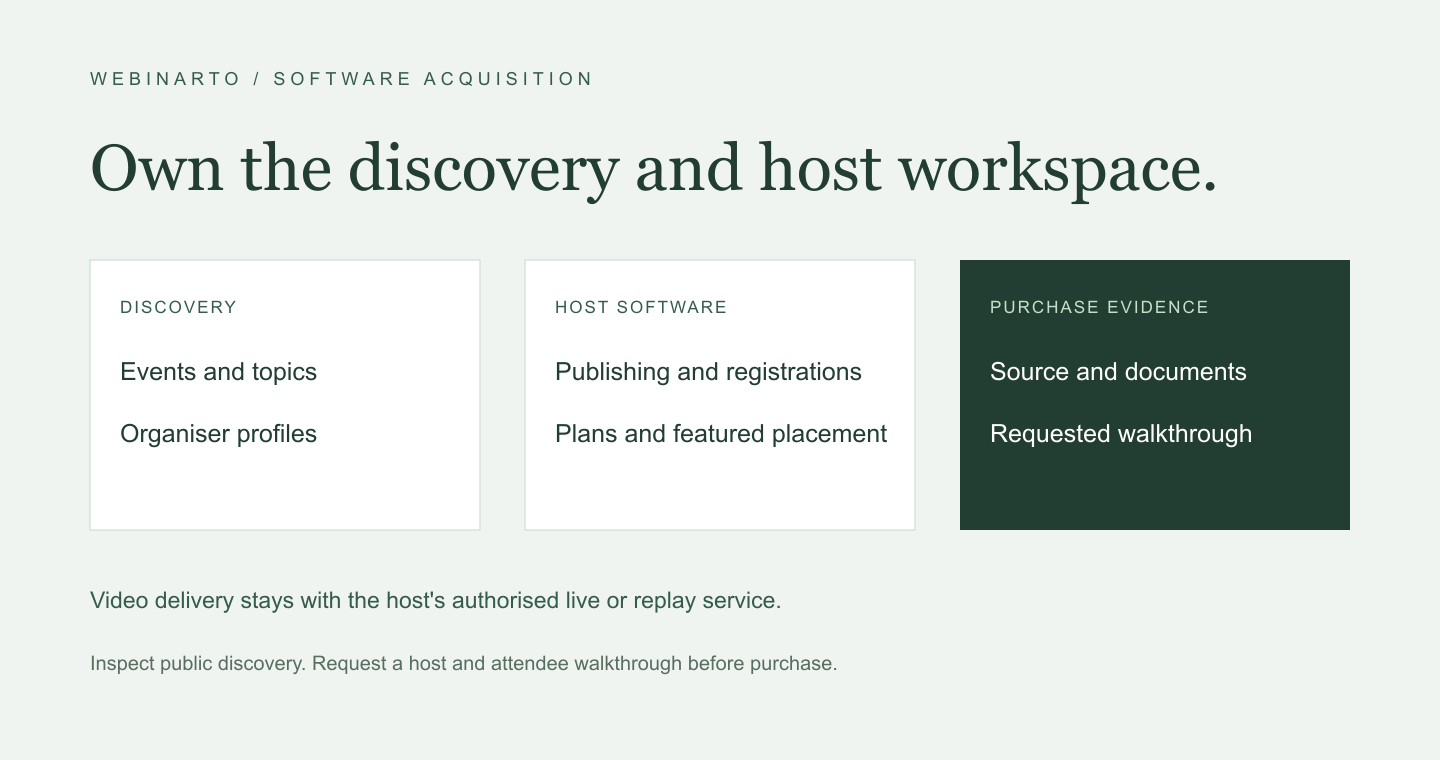
Request WebinarTo for an association-owned recurring event channel. Agree programme responsibility, authorised resources and a working walkthrough before purchase.
Buy WebinarTo's domain and host-directory application for an association's own recurring event programme. Request the current individual package through the WebinarTo Flippa listing. The acquisition concerns existing software and agreed digital assets, not an association, a member list, a video-streaming service or an established event business.
The public event directory currently renders event cards and search, topic, date and timezone controls. Inspect that public discovery interface, then request an authorised seller walkthrough of the association's proposed host, registration and resource tasks. Visible sample listings do not establish an audience or event attendance, and this public browsing check does not verify signed-in registration or payments.
Request the application around a programme you already own
Request WebinarTo for your association's event channel →
Use the WebinarTo acquisition page for the current offer and documents, and the individual WebinarTo purchase brief for the broader asset inspection. Explain that your association wants to own its programme channel. Ask Codeblix to demonstrate the relevant host, event, registration and resource records in a working release before agreeing the purchase.
WebinarTo is documented as a free webinar discovery directory and host-software product. Organisers supply authorised live and replay URLs. It does not stream video or sell webinar tickets; its platform model is host software plans and labelled featured placement. Buying it does not deliver membership synchronisation, a member-only portal, continuing-education certificates or a recurring-event scheduler unless such additional work is separately demonstrated and agreed.
The association is acquiring continuity between events
Consider a fictional professional association that runs four public educational webinars each year. It already controls its programme name, has permission to work with its chosen speakers and uses a separate service to deliver video. It wants an owned place to present its organisers, publish each event and keep authorised resources discoverable afterwards. These relationships are supplied by the fictional buyer, not included in WebinarTo's sale.
The buyer's desired result is a programme that remains understandable when the person preparing the next session changes. An attendee should find the correct event, recognise who organises it and know where the authorised live or replay link belongs. The association should know who can correct the event page, answer an event question and maintain a resource after a speaker changes their link.
This is an internal programme acquisition decision, rather than an agency buying a tool to prepare separate client events. The association already owns the programme mandate. It is deciding whether the existing public directory and host model fits that mandate, and what additional work would be required if its own access or approval requirements go further.
Name the programme owner before naming the next organiser
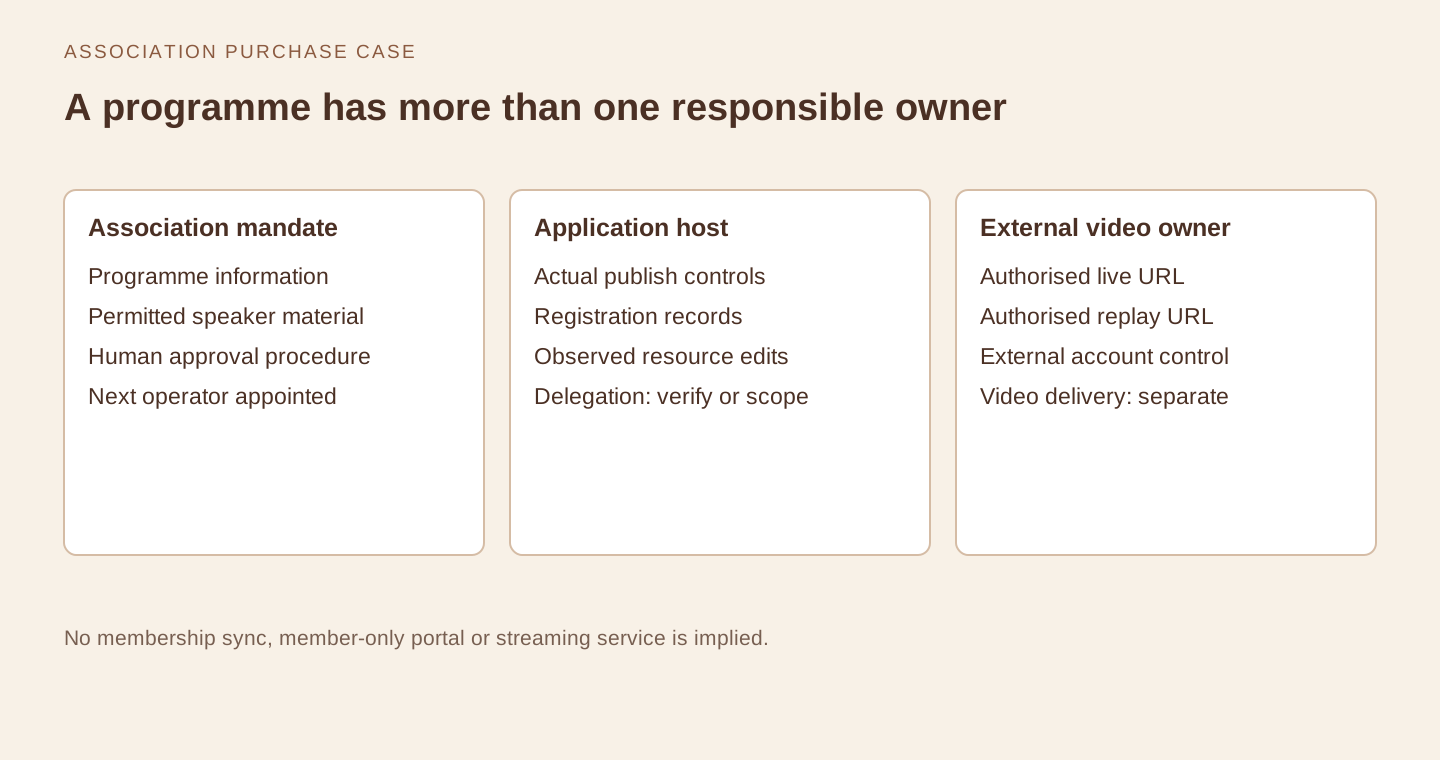
An association may have a programme lead, a temporary volunteer and a person who controls its external video account. Those are different responsibilities. The software has its own host and administration model. The purchase workshop should map the association's people to the actual delivered application roles without inventing an association committee permission system.
Ask who can create or edit the organiser profile, who can publish an event and what the platform owner may change. If the association wants several people to act on one programme, request the precise current behaviour. A host profile does not automatically establish delegated publishing, shared ownership or an approval chain. Any missing controls belong in a separate requirement.
In the fictional case, the association names one responsible programme operator and a separate person who approves its public information through an agreed human procedure. That may be sufficient for the initial purchase if the delivered account model supports it. The buyer should still record what happens if either person leaves, rather than making continuity depend on an undocumented personal account.
Build the purchase example around one complete quarterly session
The fictional association's next session concerns a public professional topic. Give it a title, an authorised organiser, a speaker who has permitted the relevant material and a defined date. Keep all workshop names and registration records artificial. The buyer is testing software, so it should not need to expose a real member list to understand the application.
Ask the seller to demonstrate the event builder and the resulting public event page. Inspect the actual displayed date, time, organiser, description and destination links. A correct title alone is not enough. The association needs the page to describe the same event its external video provider will deliver. Any required time-zone display or other presentation behaviour should be tested directly rather than assumed.
Then follow a fictional registration and the attendee view. Identify which application record shows that registration and which resources the attendee can reach. Do not treat registration as proof of attendance or professional completion. If the association's programme requires an attendance register, an assessment or a certificate, request those exact features separately.
Use a programme-continuity purchase schedule
| Programme commitment | Owner to name | Application evidence to request |
|---|---|---|
| Public event information | Association programme operator | The current host's actual create, edit and publish controls |
| Speaker material | Person authorised to supply the description and resources | The fields and resource records used in the demonstrated release |
| Registration record | Permitted host operator | The fictional attendee's record and visible attendee route |
| Live delivery | Association's external video organiser | Correct authorised destination URL; streaming is external |
| Replay continuity | Named resource maintainer | Actual edit behaviour and attendee access after a changed replay URL |
| Next quarterly session | Next appointed programme operator | Actual account and content controls; no recurrence automation inferred |
Each row links an association promise with a human owner and an application question. The schedule is not a list of features claimed to exist. The seller may demonstrate the current behaviour, identify a limitation or propose separate work. Keep that answer alongside the row so the buyer can decide whether the delivered model is sufficient.
Use the record across the whole example. The person who approves the public description may not control the external replay link. The person who receives a registration question may not have authority to change a speaker's material. Those differences are normal reasons to document the programme, rather than reasons to assume every role must become a platform administrator.
Decide whether a public directory fits a member-serving programme
An association can serve members while publishing events publicly. In the fictional case, the buyer is willing for the programme pages to be discoverable, with free registration and authorised links. That fits the public-directory direction worth investigating. It does not mean every association wants the same access model.
If your programme must be visible only to current paid members, write that requirement before discussing the offer. Ask whether the delivered application provides the exact restriction and membership status connection you need. Do not infer it from a host account or from an attendee registration. Member synchronisation, restricted directories and automatic membership checks should remain additional scope unless demonstrated.
The purchase decision can therefore be explicit. The buyer accepts the current public/account model, requires a separately agreed adaptation, or declines the asset for this particular programme. The association should not acquire a public directory on the assumption that it is already a private membership platform. Equally, it need not reject public discovery when public reach is part of its actual mandate.
A recurring programme does not require a claimed recurrence engine
The association's programme repeats, but that does not establish an automatic series feature in the application. The buyer should distinguish its human planning calendar from the delivered event records. Each quarterly session may be prepared and checked individually using the current host workflow.
Use the next quarter as a second purchase test. Ask the proposed operator to create another artificial event through the supported controls. Determine which information is entered again and which current product features, if any, help the process. Do not assume automatic duplication, recurring registrations or inherited attendee permission. The association's own procedure can be simple and manual if that is acceptable.
The important continuity question is whether a new operator can explain and maintain the next event without guessing what the previous person did. If the association needs a formal series calendar, repeated-event automation or a consolidated programme report, identify that requirement separately. Buying the current application should not silently promise an unbuilt programme-management system.
Transfer the next quarter without inheriting a volunteer's assumptions
Make the second event operator a different fictional person. The first volunteer has prepared the opening session, while the association appoints someone else for the following quarter. The new operator should receive a programme record that explains what they are authorised to maintain. An event title and a login address do not explain which speaker approved a resource, which external destination is current or who answers an outstanding attendee question.
Give the new operator the continuity schedule and ask them to identify the next permitted action in each row. They might need to correct the description, create the next session or ask the video owner to confirm a replay. Observe which actions the current application allows through the agreed account arrangement. Do not assume the new volunteer automatically inherits another person's host content or that an association role exists in the software.
If the handover requires a platform-owner action, request that exact demonstration. If it requires a new delegation feature, record it as additional work. The association may choose an account arrangement with a stable responsible owner and a documented human preparation procedure instead. The buyer should accept the actual arrangement it can operate, rather than describe several people as interchangeable administrators without examining their authority.
The former operator also needs a clear finish point. Ask how the agreed application access is changed and which records the association must retain. The procedure should separately address the external video service and any other tools the volunteer used. A change in WebinarTo does not automatically change access elsewhere, and the acquired application should not be represented as a central identity system for all programme services.
Use three observable outcomes for this part of the acquisition: the new operator can perform the agreed next action, the association knows who controls each current destination, and the former operator's remaining responsibilities are explicit. These are proposed acceptance outcomes to verify, not claims that the current public preview has passed them. When a missing control prevents the outcome, the buyer can request a separate scope or decide the application is not the right fit for its programme.
This handover test gives the association a concrete reason to buy an owned programme channel. The aim is continuity of an authorised public service across a real change of people. The purchase should leave that operating mandate understandable without turning the directory into a promised membership-management or staff-administration suite.
Rehearse a date change before an attendee follows the old information
Change the fictional session's date during the workshop. Ask the seller to demonstrate the current edit path and inspect the event page afterwards. Then determine what the application actually does with existing registration records and any relevant displayed information. Do not assume it sends a notice simply because a date changed.
The association should name the person responsible for informing affected people through whatever authorised channels it uses. That channel might be outside the acquired application. The purchase record should state which delivery behaviour is implemented and which communication remains a human programme task. An existing member email list is not automatically connected or transferred by buying WebinarTo.
Repeat the check with the external video destination if it also changes. The programme operator and video owner should agree which URL is current. The acquisition is suitable only if the buyer can maintain an accurate attendee route with the delivered application and its agreed human procedure, or can explicitly commission the missing work.
Keep video delivery under its actual external owner
WebinarTo's documented role is discovery and host software. The organiser supplies authorised live and replay destinations. The buyer must retain a separate understanding of the video service it uses, the people allowed to operate it and the material it is entitled to present. The application acquisition does not include that service relationship.
For the fictional association, the external video owner tests the intended destination separately from the directory walkthrough. The public event page should point to the correct agreed route. A functioning directory link is not proof that the external room will open, the recording will be available or a speaker has approved distribution.
This division is a reason to use the continuity schedule. When an attendee cannot find the replay, the programme operator needs to know whether the event record is wrong, the external destination changed or the association no longer has permission to share the material. The buyer should not purchase directory software as though it guarantees those separate outcomes.
Make the replay change a second ownership test
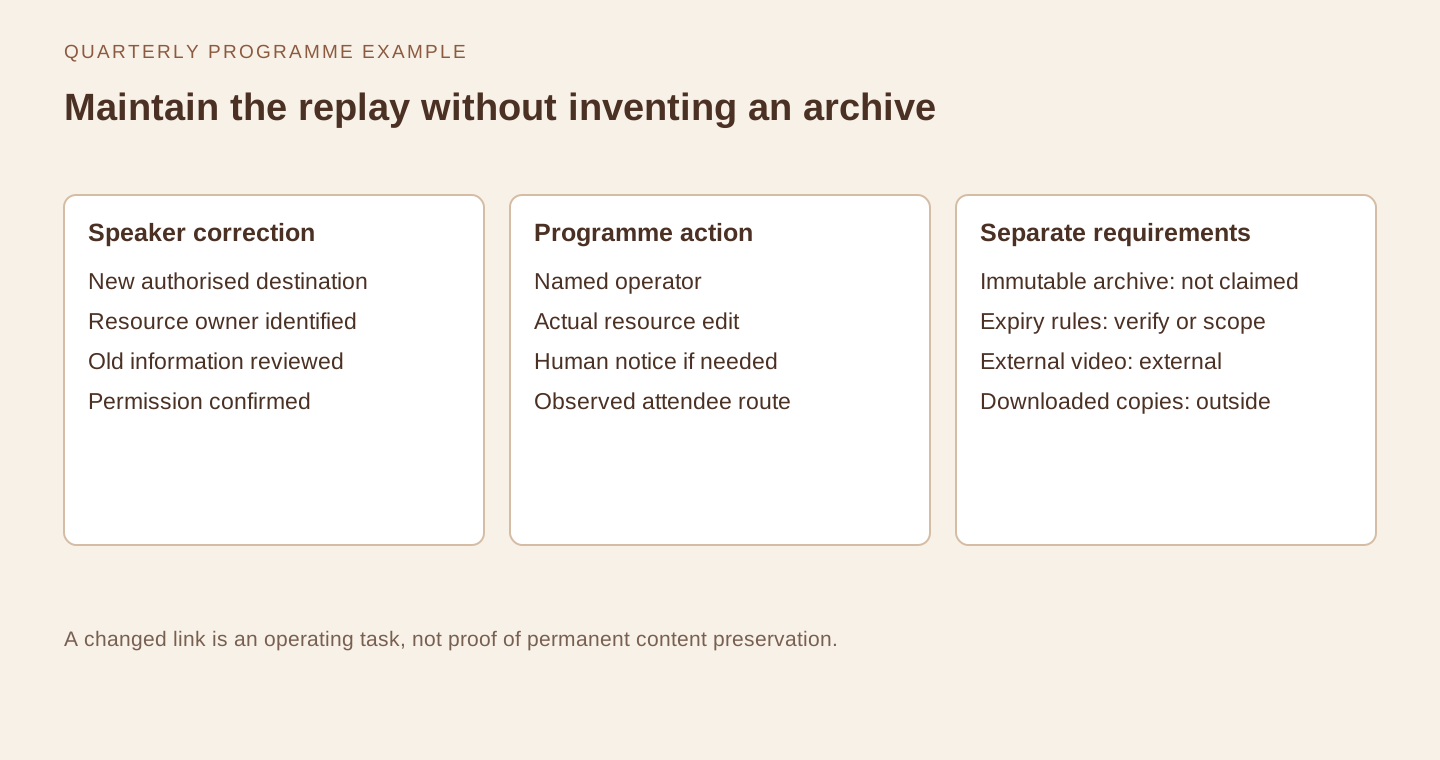
After the fictional session, suppose the speaker supplies a corrected replay URL. Ask the seller to show where the relevant destination or resource is maintained in the current application. Inspect the attendee route after the change. The buyer should record the observed behaviour rather than claim a permanent archive or an immutable history of every earlier resource.
The association then identifies who is authorised to approve the correction and who performs it. If the old destination must no longer be distributed, its human procedure should include the relevant checks. Do not assume the application controls copies of URLs already sent through external channels or removes downloaded material from attendees' devices.
This worked change is central to the acquisition case. The association wants a programme channel it can continue to maintain, not merely a page for the next live date. If its continuity requirement includes stronger content versioning, a restricted resource library or automated expiry, ask for those controls explicitly and separate any new work from the delivered host-directory package.
Choose moderation responsibility without promising formal assessment
The documented application scope includes polls, questions and answers, moderation and host tools. Ask the seller which current controls are available in the demonstrated release and how they relate to the fictional event. Keep the distinction between an interaction record and an association's professional or educational judgement.
A question submitted to an organiser does not automatically establish attendance, understanding or accreditation. If the association wants a moderator to review a question before a speaker answers, inspect the actual available workflow. If it needs a formal assessment or a completion certificate, identify that as a different requirement, not an implication of a poll or registration count.
For the worked programme, the association only needs a named person to handle relevant event questions and maintain authorised resources. It can use that bounded goal to assess the host software. This avoids purchasing a broad educational-system promise when the available asset is a directory and organiser workspace.
Clarify host-plan entitlements for an owner-operated programme
The intended platform revenue model is paid host software plans and featured visibility. An association buying the entire application for its own programme is making a different operating decision from a buyer recruiting unrelated paying hosts. It still needs to understand the current entitlement and publication controls.
Ask how the proposed association host account operates under the delivered configuration. If the buyer wants to change plan settings or offer its own organisers a different arrangement, agree the actual configuration or additional work. Do not simply assume that application ownership removes every software gate without affecting the product's behaviour.
No paying-host base or ticket income is established by demonstration records. Keep the current individual sale's financial representation separate from the association's existing programme budget. The acquisition buys a software foundation and agreed digital assets; it does not create member subscriptions, sponsorship agreements or a revenue-generating event series.
Accept programme control before announcing the new channel
The currently rendered public directory gives the association a concrete discovery interface to inspect before requesting its worked programme demonstration. The buyer should see the particular release it is being asked to accept, including the relevant host, registration and resource paths. The current product documents are useful context, while the walkthrough shows the specific programme actions the association intends to operate.
Request the agreed repository, domain, application documents, service ownership arrangement and handover assistance through the current listing. Name who will control the programme after transfer. If buyer-controlled deployment or additional programme work is part of the deal, define that result and its evidence separately from the public browsing interface already available for inspection.
Only announce the channel in terms the association can actually support. A public programme page with a maintained authorised replay is a concrete promise. A private member portal with automatic certificates is a different promise. The purchase should leave the buyer able to explain which one it owns and what work, if any, remains.
Complete the association's programme acquisition record
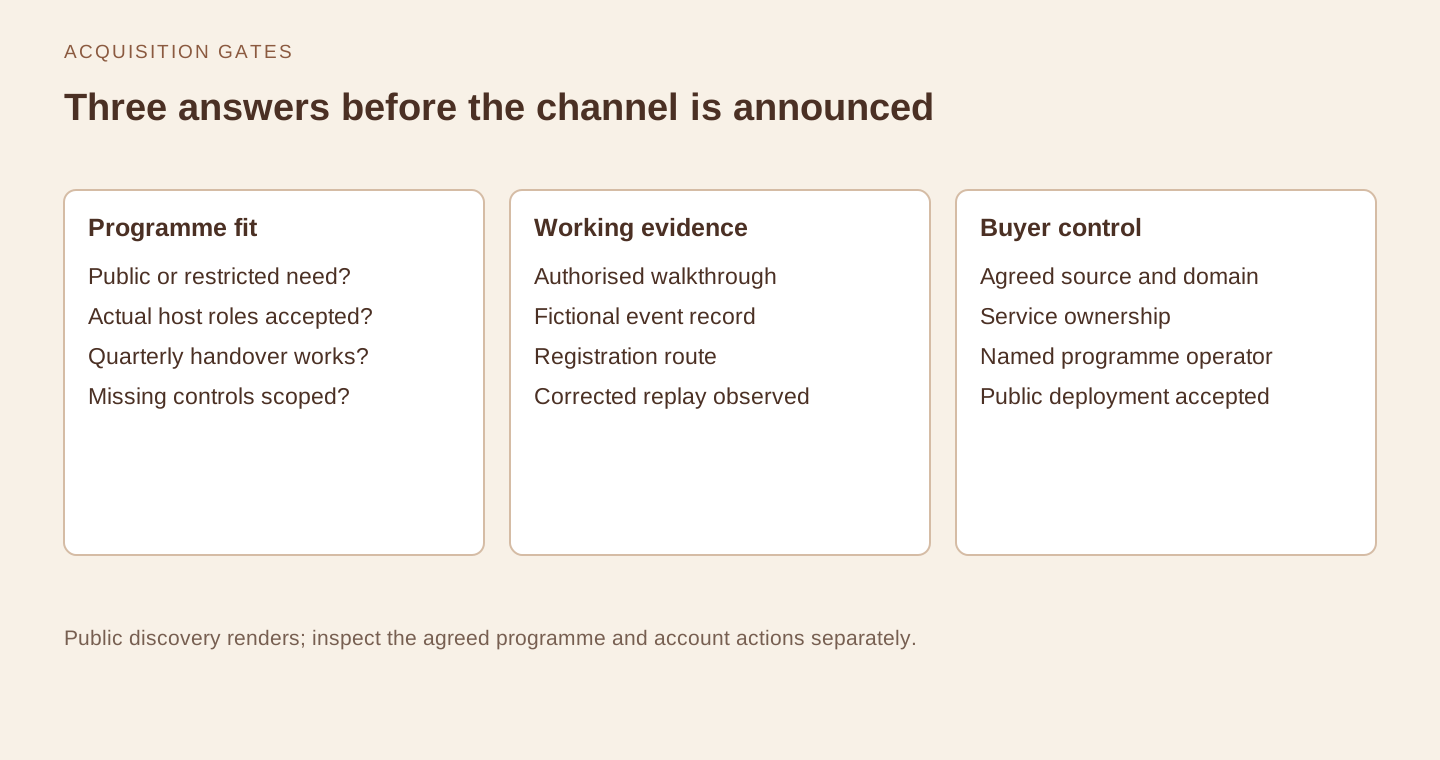
- Bring one permitted programme example and identify the people responsible for its information and external delivery.
- Request a seller-led demonstration against the actual host, registration and resource controls.
- Record missing association requirements as separate scope instead of assuming they are membership features.
- Agree the individual asset transfer and working public deployment condition before announcing the channel.
Request the WebinarTo acquisition package on Flippa with your programme-continuity schedule. The practical purchase question is whether this existing host-directory application can become a channel your association is authorised and prepared to maintain across its own events.
Explore the products discussed
Explore related acquisition offers