
Webinar platform for sale: acquire WebinarTo directory and source
Request the directory and host-software package, with the current preview condition made explicit.
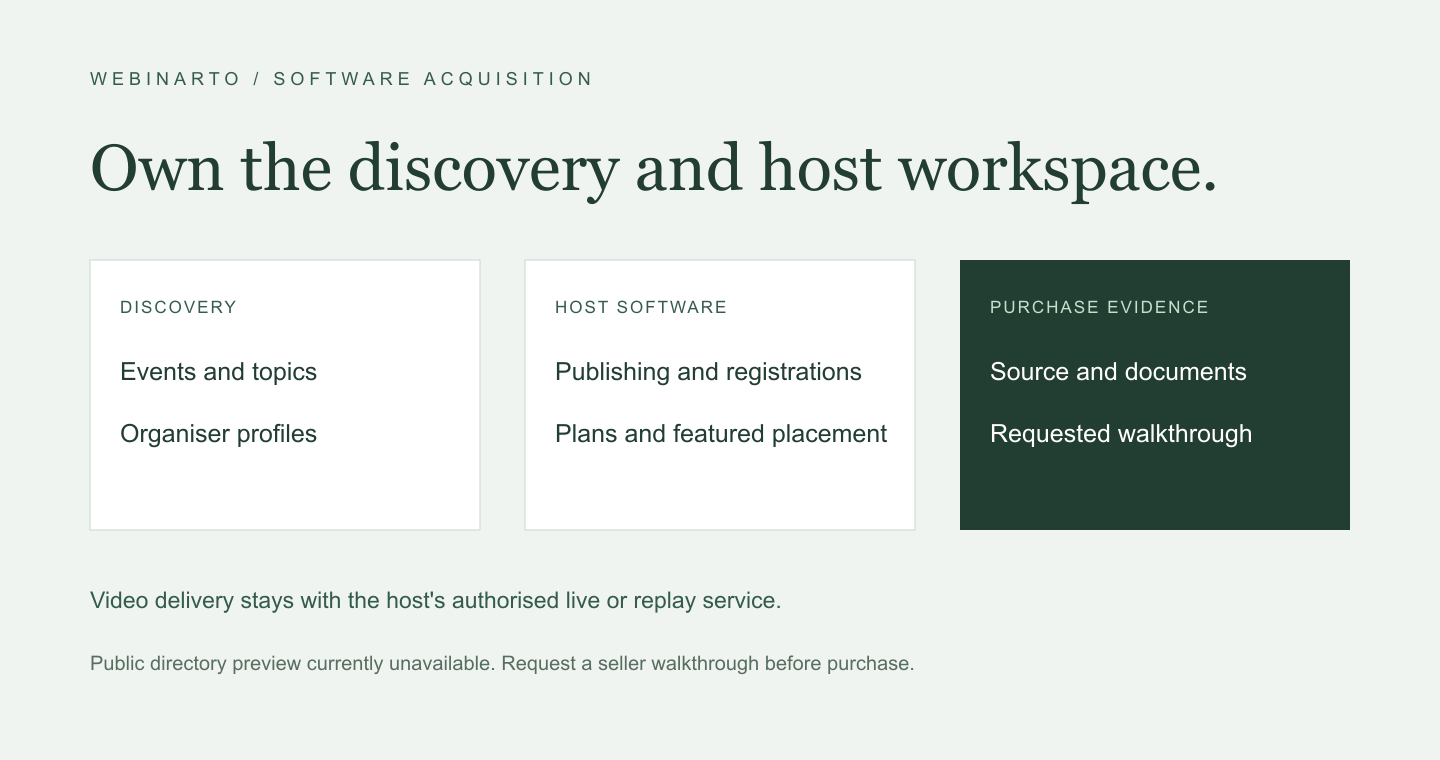
Acquire the WebinarTo domain and directory-software foundation. Request a current walkthrough, inspect the documented host tools and agree how the unavailable public directory will be handled before purchase.
WebinarTo is a webinar platform for sale through Codeblix, offered as a directory and host-software foundation with its domain, application source and product documents to agree in the transaction. The acquisition is for an operator who wants to own event discovery and organiser tools. It is not the purchase of a video streaming service or a ticket-selling business.
Current preview condition: the public directory preview is unavailable. The homepage can be reached, but that does not establish a working discovery journey. Request a current seller walkthrough and resolve the directory issue as part of your acceptance discussion before purchasing. The feature descriptions below refer to the documented product package, not a claim that the public directory currently passes a live test.
Ask Codeblix for the WebinarTo source and domain offer
Request the WebinarTo package and a current walkthrough on Flippa →
Check the current Flippa listing for availability, price, financial information and the proposed transfer. Read the WebinarTo user document and technical handover document, then bring the unanswered product questions into the seller conversation. The Codeblix WebinarTo listing records the preview limitation alongside the purchase route.
This is a software acquisition discussion. Do not infer an existing audience, paying hosts or event attendance from demonstration content. The intended commercial model is host software plans and labelled featured placements. The buyer must assess the source, establish the required services and decide how to attract and support organisers.
Make the unavailable directory part of the offer
A known runtime issue should be named before an offer, not hidden inside a broad phrase such as “ready to launch”. Ask the seller to reproduce the directory problem and describe the acceptance evidence they can provide. Decide which party will handle the remaining work, what access they need and how you will confirm that the intended journey functions under the agreed configuration.
Do not substitute a homepage screenshot for that evidence. A public landing page can load while an application route fails. The buyer needs a demonstration of the route customers will use: browse an event, open its details and continue to the registration or access step. If the seller supplies a corrected environment for inspection, record which environment and version you saw.
You can still evaluate the documents, repository and product model while the issue remains unresolved. What you should avoid is treating unresolved work as completed. Make the purchase conditional on the scope and evidence you require, and keep any agreed repair or configuration task distinct from future enhancements. This makes the transaction concrete without promising a resolution that has not yet been demonstrated.
The package stops where authorised video delivery starts
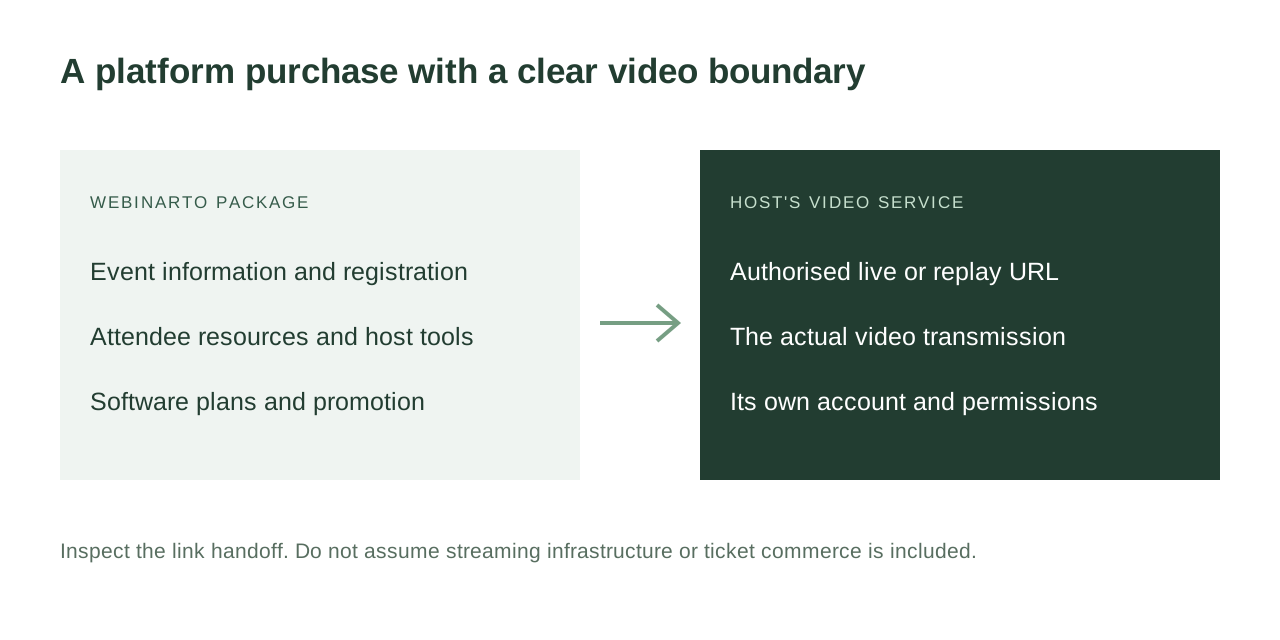
WebinarTo's current source description is explicit: it is a free webinar directory and host-growth software product. Organisers provide authorised live or replay URLs. The application does not itself stream video and does not sell webinar tickets. This boundary is central to the acquisition because the word “webinar platform” can otherwise suggest a different infrastructure and cost model.
The intended platform job is to help people discover events and help organisers prepare event pages, manage registrations and provide resources. Video transmission remains with the host's chosen service. A buyer should ask to see how a host enters the relevant URL, what an attendee sees and what happens when that link changes or is unavailable.
If your plan requires paid tickets, native broadcasting, video recording, recording storage or an integrated production studio, name those as additional requirements. They should not be inferred from a directory, an event-room page or a replay link. A focused software package may be a suitable starting point, but it is a different purchase from infrastructure that delivers the video itself.
Choose a directory owner, a host-tool operator or a managed service
One buyer may want to build a specialist event directory for an industry they already serve. Another may want to offer organiser software to a known group of hosts. A third may want to run a supported event-listing service. These routes share parts of the application, but they create different operating responsibilities.
A directory owner needs a coherent catalogue and a way to keep it current. A host-tool operator needs organisers who find the workspace useful and can publish their events. A managed service operator performs more of that work for the customer. Before making an offer, identify which relationship you can support and which features need to work for that first offer.
What would you sell after acquiring WebinarTo?
Request one fictional event through every state
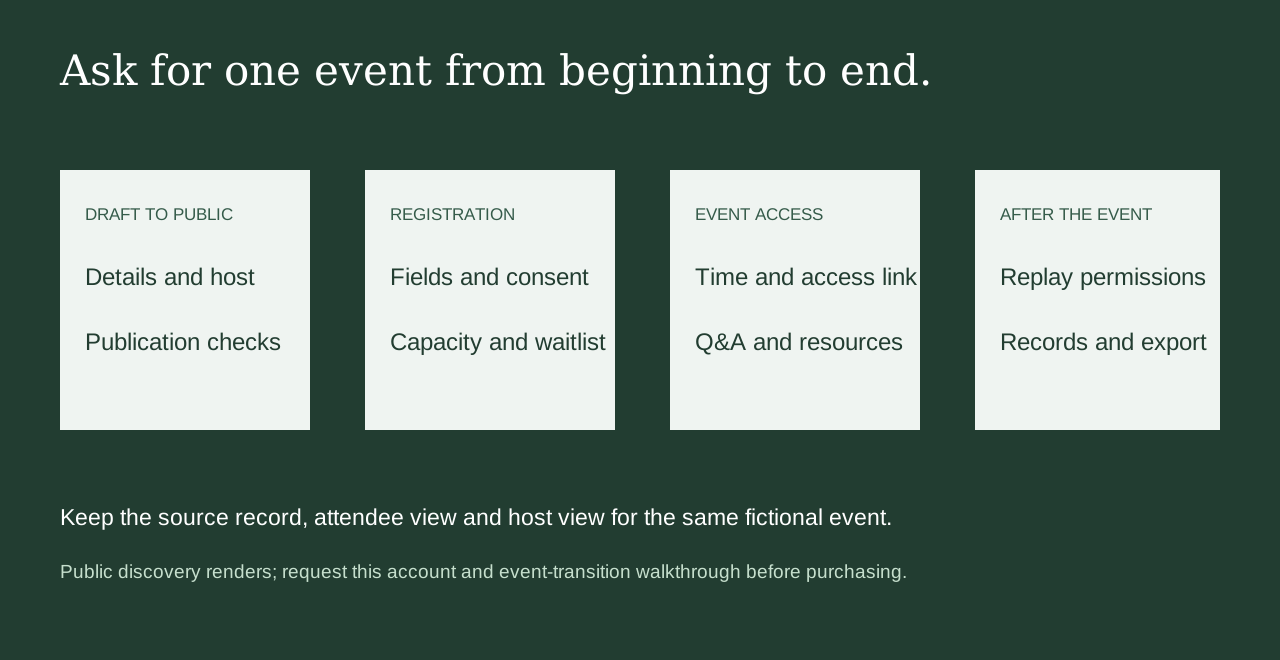
The product documents describe event pages, organiser profiles, speakers, agendas, registration controls and attendee resources. Ask for one fictional event that connects those parts. Use a title and schedule you can recognise, a test organiser and a small number of controlled registrations. This makes it easier to tell whether the host and attendee views describe the same event.
Start with a draft and inspect what is required before publication. Follow its public detail page and registration path. Then change a meaningful field such as the start time or access link and inspect the resulting view. A buyer needs to know where changes appear and which communications, if any, the product actually sends.
Finally, move the event into the appropriate past or replay state. Check the resources and authorised link that remain available. Keep the test tied to the same event record rather than watching separate demonstrations of unrelated screens. The current directory limitation means this walkthrough should be requested from the seller; it should not be represented as a working public demo until verified.
Separate catalogue content from an audience you can acquire
The source package contains demonstration organisers, events and attendee activity. These can help a buyer understand the data model and expected interfaces. They are not evidence that independent hosts have joined the business or that real attendees will visit your directory. Ask the seller which records are examples and how they should be replaced or retained after transfer.
A directory business also needs an editorial process. Who may submit an event? Who checks whether its details are useful and current? How does an organiser correct the date or remove a cancelled listing? The product may provide controls for these actions, but somebody must operate them. Buying source code does not supply that person or the relationship with the organisers.
If the sale represents traffic, subscribers or commercial relationships, request the corresponding evidence in the current transaction. Keep that assessment separate from the value of the product assets. A buyer can choose a starter directory because the software is useful without pretending that a catalogue of examples is an established audience.
Check time, capacity and registration as linked purchase requirements
Event software is particularly sensitive to timing. An organiser may think in one time zone while an attendee reads the page elsewhere. Ask how the product stores and presents the event time, and test the actual display used by your intended audience. A time-zone label should be checked against the scheduled event, not assumed correct because a selector exists.
The documented event builder includes registration fields, consent, capacity and waitlist controls. Pick a small test capacity and ask what happens when it is reached. Inspect the host's records and the attendee's message. If a waitlist is offered, determine what moves a person from the list to an accepted place and which parts require an operator action.
Also inspect changes after registration. An event can be postponed, cancelled or moved to another authorised video link. Your future customers will ask how that affects their attendees. Record the application's actual behaviour and the procedure needed around it. Do not promise automatic communication, attendance or capacity handling unless those steps have been demonstrated in the purchase environment.
| Test condition | Host-side evidence | Attendee-side evidence |
|---|---|---|
| The event is published | The correct organiser, time and access settings. | A matching public detail page. |
| Capacity is reached | The correct accepted and waitlisted records. | A clear status and next step. |
| A time or link changes | The saved change and relevant operating action. | The updated information where the product represents it. |
| The event has ended | The intended past or replay state. | Only the authorised resources and access that should remain. |
Sell a defined host plan rather than a turnout promise
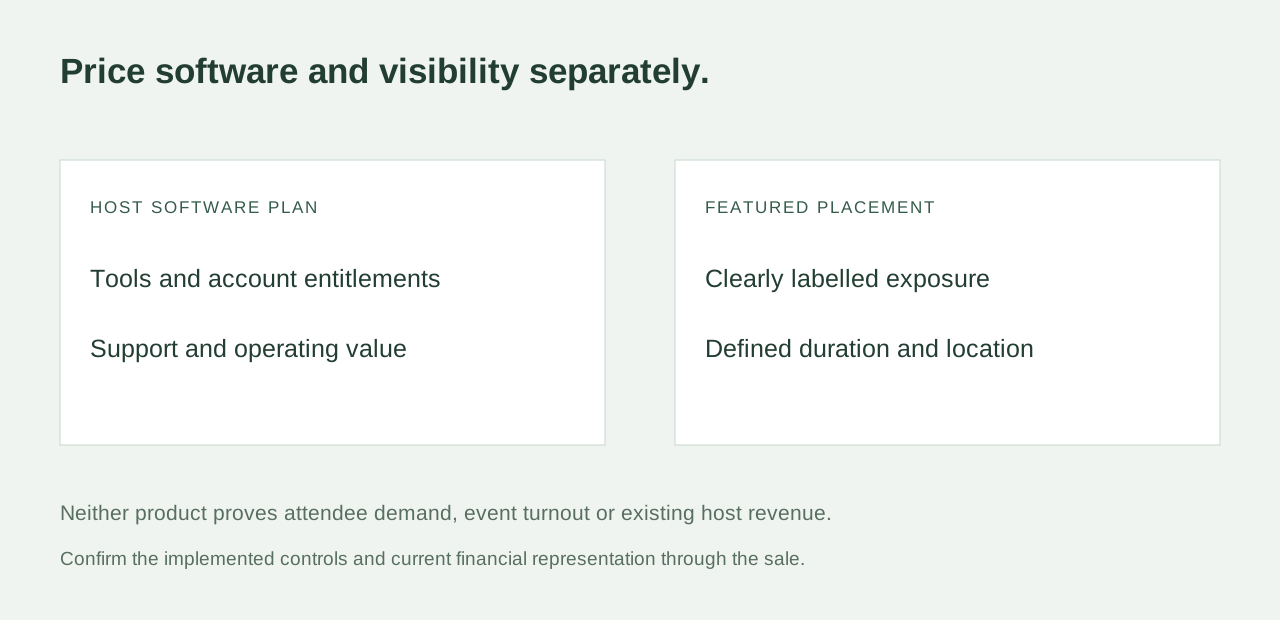
WebinarTo's intended payment model is software plans for hosts and featured event placement. A host plan should describe tools, limits or support the owner can actually provide. It should not be sold as a guarantee that a certain number of people will register or attend. The platform can help organise an event while the host remains responsible for its programme and audience work.
Ask the seller to show the plan controls and how a host's access relates to the assigned plan. What changes when a plan changes? Which controls belong to the platform owner? Which payment configuration must move to buyer-owned services? These questions inspect the software offer without inventing existing recurring revenue.
For featured placement, define the location, duration and labelling. A useful commercial product tells a host what visibility they are purchasing. It does not obscure paid positioning as an independent recommendation, and it does not substitute a promised result for a placement that can be observed.
Inspect event resources without buying a streaming claim
The documented application includes attendee resources, questions, polls and host tools. Request a demonstration of the tools that matter to your intended customer. A visible question list may support a moderated event workspace without being integrated into the host's external video provider. The buyer should know where the application ends and another service begins.
Ask who can post, moderate or export an interaction. Use fictional content and a controlled test account. If the host expects to download attendee records, inspect the actual export and its fields. If the application offers a review after an event, determine who is eligible and how the owner handles unsuitable content.
Avoid expanding the acquisition into an unpriced broadcasting or messaging project. If you need a specific provider connection, establish whether it exists in the delivered code and request evidence of the exchange. If the workflow instead uses authorised links and manual host actions, assess that honest boundary against the service you intend to sell.
Ask what the operating signals explain
Stored product descriptions mention match, lead-priority, no-show-risk and related-event operating signals. These should be treated as product guidance to inspect, not measured predictions about an audience. Ask the seller which inputs drive a signal, how it is explained and what a host is expected to do with it.
A buyer should be able to tell the difference between a descriptive count, a rule-based label and a model-generated suggestion. A label that helps a host sort registrations may be useful even when it is not a statistically validated forecast. The application should be positioned accordingly. Do not sell a draft signal as a promised increase in attendance or conversion.
Use the walkthrough to decide which signals belong in your first customer offer. You can choose a narrower offer centred on event publishing and registrations, then inspect additional tools before promoting them. This is especially sensible while the public directory issue remains unresolved: complete the core journey before adding claims around its possible commercial effects.
Put the remaining launch work in a named transfer schedule
The source foundation uses a web frontend, backend services, authentication and platform billing. Ask which accounts the buyer must create or receive, which configuration belongs in those services and who will help with the initial setup. The source and technical document should make the required environment understandable to the person responsible for the buyer's deployment.
Keep the known directory issue on that schedule. Identify the acceptance condition and the environment where it will be demonstrated. Name any agreed assistance separately from new design work, ticket commerce, streaming integration or ongoing event operations. A written scope prevents an unresolved launch task from being mistaken for a delivered capability.
- Confirm the domain, repository and product documents included in the offer.
- Identify the required buyer-owned application and billing accounts.
- Agree how the current directory problem will be reproduced and assessed.
- Request the fictional event walkthrough from publication through replay.
- Record which demonstration content will be removed, retained or replaced.
- Agree the remaining setup responsibilities and technical support boundary.
Make the offer against software evidence, not the size of a sample event
Choose who can correct the catalogue when an organiser is absent
A directory will receive information that changes after publication. An organiser may postpone an event, replace a speaker or remove access to a replay. The buyer should ask what the current source provides for editing and moderation, then decide who performs the work. A self-service host workspace does not remove the platform owner's responsibility to respond when public information is wrong and the host is unavailable.
Request a controlled example with a fictional organiser and event. Ask the seller to show the normal host edit first, then the platform administration route used when the operator must intervene. Which information can the owner change? Can the owner remove an unsuitable listing? What record remains of the event and its registrations? These are scope questions to resolve in the package, not assertions that the current public route already handles them successfully.
Identify the limits of your proposed moderation service. You may be willing to check event dates and links while leaving programme accuracy with the organiser. You may want a submission approval step for a narrow professional audience. You may need the host to confirm permissions for speakers, images and resources. Write down the operating rule you intend to apply and compare it with the delivered controls before making the offer.
A small launch can use a documented manual procedure. It should still name the responsible person, the way a host requests a correction and what happens when the change affects attendees. The software acquisition gives you tools and source code; it does not supply an editorial team or an automatic right to republish material from other event organisers.
Inspect a cancellation without promising a communication system
Ask the seller to use the fictional event to demonstrate the cancellation state that the product supports. Observe the host record, the public information and the attendee view. If the application prepares a notice, records an action or relies on the host to contact people elsewhere, describe that boundary accurately. A visible event status is not evidence that an email or message reached every registrant.
For your intended operation, decide which channel carries important changes. It may be a function of the delivered application, a configured external service or a manual organiser procedure. Request evidence for any connection you plan to advertise. If a new notification integration is required, name it as additional work rather than silently including it in the purchase price.
Then consider the period after cancellation. Can the host retrieve the relevant records? Is the event still discoverable in a way that could confuse a visitor? What should happen to an authorised replay link that was previously shown? These questions help the buyer define a usable operating process even when the initial product scope is deliberately narrow.
Make account departure an organiser acceptance test
A host may stop using the platform. Before purchasing, ask how the product separates the host's account, public organiser profile, event listings and stored registration information. You need an explanation of what remains visible, who can export relevant records and which actions belong to the platform owner. Avoid promising an automated deletion or retention policy that has not been configured and demonstrated for the intended deployment.
The technical and user documents provide a starting point, but the buyer should request the specific controls needed for their first customer offer. An organiser's departure should not require the owner to guess which events they created or leave outdated links advertised indefinitely. If the delivered tools require a manual sequence, write it into the operating notes and test it using the fictional host.
These lifecycle questions also clarify the commercial offer. A paid host plan can be a useful product when its tools and responsibilities are explicit. It should not imply that the platform owns the organiser's programme, guarantees an audience or takes over all event communications. Keep the sale centred on a defined software package, with a practical procedure for the people who will operate it.
The purchase file should name the package, the demonstrated workflow and the work still required. Include the fictional event record, the relevant host and attendee views, and the current runtime limitation. Ask for financial and customer evidence through the sale process if those assets are represented. Keep examples and proposed commercial models separate from established business performance.
Before agreeing the transfer, ask the person who will operate your platform to read that file without the seller's narration. They should be able to identify the event being tested, the intended host role and the unresolved directory condition. If the evidence is understandable only during a live call, request the missing instructions or record the relevant steps with the seller's agreement. A usable handover should survive the end of the demonstration.
Keep the first launch offer narrow enough to explain with the delivered controls. For example, you could choose a defined organiser audience and a supported event-publishing service. That is an operating decision for the buyer, not a claim that the package already contains those customers. A clear first offer lets you request the right walkthrough and price the work that remains, while preserving the distinction between the source-code purchase and the business you will build around it.
WebinarTo conditions to settle before purchase
Contact Codeblix on Flippa to request the WebinarTo acquisition package and a current walkthrough. You can also compare the available online businesses for sale if you prefer a different software model or a product with an available public preview.
Explore the products discussed
Explore related acquisition offers