
Quiz software for sale: buy ThatQuis domain and SaaS source
Acquire a focused quiz SaaS package for creators and agencies.
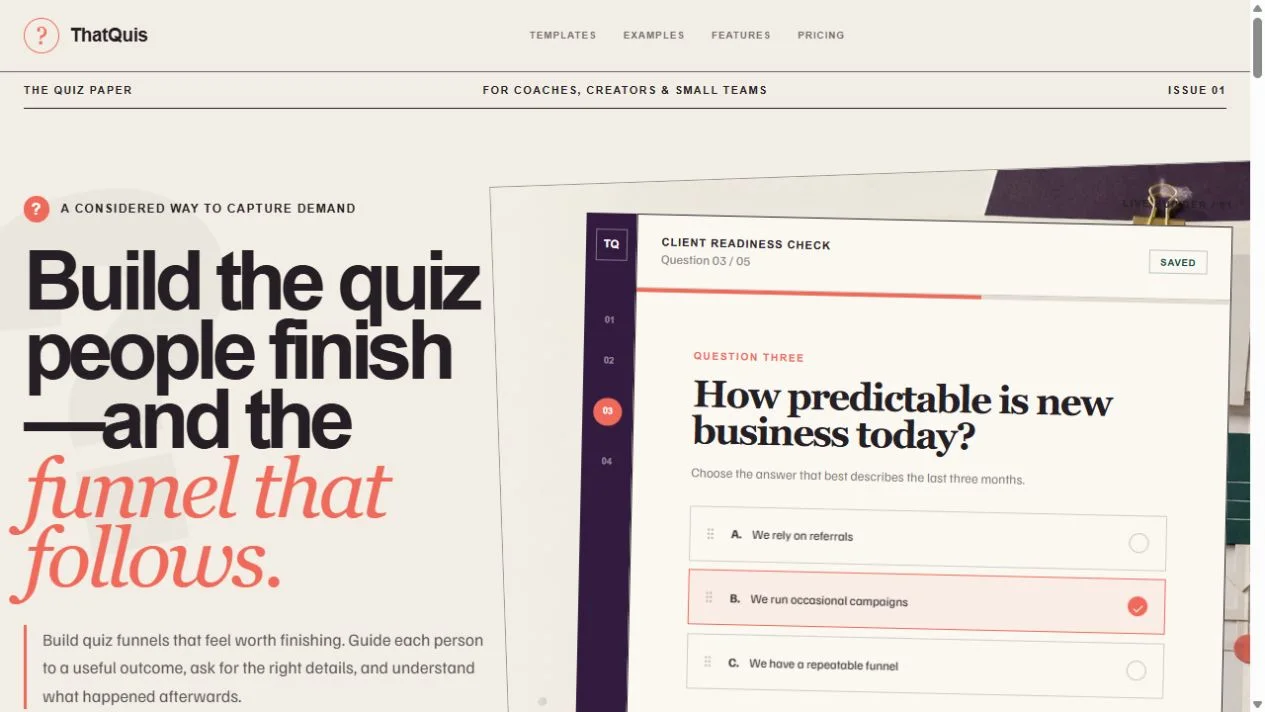
Purchase the ThatQuis quiz SaaS foundation with its domain and source. Request the package, inspect the answer-to-result journey and creator plans, and confirm the current transaction terms on Flippa.
ThatQuis is quiz software for sale through Codeblix: a focused SaaS foundation with its domain, source package and buyer documentation. Request the current package through the Flippa listing if you want to own and operate a product for creators or agencies. The application centres on quiz funnels, branching outcomes, consented leads, creator workspaces and software plans.
This purchase page helps you inspect that offer. Imagine a test visitor finishes a product finder but receives a recommendation that does not match their answers. An attractive template cannot resolve that problem. The acquisition evidence needs to show the answer path, the result and the saved response. We use ThatQuis as the specific product to inspect, while separating ordinary campaign access from ownership of the platform.
Purchase ThatQuis as an owned quiz SaaS product
Request the ThatQuis source package and contact Codeblix on Flippa →
Codeblix offers ThatQuis to a buyer who wants the domain, software source and documented quiz product foundation. Open the ThatQuis business listing to request a package walkthrough and reach the current Flippa transaction. Confirm the available assets, asking price and represented financial position there before making an offer.
The acquisition gives a buyer a focused product to operate for creators or agencies. It does not replace customer acquisition, campaign strategy or platform support. Use the specific tests below to inspect the delivered software and identify the remaining launch work. If your aim is to own the platform, ask Codeblix to include creator accounts, plan controls and service-account transfer in the demonstration, alongside the public quiz journey.
Start with the result page you would be willing to put your name on
Write one useful result before building a question. For a product finder, that could explain why a category fits and what the visitor should compare next. For a consultant, it could describe a readiness level and the evidence behind it. For an agency qualification quiz, it could help the respondent identify whether a service is relevant. The result should remain understandable even if the visitor does not submit contact details.
Next, list the minimum information needed to produce that result. This is where a purchase brief becomes concrete. If the result depends on several independent answers, you need to inspect scoring or rule matching. If later questions depend on earlier choices, you need to inspect branching. If every visitor receives the same result regardless of their answers, the product may be a simple form with a recommendation page. That can be useful, but it should be described accurately.
Finally, name the next action. A useful next step might be reading a product guide, comparing a shortlist, requesting a call or downloading a relevant resource. Do not treat every completed quiz as a sales opportunity. The software should let you see what visitors actually submitted and what they were shown. Your offer and follow-up process determine what you do with that information.
Do you need campaign access, or do you want the platform?
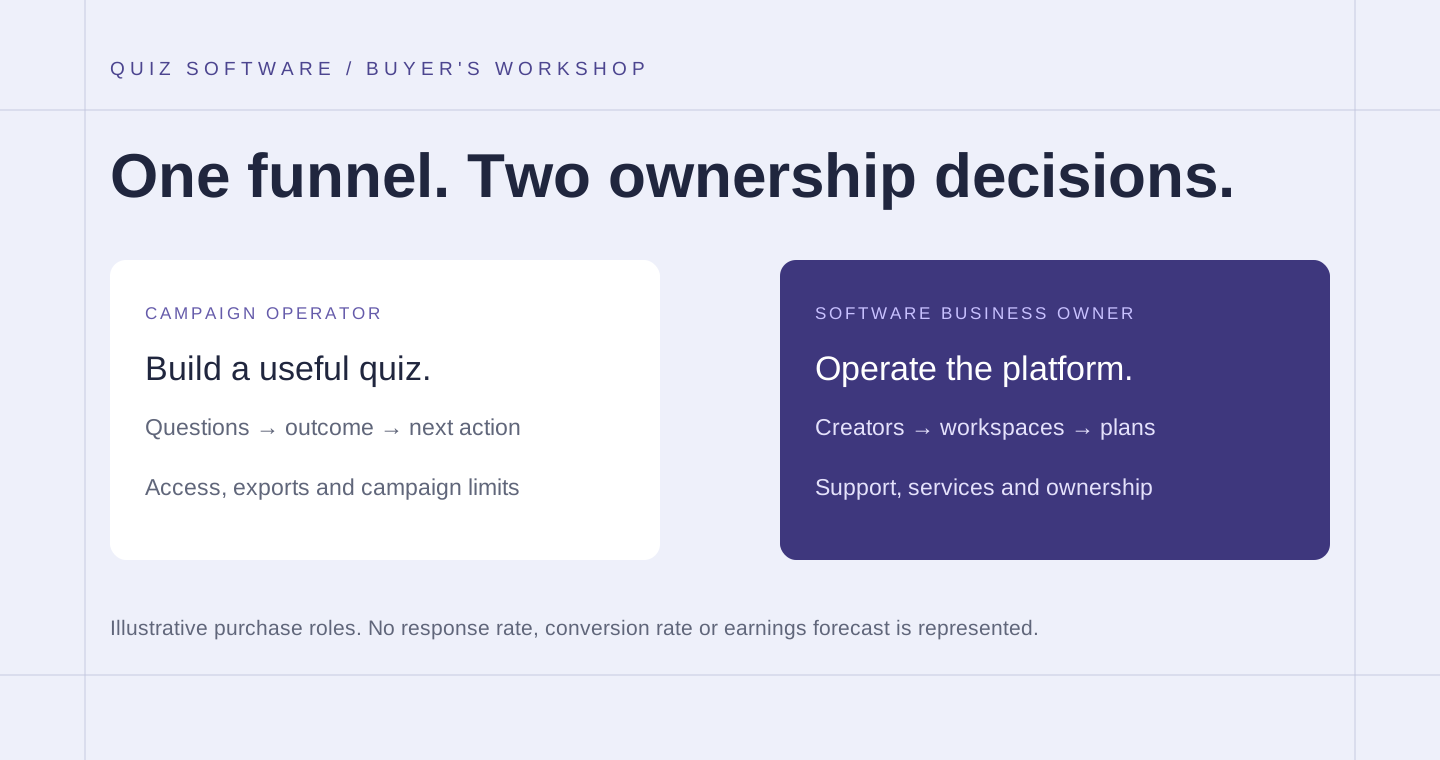
A creator buying a quiz subscription is outsourcing platform operation. They want an editor, reliable publishing, sensible limits and access to their responses. A buyer acquiring source code is taking on the work behind that service. They need creator accounts, workspaces, plans, payment configuration, support procedures and a maintenance path. These are related decisions, but the evidence needed for each is different.
| Decision | Using a quiz platform | Owning the software business |
|---|---|---|
| Primary job | Publish useful quizzes for your organisation or clients. | Provide quiz software that other creators can use. |
| Important limits | Quizzes, responses, branding, exports and team access. | How those limits are enforced and supported across accounts. |
| Payment question | What do you pay, and what happens if you cancel? | How will your own customer subscriptions, changes and failures be handled? |
| Ownership question | Can you retrieve your content and response data? | Can you operate the repository and required services under your accounts? |
| Evidence to request | A complete test quiz and usable export. | That journey plus creator separation, owner controls and handover instructions. |
A software acquisition can be sensible when you have a clear market and the ability to operate the product. It is a poor substitute for defining that market. Owning a quiz application does not bring a list of paying creators unless the sale explicitly includes and substantiates those relationships. Compare the product assets with the operating work you are prepared to take on.
Bring a branch test to the demonstration
A good demonstration starts with a small quiz you understand. Prepare two different answer paths with deliberately different expected outcomes. Keep the questions plain and the rules easy to audit. The objective is not to impress the seller with a complicated assessment; it is to make an incorrect result obvious.
Ask the seller to build or edit the quiz through the normal creator interface. Observe how required answers, outcome rules and branches are represented. Can the creator tell why a visitor will reach a particular outcome? Can they identify an unreachable question or a branch that ends without a useful result? If the software has a validation tool, inspect a real validation message instead of accepting the existence of a “publish check” button as proof.
Run both answer paths in the public experience, then compare the saved responses with what you submitted. Include a path that skips a question and a path that returns to an earlier step. A branch can produce an attractive result while recording an incomplete or confusing response history. The buyer needs to understand both the respondent experience and the creator's record.
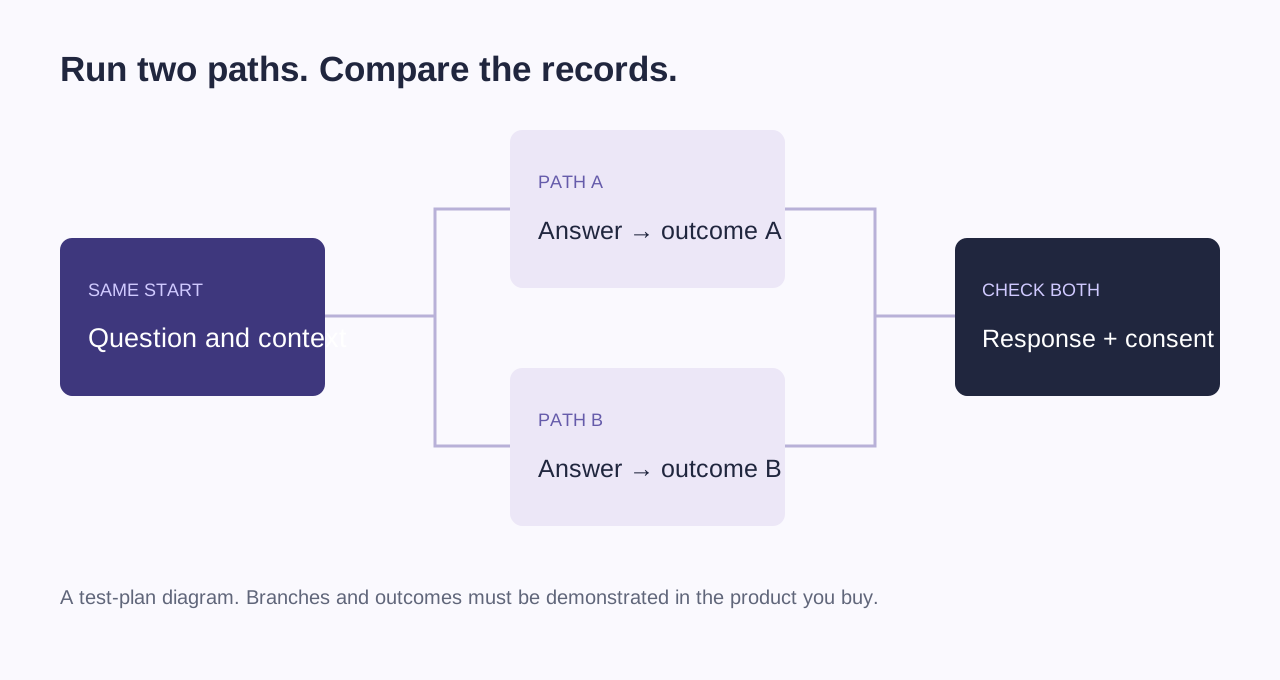
A four-run workshop you can repeat
- Complete the expected path. Answer every required question and confirm the intended outcome and call to action.
- Take the alternate branch. Check that irrelevant questions disappear and the correct result still explains the recommendation.
- Interrupt the session. Refresh, return or close the browser according to the behaviour the seller represents. Record what is retained.
- Inspect the creator record. Compare answers, result, contact information and consent wording with the respondent's actual journey.
The contact form is a decision point, not a compulsory victory screen
Decide why you are asking for a person's details and what you intend to do with them. The wording and timing of that request belong in the product review. A business using the quiz for a consultation may need a different follow-up from an ecommerce brand offering a product suggestion. The software should not force the buyer to hide that distinction behind a generic checkbox.
Inspect what the visitor sees before submitting. Is the requested information clear? Is the next action explained? Does declining optional contact collection still leave an understandable experience where the intended design allows it? If the software supports contact collection before results, after results or no collection, test the option relevant to your use case. Do not infer all three from a sales screenshot.
For a platform buyer, also inspect how the creator's choices are stored and retrieved. You may need to handle response exports, deletion requests and support questions about what appeared on a published quiz. These are product and operating questions. Applicable privacy and marketing obligations depend on the deployment and audience; configure the actual wording and procedures for your own operation rather than assuming a starter's demonstration text is suitable everywhere.
ThatQuis: a focused product with a defined scope
ThatQuis is a quiz-funnel and consented lead-capture SaaS foundation for creators and agencies. Its documented feature set includes editable templates, branching questions, scoring, outcomes, branding and creator analytics. The product also includes workspaces, usage limits, owner controls and software subscription foundations. Read the linked user and technical documents on the ThatQuis marketplace page before requesting a walkthrough.
The product is intentionally more specific than a complete marketing suite. A buyer should not treat it as an email campaign platform, a general CRM or an examination-management system. If your plan relies on a particular outbound integration, certification workflow or enterprise reporting requirement, ask whether it is delivered today and how it is configured. A clear scope helps you judge the foundation without inflating it.
ThatQuis uses rules and curated guidance for features such as template recommendations and funnel checks. It does not need an external generative AI key for those tools. This can matter to a buyer who wants predictable product behaviour and fewer external AI dependencies. It is not a claim that the application will write every quiz, create a marketing strategy or produce customers automatically.

Read analytics through a question you can answer
Analytics are useful when they help the operator make a decision. For a short quiz, begin with a small set of questions: did visitors start, where did they stop, which outcomes appeared, what details did they submit, and which next actions did they choose? Inspect the meaning of each field and the events behind it. Similar labels across products do not guarantee identical definitions.
Use your known test sessions to check the reports. A completed run should appear in the expected place. An abandoned run should not quietly look like a successful lead. Refreshing a page may produce an event without representing a new person. Ask the seller how the product counts sessions and which reports use demonstration data. The important result is an understandable operating signal, not a large number on a dashboard.
A buyer acquiring the platform should distinguish creator analytics from owner analytics. Creators need their own quiz activity. The platform owner needs to understand account access, plan limits, payment events and support issues. These surfaces have different permissions and purposes. A colourful creator dashboard does not prove the owner can investigate a billing or account problem.
Versioning determines whether yesterday's response still makes sense
Quizzes change. A creator corrects a question, adjusts a score or rewrites an outcome. After that change, an older response should still be interpretable. Ask the seller to show what is retained when a published quiz is edited. Does the response refer to a stable version, or is it displayed against the latest wording? Either implementation needs an honest explanation because the buyer may rely on old results in a client conversation.
Make a small edit during the demonstration. Change a label and publish again, then open a response from before the change. Observe whether the history is understandable. If the product supports pausing, archiving or duplicating a quiz, inspect what happens to its public link and its records. A creator should know the difference between hiding a quiz and deleting its evidence.
Also test shared links and access controls that matter to your business. A campaign draft might be public to anyone with the link, limited to a workspace or protected by an access code. Record the actual behaviour. Avoid using the word “private” without naming who can view the content and how that permission can be revoked.
Separate a client workspace from the agency that manages it
An agency may want several client campaigns under one commercial account. That is not the same as several clients sharing all responses. Map the intended relationship before choosing a plan or acquiring the platform. Name who can edit a quiz, view leads, export records, manage a brand and invite another person. Then inspect whether the available workspace and membership model supports that relationship.
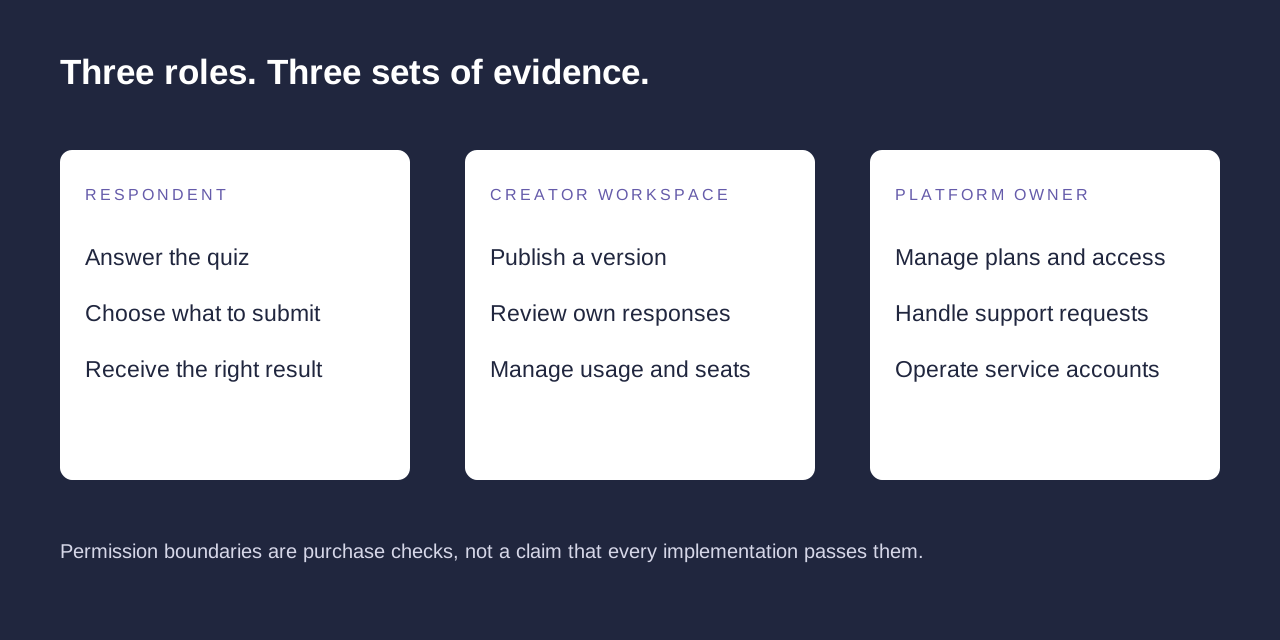
For a source-code purchase, request two test creators or workspaces. Put a recognisable test response in each and ask the seller to switch between them. A creator should not gain access to another workspace simply by opening a familiar URL or selecting an object that belongs elsewhere. This is a practical acceptance question, not a demand for a security claim without evidence.
If you plan to provide managed campaign services, decide what the client receives when your engagement ends. They may need the quiz content, response export, result wording and records of the agreed follow-up. The software's export options and your own service terms should fit together. Buying code does not settle those client arrangements for you.
Plan limits belong in a hands-on purchase test
A platform may advertise several plans, but the buyer needs to know what a limit actually does. Pick one manageable limit for the demonstration. Ask what happens when the creator reaches it: publishing stops, new responses stop, a grace period applies, or the owner receives a notice. A pricing table alone cannot answer that question.
Then inspect a change of plan. The software owner should understand which features become available, which limits change, and what happens to existing content when a customer moves to a smaller plan. If the current billing connection is still awaiting buyer configuration, record the status and request a test plan for that work. Do not confuse a subscription screen with proof that live renewals, failures and cancellations have been exercised.
ThatQuis includes editable plans and usage controls as part of its product foundation. The current asking price, represented financials and agreed transfer assets belong on the current Flippa listing. The buyer should evaluate the application independently from any hoped-for subscription income. The software can define the offer; the operator still needs to reach customers and support them.
Choose what you will sell before estimating what you might earn
A quiz software owner can serve very different customers: independent consultants who need a lead magnet, agencies managing client campaigns, educators publishing knowledge checks, or merchants building product finders. A broad set of use cases is not a substitute for a launch offer. Choose the first audience you can reach and describe what they can achieve with the delivered scope.
Then make the offer concrete. Which templates will be relevant? What does a first successful campaign look like? How much setup help can you provide? Which requests would require custom work? These questions help a buyer identify whether they want to operate a self-service product, a supported software service or an agency offering built around the product.
Which customer relationship fits your resources?
The handover should make a second operator possible
Ask for the repository, setup instructions and required service-account inventory. A buyer should know which accounts must be created or transferred, which settings map the software's plans to payments, and how demonstration content is distinguished from a real creator's records. These details should be understandable to the person who will actually operate the application.
Request a clean deployment walkthrough under the agreed transfer approach. Confirm how to update the application, where failures are reviewed and how to retrieve the data needed for support. If the seller provides technical help, define the scope and the process for asking questions. New campaign strategy, custom integrations and ongoing marketing should not be silently folded into a source-code handover.
Finish by recording the unanswered questions. You do not need every future feature before buying, but you need to know which assumptions your offer depends on. A purchase can proceed with clearly scoped follow-up work. It becomes harder to evaluate when important details remain hidden behind phrases such as “fully automated” or “everything included”.
Your acceptance file: a quiz, its records and a clear transfer list
Save the two answer paths, screenshots of their outcomes and the corresponding response records. Add a short explanation of the contact collection wording, the plan limit you tested and the workspace boundary you inspected. Keep the file small enough that a colleague can repeat the test. It should document what you saw rather than quote the seller's feature list.
For a campaign subscription, this file helps you choose the right service and plan. For an acquisition, it becomes part of the evidence behind the transfer decision. In both cases, the strongest question is whether the product lets you publish a useful quiz and understand the resulting information. Brand styling matters, but it should support that job.
Before you buy quiz software
To inspect a focused foundation, open ThatQuis and request a walkthrough around your own small quiz. To compare other operating models, browse the SaaS businesses for sale collection. Bring a purchase brief with a clear audience and a result you can defend.
When a response looks wrong, follow the evidence backwards
Suppose a test respondent selects a beginner option but receives the advanced recommendation. Do not immediately assume the result engine is broken. Ask the creator to show the published rules and identify the version that respondent used. A correctly functioning rule engine can produce the wrong business recommendation when the author configured the rules incorrectly. The buyer needs an interface and operating procedure that make the distinction visible.
Start with the public outcome, then find its saved response. Compare the submitted answer, the assigned score or outcome tag and the applicable rule. If the configuration is wrong, correct it in a new draft and repeat the test. If the record does not match the submitted information, ask the seller to investigate that discrepancy separately. Avoid editing several settings at once, because doing so removes the evidence that would explain the original behaviour.
This exercise is useful for a non-technical buyer. You are checking whether a creator can understand and maintain a real campaign without treating the application as a black box. If every unexpected result requires a developer to inspect the database, the service you plan to offer may need more support than a simple self-service price suggests. Record that responsibility rather than assuming it will disappear once the product is yours.
What should a useful response export contain?
Open an actual export from the test campaign. Identify the quiz or campaign, the response time, the answers, the outcome and any submitted contact information. If the application exposes identifiers rather than complete labels, ask how the operator resolves them. Check how multiple-choice answers and skipped questions appear. A file that opens in a spreadsheet is not necessarily a file a client can interpret correctly.
Then compare the exported rows with the creator's dashboard. A useful export should have an explained scope: all responses, a filtered period, a particular quiz or the fields selected by the creator. If it excludes incomplete runs, that may be sensible, but the creator should know. If contact details are exported, decide who is authorised to receive the file and where the business will keep it after download.
For an agency, this becomes a handover question as well as a reporting question. Can you provide a client with understandable campaign records without exposing another client's information? Can someone reproduce the same export next month? The product does not need to automate every report to be useful. It should make the delivered data and the remaining human work clear enough that you can sell and support an honest service around it.
Explore the products discussed
Explore related acquisition offers