
Buy micro SaaS for an adult-led family ownership project
Request a software asset your household can understand, divide the real work and keep the purchase under clear adult control.
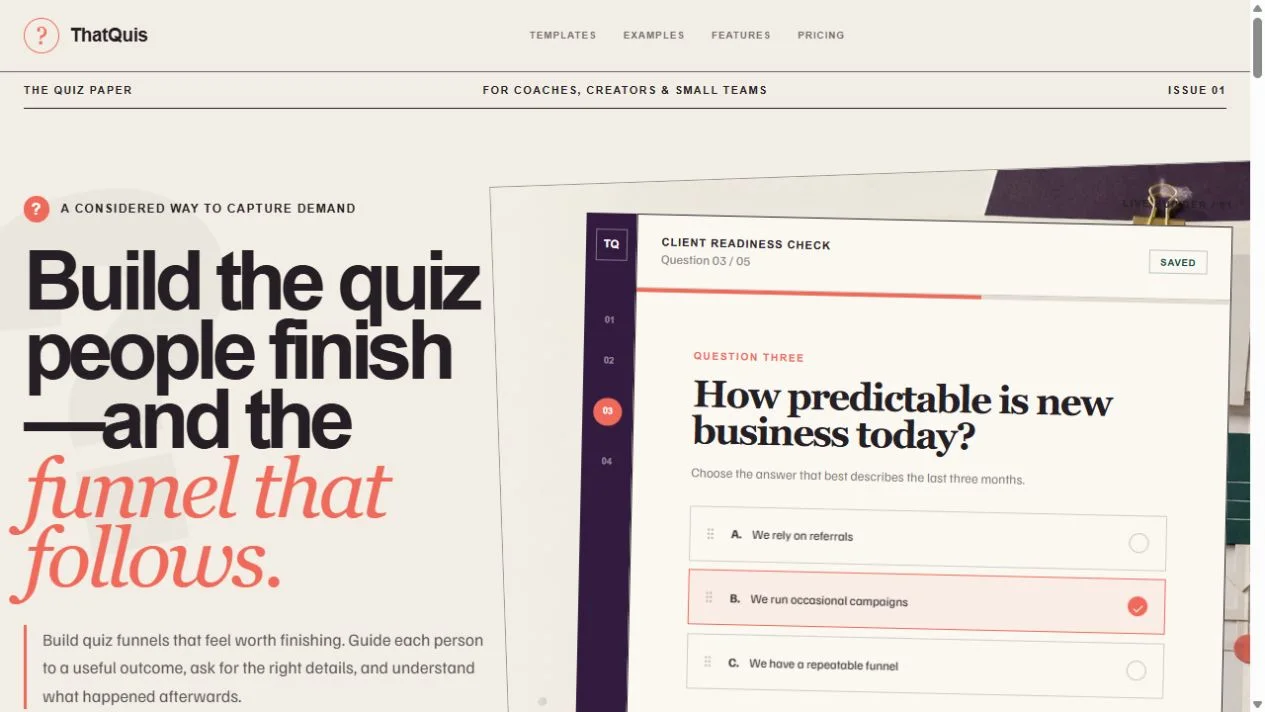
Choose an individual software acquisition from ThatQuis, Macro-Manage or MemoSlide. Request the current asset package, assign family operating roles and agree a small acceptance exercise before making an offer.
Buy a micro SaaS foundation for a practical, adult-led family ownership project. Codeblix offers individual software assets that a household can examine together: request ThatQuis's quiz application package, request Macro-Manage's fee software package, or request MemoSlide's presentation-planning package. Each is a separate sale, with current availability, price and transfer terms to confirm through its own listing.
The opportunity is to own and operate a software foundation. It is not a promise that a child will succeed in business, that a household will earn a particular income or that the application will run itself. A parent considering the purchase should choose a product the responsible adults can understand, fund and maintain. Family participation can then be organized around real tasks rather than a speculative return.
The acquisition brief below is for a household buying one asset and assigning its work. It does not require children to hold business accounts or interact with customers. Spending, access, external services and the transaction itself remain under the control of the responsible adult purchaser. Ask the seller for the asset package that matches your chosen product, then use the role and acceptance details here to define the purchase.
Choose one product your household can explain in a sentence
Begin with a product whose ordinary purpose is understandable to the people who will work on it. ThatQuis supports quiz funnels for creators and agencies. Macro-Manage helps organizations track fees. MemoSlide turns written memos into structured presentation plans using deterministic tools, without requiring an external AI key for that planning workflow.
These are different customer relationships. A household familiar with a club or tutoring operation may find fee records easier to discuss than marketing funnels. Someone who prepares presentations may be more comfortable examining MemoSlide. Someone who works with creators or agencies may understand the purpose of a branching quiz. Familiarity is useful because it gives the buyer concrete questions to ask.
Do not buy all three because the names fit a broad plan. Start by requesting the package for the one application whose users and workflow you can describe. Each sale has its own scope and transfer process. The comparison helps choose a candidate; it does not create a combined offer, a shared licence or a guaranteed customer base.
| Asset | Everyday purpose | A household advantage to name | First seller request |
|---|---|---|---|
| ThatQuis | Quiz funnels for creators and agencies | Experience with campaigns, questions or audience qualification | Show a quiz from creation to its result and relevant usage limits |
| Macro-Manage | Organization fee tracking | Familiarity with clubs, classes or membership administration | Show a fee record, payment recording and the organization controls |
| MemoSlide | Memo-to-presentation planning | Experience preparing written material and slide narratives | Show a memo becoming editable presentation sections and slides |
If nobody can explain who would use the product, request a demonstration before discussing an offer. If the purpose is clear but an essential feature is not documented, ask about that feature specifically. A simple explanation of the customer and workflow is more useful than choosing an asset because it sounds automated.
Put an adult owner beside every consequential task
A family project benefits from clear responsibility. The adult purchaser should control the acquisition budget, the business accounts and decisions about customer commitments. Other family members may help examine content, test a sample workflow or organize notes, but the operator must know who can approve spending, publish changes and grant access.
Separate participation from authority. Someone can help check whether a quiz question is understandable without controlling billing. Someone can test a presentation outline without receiving administrator access. Someone can help prepare a sample fee exercise without seeing actual customer records. Use fictional demonstration material when the task does not require real data.
The seller should know who will receive the technical handover. If the adult buyer will use a contractor, identify that person before acceptance. If an adult family member can handle deployment, have them read the technical documents and prepare setup questions. Do not leave the technical role unassigned on the assumption that a website is simple to maintain.
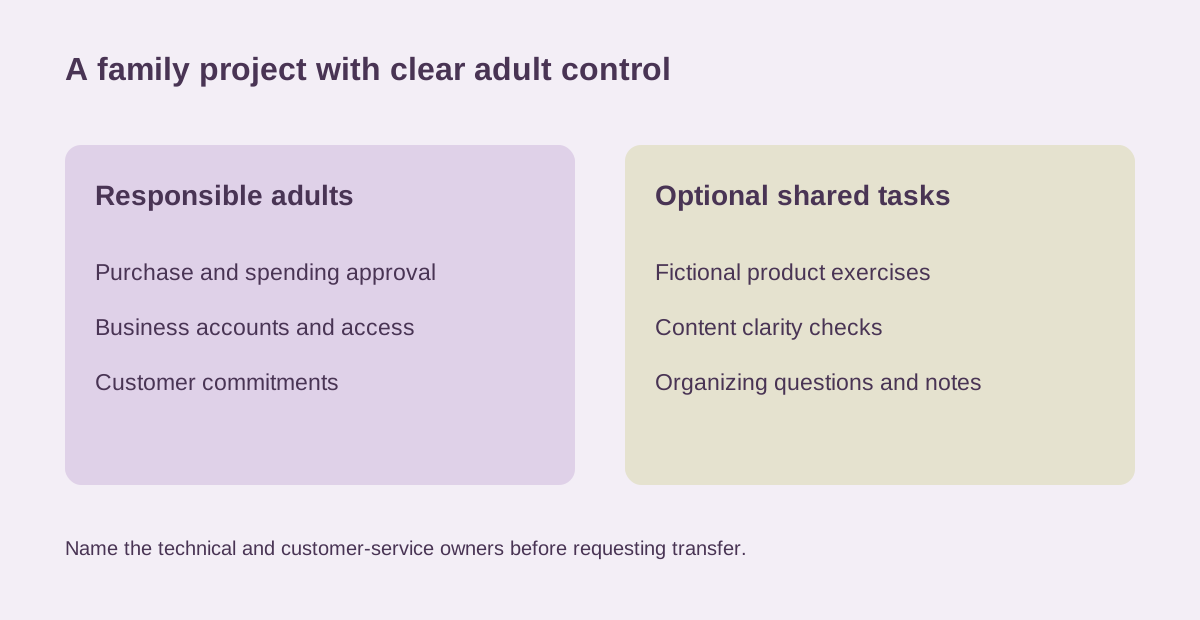
- Name the adult who approves the purchase and ongoing service costs.
- Name the person responsible for deployment and technical maintenance.
- Name the person who answers customer or organization questions.
- Define which content and test tasks can be shared safely.
- Keep administrator access limited to people who need it.
Bring this role sheet to the seller conversation. It helps determine whether you need only the asset transfer or a separately agreed setup service. It also prevents a common mismatch: buying software for a family project while assuming that somebody else will quietly own every task after launch.
The purchase price is one decision; ongoing spending is another
A small software asset can still require recurring expenditure. Hosting, external services, domain renewals and technical help should be understood before purchase. Ask the seller to identify the services required by the chosen application, then obtain quotes or write clearly labelled assumptions for your own budget.
Do not use a hypothetical subscription forecast to make the costs appear affordable. A family purchase should have a spending limit that the adult buyer can support without assuming future customers. If the sale includes established commercial performance, inspect the dated evidence separately. A starter asset should be assessed as the foundation actually offered.
Agree how new spending will be approved. An additional feature, a new external service or a larger hosting plan should not become an automatic purchase because somebody in the household is excited about an idea. Put the request beside the original purpose of the acquisition and decide whether it is necessary, affordable and within the team's capacity.
| Cost category | Evidence to obtain | Adult decision before purchase |
|---|---|---|
| Asset and agreed setup | Current asking terms and written inclusions | Maximum acceptable commitment for the package |
| Required services | Documented accounts and supplier pricing | Who pays and who receives account notices |
| Maintenance | The team's capability or a contractor's scope | Who handles routine changes and problems |
| Optional new work | A separate specification and quote | Whether it is needed before the first customer offer |
The budget is not an earnings calculator. Its purpose is to make the ownership commitment visible. If the adults cannot agree who approves ongoing costs, settle that before buying. A clear spending routine makes the acquisition easier to manage regardless of which product you choose.
Request a sample project that matches the chosen application
A family should be able to repeat a small product exercise after handover. For ThatQuis, that might be a fictional quiz with a few questions, a branching choice and a result. For Macro-Manage, it might be a sample organization with a fee record and a recorded payment. For MemoSlide, it might be a short fictional memo transformed into a structured presentation plan.
These exercises should use sample material and should not create real customer obligations. Their purpose is to help the buyer understand the delivered workflow. Ask the seller which account roles and plan limits affect the exercise. Record the steps so another responsible person can repeat them.
Then identify the difference between using the product and operating it. Creating a quiz is not the same task as maintaining the application. Recording a sample fee is not the same task as supporting organizations. Planning a presentation is not the same task as managing individual and team subscriptions. The buyer must understand both sides before making an offer.
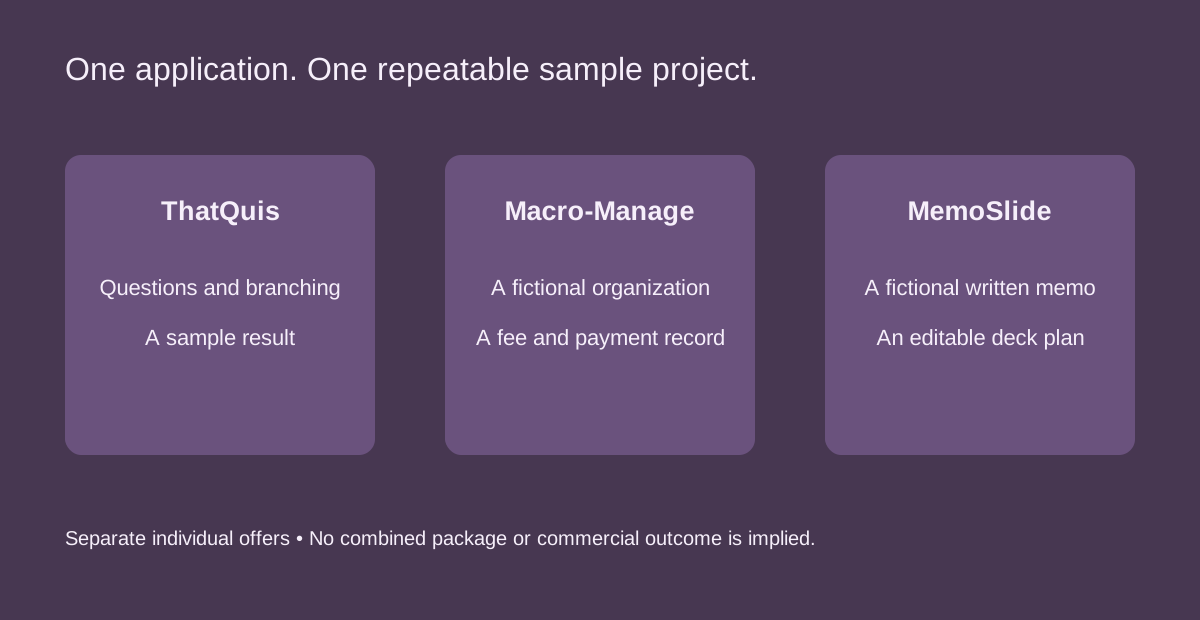
Ask for a demonstration of the present product. If your preferred exercise requires a feature the seller cannot show, record that as additional work. Do not turn an educational idea into an assumed software inclusion. The final purchase should identify the application delivered and the acceptance journey agreed by both parties.
Match the family purchase to the work adults can sustain
The choices below identify the next acquisition enquiry based on the experience in the household. They are starting points for contacting the seller, not recommendations about financial returns. Select the role that best describes the adults who would own the product.
Request the ThatQuis package first. Ask to see quiz creation, branching and results, along with Free, Pro and Agency plan limits. Confirm the actual transfer and service-account scope.
Request the Macro-Manage package first. Ask to see fee tracking, organization access and payment recording. Keep the application's tracking role separate from any payment or accounting service you require.
Request the MemoSlide package first. Ask to see the deterministic memo-to-deck workflow, individual and team roles, and the current subscription configuration. Confirm the delivered output and handover responsibilities.
If none of these roles fits, browse the available online business assets with a clearer household brief. It is reasonable to wait until the adults can identify an audience, a product purpose and an operator. The point is to buy an asset the family can responsibly own, not to force a purchase because software is available.
Keep fictional exercises separate from customer evidence
A family project may involve testing and learning. Use fictional names, content and records for those exercises. Demonstration accounts and sample results explain the interface; they do not establish a paying audience or a reliable income stream. Ask for current commercial evidence through the sale if that evidence affects your offer.
Before accepting the asset, identify which demonstration materials should be replaced or removed for launch. Ask which images, text and other materials are included in the transfer and what rights apply. A polished public preview can contain sample content that is useful for inspection but unsuitable as your own live business data.
The same distinction applies to screenshots used in the acquisition discussion. A screenshot can show a feature or account state. It does not prove that an independent customer paid for the service. If you are relying on revenue, traffic or customer claims, request dated records that support those exact claims.
This is especially useful in a household purchase because enthusiasm can make a demonstration feel more established than it is. Keep a short record of what was shown, what was evidenced and what remains part of your own launch plan. The adults can then make the offer using the same facts.
Read the documents before assigning the technical role
Open the chosen asset's marketplace page for its linked user and technical documentation: ThatQuis, Macro-Manage or MemoSlide. Ask the person responsible for deployment to read the technical material before the transfer is complete.
That person should identify the required accounts, configuration values and deployment steps. They should also know how routine maintenance will be handled. If they cannot complete those tasks, request a defined setup service or arrange suitable technical help before agreeing an acceptance date.
The adult purchaser should understand the resulting access map even if someone else performs the setup. Domain registration, hosting, repository access and external services should have named owners. Keep recovery and billing notices routed to accounts controlled by the responsible adults. The handover should not depend indefinitely on a seller-controlled account simply because the demonstration works there.
- Select one application and request its current asset package.
- Assign the adult purchase, technical and customer-service roles.
- Read the documents and list required buyer-owned accounts.
- Agree the transfer sequence and the sample acceptance exercise.
- Repeat the exercise in the buyer-controlled environment.
- Keep the handover notes where the responsible adults can find them.
A practical role sheet is easier to maintain than an informal understanding that everyone will help. It also makes it easier to involve a contractor for a defined task without handing over unnecessary control of the business.
Separate a useful first offer from a growing wish list
Family discussions can produce many ideas: a new theme, a different audience, another integration or a new subscription tier. Keep those ideas in a separate list while you assess the advertised asset. The acquisition should be understandable without assuming that every idea is implemented.
Choose the smallest customer offer that uses the demonstrated product and fits the adults' capacity. For ThatQuis, that means understanding the actual quiz and plan controls. For Macro-Manage, it means understanding the fee workflow and organization roles. For MemoSlide, it means understanding the planning output and collaboration boundaries. Ask about additional requirements separately.
A new feature should have an owner, a scope and a budget before it becomes part of the launch. A design preference can wait if the core customer journey already supports the offer. An essential missing workflow cannot be ignored simply because the public page looks complete. The buyer's decision should distinguish those cases.
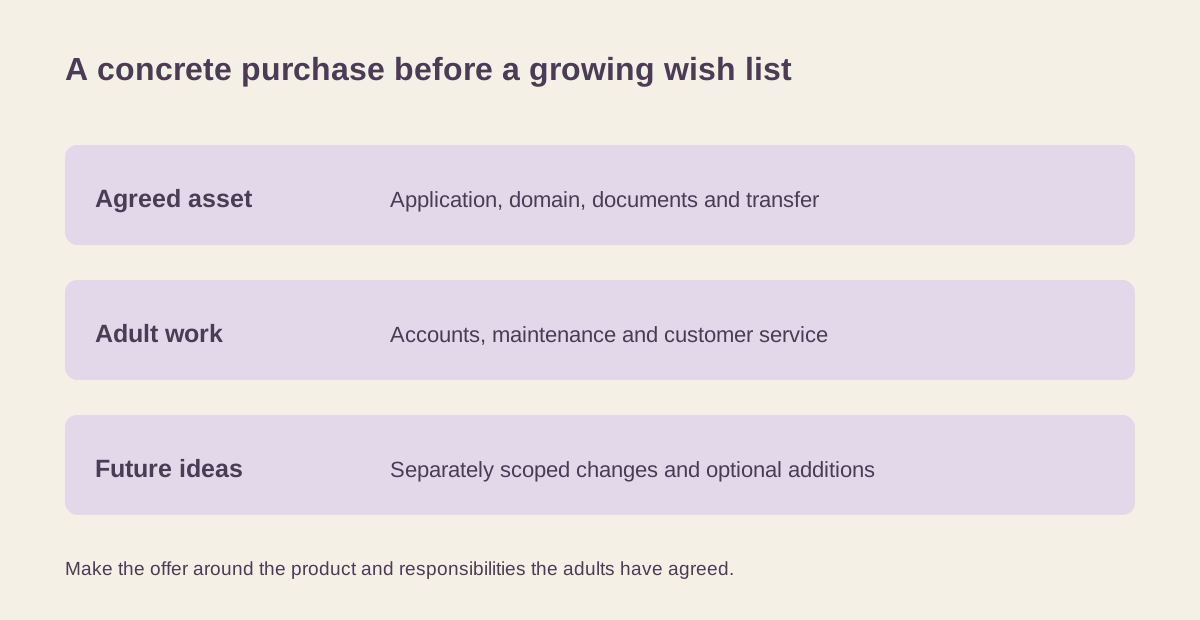
This keeps the project realistic without removing room to improve it. The family can still develop the asset over time, but the purchase is based on something concrete: a product, a transfer scope and a team that knows what it will do next.
A campaign-minded household can request a quiz asset
Consider a hypothetical family in which one adult works with small-business campaigns and another is comfortable with application maintenance. The first adult can describe why a creator might want a quiz. The second can examine the deployment documents. Their purchase enquiry for ThatQuis can therefore be specific: show the quiz workflow, explain the plan limits and identify the buyer-owned services needed to operate it.
The shared exercise could be a fictional campaign quiz using no customer data. One person writes the questions and intended result. Another enters the content and follows the published journey. The responsible adult compares the result with the intended path and records any gap. This tests whether the family understands the workflow without pretending that the exercise is a real marketing result.
Before making an offer, the adults should also decide who would handle an actual creator's question. If the commercially experienced adult cannot provide ongoing support, the technical adult should not silently inherit that responsibility. The purchase brief should name the support owner and the initial service promise. ThatQuis remains a separate asset offered on its own terms; the family exercise does not add implementation services to the sale.
An administration-minded household can request a fee asset
Now consider a different household in which an adult already helps administer a club or classes. They understand fee schedules, member questions and the need for clear records. That familiarity may make Macro-Manage a more understandable acquisition candidate than a product whose customer problem is unfamiliar.
The fictional exercise could use a sample organization, a stated fee and a recorded payment. Ask the seller to show the organization roles and the record views. The family then repeats the agreed exercise under buyer control. The point is to understand the application's tracking purpose, not to treat it as an accounting qualification or a promise that the software collects every payment automatically.
Keep the demonstration separate from real organization data. If the adults later want to serve actual organizations, they must understand the access, support and configuration requirements of that offer. The adult who knows the administrative problem can help define the acceptance criteria, while the technical owner confirms how the product is deployed and maintained. If either role is missing, arrange it before the purchase.
A writing-minded household can request a planning asset
A third household may have strong experience preparing written material but little interest in campaigns or fee administration. MemoSlide can provide a different acquisition conversation: the buyer wants to own a product that turns memos into structured presentation plans for individuals and teams.
Use a fictional memo about an ordinary project. Ask the seller to show the deterministic planning workflow and the editable sections and slides it produces. Then have a second adult inspect whether the resulting structure reflects the memo. This is a product acceptance exercise, not a judgement that every presentation will be persuasive or ready for delivery without editing.
The adults should request the actual individual and team controls if those matter to their intended customer offer. They should also identify the services required to operate the application. The memo planning workflow does not require an external AI key, but that does not remove hosting, maintenance or customer support responsibilities. A clear technical handover still matters.
Let a second responsible operator repeat the acceptance exercise
A useful family purchase check is whether another responsible adult can repeat the agreed sample project using the handover notes. They should not need the first operator to improvise every step. If a step is missing, add it to the notes or ask the seller to clarify it before acceptance.
This check is about continuity. The person who enjoys exploring software may not always be available when a customer question arrives or an account notice needs attention. The adults need a shared understanding of where the relevant records and instructions are kept. They also need to know which actions require technical help rather than an ordinary account setting.
Write down the actual result of the repeat exercise. Identify the application version or delivered repository, the sample account role and the workflow completed. Record unresolved questions separately. This turns the acquisition into an agreed product handover with accountable owners, rather than a household plan dependent on one person's memory.
Send the seller a purchase brief the adults agree on
Your first message can name the chosen application, explain the adult operating role and request the current package. Add the essential workflow you want demonstrated and any setup help you need. There is no need to claim a business forecast or promise that the family will expand the product immediately.
Ask for the current price, availability and financial representation. Confirm the domain, source, documents and other agreed assets. State any essential additional requirement separately so the seller can explain whether it is included, configurable or new work. This gives both sides a clear transaction to discuss.
To proceed, contact Codeblix through the individual sale: ThatQuis, Macro-Manage or MemoSlide. Confirm the package and current terms before making an offer. The SaaS acquisition collection remains the place to compare the wider set of available software foundations.
Explore the products discussed
Explore related acquisition offers