
Buy a quiz business for your service company's enquiry channel
Acquire an owned rules-based first conversation, with company-approved outcomes and a person responsible for the next step.
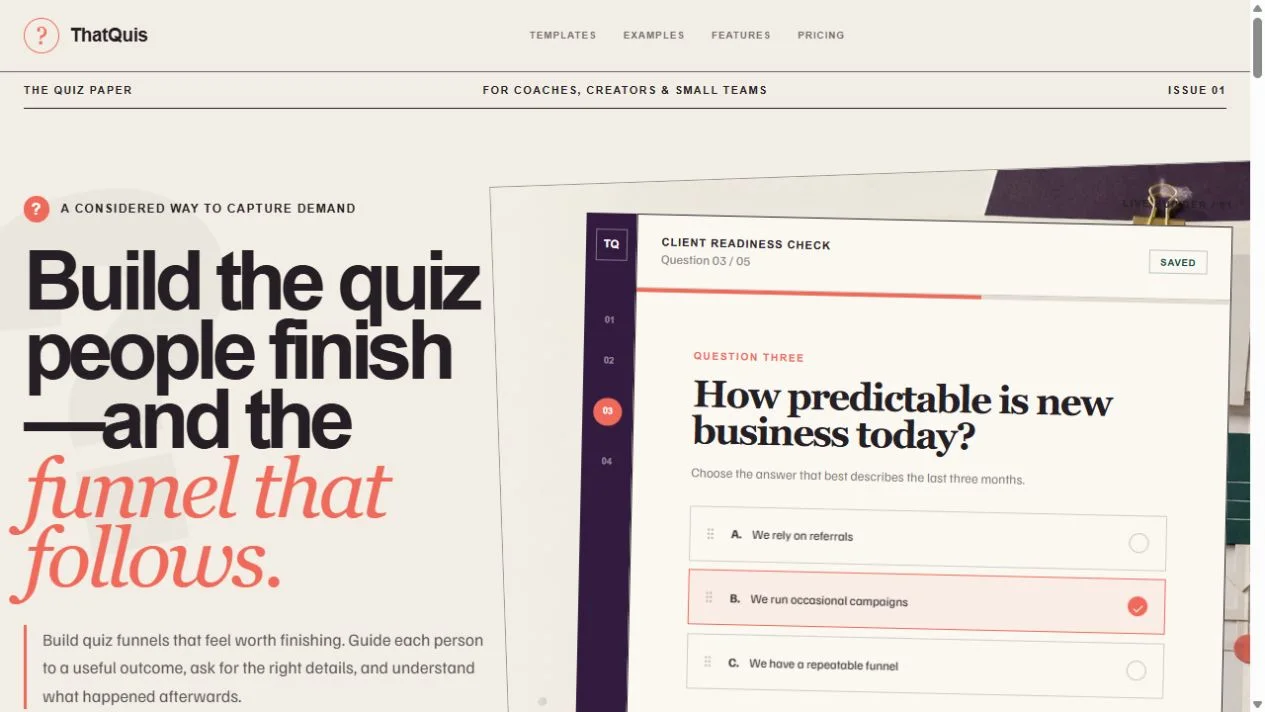
Buy the ThatQuis software and domain foundation for your service company's own enquiry channel. Request a seller walkthrough around approved questions, outcomes and permitted human follow-up.
Buy ThatQuis as the foundation of an enquiry channel your service company owns. Request the current ThatQuis domain and application-source package on Flippa. An existing renovation, maintenance or other home-services business can assess the whole software asset for its own rules-based enquiry journey. Confirm availability, price, rights and transfer terms with Codeblix before making an offer.
The purchase considered here is ownership of a quiz application, rather than a request to buy customer leads. Your company would supply its own audience, questions, approved outcome wording and people to handle enquiries. The documented product provides branching questions, scoring, outcome rules, branding, consent controls and creator analytics. Those tools can support a defined enquiry route when the buyer accepts their actual behaviour.
Use the worked renovation-company purchase case below to prepare your seller conversation. It distinguishes someone ready to speak with a person, someone still defining a project and someone whose requirement falls outside the company's service. These are proposed authored routes to demonstrate, not evidence of an existing lead campaign or promises about the number of enquiries you will receive.
Acquire a controlled first conversation with the customer
A service company considering this asset already has a different commercial goal from a new SaaS operator. It wants its own prospective customers to reach the right next conversation. It does not need to promise that every visitor will subscribe to quiz software. Write that ownership purpose into the purchase request.
For the renovation case, the first promise could be: answer a short set of project questions and see which next step the company can offer. The quiz can use approved rules to present that step. A person still needs to assess the actual project, confirm whether the company can help and make any subsequent commercial proposal.
Ask the seller to demonstrate a public quiz route and the corresponding creator response view. The purchase test should connect the answers entered, the outcome displayed and the information available for permitted follow-up. An attractive question screen is useful, but the buyer's acceptance point is the complete first-conversation journey.
The service-company mandate for the ThatQuis purchase
| Purchase element | Mandate for the worked service-company case | Separate owner contribution |
|---|---|---|
| Application and domain | Acquire the agreed ThatQuis source and domain package | Agree the intended brand, deployment and rights in the sale |
| Question route | Demonstrate project-type and readiness questions using current builder controls | Approve the actual questions and the services the company offers |
| Outcome wording | Show the authored result produced by the agreed rules | Decide what the company can honestly promise next |
| Enquiry handling | Inspect the response and consent information currently available | Provide the person and routine for permitted follow-up |
| Further connections | Identify anything beyond the current delivered application | Price and accept any requested CRM, website or scheduling work separately |
This mandate keeps the asset offer concrete. The company is buying a software foundation with an agreed transfer, while keeping its service promise and customer work under its own authority. It does not imply that the software seller supplies the company's audience, sales staff or professional service.
A worked renovation enquiry worth showing to the seller
Suppose your company handles a defined range of renovation projects. A visitor knows the broad type of work they want, but your team needs to understand whether the visitor is ready to discuss it. Use a fictional project to demonstrate a route through the current ThatQuis builder.
The route might ask which broad service is relevant and whether the visitor wants a conversation now or is still preparing the project scope. The buyer must approve those choices. If the company's actual service boundaries require another question, ask whether the current builder supports the needed format and show it in the walkthrough.
Keep the example deliberately modest. It should not calculate a construction price, assess a building's condition or decide whether a project is technically feasible. Those are different service responsibilities. The acquisition test concerns whether the application can guide a visitor toward an appropriate next conversation using your company's own authored rules.
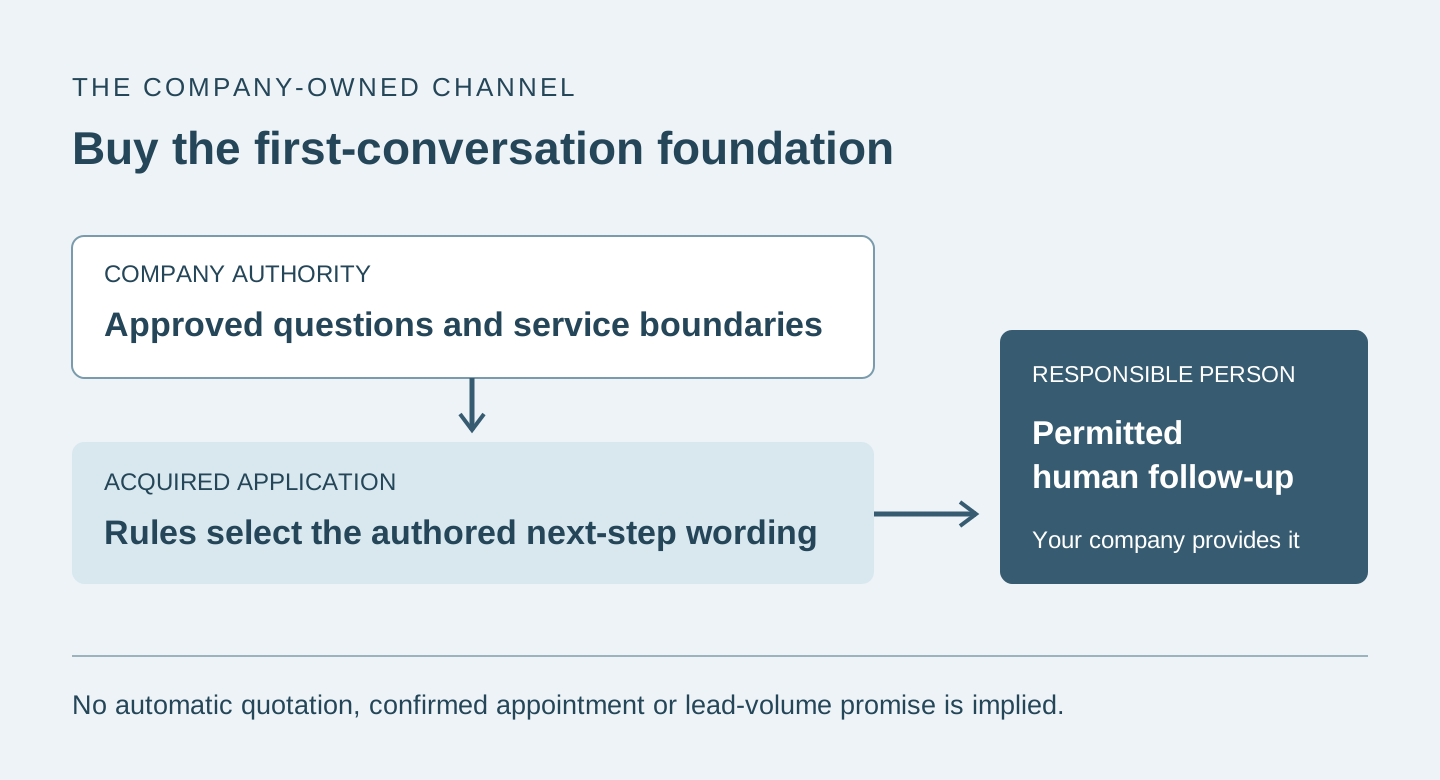
Route one: a visitor wants to discuss a project now
For a visitor ready to talk, the outcome can invite the next permitted contact step. Write the actual wording you want the seller to demonstrate. It should describe a request for a conversation and identify what the company will do after receiving it. A displayed invitation is not a confirmed visit or a signed service agreement.
During the walkthrough, submit the fictional answers and inspect the resulting outcome. Then examine the creator's response view. Ask where the approved contact information and consent choices appear, what the responsible operator can see and which part of the follow-up remains a human action.
If you require a particular delivery method or connection to another system, state it explicitly. Do not infer an automatic CRM record, calendar booking, text message or contractor assignment from a quiz response. Accept the current delivered journey first, then agree the fields and behaviour of any additional connection as a separate requirement.
Route two: a visitor is still preparing the project scope
A visitor may have a relevant project without being ready for a sales conversation. Your company can author an outcome that explains the next information it would need before discussing the work. The buyer needs to decide what that information is and approve the text. The application is presenting the company's rule, rather than independently assessing the project.
Use this route to judge whether acquiring the software would improve the enquiry promise you can actually keep. A useful result might tell the visitor to prepare a short description before contacting the team. It should not imply that a personalised professional assessment has already been completed.
Ask the seller to change one fictional answer and show the resulting route. Record which rule selected the outcome. The purchase should leave your company able to understand and maintain those decisions. A rule that nobody in the business can explain is a poor basis for a public customer promise, even if the quiz is visually polished.
Route three: the requirement is outside the company's service
An existing company often knows what it cannot take on. The quiz purchase case should include that boundary. A fictional visitor might select a type of work that the company does not offer. The authored result should make the scope clear without pretending that a professional has evaluated the visitor's property.
The buyer can request a demonstration of the appropriate outcome and the response record behind it. Ask whether the wording remains understandable if the visitor returns to change an answer. Check that the company can identify which version of its questions and rules is currently public using the controls actually delivered.
Keep referral arrangements separate. A link to another business, a paid lead transfer or a contractor recommendation would be an additional commercial promise requiring its own authority and implementation. None is supplied by this worked acquisition case. The immediate objective is a clear boundary for the service company's own enquiry channel.
Choose the enquiry promise your purchase must demonstrate
Select a route to reveal the corresponding seller-walkthrough request. The tool prepares an acquisition brief; it does not collect real project details, make a booking or submit an enquiry to your future business.
Ask Codeblix to show fictional answers leading to approved contact wording, followed by the response and consent information available to the responsible operator. State separately any requested CRM or scheduling connection.
Bring text your company can approve, then ask for the current rule that displays it. Keep project assessment, price estimates and professional advice outside the quiz promise.
Show the fictional answer that falls outside your service and inspect the resulting wording. Do not assume an included referral agreement, contractor recommendation or lead resale service.
Buy authority over the wording without inventing an expert system
ThatQuis uses rules and curated content rather than requiring a generative AI key. The documented builder includes branching, scoring and outcome rules. For this acquisition, that gives the company a specific maintenance responsibility: someone must approve the questions, answers and outcomes and understand how they connect.
A numerical score should have a defined internal meaning if you choose to use one. It might organize your company's enquiry handling, but it does not establish a professional judgment about a building or the value of a customer. The purchase walkthrough should show the actual rule and the resulting text, with a plain explanation your team can retain.
Request the ThatQuis user guide and technical handover document. Use them to distinguish the included builder from the company's own content decisions. The software asset can transfer with documentation; responsibility for the public service promise remains with the new owner.
Keep permission to follow up visible in the purchase test
The documented product includes consent controls. Ask the seller to show their current configuration and the information retained with a response. Your company needs to decide the purpose of any requested contact information and the permitted next action. Use fictional contact details during the sale demonstration.
Test the routes with and without the relevant optional choices, according to the current product's settings. Inspect what the creator can see afterward. A completed quiz and a permission to contact the visitor are different facts. The buying decision should make the operator's actual evidence visible rather than assume that every response becomes an unrestricted sales lead.
Record the access and retention requirements your company needs, then check them against the delivered controls and the agreed launch arrangement. Additional reports, deletion routines or integrations must be demonstrated or scoped explicitly. This purchase brief does not establish that a particular configuration satisfies every market's requirements; approve your actual operating arrangement before making it public.
Match the response view to a person who will use it
Name the role that will examine the company's enquiries. A service manager may need a different working view from the person editing public quiz text. Ask the seller to show the roles and response access currently available. If your intended separation needs additional controls, put those controls in a specific requirement.
Use the same fictional enquiry to inspect the whole handoff. The responsible person should be able to understand the visitor's answers and the outcome shown. Ask how the existing product lets that person find the response again. An application purchase is more useful when the future operator can connect the public journey to a manageable record.
Also agree the human routine around that record. Decide when enquiries are examined and how the company handles a question while its usual operator is unavailable. Those are staffing decisions for your business. They should not be disguised as automatic features of the acquired source package.
Purchase a route that handles the visitor's revised answer
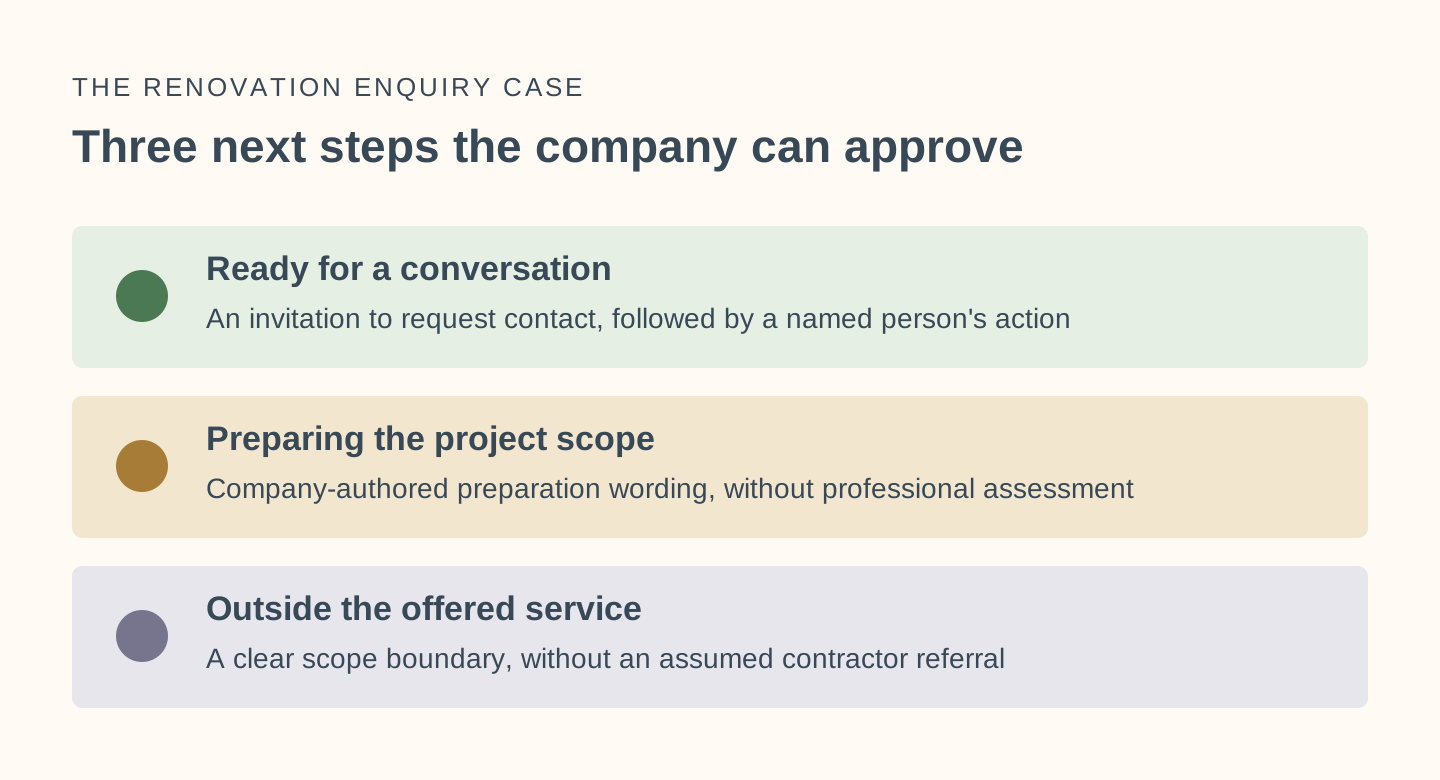
Include a visitor who changes their mind in the worked case. They might first request a conversation and then decide they need to prepare the project description. Ask the seller to demonstrate the current navigation and response behaviour for that change. Record which outcome is shown and which answers the operator receives.
The company needs to understand the resulting record before relying on it for follow-up. A previous invitation to speak should not be confused with the visitor's later choice. Use the product's actual demonstrated behaviour to decide the operating routine. If the current flow does not meet a requirement, describe the correction and request a bounded proposal.
Also submit a separate fictional response that starts with a similar project but falls outside your company's service. Ask the person who would handle enquiries to read both records. They should be able to explain the next action for each without treating a quiz score as a contract or assuming a site visit has been booked.
Reconcile the marketing promise with the service team's authority
The person preparing the public invitation may be different from the person responsible for doing the work. Bring both perspectives into the acquisition decision. A marketing owner may want a quick, welcoming route, while the service manager needs the next-step wording to respect actual project boundaries and current capacity.
For the renovation example, ask those owners to approve one short outcome for each visitor state before asking the seller to configure a demonstration. If they disagree about what the company can offer, resolve the business promise first. Purchasing editable software does not settle an unfinished service policy.
Then assign who can approve a later change. This is the company's operating decision, separate from any application role or approval feature. Ask the seller which controls exist today and list any additional workflow you require. The purchase can proceed against a clear scope while preserving an honest distinction between an agreed staff routine and a delivered software control.
Retain the approved wording with the acceptance record. It explains why the company selected the route, what its operators are expected to do and what the customer has actually been invited to request. That context helps your team maintain the channel after the repository and domain have transferred.
Accept a changed question before accepting the asset
The company may change its service scope after purchase. Include one such change in the seller walkthrough. Edit a fictional question or outcome using the current controls, inspect the resulting public experience and verify the answers that select it. This is a concrete test of ownership rather than a request for a broad feature list.
Ask which person should approve a change and how the buyer can identify the content currently published. A statement that source code is editable does not answer the everyday publishing question. The purchase should leave the company with a repeatable way to maintain its agreed customer route.
Keep additions bounded. A new question format, unusual scoring rule or separate approval process may need further development. Record the expected result and ask for a proposal. The price of the existing application and the cost of a new workflow can then be considered independently.
Separate your company channel from ThatQuis's creator plans
The acquired application has editable Free, Pro and Agency plans with usage limits and billing controls. Those foundations concern the software's creator offering. Your company's immediate buying purpose may instead be to own and operate its own enquiry route. Agree how that purpose fits the delivered application and the rights transferred.
Do not assume that an asset purchase automatically removes every usage condition from a particular deployed configuration. Ask the seller to demonstrate the relevant limits and the owner controls. Specify the intended account arrangement, customer access and any changes needed for your company's use before treating them as included.
Likewise, selling quiz access to unrelated companies would be another commercial activity. The source package may support the documented creator model, but your company would need to decide whether it wants to operate that service. Keep the first acquisition mandate clear so the seller can demonstrate the route your business actually intends to launch.
Approve the ownership spend independently of future leads
Request the current asking terms for the domain, repository and included documentation. Separately estimate hosting, required service accounts, setup, technical maintenance and the people who will approve content and handle enquiries. Use the selected application's actual requirements and quotes for any additional work.
The company should decide whether that ownership commitment is worthwhile without assuming a particular number of new customers. A configured quiz does not establish visitor traffic, completed projects or future sales. Existing audience relationships and a permitted distribution route are contributions your company must identify and support.
Compare the complete purchase with the business purpose approved by your own decision makers. If you only need a temporary campaign, discuss the full ownership commitment before bidding on the asset. This offer concerns acquiring an application foundation; the relevant value is the package your company can use and maintain under the agreed transfer.
Write the first public invitation your company can keep
The invitation that brings visitors to the quiz should describe the outcome accurately. For the worked case, the company can invite a visitor to identify a suitable next conversation. It should not promise an instant quotation, confirmed visit or professional assessment unless those are separately supported services with an accepted implementation.
Bring that invitation to the seller walkthrough together with the questions and the three outcome texts. Read the entire journey as a prospective customer. Check that the result matches what the invitation led them to expect. A clear invitation reduces the gap between acquiring a functioning product and using it as a credible company channel.
Plan where the invitation will appear using your own approved distribution channels. A new link, placement or brand treatment on an existing company website may require separate work. Ask for the delivered public quiz route and scope any additional connection explicitly, rather than infer that the acquisition includes changes to another system.
Record the service-company acceptance before submitting an offer
Mark a condition when it has a demonstrated result or a precise written purchase requirement.
Keep the selected application release, the demonstrated quiz route and the agreed transfer scope together. They give the seller a defined package to deliver and give your team a starting point for operation after ownership changes. Confirm the current support scope and buyer-owned accounts through the sale process.
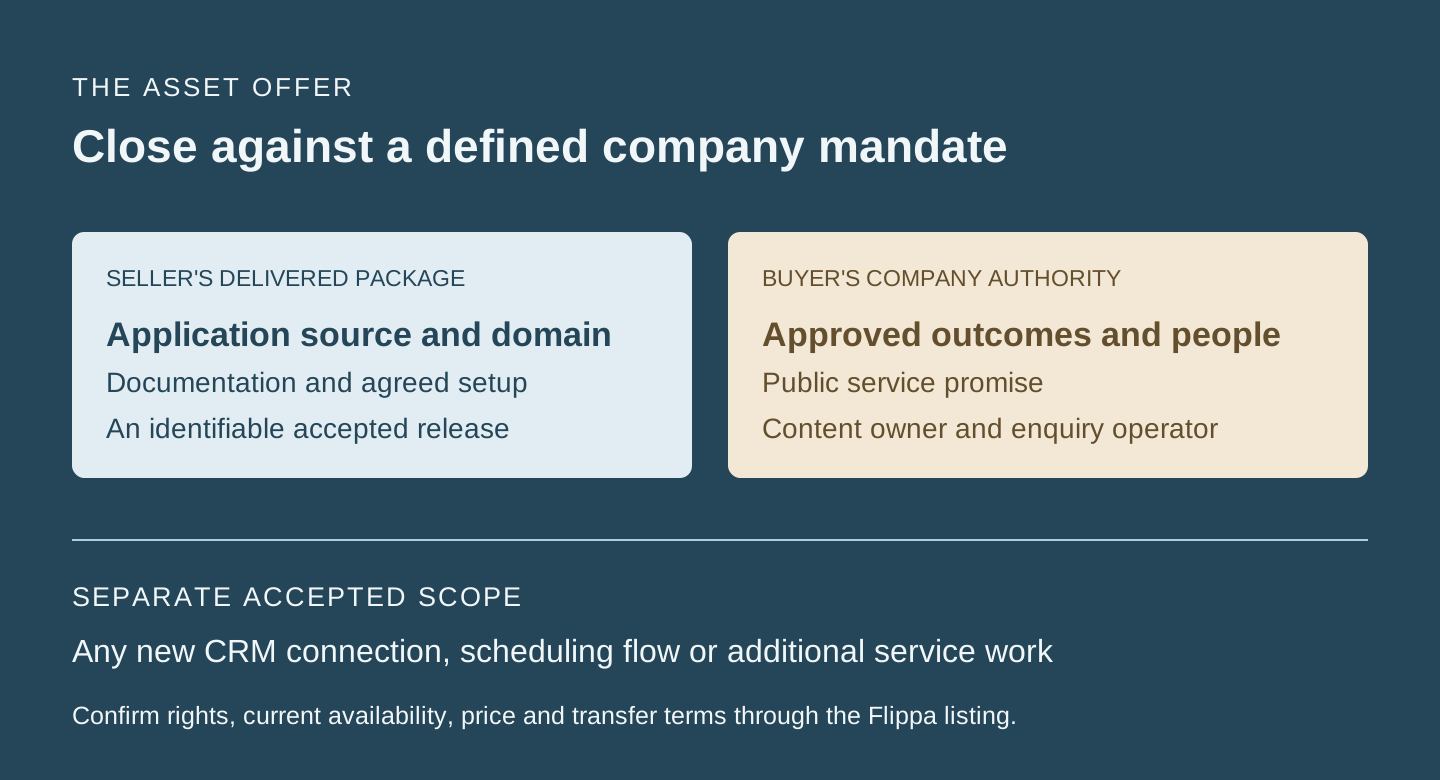
Request the ThatQuis asset for your own enquiry mandate
- Confirm the current application, domain and rights offered for your intended company use.
- Bring a fictional service enquiry and approved wording for each next-step result.
- Watch the current rule select its outcome and inspect the retained response information.
- Agree the people responsible for content authority and permitted follow-up.
- List additional connections separately, with their required fields and accepted behaviour.
- Complete the agreed transfer against the demonstrated release and support scope.
Use the ThatQuis marketplace listing to review the documented package, then open the current Flippa sale to discuss a defined acquisition offer. Send the service scope, a fictional question route and the next-step wording your company wants demonstrated.
Buy the source and domain foundation on the terms agreed with Codeblix, complete the accepted setup and give the enquiry route a responsible owner. The result you are purchasing is a maintainable software channel for your company's own first conversation, with future distribution and service delivery kept as explicit business responsibilities.
Explore the products discussed
Explore related acquisition offers