
Buy source code to extend an existing software product
Acquire a complete application, then agree the rights and engineering for your extension.
Buy ThatQuis or MemoSlide source and domain for a defined product extension. Separate the existing app from adaptation rights, shared identity and integration work.
You can buy software source code through the individual Codeblix offers for ThatQuis and MemoSlide. Each is an existing application with its own domain, interface, data model and product documents. An engineering team considering either asset as the basis of an extension to an existing product should request the complete acquisition package, then agree the rights and engineering work separately. Neither offer should be read as a ready-made integration into your application.
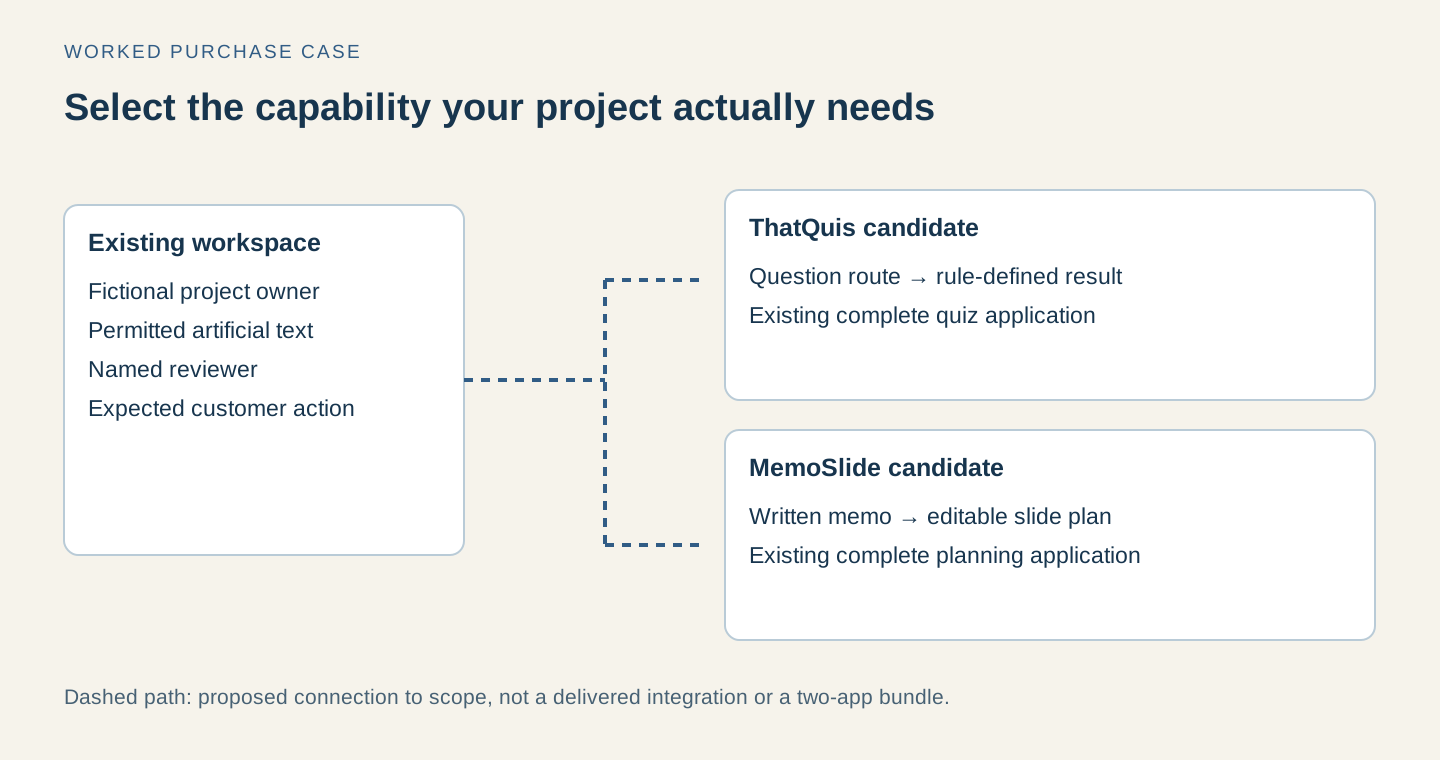
This purchase case is for a company that already operates software. It wants a particular customer workflow, rather than another standalone brand to market. The worked buyer below runs a fictional project workspace and is considering a questionnaire journey or a memo-planning workspace. The company, its users and its project are examples. The two Codeblix applications are real, separate acquisition candidates. Buying one does not deliver the other.
Request the existing application before specifying its future integration
Request the ThatQuis source-and-domain offer on Flippa → Request the MemoSlide source-and-domain offer on Flippa →
Use the ThatQuis acquisition page and MemoSlide acquisition page to inspect the individual packages, current availability and documents. The broad ThatQuis product acquisition brief and MemoSlide product acquisition brief cover ownership of those products as businesses. Here the purchasing decision is narrower: whether your existing engineering organisation should acquire a complete application and fund its adaptation.
Ask Codeblix to identify the repository, domain, documentation, transferable assets and agreed assistance in the sale. Explain the intended adaptation before negotiating. Written confirmation should distinguish ownership of the application from third-party dependencies, customer content and any modification or redistribution permissions you require. Do not infer an unrestricted OEM licence, an embeddable component, a public integration API or a delivered single-sign-on connection from the presence of source files.
The workspace vendor is buying a capability boundary
Consider a vendor whose existing product stores project briefs. Customers can write notes and assign work, but the product does not turn answers into a branching result or turn a written memo into a presentation plan. The vendor can commission a new implementation, buy access to another hosted service, or investigate acquiring an application it can own and adapt. This article concerns the third transaction. It does not claim that an acquisition will be cheaper or faster for that particular vendor.
The purchase request should name the missing customer action. “We need more features” cannot guide an acquisition. “An authorised project owner needs to ask several questions, follow a rule-defined route and approve an outcome before another employee reads it” is a usable starting point for ThatQuis. “An authorised project owner needs to structure a written decision memo into an editable slide plan” is a different starting point for MemoSlide. Those are distinct outcomes, so the buyer should not purchase both merely because they share a technology stack.
Next identify where the proposed action begins and ends in your current product. A project page might link to a separate application first. A later project might place a new user interface inside the existing workspace. A deeper integration might share identity and selected records. These are buyer design choices, with different work and permission requirements. None becomes part of the delivered sale simply by appearing on the buyer's roadmap.
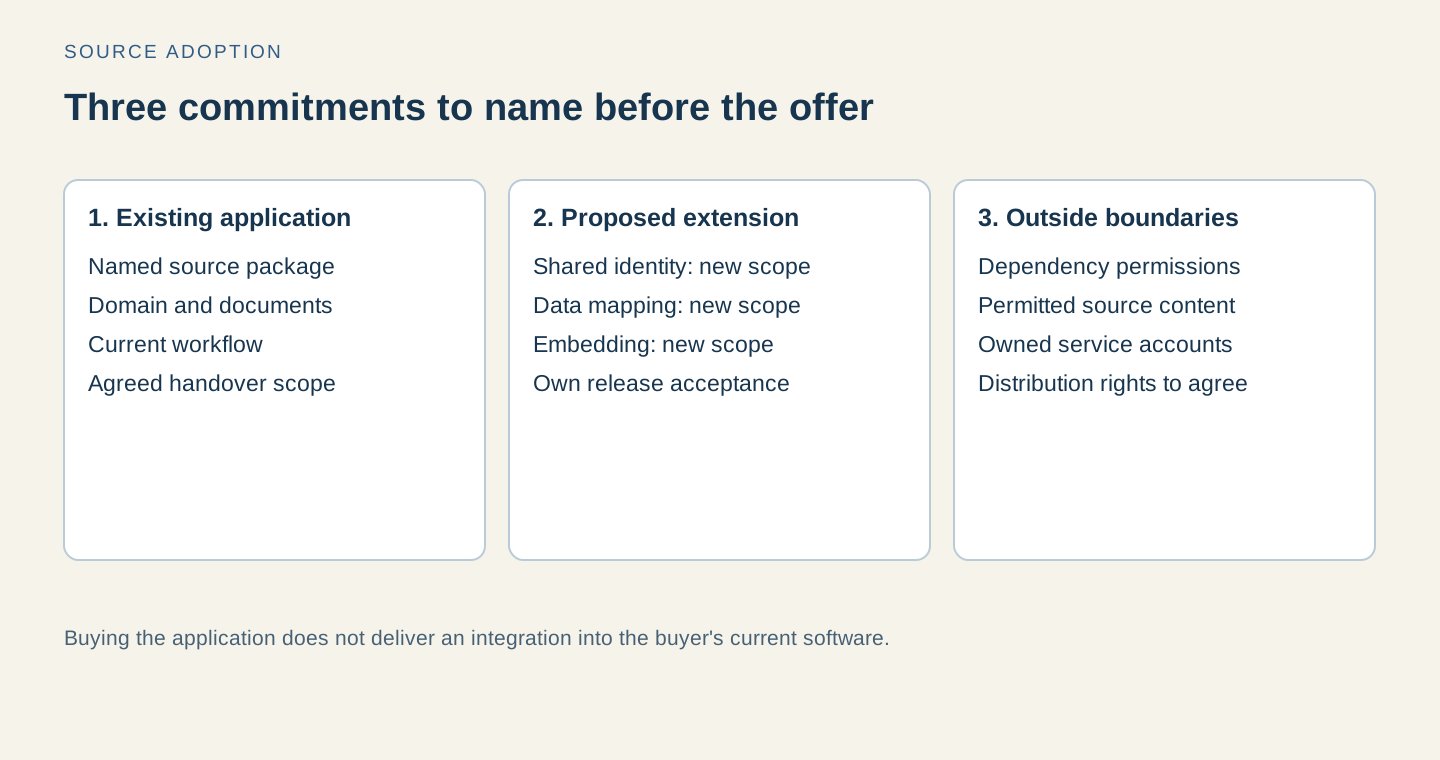
Choose the questionnaire journey only when the result is the product need
ThatQuis is a quiz-funnel and consented lead-capture application. Its documented product includes editable templates, branching, scoring, outcomes, versioned public quizzes, resumable respondent flow, creator workspaces, usage controls and software subscription foundations. This gives an engineering buyer an actual workflow to investigate, rather than a set of screenshots advertised as a reusable module.
For the fictional workspace vendor, the possible value is a question-to-result journey. Its product manager should supply a small questionnaire with a route that changes after an answer. The seller can demonstrate how the current ThatQuis application represents that route and result. The buyer then records which parts it wants to preserve, which parts conflict with its current product, and which parts require a new implementation. A demonstration of a published quiz does not prove an integration into the vendor's project permissions.
The application also includes consented lead capture. Your intended extension might not need marketing leads at all. That difference matters to the acquisition decision: the team should investigate whether adapting the existing journey is sensible while explicitly reviewing any consent, export and analytics behaviour that would change. Removing a screen does not automatically remove the underlying records or scheduled actions. The purchase case should include a change inventory, not an assumption that everything outside the desired screen can be ignored.
Choose memo planning when the written source must survive the extension
MemoSlide occupies the space between a written memo and a presentation. It accepts plain text and Markdown, detects structure, supports narrative frameworks and slide planning, and provides team review and exports. Its planning workflow is deterministic; no generative AI key is required. It is not represented as a full PowerPoint clone, automatic image generator, meeting transcription service or external document-drive connector.
The workspace vendor might want a project decision memo to become a draft slide plan while preserving the author's source material. That is a reason to inspect MemoSlide. It is not a reason to assume the current project database can be attached without changes. The buyer should demonstrate the existing import and planning flow first, then define how an authorised memo would enter that flow from its current software. The resulting product extension may need a deliberate copy, a reference, a synchronised record or something else; the sale should not silently choose that architecture for the buyer.
Read the MemoSlide user guide and technical handover document before the purchase workshop. They give the team a common description of the application it is buying. Your desired future interface belongs in an additional specification, with a clear distinction between current behaviour and proposed work.
Put the delivered app, your changes and outside rights on three separate lines
| Delivered complete application | Buyer modification to agree | Outside right or service to verify |
|---|---|---|
| ThatQuis quiz authoring and respondent workflow | Opening a permitted questionnaire from an existing project page | Rights to adapt the acquired code and any included templates |
| MemoSlide memo import and editable slide planning | Supplying selected project text through a new connection | Permission to use the source memo and any brand material |
| The acquired app's existing identity and workspace model | Mapping your product's account and permission model | Buyer-owned authentication and backend service arrangements |
| Existing application billing and plan controls | Deciding whether the extension uses your current product entitlement | Merchant ownership and the actual agreed commercial rights |
The middle column is essential. Without it, a purchase document can appear to promise the future integrated product while the seller is delivering a complete standalone application. Your engineering lead should describe each proposed change in ordinary customer terms and identify the relevant part of the existing application. The seller can then confirm whether it is included, separately quoted, left to your team or outside the agreed work entirely.
This record also makes a refusal useful. If the intended redistribution right is unavailable, or a required dependency cannot be used in the proposed arrangement, the buyer learns that before committing to the wrong asset. Do not treat a blank answer as permission. Confirm the specific sale documents and dependency terms with the responsible parties rather than importing a generic source-code licence from another marketplace purchase.
Keep the first adoption proposal smaller than a product merger
A complete product merger changes many things at once: navigation, account ownership, data access, subscription entitlement, support, deployment and customer expectations. The buyer does not need to promise that merger in order to discuss an acquisition. It can propose a first independently accepted adoption stage and reserve later integration for a separate decision.
For the fictional vendor, that first stage could be a buyer-owned copy of the acquired application used with artificial project material. The original application workflow remains recognisable. The team learns whether it can maintain the product and whether the desired capability actually solves its customer problem. This is a proposed buyer acceptance arrangement, not a claim that Codeblix has already configured the vendor's environment.
A link between two separately operated products is also not shared authentication. If the buyer chooses an initial separate login, describe it honestly. If its customers require a continuous signed-in experience, make that a delivery requirement with an agreed implementation and test. The acquisition can still be appropriate, but the team must buy and accept the actual work it needs rather than present a future connection as an existing feature.
Use one permitted project to expose the data-model mismatch
Bring one small fictional project to the purchase workshop. Give it a project owner, one reviewer and a written decision. For a ThatQuis adoption, include several answers and an expected rule-defined result. For a MemoSlide adoption, include a short memo with a supporting fact, a proposed action and a section that should remain attached to the plan. These examples should be small enough that the team can explain every record.
Now identify the current application object for each part of that example. A project in your existing software is not automatically a quiz workspace, and a document is not automatically a MemoSlide project. Ask where the application stores ownership, content, revision and access. Then write a proposed mapping. If two current-product objects would become one acquired-app object, identify the consequence before the team writes an adapter.
Finally, mark the direction of every proposed data movement. Is the acquired application receiving a copy that can later change independently? Does the buyer expect updates to travel both ways? What happens when the original project is archived? These are design requirements to price and accept. The current sale does not represent automatic synchronisation, a conflict-resolution service or a supplied connector to the buyer's database.
Account mapping is a product decision before it is a login task
The buyer's current customer contract may organise people by company, team, project or individual account. The acquired application has its own access rules. Before choosing a technical connection, decide which person should own the new work, who may review it, and who may recover it if that person leaves. An email address appearing in both systems does not establish those permissions.
Use the fictional owner and reviewer to describe the intended outcome. The owner might be allowed to change a questionnaire while the reviewer may only inspect its result. In the memo case, the reviewer might comment on a plan without changing the underlying source. Check the current application roles in a seller demonstration, then identify any differences from your intended product. Keep unsupported permissions or additional administrative controls in the change scope.
This is also where the team should resist a shortcut that shares an unrestricted service account between applications. An acquisition does not justify making every current-product user a platform administrator. The acceptance record should name the permitted customer action and the account that performs it. Your engineering team remains responsible for designing and reviewing any new connection it builds.
Decide which subscription promise the extension will make
ThatQuis and MemoSlide have their own software plan foundations. Your existing product may already charge its customers under a different model. Buying the code does not merge those commercial relationships. The team must decide whether the acquired app remains a separately sold product, becomes an included capability under an agreed existing plan, or takes some other explicitly scoped form.
For the fictional vendor, a customer who already pays for its project workspace should not discover an unexplained second entitlement halfway through a promised feature. Equally, the team should not remove the acquired app's billing interface and assume all usage limits have vanished. Identify what currently grants access, which controls remain after adaptation, and how the new customer promise will be tested.
Keep financial representation separate. These offers are software assets to assess through their current individual listings; demonstration workspaces and plan screens do not establish recurring customers or earnings. The buyer's planned integration revenue is a future business decision. Do not use an imagined conversion rate or a comparison with your existing company revenue as proof of the value delivered by the acquisition.
Check the right to adapt each layer you intend to reuse
An application can contain code, templates, example content, icons, fonts, photographs, brand files and externally provided packages. The right to transfer or modify one layer does not answer the question for every other layer. Ask for the actual package inventory and the applicable terms. Your intended use should be written in the acquisition conversation so the seller can identify what can be agreed.
For a codebase extension, the most useful distinction is between operating the existing application and distributing a modified capability inside another product. Do not assume the transaction grants an unrestricted right to resell copies, offer an OEM licence or sublicense third-party assets. If one of those rights is necessary, make it an explicit condition to resolve with the seller and the relevant rights holder before purchase.
The same discipline applies to the buyer's materials. A sample memo supplied by a prospective customer is not automatically authorised for a permanent product demonstration. A questionnaire copied from another vendor is not automatically yours to commercialise. Use material you are entitled to provide, and keep the rights inventory attached to the worked adoption example rather than trying to reconstruct its origin after integration.
Accept the purchased baseline independently of your modified release
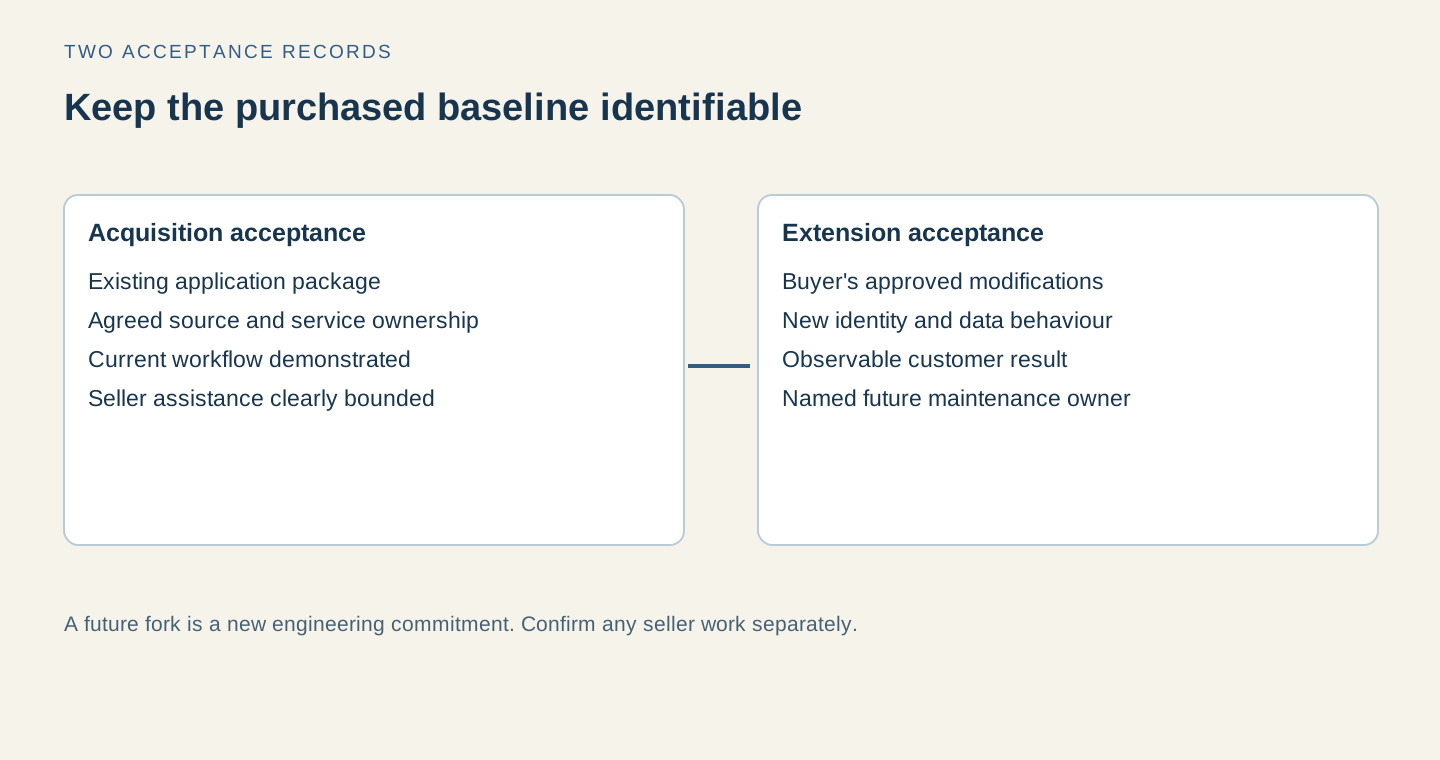
The acquisition should leave the team able to identify the application it received. Agree the repository state and application package included in the transaction, together with the service ownership arrangement and demonstration used for acceptance. The buyer can then distinguish a fault in that baseline from a change introduced by its own integration project.
This matters when an extension changes behaviour deliberately. Your current product might use different navigation, plan names or export destinations. A later observation that the integrated version differs from the original application is not enough to explain whether something is wrong. Keep the accepted baseline, the approved change and the expected customer outcome together in the adoption record.
Ask the seller to describe the agreed handover assistance and its finish point. Do not treat a source acquisition as an indefinite obligation to maintain your future fork. If Codeblix will perform additional integration work, obtain its specific scope and acceptance separately. If another engineering team will do it, provide that team with the same baseline record and rights constraints before it estimates or starts changes.
Buy the first useful change with an observable customer result
After choosing a candidate, define the smallest proposed extension that would justify the acquisition for your product. In the questionnaire case, the result might be an authorised project owner completing a chosen question route and receiving the expected result in an agreed location. In the memo case, it might be an authorised owner supplying permitted text, reviewing the resulting plan and opening an agreed export.
Do not describe that first result as “integrated successfully.” Write what the customer can do, which original application behaviour must remain intact and which newly agreed behaviour is being accepted. Include an exception: a person without access, an unavailable source project or an input that does not meet the accepted format. The buyer is purchasing a usable capability, so its acceptance example should include the boundary of use.
This keeps the acquisition decision commercially clear. If the team cannot identify a useful initial result without replacing most of the application, it should reconsider whether this is the right purchase. If the existing workflow closely matches the intended capability and the rights and adaptation scope can be agreed, it has a concrete basis for an offer. Neither outcome requires a speculative savings claim.
Give the engineering buyer an explicit stop condition
Before requesting a final offer, write the condition that would make your team decline this particular purchase. For the fictional workspace vendor, one condition might be an unresolved right needed for the intended modified distribution. Another might be a proposed data connection that requires replacing the very workflow the team wanted to acquire. These are reasons to pause this adoption proposal, rather than silently turn it into a much larger implementation commitment.
Apply the condition to the actual example. If the team wants a questionnaire result to remain attributable to the original question version, its proposed project mapping must preserve that meaning. If it wants a memo-derived plan to remain editable independently, its customer promise must explain when the plan stops following the source. The team should be able to describe the resulting customer behaviour before accepting an integration estimate.
A seller demonstration can establish the current application's behaviour. Your proposed change record explains what you intend to buy or build beyond it. When the two do not meet, ask for a revised scope or choose another route. Buying complete software is useful only when your company is prepared to own the resulting product decision as well as its repository.
Complete the source-adoption purchase record
Use this record before making an offer for either application. A checked item means your team has an answer and knows where the evidence or agreement belongs. It does not grant a right, prove an unbuilt connection or replace the seller's current transaction terms. Leave an item open when the answer depends on additional work.
- Choose the questionnaire or memo-planning outcome and open that application's individual sale.
- Give the seller the proposed adoption record, including the intended modification and rights questions.
- Agree what is delivered in the acquisition and what remains a separate engineering commitment.
- Accept the purchased baseline before presenting a future integrated release to your customers.
Request ThatQuis on Flippa if the question-to-result workflow is the capability you want to acquire. Request MemoSlide on Flippa if written-source planning is the relevant foundation. Bring a specific adoption proposal to the transaction so the delivered application, the intended rights and your future engineering work can each be agreed clearly.
Explore the products discussed
Explore related acquisition offers