
Buy a custom-fashion platform for your concierge operation
Acquire AfroZeal around the private brief and a clear managed introduction.
Request AfroZeal for an existing bespoke-fashion concierge. Follow the occasion brief, owner queue and separately agreed proposal through a worked purchase case.
Buy AfroZeal's domain and application for an existing bespoke-fashion concierge operation. Request the current individual software package through the AfroZeal Flippa listing. This acquisition case centres on Commission a Piece: a customer supplies a private occasion brief, budget, timing and fit notes, and a human operator manages the introduction to a suitable maker.
The buyer in this example already understands bespoke work and brings its own permitted customer and maker relationships. The sale concerns the digital platform and agreed transfer work. It does not transfer a tailoring team, artisan contracts, a customer network or a guarantee of fit and delivery. The buyer's purchase decision is whether the existing request record and owner workflow fit the managed service it is prepared to sell.
Request AfroZeal around the managed introduction you intend to operate
Request the AfroZeal application and domain package →
Use the AfroZeal acquisition page and individual AfroZeal purchase brief to inspect the overall asset. The technical handover document provides further product and setup context. Confirm current availability, price, represented finances, included source and domain, and the assistance covered in the actual transaction.
The documented application also contains listed-product commerce, artisan storefronts, payment foundations and six Gemini-assisted tools. The current Artisan Pro price is zero and configurable; demonstration accounts establish no subscription income. The concierge fee has a configurable default of twenty-two percent, while the public service description applies a separately agreed fee after a managed proposal. The request flow is not represented as an automatic bespoke-fee checkout, fitting approval system or production scheduler.
The concierge buyer has a different promise from a catalogue retailer
A catalogue customer chooses an existing listed item. A bespoke customer begins with a desired piece and an occasion, then needs a person to assess the request and arrange a suitable conversation. An existing concierge business buying AfroZeal for this second promise should inspect the request path directly. The whole application is offered, but the purchase mandate can still centre on one defined operating service.
Consider a fictional concierge whose customer wants a garment for a family celebration. The customer has a target date, a budget range and preferences for material and colour. The concierge knows makers it is entitled to approach and wants an owned channel for receiving the request and tracking its handling. Neither the fictional people nor those relationships are assets supplied by Codeblix.
The buyer's useful outcome is a clear brief that an authorised person can evaluate, with an understandable record of its stage. That gives the seller a concrete demonstration to prepare. It also lets the buyer judge the application against its existing service rather than assume that a broad fashion marketplace automatically manages every part of bespoke production.
Give the fictional customer enough context to submit a usable brief
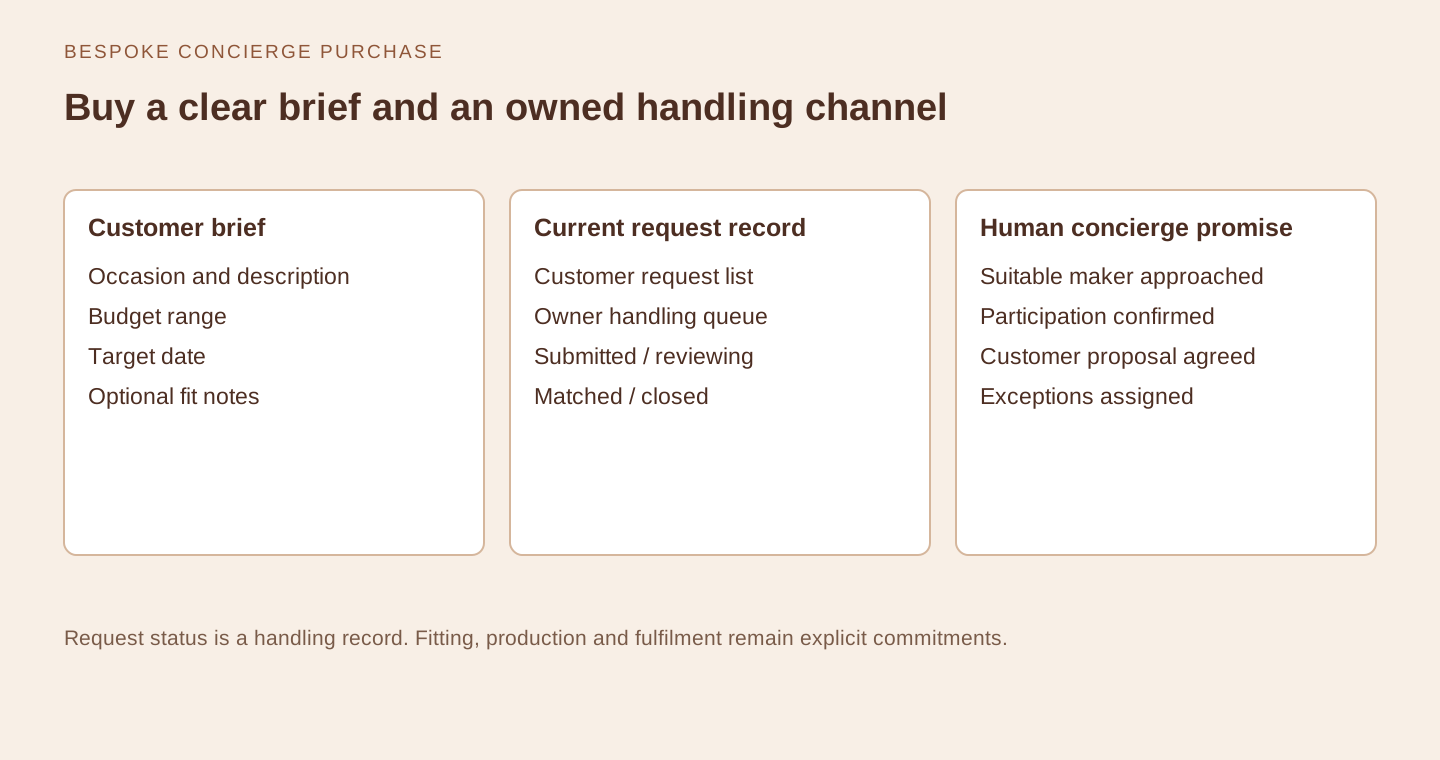
The current Commission a Piece form asks for the occasion or purpose, target date, a description, minimum and maximum budget, and optional measurement or fit notes. The inspected source validates a sufficiently clear description and a coherent budget range. Ask the seller to demonstrate those actual fields with artificial information the buyer is permitted to use.
For the fictional celebration, the customer describes the garment's purpose and the material preferences they already know. A useful test includes one point that requires a human question, such as whether the target date is the event itself or the latest acceptable arrival date. The concierge should be able to recognise that question from the submitted information and identify its next action.
Keep the first purchase example small. One clear occasion, one customer account and one named human operator are enough to connect the form with the owner's request view. The buyer can then expand its operating scope deliberately after it understands what the delivered application records and what its own concierge procedure must maintain.
Use a custom-piece promise schedule in the acquisition workshop
| Customer information | Current application record | Human commitment to identify |
|---|---|---|
| Occasion and desired piece | Occasion and description | Who decides whether the request fits the concierge's service |
| Budget | Minimum and maximum amounts | Who agrees what the proposed service and fee will cover |
| Timing | Target date | Who confirms feasibility with the maker and customer |
| Fit information | Optional measurements or notes | Who obtains the maker's actual fitting requirements |
| Suitable maker | Current request and owner handling | Who is authorised to approach and confirm the chosen maker |
| Managed proposal | Actual demonstrated controls and any separate record | Who approves the customer promise and agreed concierge fee |
Use the schedule to connect the actual fields with the work the buyer already knows how to perform. The seller can demonstrate the application record and its permitted views. The concierge can describe the human decision that follows. Any additional control needed to join those two belongs in the agreed scope, with a clear expected result.
Keep the same artificial request in view throughout. The owner should recognise the occasion, budget and timing the customer submitted. The buyer then has a traceable example for deciding whether this application can become its owned front door for bespoke enquiries.
Inspect the submitted request from the customer's own account
The source provides a customer's request list with the occasion, description, budget range and status. Ask the seller to return to that view after submitting the fictional brief. This connects the public service proposition with the customer's record and gives the buyer something specific to inspect on a later visit.
Read the page as the customer would. Can they identify the request they made and the stage currently shown? Does the description provide enough context for them to recognise the correct occasion? The buyer should discuss any wording it wants to change as part of the agreed configuration or additional work, keeping the customer promise aligned with the actual status behaviour.
Use a second artificial customer to inspect the normal account boundary in the authorised walkthrough. The purchase discussion should establish how the current application protects and presents each person's request. Keep genuine fit notes and personal customer material out of this test until the buyer has accepted its service and account arrangement.
Let the owner queue represent the work it actually tracks
The inspected request model includes submitted, reviewing, matched and closed states, with owner controls for updating the status. Ask the seller to demonstrate a change on the fictional request and inspect the corresponding customer view. This is a practical way to see how the concierge can show progress through its handling queue.
Agree what each label will mean in the buyer's operation. Reviewing might mean the operator is checking the brief. Matched should have a clear human definition for the introduction the concierge has arranged. Closed should be used consistently with the operator's record. The application state describes the request; the maker's actual acceptance, production and fulfilment remain commitments to establish.
Write the agreed definitions beside the promise schedule. A new operator should be able to explain the next human action for each state. If the buyer wants additional milestones, fitting approvals or production events inside the application, specify those separately rather than overloading one request label with an entire garment-delivery process.
Keep the maker's participation explicit in the managed proposal
The concierge's existing relationships are useful because it knows whom to approach and which questions to ask. For the fictional garment, it needs the maker to consider material availability, technique, fit information and timing. The buyer should identify where its own operating record retains the resulting answer and how that answer becomes the customer's proposed service.
Ask the seller to show the current request and any relevant provider information in the demonstrated release. Then state which introduction and maker confirmation work the concierge performs outside those controls. This lets the buyer evaluate a realistic managed operation without inventing an automatic provider-allocation or artisan-acceptance system.
The acquisition example should end with a named responsibility, not a vague statement that the platform found a designer. The concierge needs to know who may commit the maker, who communicates with the customer and who handles a request that the first maker cannot accept. Those are concrete business duties the buyer can assign before it purchases the application.
Agree the budget range and the concierge fee as different information
The customer form stores a budget range. That helps the human operator assess the request, but the final managed proposal still needs to say what the customer is agreeing to purchase. The buyer should ask how its own procedure will describe the garment, the concierge service and any separately agreed charges.
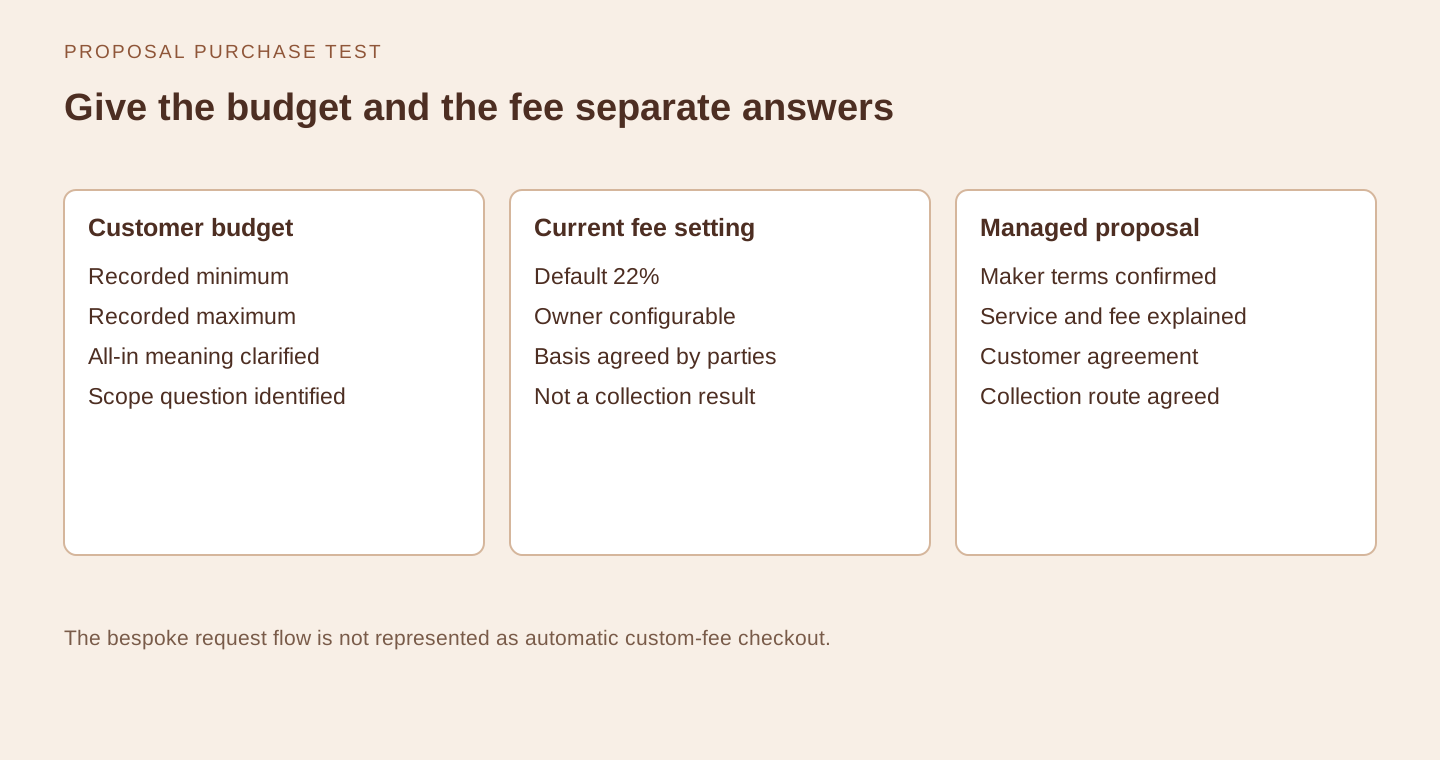
The default configurable concierge percentage is twenty-two percent in the current source. Treat that as a setting to inspect and discuss, not evidence of fees already collected or automatic charging in the bespoke request path. The public service description applies the separate fee after a managed proposal is agreed. The buyer needs a specific collection and evidence procedure for its intended offer.
Ask Codeblix to demonstrate the owner setting and explain the current collection boundary. Then place any requested custom-fee payment automation in the additional-work schedule. This keeps the purchase commercially clear: the buyer acquires the actual brief and handling application, while the agreed transaction identifies any further payment implementation it requires.
Work an all-in budget question before accepting the proposal
Use simple fictional arithmetic to test the human proposal procedure. Suppose the customer enters a budget range of eight hundred to twelve hundred arbitrary currency units. The maker's hypothetical garment amount is one thousand, and the parties are considering a twenty-two percent concierge fee calculated on that amount. These are artificial workshop inputs, not actual garment prices, revenue or a claim about the fee basis required by the application.
| Item to clarify | Artificial value | Operating answer needed |
|---|---|---|
| Customer's stated ceiling | 1,200 | Does that cover the whole proposal or only the garment? |
| Hypothetical garment amount | 1,000 | Has the maker confirmed what it includes? |
| Illustrative concierge fee | 22% of 1,000 = 220 | Have the parties agreed this basis and the collection route? |
| Illustrative combined amount | 1,220 | The operator must resolve the difference before promising an all-in 1,200 proposal. |
The useful purchase test is the clarification, not the calculation. The application captures a budget range; the concierge needs to establish what the customer means by it. Ask the seller where the current request stores the supplied values, then show where the buyer's human proposal record will retain the agreed answer. The operator should be able to explain the amount it intends to present before arranging any collection.
Keep the final customer promise with the same fictional request. If the customer changes the scope or approves a different total, the operator records that decision through the agreed procedure. This lets the buyer assess whether the delivered brief is sufficient for its service or whether it needs additional proposal fields or automation. The existing fee setting remains a configuration fact; the accepted commercial proposal is a separate human commitment.
Rehearse a target-date change before promising the piece
Change the fictional customer's target date after the operator has begun handling the request. The concierge should recognise that feasibility may need to be checked again. Use the actual delivered request controls and the buyer's human procedure to explain where the changed information is recorded and who obtains the maker's answer.
Keep the original request identifiable while observing the current behaviour. The source inspected here establishes the submitted record and owner status changes; any richer change-order, immutable brief history or customer editing workflow must be demonstrated or separately scoped. The buyer can choose a documented external amendment record if that fits its operation.
The useful outcome is a customer promise that remains accurate. The concierge tells the customer what can be confirmed, asks the maker the necessary question and records the resulting decision through its agreed procedure. A target date in the form is helpful context; the human confirmation determines what the operator is prepared to promise.
Bring fit notes into the human conversation carefully
The optional measurements or fit notes can make a brief more informative. Ask the seller to show the actual input and permitted request views using artificial notes. The buyer should identify who needs that information for its service and how the customer understands the purpose of providing it.
The maker may need different or more precise information before agreeing a piece. The concierge's operating procedure should make that conversation clear. The acquisition is not a transfer of tailoring expertise, and a text field is not a validated fitting system. Keep any required measurement guide, appointment workflow or approval feature in the relevant additional scope.
For the fictional piece, the operator can simply record that the maker's fitting requirements must be confirmed through the agreed human route. That gives the buyer an honest initial service boundary while using the current brief to collect useful context. The software can support the enquiry without being represented as a guarantee of physical fit.
Use the AI tools as assistance within an owned operation
AfroZeal documents Gemini-assisted tools for pricing context, descriptions, authenticity context, trends, fit suggestions and personal styling, with stored run history. They are part of the broader application to inspect, and they require buyer-owned service configuration. The buyer can request a separate demonstration of any tool it plans to offer to its providers or customers.
For a managed custom piece, the concierge should identify the actual role of any assisted output. It might provide wording or context for a human discussion. The maker and operator remain responsible for the offer they agree to perform. The source request workflow and human introduction should remain understandable even when the buyer decides to use one of the available tools.
Keep the purchase workshop focused. First accept the brief, customer view and owner handling record. Then inspect an assisted tool only if it supports the buyer's defined service. This makes the acquisition discussion about a useful operating application rather than a speculative claim that AI replaces a concierge, verifies every cultural claim or guarantees a particular garment result.
Separate a listed product order from a bespoke introduction
The overall AfroZeal application also supports catalogue products, customer checkout, provider orders and connected-account payment foundations. Those are relevant parts of the purchased asset. The buyer should identify them separately from the Commission a Piece request so its staff know which workflow they are handling.
Use a fictional listed accessory as a comparison during the workshop. The customer chooses a specific published product through the catalogue route. Then return to the bespoke garment request, where the customer begins with a brief and the concierge manages an introduction. The two paths can coexist under one application owner while making different customer promises.
That distinction matters for the proposal, payment record and fulfilment question. Ask the seller to demonstrate the actual current path relevant to each. The buyer can then write a service description that tells customers whether they are buying listed goods or asking the concierge to arrange a custom-piece proposal.
Make an unavailable maker a useful purchase exception
For the fictional celebration, suppose the first maker declines the proposed timing. The concierge already knows this can happen in a managed service. Its operating record should identify who considers another suitable maker, who obtains the customer's agreement and how the current request status remains accurate.
Ask the seller to demonstrate the available owner controls on that request. Use the result to decide whether the buyer's human introduction procedure is sufficient or whether it requires additional in-application controls. Keep the requested outcome concrete: the customer should know whether the concierge is still reviewing the request, has arranged an introduction or has closed the enquiry.
This is a stronger acquisition test than assuming every brief will lead to a piece. The buyer is purchasing an owned channel for a service with human decisions. Its permitted relationships and professional judgement remain part of the operation it must supply after the digital asset transfers.
Give the next concierge operator a complete service record
Ask a second authorised operator to explain the fictional request from the schedule. They should identify the occasion, budget, target date, relevant fit question, proposed maker responsibility and next customer communication. The actual request status should help them locate the current stage, while the buyer's human record supplies the agreement details maintained elsewhere.
This rehearsal lets the buyer assess its own operating readiness without claiming new staff roles in the delivered product. The seller should demonstrate the actual owner account arrangement and the controls it provides. If the buyer needs delegated concierge access, separate internal teams or an approval hierarchy, define those requirements in the agreed scope.
Confirm the source, domain, documents, service ownership and assistance included in the current acquisition offer. The buyer should leave the discussion knowing which existing software it receives, which human service it will operate and which specific additions remain. That is a concrete basis for acquiring AfroZeal around a managed custom-piece promise.
Complete the bespoke-concierge acquisition record
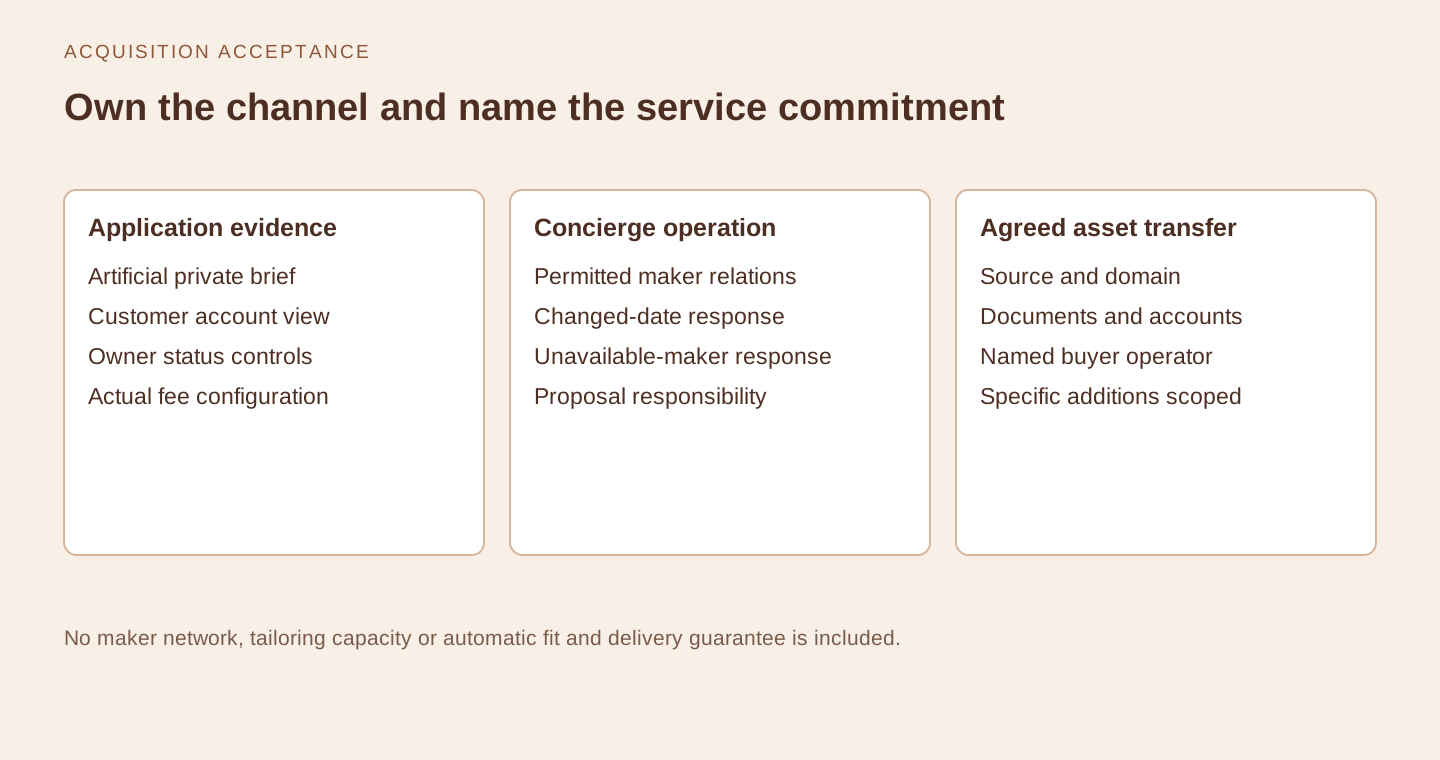
- Bring one permitted artificial custom-piece request and the human service promise it needs to support.
- Ask Codeblix to demonstrate the actual brief, customer view, owner status controls and fee setting.
- Work a date change and an unavailable-maker case through the proposed operating procedure.
- Agree the individual asset transfer and any additional controls before presenting the service as ready.
Request the AfroZeal acquisition offer on Flippa with the completed custom-piece promise schedule. An existing concierge can make a specific purchase decision when the application record, human introduction and agreed customer commitment are all clear.
Explore the products discussed
Explore related acquisition offers