
Buy a produce marketplace website: the FruitKiwi acquisition package
Request the domain, application and handover details for a B2B sourcing platform, with TenBasket as a direct-store alternative.
Acquire a produce sourcing platform foundation with supplier storefronts, quote requests and supplier plans. Contact Codeblix through Flippa for FruitKiwi's current asset package, price and transfer terms.
Buy the foundation for a produce sourcing marketplace. Request FruitKiwi's current acquisition package through Flippa, including the agreed domain, application source and handover materials. The product connects business buyers with supplier storefronts, requests for quotes and structured quote comparison. Its intended platform income comes from supplier plans and promoted listings.
This is an offer to acquire the digital product foundation, not an offer to purchase fruit, a farm or an established restaurant supply contract. A restaurant purchaser needs a supplier response; the platform owner provides the sourcing service around that relationship. If you want to operate a direct grocery store instead, request the TenBasket asset package as a separate ownership option.
If you are comparing wholesale produce software with a food marketplace business for sale, start with the role you want to own. You could operate a sourcing platform that helps suppliers meet business buyers. You could sell groceries directly through your own storefront. You could also buy software and discover, too late, that your real requirement was warehouse stock control. A careful purchase brief keeps those choices separate.
Codeblix offers two relevant starter assets: FruitKiwi, a B2B produce sourcing marketplace, and TenBasket, an online grocery storefront. The purchase details below define the operating roles and the evidence to request with your offer. Current availability, price, financial evidence and the precise transfer package belong in the linked Flippa transaction.
The purchase splits at the invoice
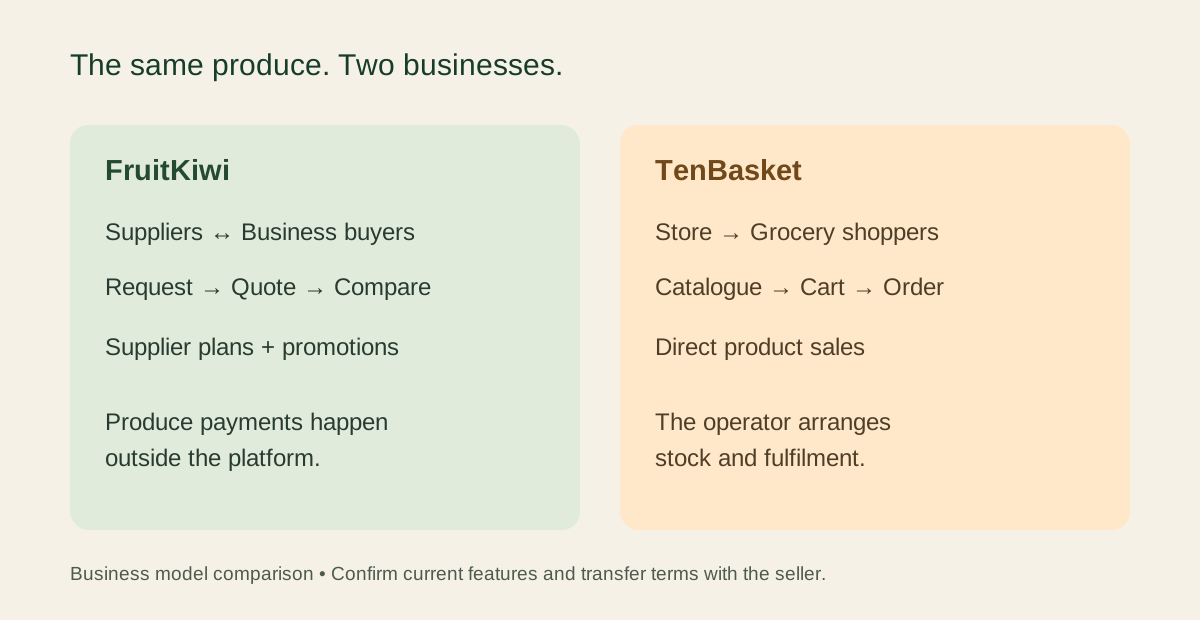
The quickest way to compare these assets is to follow the commercial relationship. In FruitKiwi, produce buyers discover suppliers, send requests for quotes and compare responses. Produce invoices and produce payments take place outside the platform. The platform's intended income comes from supplier software plans and promoted listings. Owning that platform means selling a useful sourcing service to suppliers, while helping buyers find responsive trading partners.
TenBasket follows a direct retail journey. The store operator chooses the catalogue, manages prices and receives customer orders through a grocery storefront. Its intended income comes from grocery product sales. The owner must arrange the real-world fulfilment that makes those sales possible. A working cart does not provide stock, picking capacity or a delivery fleet.
| Purchase question | FruitKiwi | TenBasket |
|---|---|---|
| Who uses the product? | Produce suppliers and business buyers | Grocery shoppers and the store operator |
| What does the platform sell? | Supplier software access and promoted visibility | Products from the operator's grocery catalogue |
| Where does the produce payment happen? | Outside the sourcing platform | Through the store's configured checkout arrangements |
| What needs an owner? | Supplier onboarding, sourcing activity and subscription support | Merchandising, order support and fulfilment |
| What should be demonstrated? | A request sent to suppliers and the comparison of responses | A basket, checkout, order record and customer follow-up |
Review FruitKiwi's included features and documentation if the sourcing route matches your background. If you already run a food store or want to handle direct orders, open the TenBasket purchase details alongside this comparison.
A restaurant supply network is a plausible starting audience
A buyer who knows independent restaurants, caterers or small hospitality groups may have a useful starting point for a sourcing marketplace. The advantage is familiarity with the purchasing conversation: pack sizes, availability, delivery coverage, minimum quantities and the need for a prompt reply. That knowledge helps you judge whether the software supports a real buying decision.
Before purchasing, write one sample request using a market you understand. For example, a restaurant buyer might want a weekly supply of tomatoes and leafy vegetables, with a specified pack size and delivery area. Use this as a test scenario, not as a claim that FruitKiwi already has that customer. Ask the seller to show the request entering the system, reaching relevant suppliers and producing responses the buyer can compare.
Watch the differences between quotes. If one supplier prices a crate and another prices a kilogram, a buyer needs enough information to understand the difference. If a response omits a delivery condition, a messaging thread may be needed before the business parties agree. Your assessment should focus on whether the present product supports the conversation clearly. Any new conversion rules, stock feeds or delivery integrations you want should be listed as additional work.
- Choose a geographic area small enough to understand supplier coverage.
- Choose a purchasing group with a recognizable need, such as restaurants or independent shops.
- Ask suppliers which enquiries they would consider worth answering.
- Check whether a buyer can tell a current response from an old one.
- Keep responsibility for the produce contract clear between the trading parties.
This gives your acquisition a defined commercial purpose. A broad promise to connect every grower with every restaurant offers little help when you need to recruit the first active supplier. A narrow launch market also makes the seller demonstration more useful: you can test the actual relationship you intend to sell.
For a grower network, inspect the supplier's reason to return
A farm produce website can be a simple catalogue, a direct shop or a sourcing network. The phrase alone does not tell you which one you are buying. FruitKiwi's documented supplier storefronts, messaging, buying lists, analytics, plans and promotions should be assessed as a package for repeat sourcing activity.
Imagine that you already work with a group of growers. The first decision is whether they would pay for a shared software service, whether they prefer to run separate stores, or whether they need a sales representative doing the work for them. These are different offers. A supplier plan becomes easier to discuss when you can name the service being purchased: a maintained storefront, access to relevant requests, a manageable reply process and a clear account experience.
Do not make supplier fees depend on a forecast you cannot support. Review any real activity and financial evidence in the sale. If the asset is being sold as a starter, budget for building the network yourself. A supplier subscription feature proves that a charging mechanism exists; it does not prove that suppliers have agreed to pay or will keep paying.
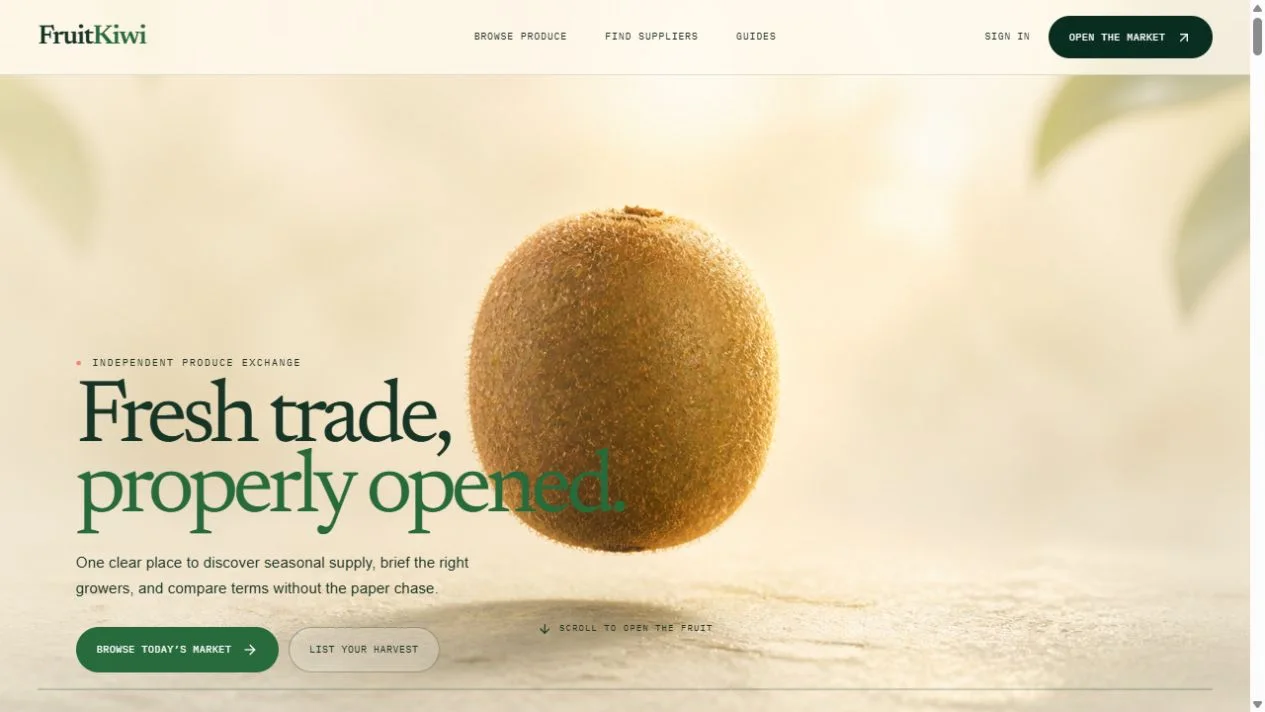
Keep the public preview beside your own purchase brief. The visual presentation is one part of the review; the supplier account, request handling and transfer documents establish the details needed for an ownership decision. Ask the seller to connect each essential screen to the actual workflow you intend to operate.
The product walkthrough should include an ordinary supplier account, not only an administrator account. Ask to see the storefront editor, a relevant enquiry, the response process and the plan controls. An owner who can explain that complete route is better placed to discuss what is included in the purchase and what the buyer will still need to configure.
Fresh produce does not make every software feature interchangeable
A specialist wholesale operation may need lot tracking, warehouse locations, purchasing contracts, credit limits or links to existing stock systems. Those requirements should not be inferred from FruitKiwi's sourcing features. If your acquisition brief depends on any of them, ask for a specific demonstration and a written inclusion statement before you value the asset on that basis.
The same care applies to a grocery storefront. TenBasket's catalogue and order tools should be tested as storefront features. Do not assume that they automatically support your preferred scales, labels, delivery scheduling or variable-weight settlement. Put those requirements in a separate column and ask the seller which are implemented, which need configuration and which require new development.
| Your requirement | Evidence to request | Decision if absent |
|---|---|---|
| Business buyers compare supplier replies | Demonstrate FruitKiwi's request and quote comparison route | Resolve missing steps before agreeing the handover scope |
| Customers place direct grocery orders | Demonstrate TenBasket's catalogue, cart and order record | Confirm the configured checkout journey |
| A particular warehouse or stock integration | Show the actual connected system and data exchange | Price and plan it as additional work unless included |
| Existing commercial activity | Dated records that reconcile with the sale claims | Treat the asset according to the evidence available |
| Domain and application ownership | Written asset list and transfer steps | Clarify ownership before committing to purchase |
You do not need an enormous requirements document to make a sensible shortlist. A one-page brief with a few essential workflows is often more useful than a long wish list. Mark the features that would stop your purchase if absent. Everything else can be considered against your time, skills and available budget.
Run the comparison with your own preferred role
Use the selector below to identify the first asset worth examining. The result is a starting point for a seller conversation. It is based on the documented business models, not a return forecast or a recommendation to spend a particular amount.
Inspect FruitKiwi first. Ask for the supplier plan, enquiry and comparison journeys. Decide whether you can recruit and support both sides of a sourcing network.
Inspect TenBasket first. Ask for a complete customer order demonstration. Make stock, picking, customer support and delivery part of your purchase brief.
Keep your operational specification in front of the seller. Neither a sourcing feature nor a shopping cart establishes that your warehouse requirements are included. Request proof of each essential capability.
Price the platform work separately from food operations
A software acquisition and a produce operation have different cost lines. Hosting, email, payment services, technical maintenance and account support belong in the platform budget. Stock purchases, storage, picking materials and delivery belong in the food operation. Some owners need both sets of costs; a sourcing platform owner may have a different scope from a grocery retailer.
Use written quotations for services where possible. If you have not obtained a quote, mark the value as an assumption and replace it later. The purchase price is only one part of the first-year commitment. An attractive asking price can still be a poor fit if the owner cannot fund the work required after transfer.
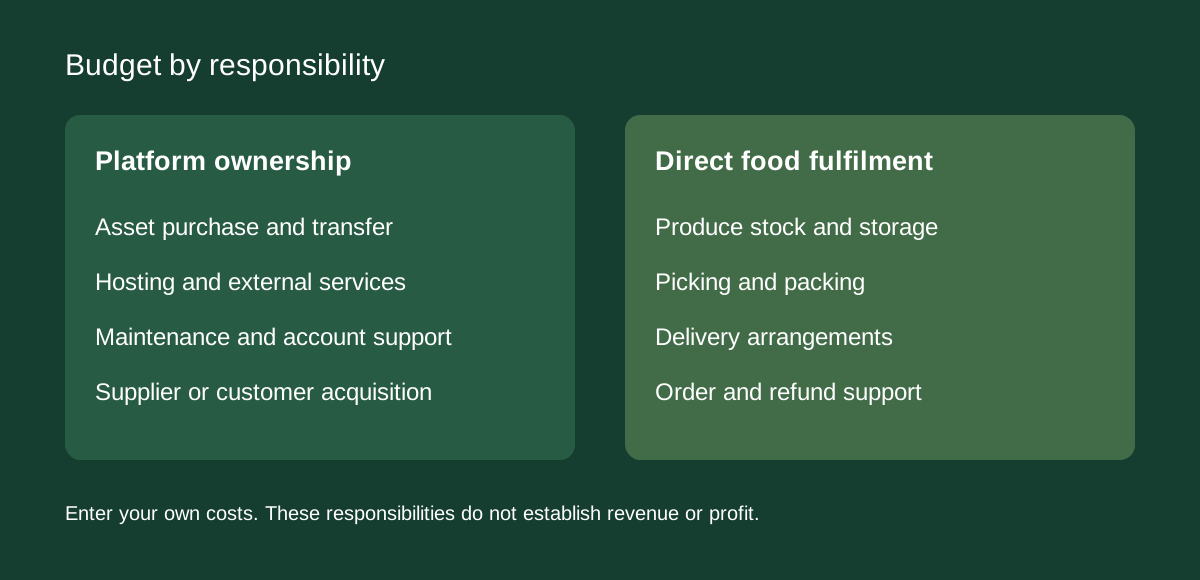
Your first-year platform worksheet. All fields start at zero. Enter your own figures in one currency. The total adds one-time amounts, twelve months of monthly costs and annual costs. It excludes food operations unless you add them to the allowance.
First-year input total:
A zero starting value is not a claim that these services are free. It keeps the worksheet tied to your evidence. For a direct grocery store, prepare a second operating budget for stock and fulfilment before moving ahead. For a supplier network, prepare a realistic plan for the time spent onboarding accounts and keeping enquiries useful.
Ask for a handover that follows one real workflow
A good handover conversation can follow the same sequence as a customer. For FruitKiwi, begin with supplier registration and a complete storefront. Continue with a buyer request, supplier responses, the comparison view and follow-up messaging. Finish with the owner's account and plan controls. For TenBasket, begin with catalogue management, place an order, inspect the order record and follow the customer communication.
Ask the seller to explain which accounts you will create under your own ownership. Hosting, email and payment settings should be understood before the transfer date. Review the technical documentation for environment configuration and deployment responsibilities. Request a list of external services and ask how any demonstration content should be handled for launch.
- Agree the exact domain, repository, documentation and other included assets.
- Demonstrate the essential buyer and supplier or store workflows.
- Record configuration tasks and any separately priced development.
- Agree the order of domain, code and service-account transfer steps.
- Repeat the agreed acceptance journey in the buyer-controlled environment.
This sequence makes the purchase easier to assess because each claimed asset has a purpose. It also reduces the chance of confusing access to a demonstration with ownership of a deployable product. The final agreement should state what changes hands and how acceptance is recorded.
Open the FruitKiwi user guide and technical handover before requesting a walkthrough. For the retail route, read the TenBasket user guide and technical handover. Bring questions from those documents into the Flippa conversation so the answers are attached to the sale discussion.
A side project still needs an accountable food-market owner
You may be considering an online business alongside existing work. In that case, choose a role that fits the hours you can reliably provide. A sourcing platform may suit someone with supplier relationships and time for account support. A direct store needs dependable fulfilment arrangements whenever orders are accepted. Neither becomes hands-off simply because the website is online.
A parent and adult family members could review an acquisition together as a practical ownership project. The useful discussion is about responsibility: who speaks to suppliers, who maintains the product, who answers customers and who controls spending? Divide the work before deciding that a software asset fits the household. Keep the purchase decision with the person who can take responsibility for the business and its accounts.
It is also reasonable to decide that an existing food retailer is the better buyer. Someone with stock, delivery routines and regular customers may have a clearer use for TenBasket than someone starting all three from zero. A trade-network operator may have a clearer use for FruitKiwi than a buyer whose only plan is to wait for search traffic. Choose the asset that matches an advantage you can name.
Use a seasonal request to expose the details that matter
Consider a hypothetical restaurant group reviewing suppliers for a seasonal menu. It needs more than an attractive produce image. The purchaser wants the product specification, pack, delivery coverage and a reply that remains useful when availability changes. This is a useful acquisition test because it puts the documented sourcing features under an ordinary commercial question.
Prepare the request before the seller demonstration. State the item, the unit you are comparing, the delivery area and the information you expect a supplier to provide. Keep the quantities modest and clearly label the exercise as a test. You are checking a software journey, not placing a real produce order or claiming an existing customer relationship.
| Request detail | Why the buyer needs it | What to inspect in the product |
|---|---|---|
| A named produce specification | Different varieties or grades may not be equivalent | Whether the request carries enough detail for a relevant reply |
| A stated pack or unit | Quotes need an understandable comparison basis | How the supplier records the offer and how the buyer reads it |
| A delivery area and intended timing | A low headline price may be irrelevant outside supplier coverage | Where the parties communicate the delivery conditions |
| A follow-up question | Purchasers often need clarification before agreeing | The messaging route and the information retained in context |
Ask the seller to show two different responses. They need not be real commercial quotes; demonstration responses are sufficient for a functional test when identified as such. Follow the buyer's attempt to compare them. Notice whether the important details remain visible and whether the buyer can return to the conversation without losing context.
Then change one condition in the exercise. Perhaps the restaurant needs a different pack size, or a supplier cannot cover the intended date. Ask how that clarification is handled. A response workflow that looks clear when every offer is identical may reveal limitations when a condition changes. Record those limitations as purchase questions rather than assuming that the next release will solve them.
The point of this exercise is not to turn a starter asset into a complete food-distribution system. It is to establish whether the documented sourcing foundation supports the type of trading conversation you plan to host. If the essential route works, you can discuss launch and transfer with a concrete understanding. If it does not, you can request a scoped change or decide that a different asset fits better.
Separate the supplier offer from your own sales pitch
When you buy a marketplace, you inherit a product foundation and then choose how to present its service. A supplier-facing offer should describe what the platform actually provides. For FruitKiwi, that conversation can focus on storefronts, sourcing requests, messaging, plan access and promoted visibility. Avoid promising a fixed number of enquiries or sales unless you have evidence and an agreement that supports that promise.
A purchaser who already serves growers might offer onboarding help as a separate service. A purchaser with restaurant contacts might concentrate on making requests clear and relevant. Those are possible owner-led commercial choices, not existing revenue claims about FruitKiwi. Decide which service you would be responsible for delivering, how it would be priced and whether it needs additional product work.
Bring a draft of that supplier offer into your purchase review. If you cannot explain the service without relying on an unbuilt feature, narrow the offer or change the specification before buying. If you can explain it using demonstrated capabilities, ask the seller to confirm the controls you would use to deliver it. That is a more useful basis for an offer than a list of unrelated food keywords.
Bring these answers to the offer conversation
If the sourcing route fits, review FruitKiwi's current Flippa listing and ask for the request-to-quote walkthrough. If the retail route fits, review TenBasket on Flippa and ask for the order acceptance journey. The current sale pages are the place to confirm price, availability and transaction terms.
For a wider shortlist, compare the online businesses available through Codeblix. Buyers concentrating on subscription software can also open the SaaS business collection. Keep the purchase brief beside the listings: the right acquisition is the one whose customer relationship, operating work and transfer scope you are prepared to own.
Explore the products discussed
Explore related acquisition offers