
Customer feedback management software
Customer feedback management software brings customer comments into a usable evidence trail: where they came from, what they mean and who will act on them. Codeblix develops custom feedback workspaces for teams that need their own collection boundaries, analysis rules and improvement handoffs. Try the account-coverage example, compare established platforms and use the acceptance checklist to prepare your project brief.
Make the evidence behind an improvement inspectable.
Customer experience and research teams need more than a collection of comments. The application should preserve context, explain its counts and connect a finding to an owner who can investigate it.
Know which sources support the finding
Keep the original comment, source reference, period, account key and access status together. Show excluded observations and their reasons beside the eligible sample. A missing interview or unreviewed import should remain visible when someone reads the analysis.
Count observations and accounts separately
Three comments about an issue may come from two accounts. Store both measures and name the denominator. In CF-16, Aster contributes two onboarding comments but counts once in that theme’s account coverage. The selected sample describes its participants rather than every customer.
Carry reviewed evidence into an owned improvement
Bind an insight to the exact coding edition the reviewer inspected. Name the improvement team, affected accounts and follow-up evidence. If inclusion or theme coding changes, reopen the analysis before relying on its earlier handoff.
See how a comment changes the interpretation.
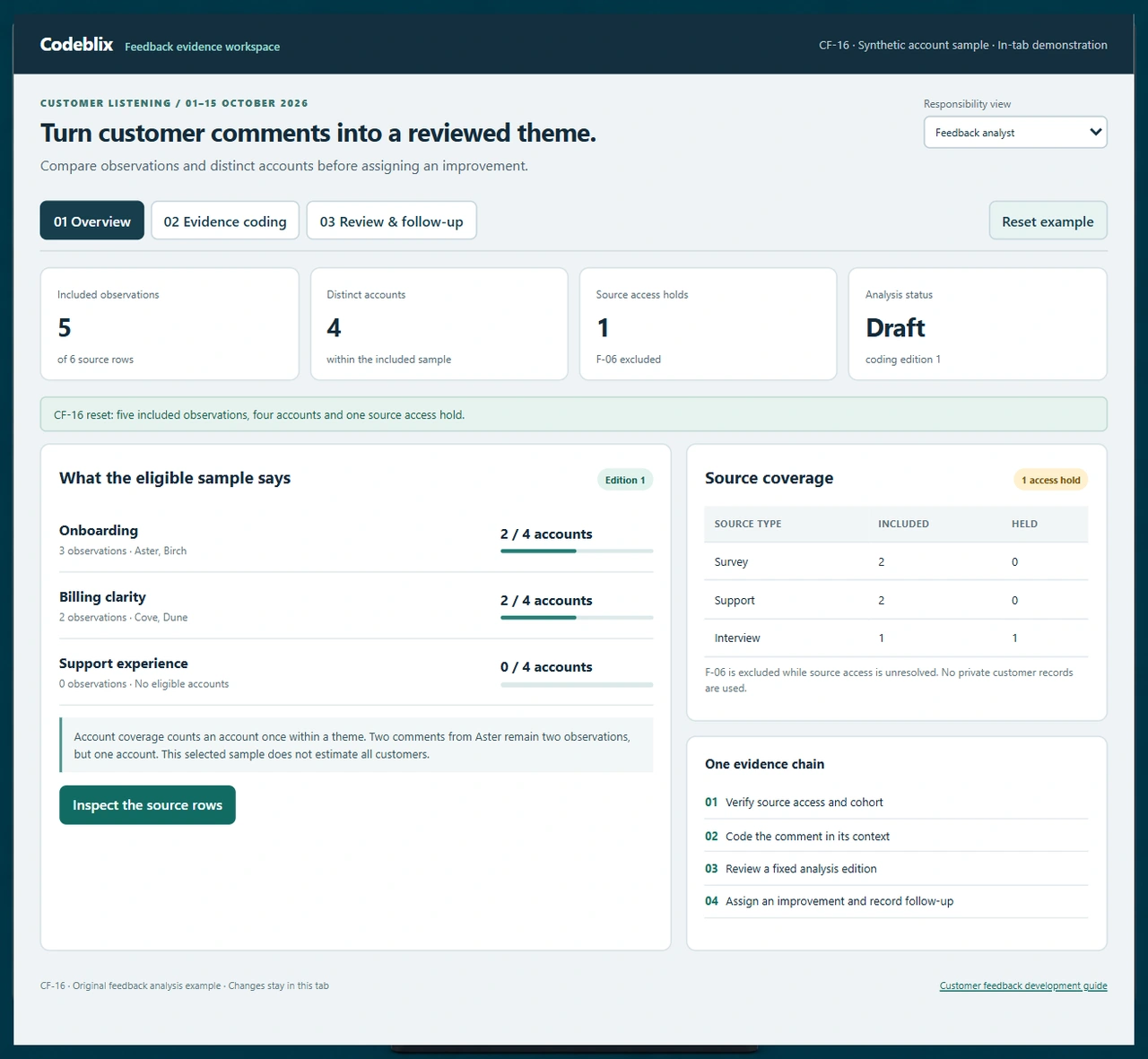
The CF-16 workspace follows six source rows through eligibility, theme coding and review. Five eligible observations represent four accounts. Recoding one interview changes which accounts belong to the billing theme.
Try the five-observation, four-account example
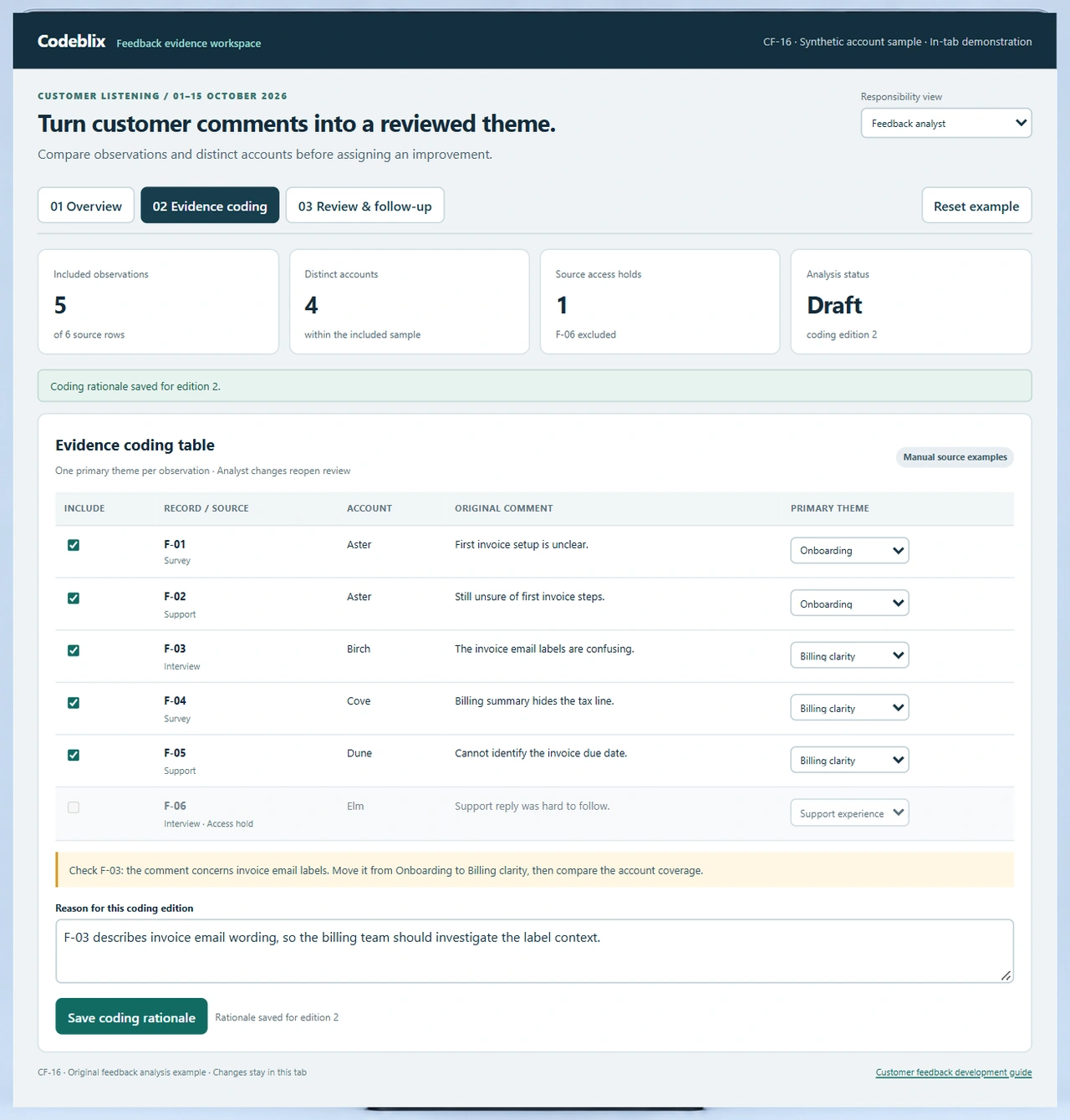
Open Evidence coding and move F-03 from Onboarding to Billing clarity. Save the rationale. The sample still has five observations and four accounts, but billing now covers Birch, Cove and Dune: three accounts instead of two. Aster’s two onboarding comments represent one account.
Open the feedback analysis workspaceChallenge the finding after it has been accepted
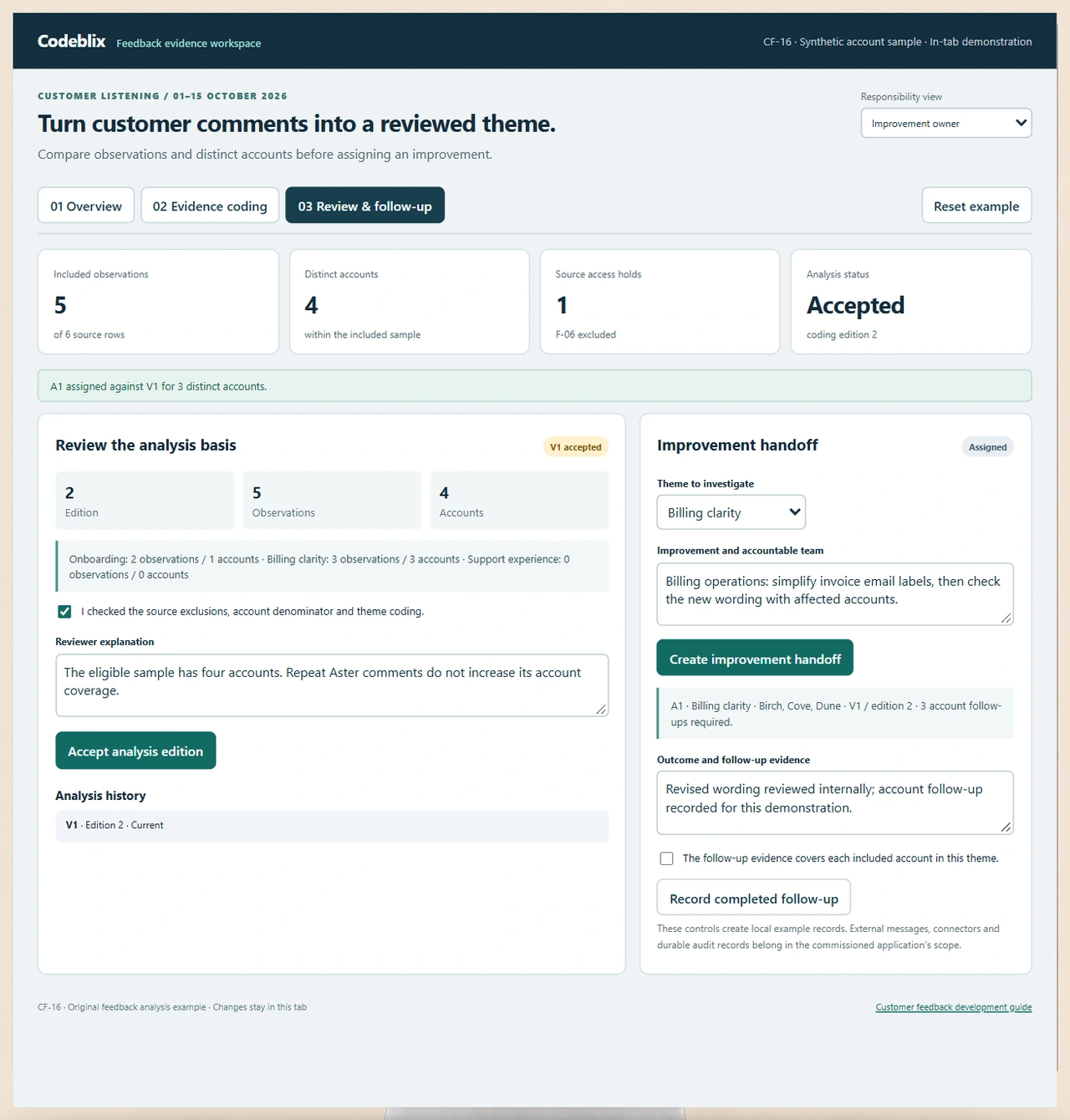
Switch to Insight reviewer, confirm the checks and accept V1. As Improvement owner, create the billing handoff and record its follow-up confirmation. Then exclude F-03 as the analyst. The eligible sample becomes four observations across three accounts; V1 is superseded and completion against the old basis is held.
Connect a theme to an individual product request
A feedback theme explains a pattern across observations. A product request carries a specific change through evaluation and a decision. Link a finding to the request record when appropriate, while preserving the sample and coding that led to it.
Compare feature request workflowsChoose the smallest application that answers the decision
Survey software may cover a focused listening program. A feedback platform may fit when collection, analysis and follow-up already match your process. Consider an extension or custom build when account matching, restricted source access, review authority or an existing operating system requires tailored behavior.
From collected feedback to a checked improvement loop
Agree how source custodians, analysts, insight reviewers and improvement owners work across these six stages.
Define the question and collection boundary
State the decision the feedback should inform, the customer group and the period. Inventory surveys, interviews and service conversations. Agree which source fields can be collected, who can inspect the originals and how account identifiers will be matched.
Reconcile incoming observations
Give each observation a stable source ID. Preserve its wording and source date, then flag access holds, repeated imports and unresolved account matches. An analyst should be able to explain why a row is included before it contributes to an aggregate.
Code the meaning with its context intact
Define a theme vocabulary and document the coding policy. Record the analyst’s correction when a comment belongs elsewhere. The example assigns one primary theme per observation; projects needing multiple themes must specify how overlapping counts are displayed.
Review coverage and interpretation together
Present the observation count, distinct-account count, excluded sources and period with the finding. An insight reviewer checks the denominator and the coding explanation. Preserve the accepted edition so later readers can reconstruct what supported the conclusion.
Assign an improvement with evidence references
Choose an accountable team, investigation question, next action and expected evidence of completion. Link the relevant theme and analysis version. Urgent individual service problems still need their established service response while the broader pattern is investigated.
Record follow-up and revisit changed evidence
Track which eligible accounts need an update and what response was recorded. Separate completed follow-up from proof that the underlying problem improved. Reopen stale handoffs when source eligibility or interpretation changes, and retain the earlier analysis history.
Collection, coding and access requirements
- Specify collection channels separately from analysis. A survey builder, transcript import and service-system connection have different field mappings, access rules and operating costs. Start with an authorized sample and verify the required source interface before adding it to scope.
- Separate source custody from analysis access. Decide who may read raw comments, alter account matching, correct themes, accept findings or export summaries. Apply authenticated permissions on the server in the delivered application; the example’s responsibility selector helps explore the workflow.
- For automated classification, agree the accepted vocabulary, evaluation sample, human correction path and model-change review. Keep evidence references available to the analyst. A generated summary or sentiment label needs a defined verification method before it informs an operational decision.
Imports, connections and historical analysis
- Map existing survey rows, account keys, coding labels and past reports. Reconcile imported row counts and repeated source IDs. Preserve unresolved identity matches for review rather than combining similar-looking names automatically.
- For each proposed connection, specify authorization, permitted fields, source ownership, update direction, stable IDs, deletion handling and retry behavior. Include a failed synchronization and a duplicate import in acceptance. Availability of a vendor API alone does not establish the specific connection.
- Define what happens when a source is withdrawn, corrected or no longer accessible. Recompute eligible coverage and flag dependent findings for review. Retain only the history permitted by the agreed retention and access policy.
Quote, deployment and ongoing ownership
- Bring an anonymized feedback export, an account-matching problem and one finding that needs follow-up. Codeblix can scope the core workspace, source acquisition, reporting, migration and connected actions as separate deliverables.
- Choose the hosting owner, access administration, backup schedule, restore checks and export format. Estimate support for taxonomy changes, source schema changes, failed imports and revised review rules alongside the initial build.
- Roll out with a bounded sample and named owners for import exceptions, coding disputes and overdue improvements. Verify recovery of an accepted finding and its evidence references. Review actual follow-up quality before expanding the collection program.
Six records that make customer feedback explainable
Use this model to compare how an application preserves a comment’s context and converts a reviewed pattern into accountable work.
| Record | Example inputs | Required output and control |
|---|---|---|
| Collection boundary | 01–15 October 2026; selected synthetic account sample; survey, support and interview sources | Record the question, period and source coverage; avoid treating a selected sample as the whole customer population. |
| Observation | F-01 through F-06; original comment; source type; eligibility | Keep source identity stable and exclude F-06 while its source access is held. |
| Account reference | Aster has F-01 and F-02; Birch, Cove and Dune have one included observation each | Count repeat observations separately while counting an account once per primary theme. |
| Theme coding edition | Onboarding, Billing clarity, Support experience; F-03 corrected in edition 2 | Preserve the correction rationale and recalculate theme coverage after every inclusion or coding change. |
| Accepted analysis | V1 accepts edition 2: five observations, four accounts; Billing clarity covers three accounts | Require explicit reviewer confirmation and retain superseded analysis history when the basis changes. |
| Improvement and follow-up | A1; Billing operations; Birch, Cove, Dune; analysis V1 / edition 2 | Name the improvement owner and retain outcome evidence; hold completion if the underlying analysis is stale. |
Initially, Onboarding contains F-01, F-02 and F-03: three observations from Aster and Birch. Billing clarity contains F-04 and F-05 from Cove and Dune. F-06 is held outside the sample. Recoding F-03 to Billing clarity leaves five eligible observations and four accounts overall, changes Onboarding to two observations from one account, and changes Billing clarity to three observations from three accounts. V1 accepts edition 2, and A1 references those three billing accounts. Excluding F-03 later leaves four observations across three accounts, supersedes V1 and marks A1 for fresh analysis. All names and comments in the example are synthetic.
Compare feedback platforms using the same evidence change
These vendor pages offer different collection and action models. Ask each shortlisted provider to demonstrate account coverage, a corrected theme and the effect on an accepted finding.
| Option | Published focus | Ask in your demo |
|---|---|---|
| AskNicely | Customer surveys, feedback dashboards and workflows for action across teams. | Show repeated comments from one account and explain the denominator used in a theme’s coverage. |
| Survicate | Multichannel surveys, a research hub, feedback themes and automated flows. | Correct one theme assignment and show how the finding, its source references and subsequent action change. |
| Salesforce Feedback Management | CRM-linked surveys, feedback reporting, sentiment information and follow-up workflows. | Demonstrate source access boundaries, the required platform edition and a handoff affected by corrected evidence. |
Include collection volume, analyst access, source permissions, account identity, export rights and interface maintenance in the cost comparison. The questions above are evaluation exercises; vendor capability should be checked in the relevant plan and demonstration.
Category reference: AskNicely’s collection, analysis and action product overview. The CF-16 source model, account-coverage example and acceptance checklist are original Codeblix decision resources.
Give customer evidence a useful operating handoff.
Connect customer listening to the teams responsible for service, product decisions and ongoing improvement.
Explore professional services workflowsQuestions to settle before commissioning feedback software
Define what the team needs to learn and how it will act before choosing collection channels or dashboard charts.
What should customer feedback management software keep together?
It should connect the original observation, source, period, account reference, interpretation and action. Useful reporting also explains exclusions and how each count was calculated, so a reader can judge the evidence behind a finding.
Can Codeblix build a feedback workspace around our process?
Yes. Codeblix offers software development and consultation for a tailored collection, analysis and improvement workflow. The demo and checklist help define your data sources, identity rules, reviewers and operating handoffs before estimating the application.
Why do comments and account counts differ in the example?
Aster supplies two comments. Those are two observations but one account within the onboarding theme. Counting the measures separately makes repeated feedback visible without presenting it as additional account coverage.
Does a feedback theme belong in a service ticket or a feature request?
A theme groups evidence about a recurring issue. An urgent service case needs its service owner, while a specific product change can enter request evaluation. Link those records to the finding and keep their distinct response and decision responsibilities clear.
Can the application collect surveys and analyze interviews?
Both can be scoped when they serve the collection plan. Define the survey fields, interview source format, access permissions and account matching for each. Verify each import or live interface with representative permitted data during acceptance.
Can AI classify customer comments?
Automated classification can be evaluated as part of the project. Agree a vocabulary, an evaluation dataset, correction rules and a reviewer’s evidence view. The working example uses explicit analyst coding so its interpretation and counts can be checked directly.
What happens when evidence changes after a finding is accepted?
The example supersedes the accepted analysis and holds completion of its linked handoff. A commissioned application should also define notifications, retained history and treatment of withdrawn sources under your access and retention rules.
What affects development and operating cost?
The number of source interfaces, survey requirements, identity matching, coding model, review roles and connected actions shape the estimate. Include historical imports, hosting, recovery, exports and support for changing source formats in the quote.