
Feature request software that keeps the customer evidence behind each decision.
Feature request management software connects customer suggestions to a product decision and the people waiting for an update. Codeblix builds custom request workspaces for teams whose account identities, private evidence and delivery approvals need a tailored workflow. Explore the duplicate-request example, compare software options and bring your own acceptance cases to a development consultation.
Turn a busy request board into a decision trail.
A useful request system explains what customers need, why a decision changed and who still deserves an update. Start with those operating questions before choosing a voting board or a larger product platform.
Preserve the customer’s original problem
Retain the submitted wording, product area, account identity and source conversation. A canonical request summarizes the desired outcome while each submission keeps its own context and visibility. Internal notes should not become public merely because a request moves to a shared board.
Distinguish repeated signals from broader demand
Two colleagues from one account may describe the same problem in different channels. Keep both sources while showing the distinct-account count separately. Merge only requests with the same outcome; an export feature and permission to export require different acceptance decisions.
Close the loop after a verified release
A Planned status records a product decision. A release handoff adds the accepted delivery reference and the accounts needing follow-up. Keep queued, attempted, failed and confirmed notifications distinct, with an owner for unresolved messages.
See the evidence survive each handoff.
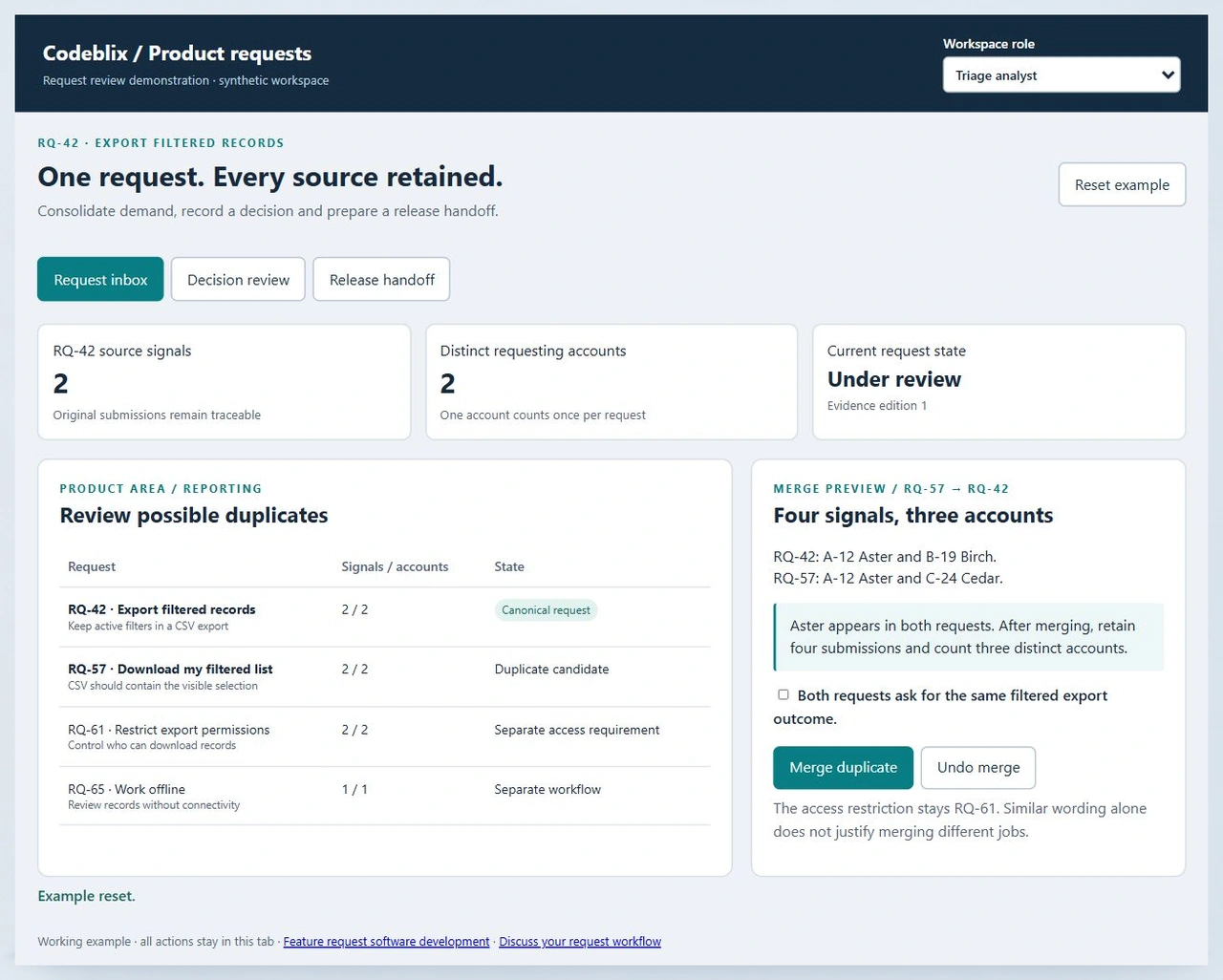
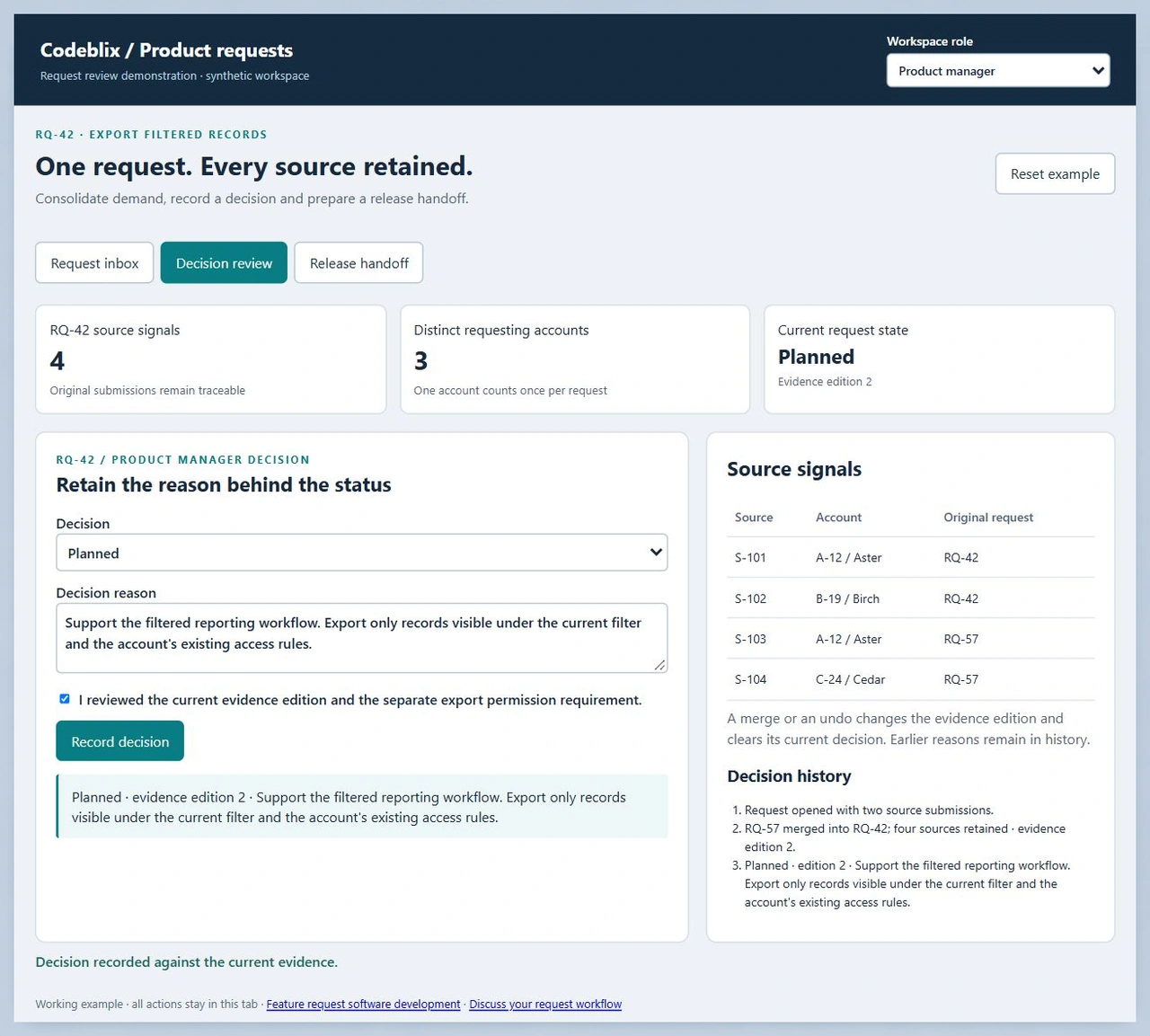
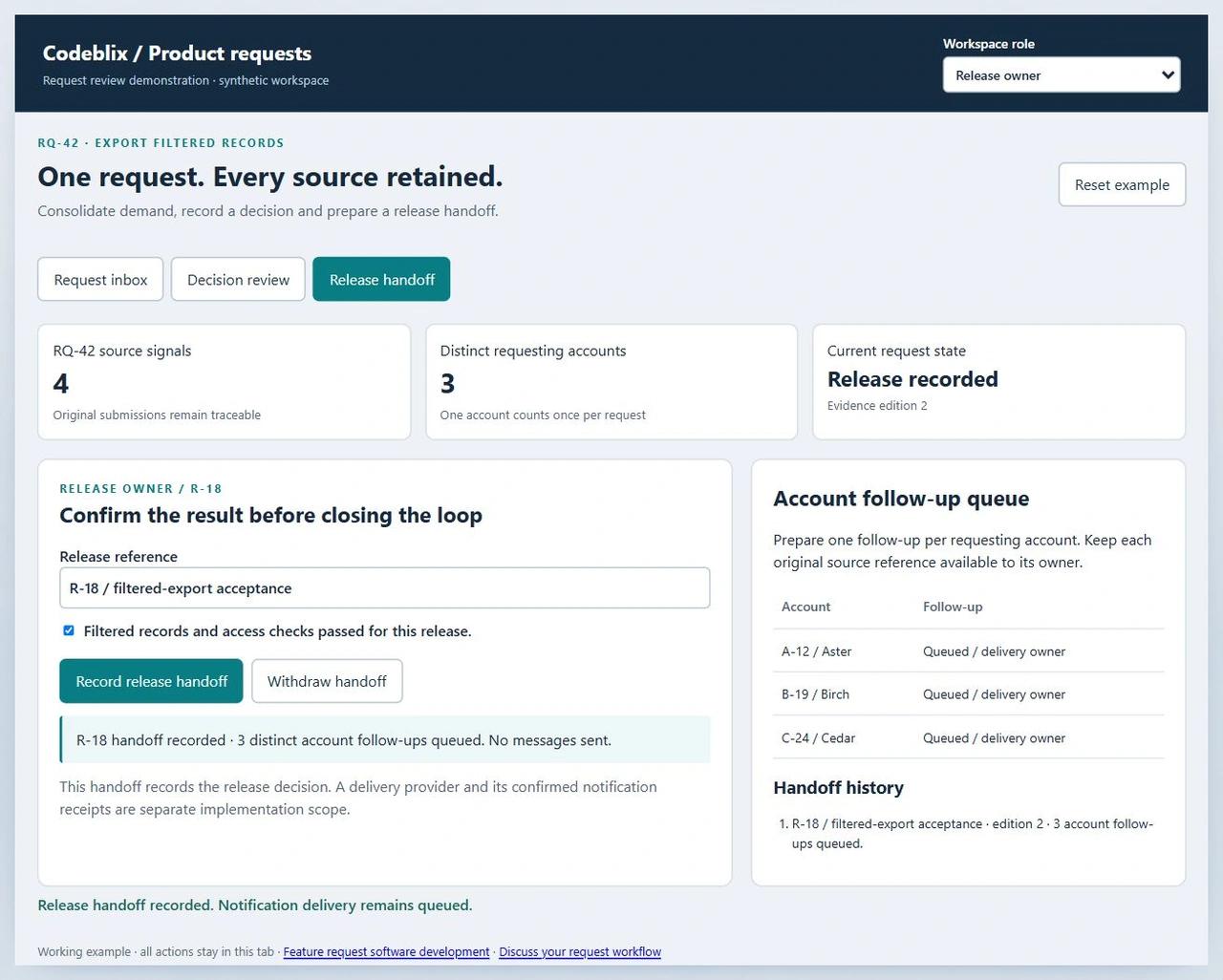
The request-management demonstration follows two similar export requests into one reviewed decision. Original submissions remain visible, repeat account signals count once and the release owner prepares three account follow-ups.
Run the duplicate-request and release example
In the Request inbox, confirm the matching outcome and merge RQ-57 into RQ-42. Four submissions now represent three accounts. Switch to Product manager, review the evidence and record a Planned decision. As Release owner, confirm acceptance and record R-18. Inspect the three-account follow-up queue, then change the release reference to see the handoff withdraw.
Open the working request review workspaceCompare the same difficult merge in every demo
Ask each vendor to merge two requests with an overlapping account, undo the merge and show the resulting source references. Then change an accepted requirement after a decision. Inspect account counts, earlier reasons, customer-visible status and the next person’s task together.
Separate feedback participation from feature ownership
An advocacy campaign can invite customers to discuss a product problem. Request management then owns the suggestion, duplicate review and decision trail. Participation recognition and permission to publish a customer story remain separate program decisions.
Compare customer advocacy campaign workflowsChoose one useful first-release boundary
A first version can focus on one product area, private request intake, duplicate handling and an owned follow-up queue. Add public voting, scoring frameworks or additional channels only when they support the team’s actual decision process.
Read the SaaS MVP scope guideChoose a subscription, extension or custom application
A standard feedback platform may already fit the intake board, roadmap and release update. Extend your current product when its authenticated account context is central to request visibility. Custom development becomes useful when review permissions, evidence retention or delivery handoffs require a workflow the shortlisted products cannot demonstrate.
From a customer suggestion to an accountable release update
Use these six stages to define a request analyst, product manager and release owner’s responsibilities. A change to the underlying request evidence should trigger an explicit review.
Capture the source, audience and desired outcome
Give every submission a stable identifier and a link to its source. Record the product, customer account, problem, requested result and appropriate audience. Redact confidential attachments before exposing any summary to customers.
Review similar requests before merging
Compare the actual job, constraints and acceptance conditions. Select a canonical request and retain the original submission references. Record a merge reason and provide an undo path when later evidence reveals different needs.
Recalculate demand by account identity
Count source submissions and distinct accounts as separate measures. Keep duplicates traceable without counting one account twice. Decide how prospects, anonymous requests and unavailable account matches enter the review queue.
Record the product decision and rationale
A product manager reviews the current evidence, records Planned or Declined and explains the boundary. Retain earlier decisions when the evidence changes. A request’s popularity is one input alongside feasibility, risk and the product strategy.
Attach the accepted delivery evidence
Link the implementation or release reference and its relevant acceptance checks. A release owner confirms what actually reached the agreed audience. Keep delivery scope, public wording and notification eligibility separately controlled.
Prepare follow-ups and reconcile the outcome
Create one follow-up per eligible account for the release. Repeated actions must find the existing handoff. If release evidence changes, withdraw the active handoff, retain its history and review any messages already delivered.
Records, roles and access rules
- Request analysts capture source context and review duplicate candidates. Product managers own the decision rationale. Release owners confirm delivery evidence; communication owners reconcile follow-ups. Administrators manage account matching, retention and the permission model.
- Keep source submissions, account references, canonical requests, merge history, decision editions and release handoffs separately identifiable. Useful outputs include unresolved duplicates, decisions needing renewed review, requests awaiting delivery evidence and failed customer updates.
- Define who sees private conversations, commercial account fields and internal estimates. Public request status needs an approved summary and audience rule. Reaching Planned must not grant access to confidential source material or create an automatic delivery promise.
Migration and connections
- Import source IDs, account mappings, subscriptions, statuses and earlier decisions together. Preserve original timestamps and unresolved duplicates. Reconcile both source counts and distinct-account counts after migration; do not send a fresh notification merely because old history was imported.
- Review the actual support, CRM, development tracker and communication interfaces before quoting connectors. Specify source ownership, authentication, stable event IDs, mapping direction, retries and how deleted or renamed records are handled. Each connection needs its own acceptance cases.
- Separate request capture from release notification delivery. Agree consent, unsubscribe behavior, visibility and retention for the chosen audience. Store only the source context the product team needs and provide controlled exports for handover.
Development estimate and operating support
- Bring a sample intake form, two realistic duplicates, one declined request and one release update. The estimate should separate the request workflow, customer portal, migration, external interfaces and ongoing hosting costs. No standard subscription price is implied by the example.
- Include durable merge history, server-enforced permissions, concurrent edits and stable notification keys in implementation acceptance. The browser demonstration helps test the decision rules; hosting, authentication, backups, monitoring and delivery receipts belong in the application scope.
- Agree data ownership, export formats, restore checks, support coverage and responsibility for misdirected notifications. Test a withdrawn release and a delayed provider response before rollout. Operational support needs to cover changed product decisions as well as unavailable screens.
Six records that explain a feature request decision
Use this original RQ-42 model to compare applications before commissioning development. The source count, account count, decision and release handoff answer different questions.
| Record | Example inputs | Required output and control |
|---|---|---|
| Source submission | S-101 Aster; S-102 Birch; S-103 Aster; S-104 Cedar | Retain four original statements and source request IDs. A merge changes association, not the original words. |
| Account identity | A-12 Aster; B-19 Birch; C-24 Cedar | Distinct account demand is three after merging. Repeated submissions from Aster do not become another account. |
| Canonical request | RQ-42: CSV export respects active record filters | Keep the intended outcome distinct from RQ-61 export permissions and RQ-65 offline access. |
| Merge relationship | RQ-57 → RQ-42; reviewed matching outcome; reversible association | Retain source membership and increment the evidence edition on merge or undo. Preserve the earlier decision reason. |
| Product decision | Evidence edition 2; Planned; Product manager; scope rationale | Tie the decision to its reviewed evidence. Another merge or undo clears the current decision while retaining history. |
| Release and follow-up | R-18; acceptance check; Release owner; three queued account updates | Require the current Planned decision. Withdraw a changed handoff and keep notification delivery outcomes separate. |
The synthetic example begins with two submissions on RQ-42 from Aster and Birch, plus two on RQ-57 from Aster and Cedar. Their merge retains all four submissions but produces three distinct requesting accounts. RQ-61 remains a separate access-control requirement. A Product manager accepts evidence edition 2 with a written reason. R-18 can be recorded only after the Release owner confirms the acceptance check. The resulting queue has one row each for Aster, Birch and Cedar. Repeating the handoff creates no extra rows. Changing its release reference withdraws the active handoff; undoing the merge restores the original memberships and clears the current decision. This example uses local browser state and sends no messages.
Compare feature request platforms with one shared test case
These current vendor pages cover request collection, prioritization and communication in different ways. Ask each provider to demonstrate your account identities, private sources and reversal cases.
| Option | Published focus | Ask in your demo |
|---|---|---|
| Canny | Request collection, duplicate handling, account context, prioritization and release updates. | Merge two requests with one overlapping account, then undo the merge. Which source references, counts and earlier status decisions remain? |
| Featurebase | Feedback portals, customer voting, product roadmaps and notifications when requests ship. | Show private source visibility, account-level counts and a withdrawn release update using your actual supported communication channels. |
| UserVoice | Feedback capture, customer context, idea evaluation and communication from review through release. | Change evidence after a Planned decision, inspect the retained rationale and export the account follow-up history. |
Select an existing platform when its operating model, privacy controls and total cost fit. Extend an application when its account context and deployment ownership make that practical. Discuss a custom build for specific review or evidence requirements. Compare migration, interface maintenance, hosting and customer communication operations alongside the visible screens.
Category reference: Canny’s feature request collection and decision overview. The RQ-42 entity model, duplicate-account example and acceptance CSV are original Codeblix resources. The comparison questions are evaluation cases, not claims that the named platforms lack those capabilities.
Connect product requests to the customer relationship.
Let service and product teams share the request reference while retaining clear ownership of confidential evidence, delivery decisions and customer communication.
Explore professional service softwareQuestions to answer before choosing request software
Settle the account model, review responsibility and customer update path before selecting a board.
What does feature request management software do?
It organizes customer suggestions around a product decision. Keep the original sources, requesting accounts, duplicate relationships, status rationale and release follow-up connected. A useful application explains why a request changed and who still needs an update.
Can Codeblix build a custom feature request workspace?
Codeblix offers custom software development and consultation. Start with your request sources, account identities, privacy rules and review responsibilities. The working demonstration and acceptance checklist help define the application and any required interfaces.
Should several requests from one account count as several votes?
Define the measure explicitly. The example retains every source submission while counting each account once per canonical request. Four submissions from Aster, Birch, Aster and Cedar therefore represent three requesting accounts. Contact-level voting can be a separate measure.
When should two feature requests be merged?
Merge when their desired outcome and material constraints match. Similar wording is insufficient. Preserve original context, source identifiers and an undo path. An export feature and the permission to export remain different requirements in the example.
Does Planned mean a feature has been delivered?
Planned records a product decision under the team’s status rules. Delivery requires the agreed release evidence and acceptance checks. Keep customer wording and any delivery commitment explicit so a status change does not accidentally become a date promise.
How should changed evidence affect an earlier decision?
Record a new evidence edition and reopen the current decision when a merge or scope change affects its basis. Retain the earlier reason and reviewer. The example clears its current decision after a merge or undo instead of inheriting an approval from different evidence.
Can a project include CRM, support or issue-tracker connections?
Yes, through an agreed integration scope. Review the specific interfaces, authorization and data ownership first. Define mapping direction, stable source IDs, retry handling, deletion behavior and customer visibility; demonstrate each connection before accepting it.
What affects the development and support estimate?
Intake channels, account matching, public visibility, migration, approval rules and communication providers affect effort. Separate the core request workflow from integrations, hosting, monitoring and ongoing support. Use realistic duplicate, decline and release-withdrawal cases when comparing quotes.