
Product roadmap software that makes the tradeoff visible.
Product roadmap software connects product direction to the initiatives a team can realistically take on. It helps product leaders compare outcomes, allocate capacity and communicate a reviewed plan. Codeblix develops custom roadmap applications around your planning rules, decision roles and delivery systems. Test the six-initiative example, compare established platforms and prepare a focused development brief.
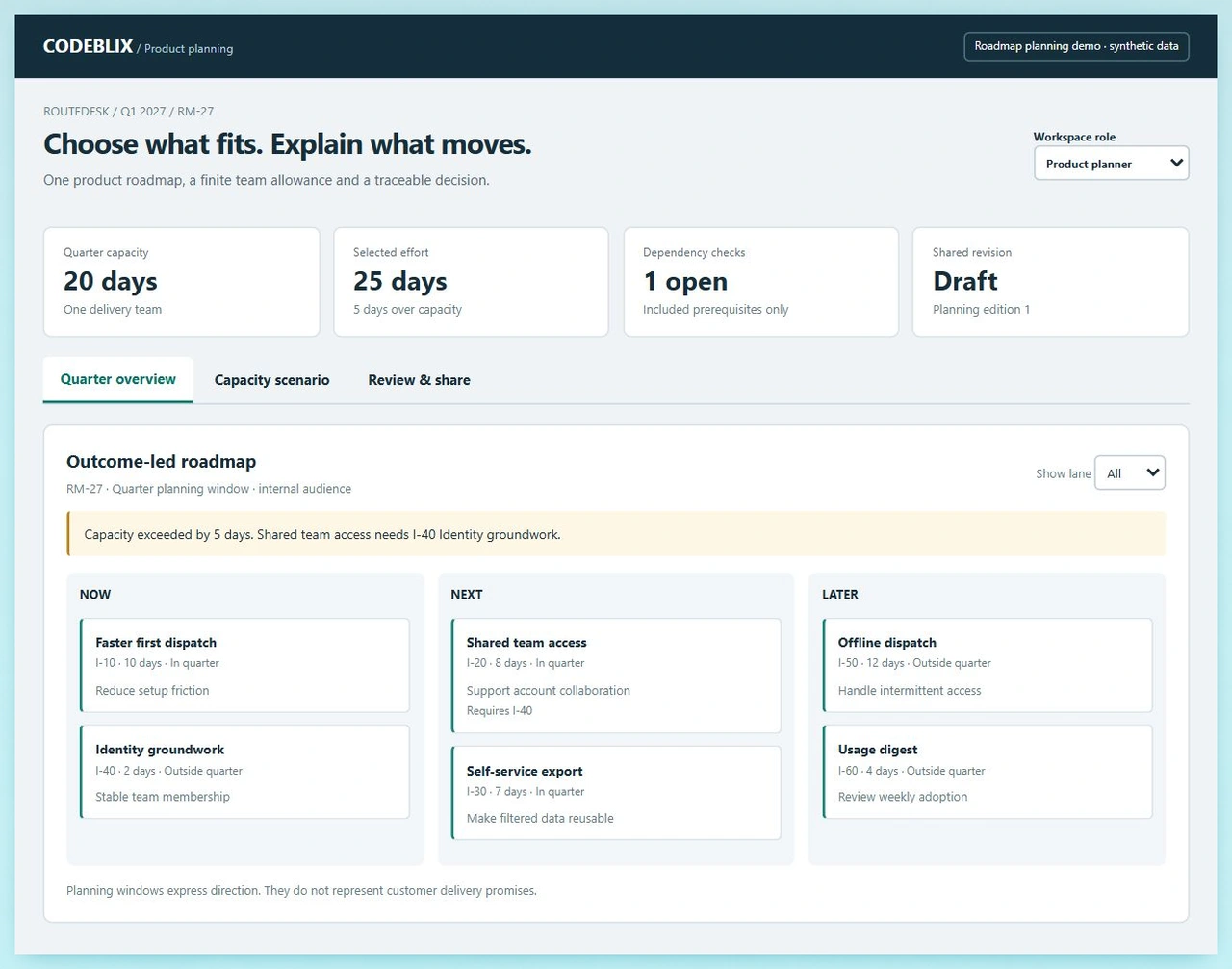
Explain why an initiative is in the plan.
A useful roadmap makes the product decision understandable to engineering, leadership and the people communicating with customers. Start with the outcome and the tradeoff before choosing a visual timeline.
Link initiatives to a product outcome
Store the problem, intended benefit, evidence reference and accountable owner alongside each initiative. Keep Now, Next and Later direction separate from selection for a particular quarter. A promising idea can remain visible while sitting outside the current allocation.
Expose the work behind the headline
Show effort assumptions and prerequisite work together. In the example, shared team access needs identity groundwork. Omitting that work makes the selection incomplete. A single-team day allowance is the example’s planning unit; multiple teams need their own capacity rules.
Keep shared direction tied to a reviewed edition
Record who accepted the current scenario and which audience received its revision. Changes to capacity, selection or rationale reopen review. Preserve the earlier snapshot and withdrawal reason so a stakeholder can understand how the direction evolved.
Follow one roadmap from an overloaded draft to an approved plan.
The RM-27 demonstration begins with 25 days of selected work and a 20-day allowance. Change the selection, include the missing prerequisite and review the exact edition before sharing it internally.
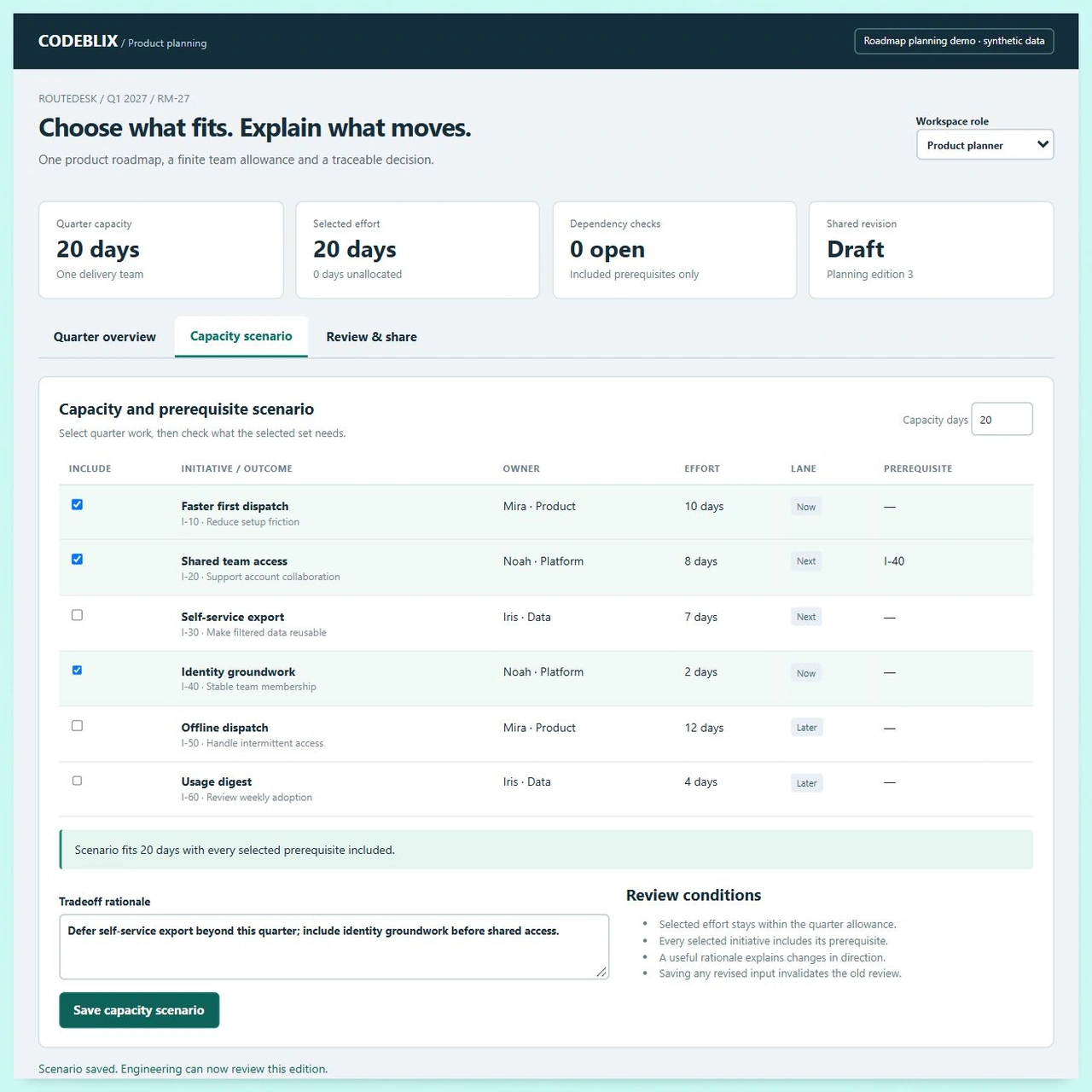
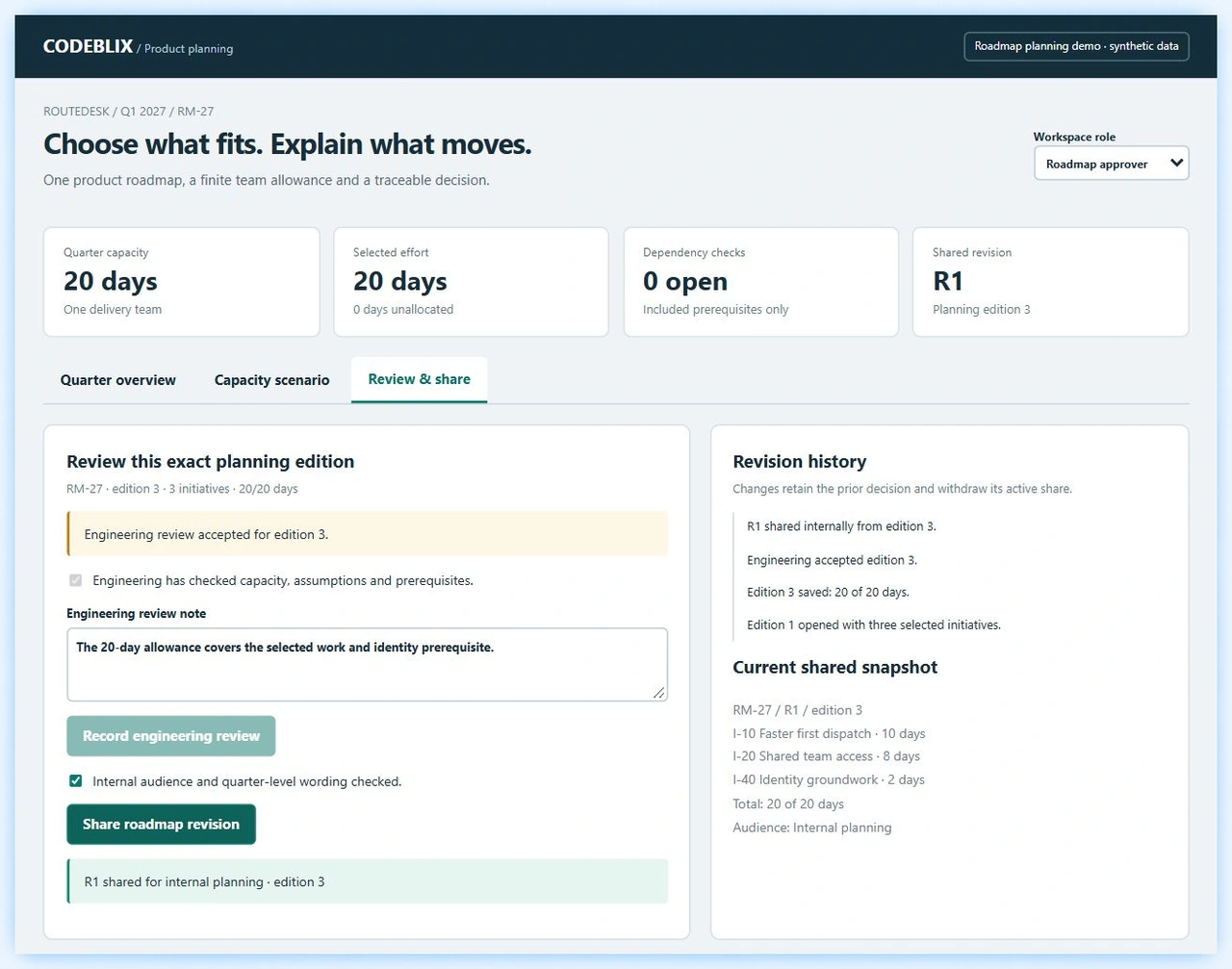
Run the 25-day to 20-day planning exercise
Open Capacity scenario and try to save the initial selection. Remove I-30 Self-service export and include I-40 Identity groundwork. The selected total becomes 10 + 8 + 2 = 20 days. Save, switch to Engineering reviewer and confirm the checks. As Roadmap approver, check the internal audience and share R1.
Open the working roadmap plannerKeep request intake connected without making it the roadmap
A request workspace explains the customer need and its product decision. A roadmap compares several initiatives against a horizon and capacity. Link the accepted request reference into an initiative while retaining its source history in the request system.
Review feature request managementTest a changed allowance after sharing
After creating R1, return as Product planner and reduce capacity to 19 days. The active share withdraws and its review clears. The prior R1 entry remains in history while the 20-day selection requires another tradeoff. Ask shortlisted vendors to demonstrate this change with your audience model.
Choose a platform, an extension or a custom application
An established roadmap platform can be the right choice when its planning model and access controls fit. An extension may suit a team whose existing product records already hold the necessary context. Custom development is useful when allocation rules, review boundaries or controlled stakeholder views require a specific workflow.
A planning cycle from product outcome to revised stakeholder view
Define the product planner, engineering reviewer and roadmap approver’s responsibilities across these six steps.
Set the product goal and planning horizon
Name the product, outcome, time window and audience. Agree how Now, Next and Later are interpreted and how quarter selection is communicated. Capture assumptions that could change the plan, including team availability and unresolved discovery.
Describe initiatives with comparable assumptions
Assign stable IDs, an owner, expected outcome and an effort basis. Retain the evidence that supports consideration. Separate a product initiative from the implementation tasks used by a delivery team, and preserve references between those records.
Check prerequisites before allocating work
Identify work that must accompany or precede an initiative. Validate missing prerequisites, conflicting assumptions and dependency loops in the delivered application. The example blocks a selection containing shared access without identity groundwork.
Choose a capacity scenario and explain the tradeoff
Compare selected effort with the available allowance in one consistent unit. Defer work, reduce scope or review capacity explicitly. Write why the chosen set best supports the outcome; a high score alone does not settle the choice.
Review the current edition and audience wording
Engineering checks selected scope, effort assumptions and prerequisites. A roadmap approver checks audience access and the level of commitment implied by the wording. Record the review against the current planning edition.
Share a revision and manage subsequent change
Create a stable stakeholder snapshot with its selection, capacity basis and version reference. When inputs change, withdraw the active share and retain its earlier history. Reconcile connected delivery records and any audience updates under the agreed communication process.
Records, permissions and sharing boundaries
- Map goals, initiative IDs, capacity assumptions, dependencies, scenarios, reviews and shared snapshots before drawing the timeline. Decide who may alter a planning basis, inspect private evidence, approve an audience or export a prior revision.
- The selectable roles in the demonstration explain responsibility within one local tab. Specify authenticated server permissions, durable records, concurrent-edit protection and auditable exports for the commissioned application.
- Define internal, partner and public views separately. Keep confidential account evidence and engineering notes out of shared summaries. Agree whether a time window expresses direction, a target or an actual contractual commitment.
Migration, delivery tools and reconciliation
- Inventory current spreadsheets, roadmap versions, initiative identifiers and linked delivery issues. Reconcile imported initiative counts, owners, effort units and dependency references. Retain decisions that explain why work was deferred.
- Scope each connection after inspecting the specific project tracker interface. Define authoritative fields, authorization, update direction, stable identifiers, retries and conflict handling. Include a demonstration of the actual connected behavior in acceptance.
- Decide how completed, split, cancelled or renamed delivery records affect the roadmap. A delivery update should not silently change a stakeholder promise. Include reconciliation and a visible exception owner in integration acceptance.
Estimate, deployment and operating support
- Bring an anonymized planning sheet, one overloaded quarter and one dependency dispute. Separate the estimate for the core planner, stakeholder access, migration, integrations, hosting and support. A tailored development quote follows the agreed scope.
- Choose deployment ownership, backup retention, restore verification, monitoring and export formats. Include a reduced-capacity revision and a failed interface retry in rollout acceptance. Maintain an operating owner for incorrect or outdated stakeholder views.
- Agree how planning policy changes are priced and supported. Team calendars, uncertainty, multiple capacity pools and dependency scheduling need explicit models beyond the single-team whole-day example. Test those rules with your own planning cases before approving implementation.
Six record types behind an explainable product roadmap
Use RM-27 to compare applications by their planning decisions and handoffs. This model distinguishes product direction, current selection and the revision a stakeholder actually sees.
| Record | Example inputs | Required output and control |
|---|---|---|
| Product outcome | RouteDesk; Q1 2027; setup friction and team collaboration | Keep the goal and supporting evidence separate from an individual task list. |
| Initiative | I-10 10 days; I-20 8; I-30 7; I-40 2; I-50 12; I-60 4 | Retain owner, intended outcome and estimate basis for each candidate. |
| Capacity basis | One team; quarter allowance 20 whole days | State units and assumptions; review changes before reusing an approval. |
| Prerequisite relationship | I-20 Shared team access requires I-40 Identity groundwork | Flag a selected initiative whose prerequisite falls outside its selected set. |
| Scenario and review | Edition 3; I-10/I-20/I-40; 20 days; engineering confirmation | Require a valid selection and a useful tradeoff rationale before review. |
| Shared revision | R1; edition 3; internal audience; selected initiative snapshot | Prevent repeated shares, retain history and withdraw the active revision when its basis changes. |
The synthetic RM-27 plan initially selects I-10, I-20 and I-30: 10 + 8 + 7 = 25 days against 20 available. I-20 also requires I-40, which is excluded. Deferring I-30 removes seven days and including I-40 adds two, giving 20 days with no missing prerequisite. Engineering reviews edition 3; the roadmap approver checks the internal audience and creates R1. Repeating Share retains R1. Changing the allowance to 19 days withdraws the active share, clears the review and retains the earlier revision history. The local demonstration sends no external updates.
Compare roadmap software with the same capacity change
These current primary pages describe established planning products. Use the same initiative list and reduced-capacity scenario to compare actual behavior, audience controls and operating cost.
| Option | Published focus | Ask in your demo |
|---|---|---|
| ProductPlan | Visual planning, stakeholder views, prioritization and delivery-tool connections. | After a capacity reduction, show the revised selection, prior shared view and audience communication path. |
| Productboard | Customer insights, product priorities, strategy alignment and roadmaps. | Trace a selected initiative to its evidence and show how a prerequisite change affects the reviewed plan. |
| Tempo Roadmaps | Visual roadmapping, feedback collection, prioritization and stakeholder communication. | Demonstrate the finite-team scenario, a missing prerequisite and the history of a changed stakeholder revision. |
Compare the planning policy, permission model and exception handling alongside the view design. Include seat and audience costs, imported history, interface maintenance and data export in the decision. These evaluation questions do not assert that a listed vendor lacks a capability.
Category reference: ProductPlan’s current roadmapping and prioritization overview. The RM-27 capacity example, record model and acceptance cases are original Codeblix buyer resources.
Give product and delivery teams a shared planning reference.
Connect initiative direction to delivery work while preserving the product decision, capacity assumptions and stakeholder audience.
Explore professional service softwareQuestions that shape a roadmap software quote
Agree the planning unit, dependency meaning and audience commitment before commissioning the workspace.
What does product roadmap software help a team decide?
It connects product goals, candidate initiatives and planning direction. Useful software also explains selected scope, effort assumptions, dependencies and audience views. Your operating rules determine how these records become a reviewed plan.
Can Codeblix develop a roadmap application for our planning process?
Yes. Codeblix provides custom software development and consultation. Use the working example to discuss your capacity units, review authority, stakeholder access and delivery records, then scope the application around those requirements.
How is a roadmap different from a feature request board?
A request board keeps the original customer suggestion and its evaluation. A roadmap compares product initiatives over a planning horizon and communicates chosen direction. Link source requests to initiatives while retaining each system’s ownership.
Does a Now or Next label promise a delivery date?
Define that meaning with the relevant audience. In this example the lanes express planning direction and quarter selection is a separate field. Date commitments require explicit scope, authorization and communication rules.
How does the example handle a missing dependency?
I-20 Shared team access requires I-40 Identity groundwork. Saving is held while that prerequisite is excluded. Including its two days exposes the capacity cost; removing a different seven-day initiative brings the selected set to 20 days.
What happens when capacity changes after sharing?
The example withdraws the current shared revision and clears its engineering review. It retains the old revision entry and requires a fresh valid scenario. A delivered application should also reconcile external audience updates and keep relevant receipts.
Can project tracker data be connected?
Connections can be included after reviewing the specific interface and authorization. Agree which system owns each field, how identifiers match and how retries or conflicting edits are resolved. Test connected behavior separately from the planning screen.
Which requirements affect build and support cost?
Capacity pools, dependency rules, stakeholder permissions, imported history, external interfaces and hosting affect scope. Include durable revision records, server authorization, restore checks and ongoing policy changes when comparing a custom build with subscription software.