
Idea management software
Idea management software organizes suggestions around a business challenge, records how they are evaluated and follows the selected ideas into experiments. Codeblix builds custom idea management applications for teams whose campaign rules, review responsibilities and pilot decisions need a tailored workflow. Explore the working scorecard, compare established platforms and bring a concrete challenge to a development consultation.
Give worthwhile ideas a clear route to a decision.
Innovation leads and operational improvement teams need to explain which problem a suggestion addresses, who assessed it and what happens after the decision. Design those responsibilities before choosing a submission form or leaderboard.
Keep submissions attached to a useful challenge
Describe the problem, participating teams, closing rule and evidence expected from a contributor. Preserve ideas that fall outside the brief with a routing reason. A high score on an unrelated proposal should not quietly move it into the campaign’s pilot queue.
Make the evaluation reproducible
Publish the criteria, rating scale, weights and required reviewer count for each campaign. Record each evaluator’s rationale and conflicts. An average based on one eligible review should remain distinguishable from a completed two-person assessment.
Connect selection to an affordable experiment
Give the sponsor an explicit choice of pilot owner, cost ceiling, review date and acceptance criteria. Reserve the approved amount once, retain existing commitments and revisit the authorization when its evaluation basis changes.
Follow an idea from evaluation to a bounded pilot.
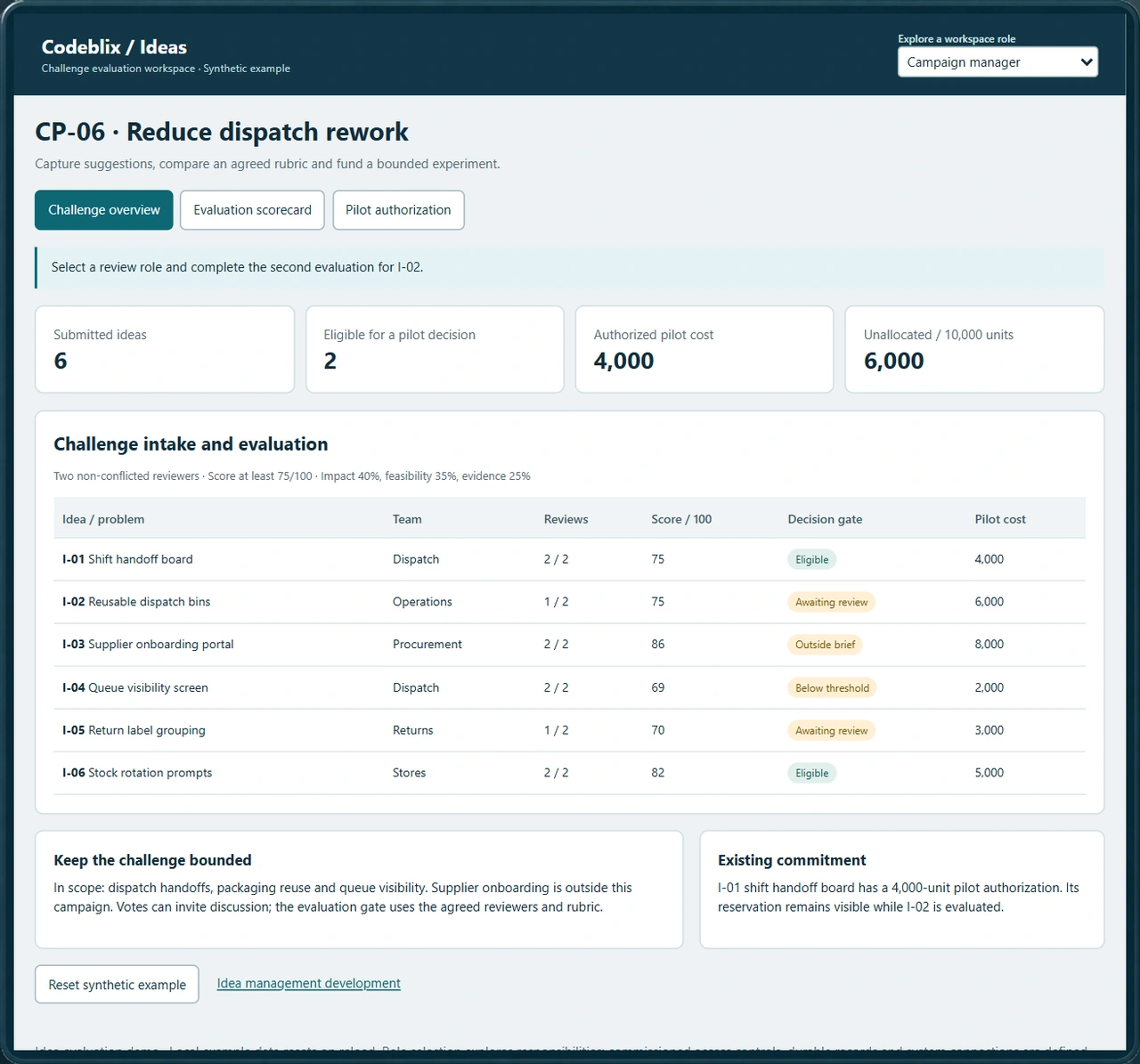
CP-06 contains six operational suggestions. One awaits a second reviewer, one falls below the threshold and another sits outside the challenge. The three views show intake coverage, the actual scoring calculation and a sponsor’s budget decision.
Reproduce the 78-point evaluation
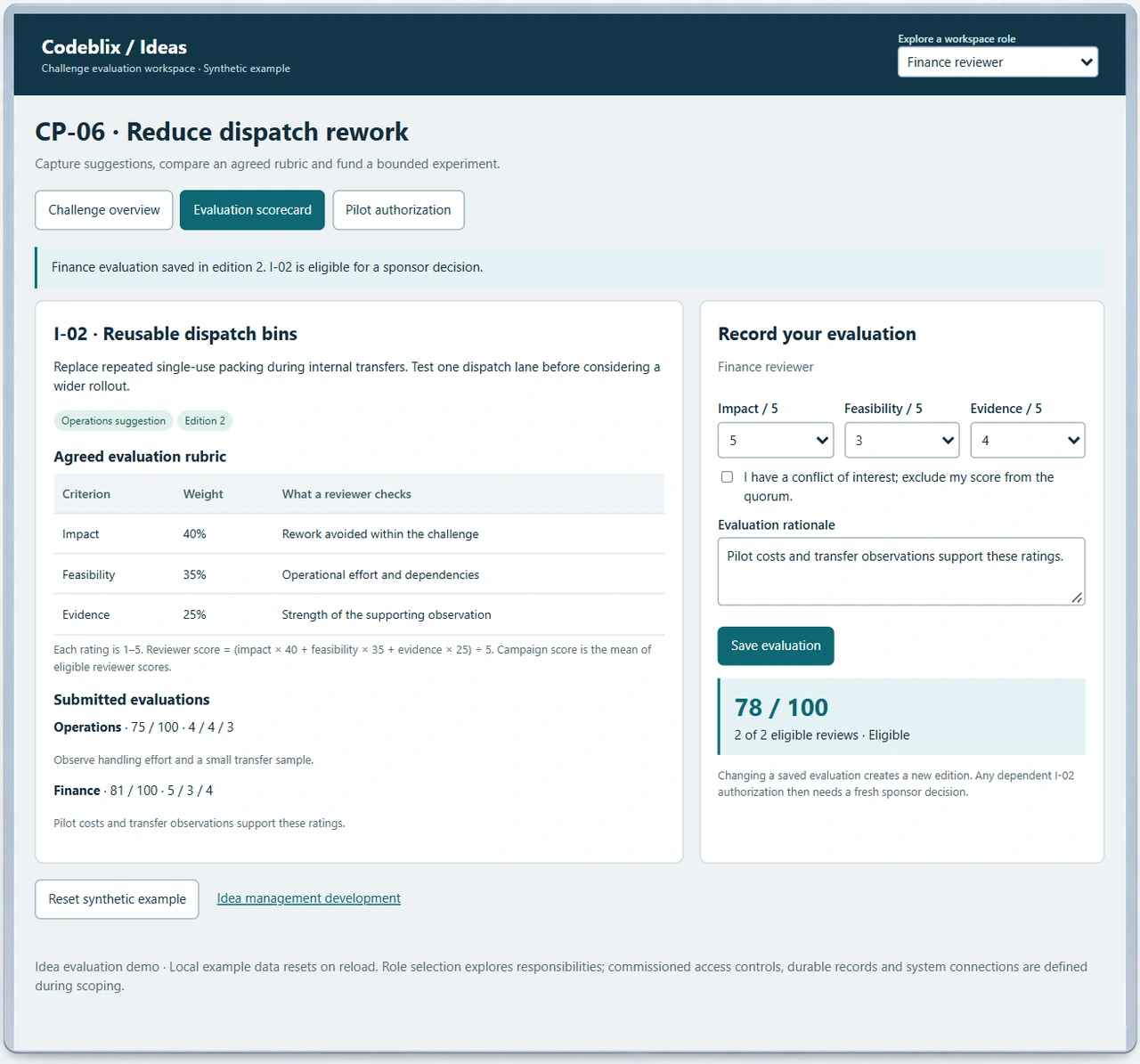
In the demo, open Evaluation scorecard and choose Finance reviewer. Set impact to 5, feasibility to 3 and evidence to 4, then save a rationale. The weighted result is 81/100. Operations has already recorded 75/100, so the completed two-reviewer mean is 78/100 against a threshold of 75.
Try the idea evaluation workspaceTest a conflict after the pilot is authorized
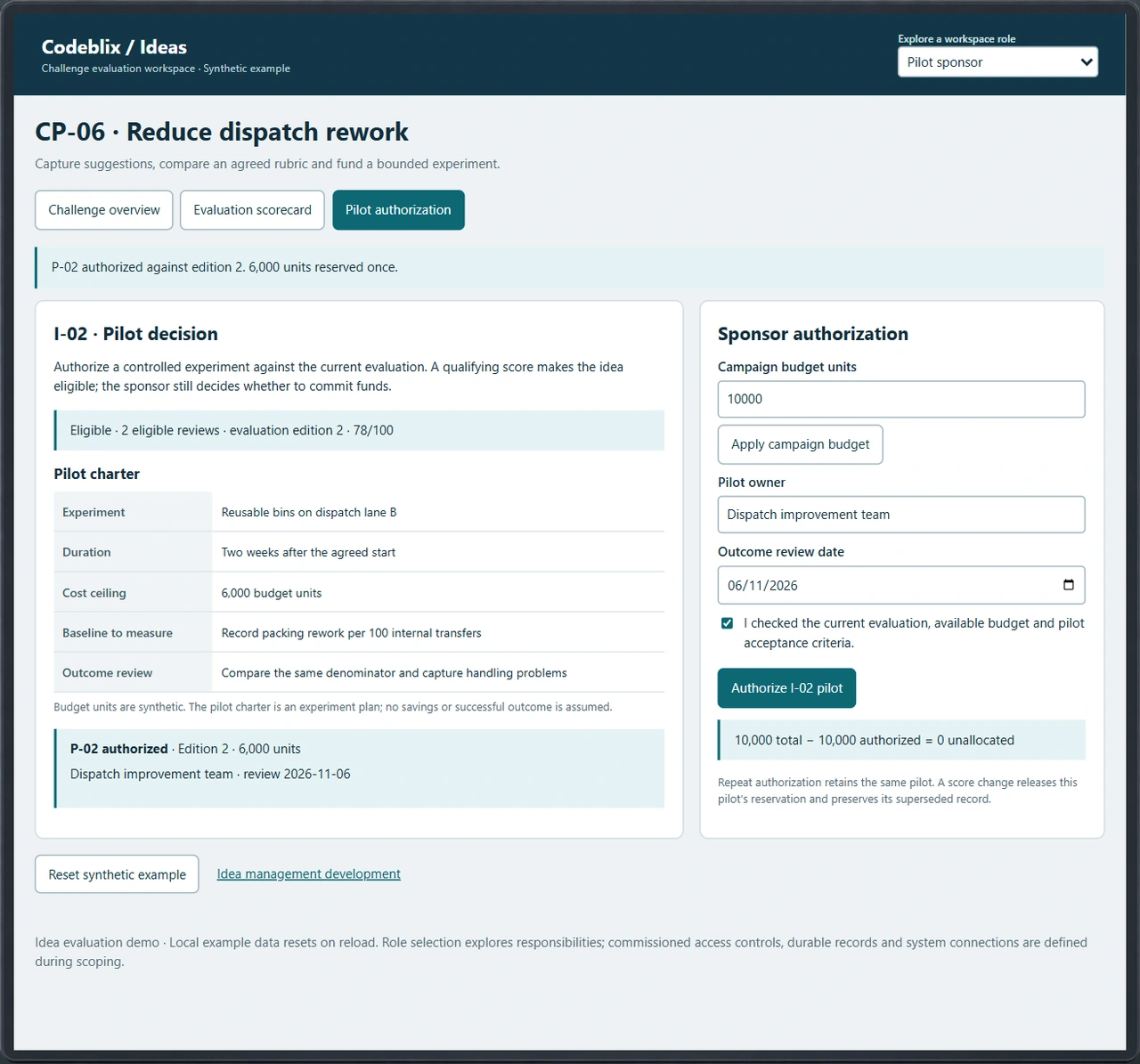
As Pilot sponsor, confirm the checks and authorize the 6,000-unit I-02 experiment. The existing 4,000-unit pilot brings total commitments to 10,000. Return as Finance reviewer and declare a conflict. The eligible quorum falls to one; the old I-02 authorization becomes superseded and its 6,000-unit reservation is released.
Distinguish an innovation campaign from a product backlog
An idea program asks which experiments could address a challenge. A feature request evaluates a specific product change, and a roadmap allocates delivery capacity to selected initiatives. Connect their records when an experiment produces a product decision, while keeping each decision owner clear.
Compare product request evaluationCompare configuration, extension and custom development
Start with a configured platform when its campaign model and access controls fit. Explore an extension when only a bounded interface or review step differs. Custom development is useful when evaluation rules, private participation, operational records or pilot authorization require a more specific application.
A challenge-to-pilot workflow with owned decisions
Use these stages to scope a program for employee ideas, operational improvement proposals or a focused innovation campaign.
Open a challenge with decision rules
Name the business problem and the person accountable for the campaign. Set participation boundaries, evidence fields, evaluation criteria, quorum and budget authority. Decide whether contributors can see other suggestions before submitting their own.
Triage suggestions against the brief
Capture the contributor’s problem statement, intended change, affected process and supporting observation. Resolve incomplete submissions, repeated ideas and out-of-scope proposals with a visible disposition. Preserve source references when related ideas are linked.
Collect eligible reviewer assessments
Assign reviewers with the relevant operational and financial knowledge. Store criterion ratings and the explanation behind them. Declare conflicts and abstentions explicitly; replace an excluded evaluator when the required quorum would otherwise be lost.
Record the selection decision
Show the calculation and campaign rules beside the shortlist. The score informs a human decision about a pilot, further evidence, deferral or rejection. Keep the reason and evaluation edition with that decision, and give the contributor a useful next step.
Authorize a bounded pilot
Agree the experiment owner, permitted spend, baseline, duration and outcome review. Check remaining funds against existing reservations. Pass the authorized charter to the team carrying out the experiment while retaining the sponsor’s decision reference.
Review outcomes before wider adoption
Compare observations against the pilot’s stated baseline and denominator. Record problems, costs and the sponsor’s conclusion. Separate an encouraging test from a rollout commitment, and preserve the learning when a pilot is stopped or revised.
Participation, review authority and confidentiality
- Specify employee, partner and external contributor access independently. Decide whether an idea is public within the campaign, restricted to evaluators or visible only after triage. Include attachments, identity exposure and export permissions in that decision.
- Separate campaign administration, contribution, evaluation and funding authority. Define who can amend a rubric, replace a reviewer, declare a conflict, close submissions or authorize a pilot. A role selector in a demonstration helps explore the workflow; the commissioned application needs authenticated server-side permissions.
- Agree how changed ratings and campaign rules affect earlier decisions. Retain an inspectable edition history and notify the responsible owner when a decision needs another review. Define appeal, withdrawal and closure paths alongside the successful pilot path.
Migration, interfaces and practical administration
- Inventory suggestion spreadsheets, campaign forms and existing pilot records. Map stable IDs, contributor references, criteria, decision reasons and attachments. Reconcile imported counts and preserve unresolved mappings for a named administrator.
- Scope identity, collaboration, project or reporting connections individually. Confirm the authorized interface, available edition, field direction, synchronization schedule and failure owner. A link to a vendor integration page does not establish a working Codeblix connection.
- Include a repeated import, changed contributor identity, removed attachment and failed handoff in acceptance. Decide which application owns the pilot cost commitment and how reconciliation works if another system also records project budgets.
Development estimate, deployment and operating support
- For a useful quote, bring one challenge brief, several anonymized submissions, the scoring policy and an example of a disputed decision. Identify the expected participant count, campaign volume, access model and required handoffs.
- Price the core application, historical migration, interfaces and reporting separately. Include hosting ownership, accessibility, backup and restore, data export and administrator training. Additional mobile applications or automated scoring need their own acceptance scope.
- Define ongoing ownership for rubric changes, overdue reviews, failed connections and pilot reconciliation. Launch one bounded campaign, inspect its decision records and restore behavior, then decide whether to expand the program.
Six records connecting a suggestion to an experiment
Use this entity model to inspect what survives a decision, a reviewer conflict and a later pilot review.
| Record | Example inputs | Required output and control |
|---|---|---|
| Challenge | CP-06; dispatch rework; impact 40%, feasibility 35%, evidence 25%; quorum 2; threshold 75 | Store participation, rubric edition, selection authority and budget policy with the campaign. |
| Idea | I-01 to I-06; problem, suggested change, team, scope decision and supporting observation | Preserve the contributor’s context and route an outside-brief idea without using its score to bypass triage. |
| Evaluation | I-02 Operations 4/4/3 = 75; Finance 5/3/4 = 81; rationale and conflict flag | Count only non-conflicted evaluations toward the two-reviewer quorum and retain each calculation. |
| Selection decision | I-02 mean 78/100; evaluation edition 2; sponsor’s decision and reason | Bind the decision to the evaluation edition and distinguish eligibility from funding authority. |
| Pilot authorization | P-02; 6,000 units; owner; review date; existing I-01 commitment 4,000 | Reserve funds once and preserve a superseded authorization when the score basis changes. |
| Pilot outcome | Rework per 100 internal transfers; observation period; handling exceptions; next decision | Retain the baseline, denominator and learning before recording an expansion decision. |
CP-06 has a 10,000-unit campaign budget with 4,000 already committed to I-01. I-02’s Operations ratings produce (4×40 + 4×35 + 3×25) ÷ 5 = 75. Finance ratings of 5/3/4 produce 81, giving a two-reviewer average of 78. The sponsor can authorize the 6,000-unit pilot, leaving zero unallocated. Declaring the Finance review conflicted removes it from the quorum, supersedes that pilot authorization and releases 6,000 units; the earlier 4,000 commitment remains. These synthetic budget units illustrate authorization arithmetic, not a software price or projected saving.
Compare platforms with the same campaign and reviewer change
Use these primary vendor references to shortlist an approach, then ask each provider to run the quorum, conflict and pilot-reservation exercise with the edition you would buy.
| Option | Published focus | Ask in your demo |
|---|---|---|
| HYPE | Targeted campaigns, structured submissions, evaluation, ownership and implementation tracking. | Remove one conflicted evaluator after a pilot decision and show how quorum and dependent decisions are handled. |
| Viima | Idea collection and an adaptable process for developing ideas through implementation. | Reproduce the weighted calculation and distinguish a discussion vote from an eligible evaluator’s rating. |
| ITONICS | Ideation campaigns, criteria-based evaluation and links from selected ideas to implementation and impact. | Show which records connect the evaluation edition, sponsor authority, pilot commitment and outcome evidence. |
| Ideanote | Goal-driven idea collections, configurable workflows, evaluation and innovation reporting. | Demonstrate a two-reviewer quorum, declared conflict and revised pilot decision using the same six-idea campaign. |
Evaluate participant access, reviewer seats, private campaigns, workflow configuration, export, interfaces and implementation support together. The exercises above identify buying questions; confirm each provider’s behavior in a current demonstration rather than assuming a capability is absent. Viima is part of HYPE Innovation; treat the two product references as related offers when comparing suppliers.
Category reference: HYPE’s idea capture, evaluation and execution overview. The CP-06 rubric, six-record model, interactive pilot example and acceptance checklist are original Codeblix buyer resources.
Connect improvement ideas to accountable work.
Shape campaign participation and experiment handoffs around the teams responsible for the operating process.
Explore professional services systemsQuestions before choosing an idea management application
Resolve the participation and decision model before comparing feature lists or commissioning a build.
What is idea management software used for?
It supports collecting suggestions, evaluating them against a defined challenge and following selected ideas into action. The useful record connects the original problem, evaluator reasoning, decision owner and subsequent experiment or implementation.
Can Codeblix develop a tailored idea management platform?
Yes. Codeblix provides custom software development for campaign intake, evaluation and pilot handoffs. The working example and checklist help specify the review policy, participation model, records and interfaces needed for a project estimate.
How does the weighted score in the demo work?
Impact contributes 40%, feasibility 35% and evidence 25%. Each criterion is rated from one to five. Dividing the weighted sum by five gives a score out of 100. The mean of two eligible reviewer scores must reach 75 before the idea qualifies for a sponsor decision.
Can contributors vote on ideas as well as reviewers scoring them?
A project can include discussion or voting, with clear rules for eligibility and repeated participation. Decide whether votes inform triage, visibility or a decision. In this example the selection threshold uses assigned reviewer assessments rather than a popularity count.
What happens when an evaluator declares a conflict?
That evaluator’s score is excluded from the demo quorum. If the idea loses the required second review, a dependent pilot authorization is superseded and its reservation is released. A commissioned workflow should also specify replacement reviewers and notification responsibilities.
Is idea management the same as a product roadmap?
An idea campaign explores options for a problem and evaluates experiments. A roadmap coordinates selected initiatives against delivery capacity and dependencies. A successful pilot may inform a roadmap decision, with its original evidence linked for context.
Can the application connect to our identity and project systems?
Connections can be scoped after the required interfaces and permissions are verified. Identify identity ownership, allowed fields, update direction, retries and the pilot handoff. Include a failed transfer and a repeated request in acceptance for each agreed interface.
What determines the price and support scope?
Campaign complexity, private participation, review rules, durable history, imports and system handoffs affect the estimate. Include deployment ownership, backup recovery, exports, administrator training and support for policy or interface changes in the quote.