
IoT application development services
Codeblix provides IoT application development services for the software that receives device data, checks it and presents usable records to your team. Commission a custom application around your asset identities, message formats and operating workflow. Start with a defined data path, exercise the event-replay demo and bring the difficult inputs to a development consultation.
Give your operators a reliable software handoff.
Asset operators and technical owners need to agree what the application accepts, which value it displays and who acts when the source becomes unreliable.
Connect messages to a stable asset identity
A device label, gateway topic and maintenance reference can describe the same asset differently. Establish the mapping before displaying observations. Preserve the source identifier and model version so a replaced sensor or renamed line does not quietly inherit another asset’s history.
Make acceptance rules visible
A newer arrival is not always a newer observation. Define duplicate handling, event-time ordering, allowed units and the treatment of missing fields. Retain rejected inputs with a reason while keeping the latest accepted value available to the operator.
Carry uncertainty into the operating decision
Display observation time and freshness alongside the value. Give a reviewer enough context to acknowledge exceptions or request correction. Agree how an expired source, failed integration or changed model affects downstream reports and operator actions.
Every displayed value needs an accepted source.
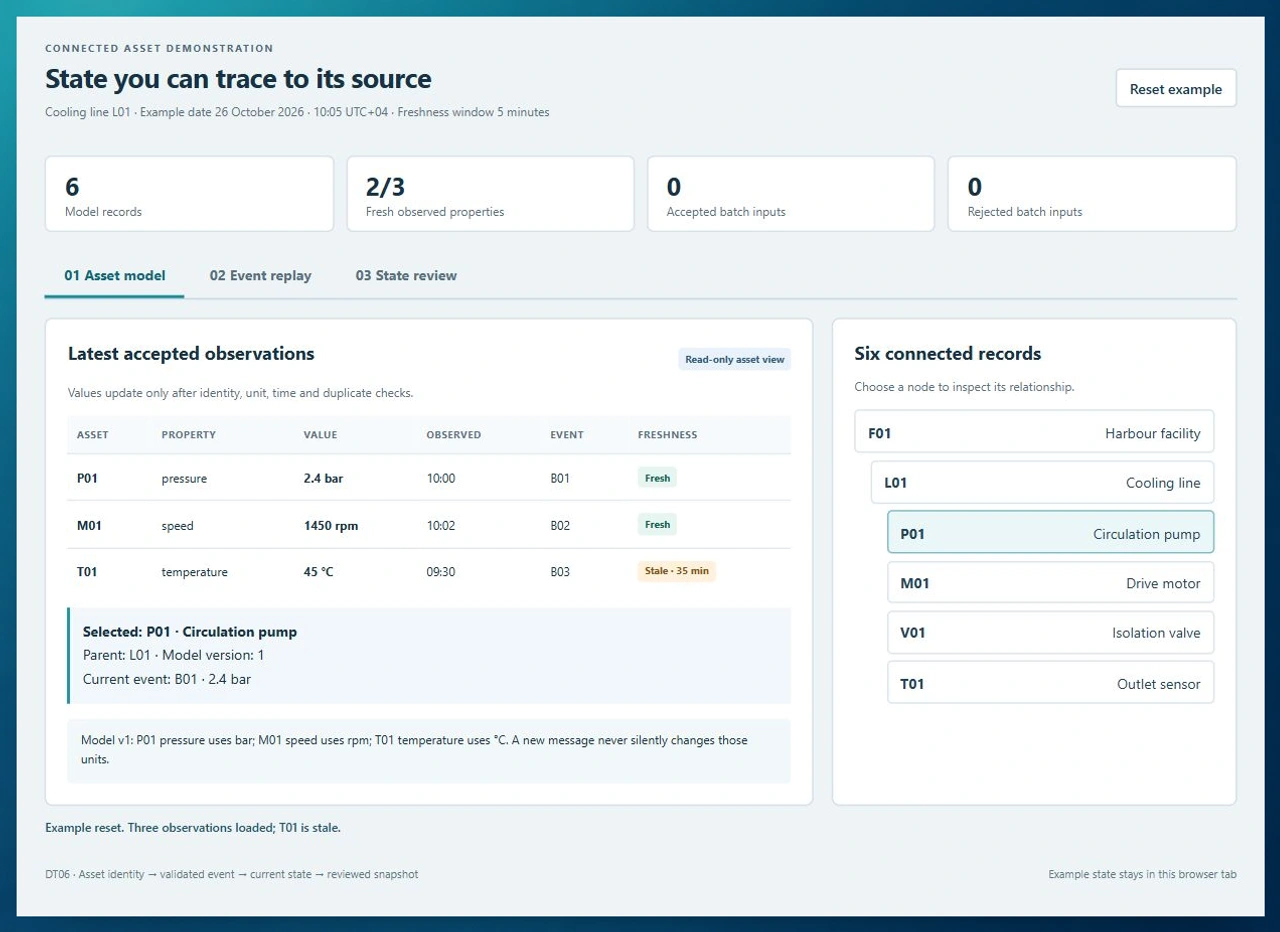
DT06 follows a cooling line with six connected records and three observed properties. Inspect its starting state, process a mixed input batch and create a reviewed snapshot.
Run the DT06 input sequence
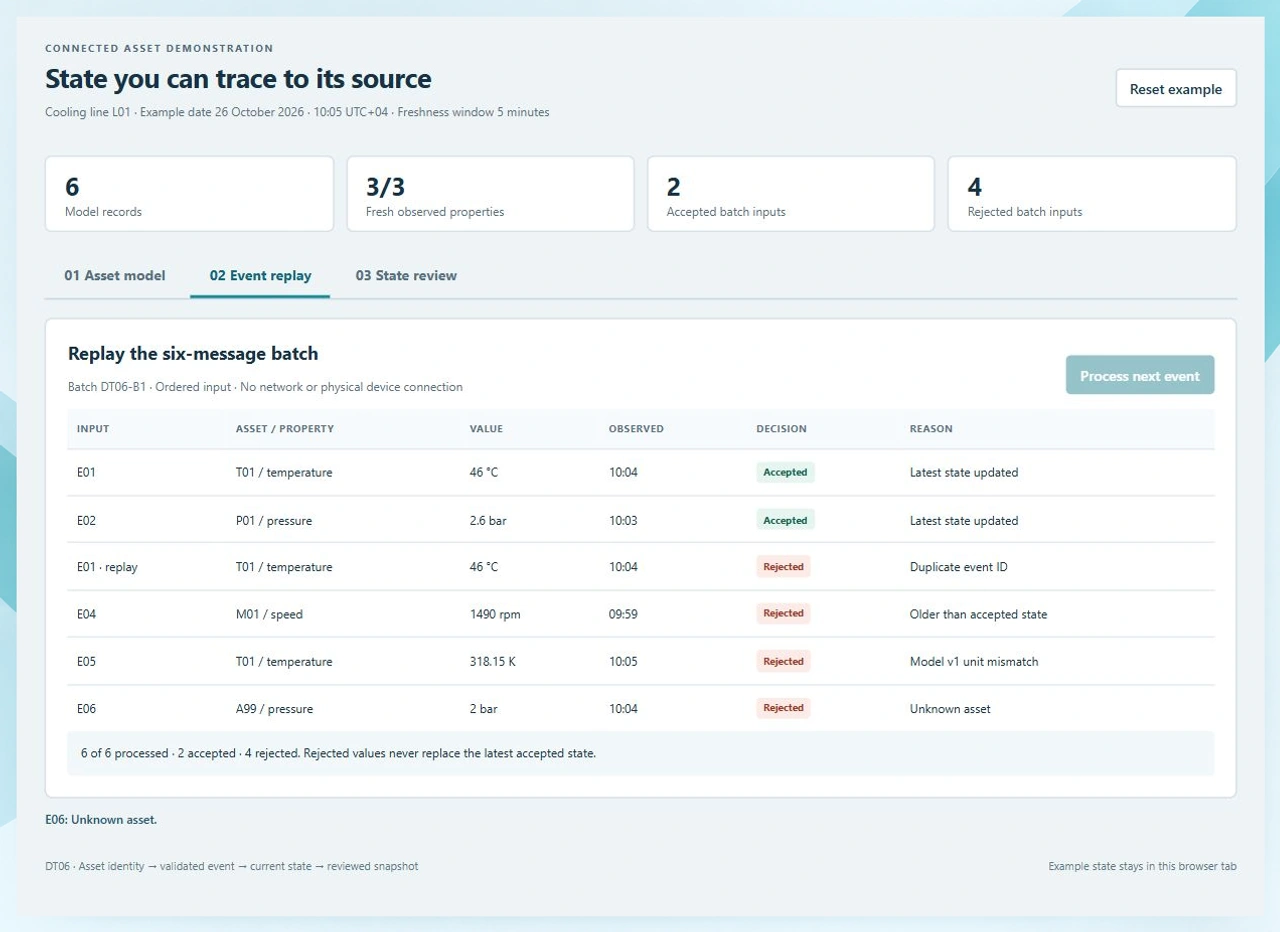
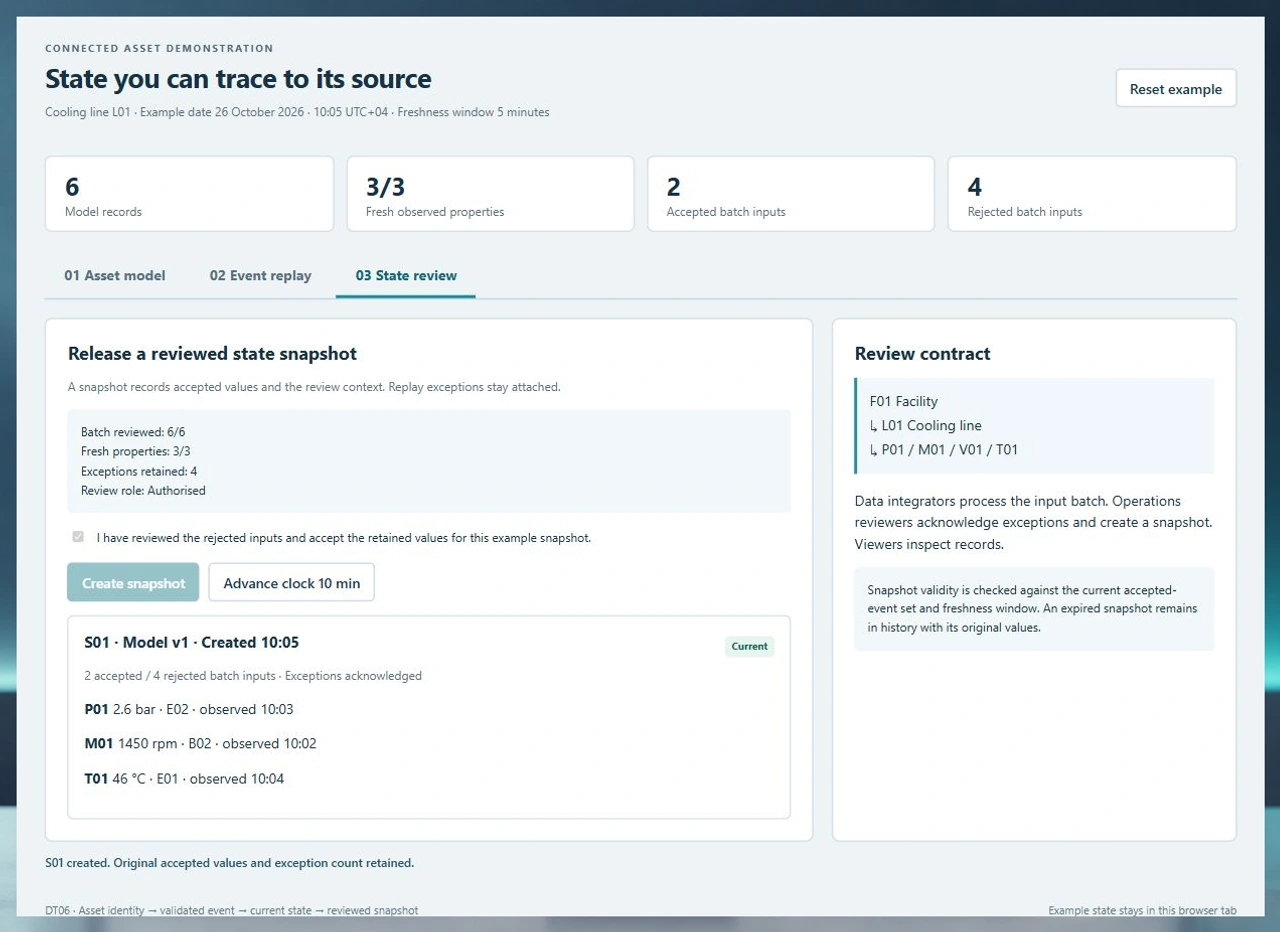
Open Event replay and process all six inputs. E01 and E02 update the accepted state; a repeated E01, older E04, incompatible E05 and unknown-asset E06 remain rejected. Switch to Operations reviewer, acknowledge the exceptions and create S01. Advance the clock to inspect expiry.
Try the asset-event application demoConnect observations to facilities work
An accepted equipment observation can support a facilities task, while work orders retain their own priority, assignee and completion evidence. Specify the handoff reference and review rule before connecting the two applications.
Review facilities task requirementsKeep instrument records linked to the source
Calibration records describe an instrument’s service and review history. The device-data application needs a stable instrument reference and an explicit rule for using its observations when the source record changes.
Inspect calibration record workflowsBuild the device-to-operator path in six stages
Use one bounded asset group to establish the data contract and acceptance evidence before expanding the application.
Name the decision and its owner
Identify who will use the application and what action the information supports. Select the initial asset group, expected observation frequency and response owner. Agree the difference between a monitoring view, a maintenance handoff and a command that changes physical equipment.
Document the supported source interface
Bring gateway or platform documentation, representative payloads and access requirements. Map asset IDs, units, timestamps and sequence identifiers to an agreed contract. Define authentication, source ownership and the evidence required to test the connection.
Build validation before the dashboard
Process valid and difficult messages through the same acceptance path. Check unknown assets, duplicates, schema versions, unit mismatches and old observations. Store both the incoming event and its decision so the displayed state can be explained later.
Present current state with its age
Connect each accepted observation to the asset record and parent relationship. Show its event ID, observed time, unit and freshness state. Decide which fields remain visible during an outage and how users recognise data that has fallen outside the agreed window.
Apply review and downstream permissions
Separate data integration, operating review and read-only access. Define who can correct a mapping, acknowledge exceptions and release a report or snapshot. Recheck permissions on the service handling a change, and retain who approved the resulting handoff.
Rehearse recovery and hand over ownership
Test reconnection, replay, changed credentials and backup restoration against the intended environment. Reconcile the initial asset import and accepted-event history. Hand over source contracts, deployment settings, exception ownership, support coverage and the procedure for changing validation rules.
Application scope, hardware and integration ownership
- Scope the web interface, application API, accepted-event store, asset model and review workflow as named deliverables. Specify supported devices and protocols through verified interface documentation.
- Keep gateway configuration, firmware changes, sensor installation and certification responsibilities with the appointed engineering owners. Include their test environment and sign-off in the delivery plan.
- Separate observed values from physical control commands. A command path needs its own authorisation, acknowledgement, timeout and equipment-owner acceptance cases.
- Price connections individually after checking their authentication, message format, rate limits, data direction and retry behaviour.
Migration, deployment and operational support
- Prepare asset identifiers, parent relationships, property contracts, source mappings and retained event samples. Reconcile duplicate identifiers and incompatible units before migration.
- Choose hosting and data location, retention, backup frequency and recovery objectives with the system owner. Keep device credentials in the agreed secret-management system.
- Pilot a limited source group. Verify message acceptance, stale-state display and reconnection under representative traffic, with a documented rollback path.
- Agree responsibility for application faults, network loss, device failure and mapping corrections. Define support hours, escalation and the evidence required to investigate an exception.
A development quote your technical team can assess
- Supply one valid payload, one duplicate, one old observation and one malformed message, together with the expected operating result. Use those same cases in each supplier walkthrough.
- Request separate estimates for discovery, software development, source connections, data cleanup, hosting, deployment and ongoing maintenance.
- Specify expected asset count, message frequency, retention, concurrent users and reporting needs. Load and recovery testing should use those agreed volumes.
- Include code ownership, documentation, administrator access and acceptance responsibility in the proposal. Agree how changes to the source contract affect scope and support.
Six application records to include in the quotation
These records make the data path inspectable from the original message to an operating handoff. DT06 provides a repeatable example for discussing the required behaviour.
| Record | Example inputs | Required output and control |
|---|---|---|
| Asset identity and relationship | F01 facility, L01 line, P01 pump, M01 motor, V01 valve, T01 sensor | A stable ID and parent link; unknown A99 is rejected. |
| Property contract | P01 pressure / bar; M01 speed / rpm; T01 temperature / °C; model v1 | E05 supplies Kelvin and is rejected against the Celsius contract. |
| Incoming event | Event ID, source asset, property, value, unit and observed time | Repeated E01 is recognised by ID; older E04 cannot replace M01’s accepted event. |
| Accepted state | P01 B01 2.4 bar; M01 B02 1450 rpm; T01 B03 45 °C | Only valid E01 and E02 update the state, to 46 °C and 2.6 bar respectively. |
| Exception decision | Input position, event reference, reason and accepted/rejected outcome | Retain four rejected inputs independently of the three currently observed properties. |
| Reviewed snapshot | S01 model v1, accepted values, event references, time and acknowledgement | Reviewer action requires a complete batch and three fresh properties; the original values remain when S01 expires. |
At 10:05, P01’s 10:00 pressure and M01’s 10:02 speed are within the five-minute freshness window. T01’s 09:30 temperature is 35 minutes old, so freshness starts at two of three properties. Processing the six inputs accepts two and rejects four. T01 becomes 46 °C at 10:04 and P01 becomes 2.6 bar at 10:03; M01 stays at 1450 rpm. All three properties are now fresh. An authorised reviewer can acknowledge the four exceptions and create snapshot S01. Advancing the example clock to 10:15 makes all three observations stale and labels S01 Expired while retaining its original values.
Ask prospective development teams to run the same messages
Use the same source messages and operating responsibilities when discussing proposals with these development teams. Confirm the application layer, connection work and handover included in each quotation.
| Option | Published focus | Ask in your demo |
|---|---|---|
| ScienceSoft | Requirements engineering, architecture, platform and user-application development, testing and support. | Which team owns event-time ordering, rejected messages, source mapping and the operator view during an outage? |
| ELEKS | IoT application engineering, device and data connectivity, analytics and user-facing software. | Replay a duplicate and an old observation, then show the retained state, exception reason and recovery procedure. |
| Embitel | Mobile, desktop and web applications connecting devices and cloud data through a full application delivery lifecycle. | Separate the application quote from gateway, firmware and hardware responsibilities, including the acceptance owner for each connection. |
Use DT06’s six-input batch, visible rejection reasons, expected state values and snapshot-expiry sequence to compare delivery proposals against the same acceptance criteria.
Category reference: ScienceSoft’s primary IoT application development service overview. Use the DT06 asset model, replay workspace and acceptance cases when preparing the application scope.
Link accepted device data to the team that uses it.
Connect asset observations, facilities work and instrument records through defined references and permissions.
Explore operational software requirementsQuestions to settle before commissioning the application
Bring the source contract and operating responsibility into the first project conversation.
Can Codeblix build an application around our existing device data?
Yes. Codeblix offers custom application development around an agreed source interface, asset model and operating workflow. The initial consultation reviews representative messages, access requirements, user roles and the pilot environment before the connection and software delivery are quoted.
Which materials should we send for a development quotation?
Prepare an anonymised asset list, source-interface documentation, message examples, required screens and user roles. Include duplicates, late observations and invalid payloads with the expected result. Add expected traffic, retention, hosting constraints and the team responsible for the device side.
How will the project handle duplicates and late messages?
Agree whether identity comes from a source event ID, sequence or another stable key. Specify how observed time determines the accepted state. DT06 rejects a repeated E01 and an E04 older than M01’s retained observation; the delivered application needs those rules enforced in its service and storage path.
How do you prevent stale values from appearing current?
Set a freshness window for each required property and show its observation timestamp. Define the operator action when the window expires. In DT06, advancing the clock by ten minutes leaves the accepted values intact while their freshness and the reviewed snapshot change to an expired state.
Can the software issue commands to equipment?
Include command requirements explicitly in the project brief. A control path needs equipment-owner review, authenticated permissions, command identifiers, acknowledgements, timeouts and recovery checks. Scope that path separately from a monitoring and record-review application.
Who owns firmware, gateways and installed sensors?
Name the hardware, firmware, network and application owners in the delivery plan. The software scope should specify the interfaces they provide and the joint tests needed before rollout. Device installation, firmware releases and certification remain assigned engineering responsibilities.
How are deployment and continuing support priced?
Request separate line items for application delivery, source connections, data cleanup, hosting, deployment and maintenance. Agree support hours and escalation for application, source and network incidents. Pricing follows the reviewed scope and acceptance criteria rather than an assumed number of devices alone.
What should be demonstrated before we accept the application?
Use representative valid and rejected messages to verify the displayed state and audit record. Test permissions, source outage, reconnect replay, changed mappings and backup recovery. Confirm code and data ownership, operating documentation and the person authorised to approve each acceptance case.