
Sales capacity planning software that makes hiring assumptions measurable
Sales capacity planning software translates active selling seats, hiring dates, ramp time and productivity assumptions into a period capacity model. Codeblix offers custom software development for sales and finance teams that need to reconcile that model with targets, funded headcount and review decisions. Compare a hiring delay, understand the remaining coverage gap and agree which assumptions authorize the next plan.
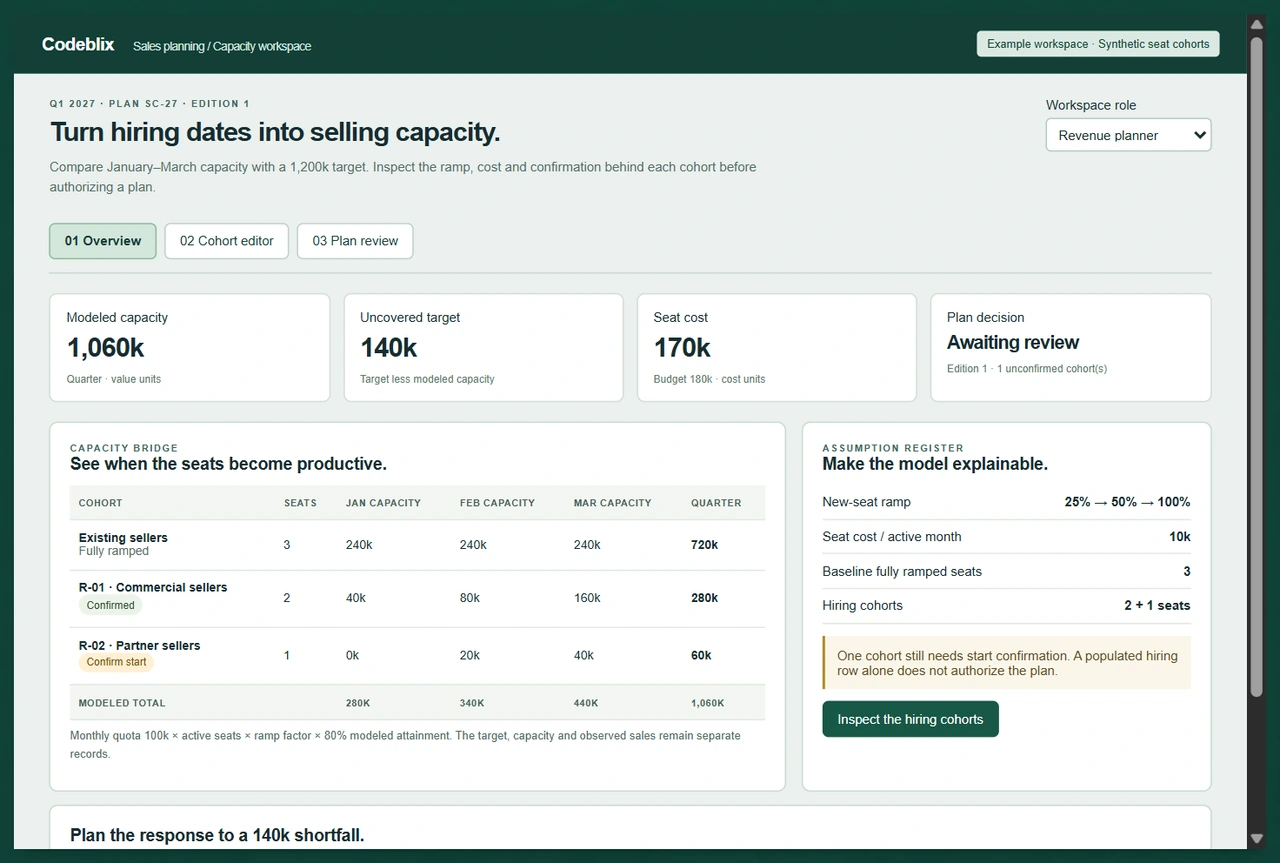
Choose a hiring response with the numbers in view.
A headcount total cannot explain when new seats start contributing. Plan around active months, ramp factors, productivity assumptions and the funded cost of each cohort.
Expose the ramp behind quota coverage
Show the contribution for each cohort and month. Keep fully ramped incumbents, new hires, vacancies and planned starts distinguishable so a year-end headcount count cannot inflate early-quarter capacity.
Compare starts against cost and target
A later start lowers both active-month cost and modeled output. Evaluate those changes together, then document whether the response is earlier hiring, a revised assumption, additional funding or an accepted shortfall.
Review the saved hiring assumptions
Confirm the start evidence, check the funded ceiling and acknowledge any uncovered target. Tie the decision to a plan edition so changing a cohort cannot silently reuse an earlier approval.
Trace a hiring assumption into the quarter plan.
The sales capacity planning demo follows three existing sellers and two hiring cohorts. Inspect the monthly bridge, edit a start assumption and see why an unconfirmed cohort holds up plan approval.
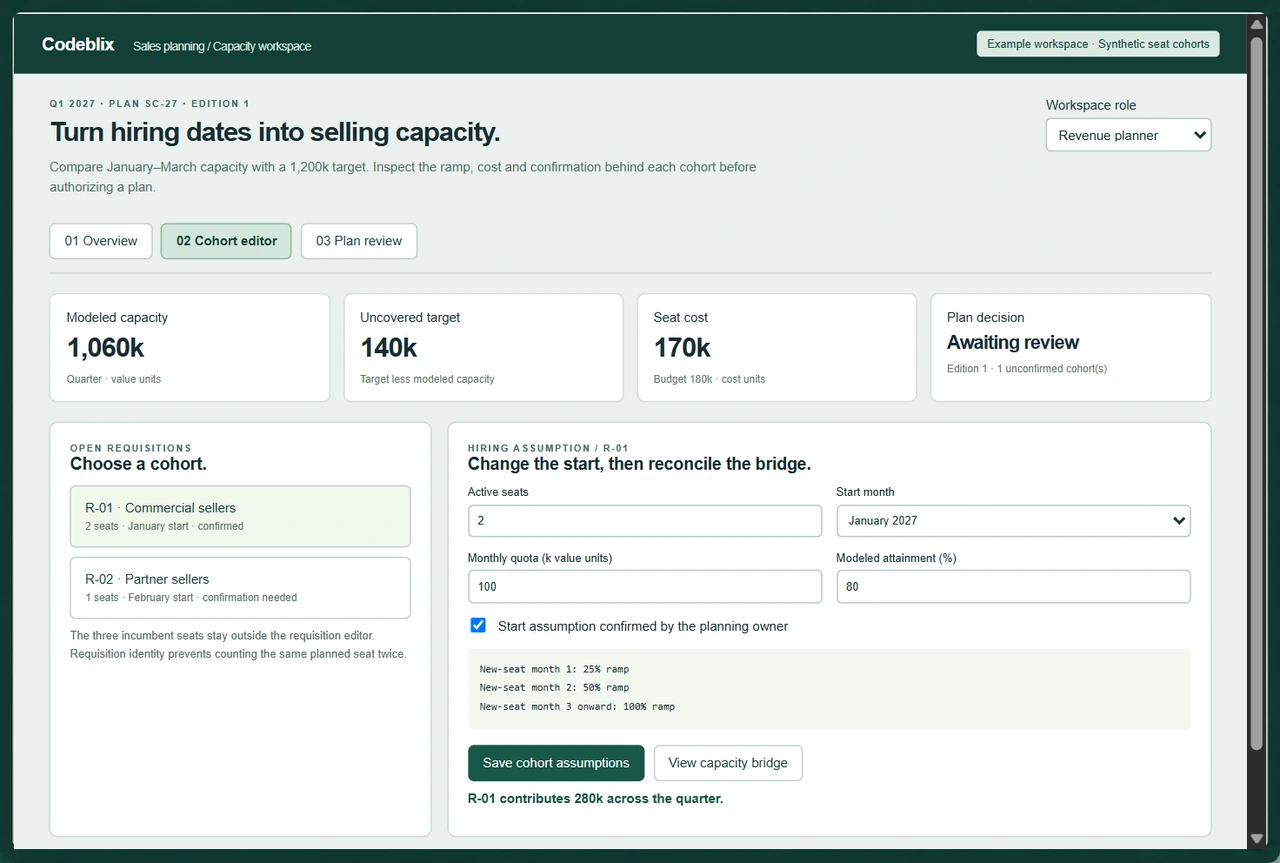
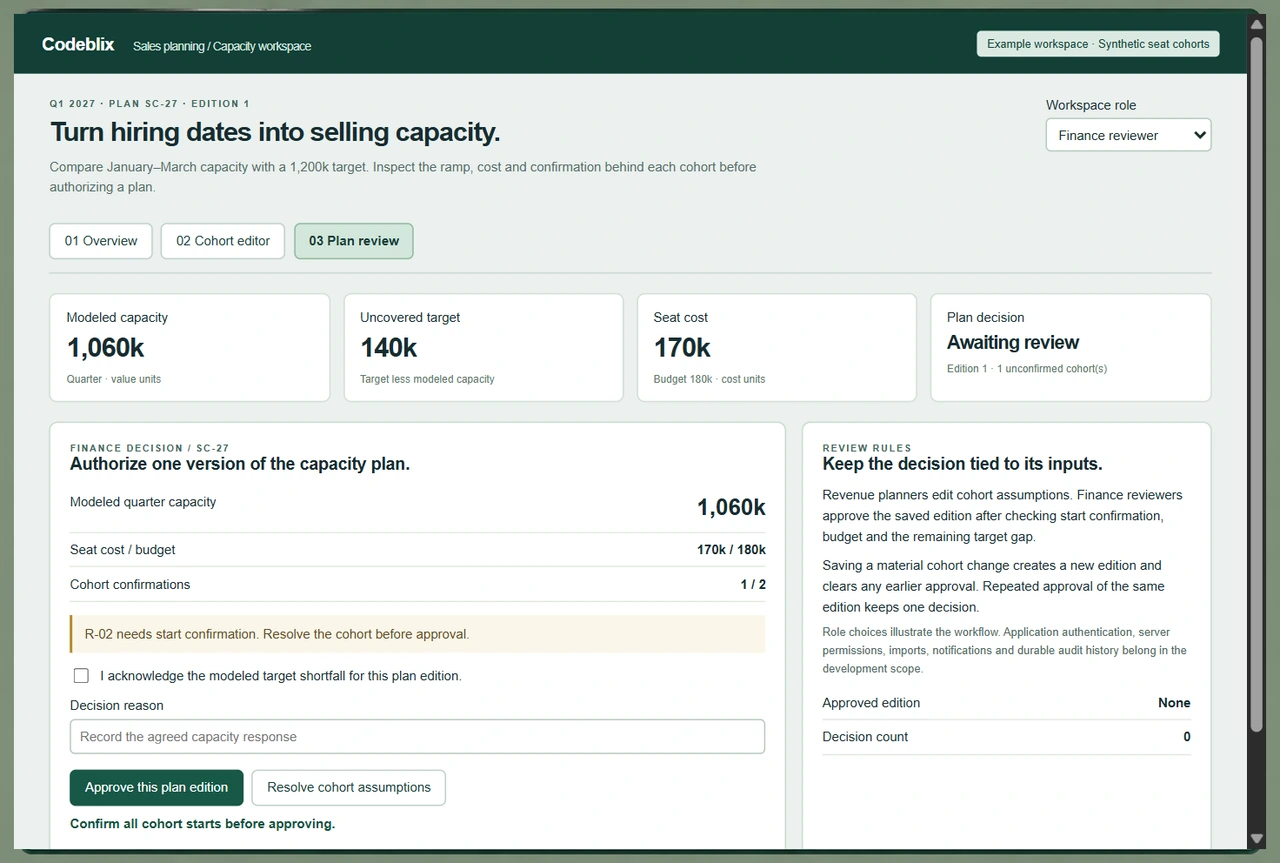
Try a real hiring-date scenario
Open the cohort editor and delay the two-seat January cohort until February. Save the change and reconcile the monthly contribution, quarter gap and active-month cost. The plan review screen also exercises start confirmation, role separation and edition approval.
Open the sales capacity planning demoKeep capacity separate from the submitted forecast
Capacity describes what a staffed selling organization could produce under stated assumptions. A sales forecast evaluates expected deals or another defined commercial outcome for the period. Compare their measures and calendars without adding capacity to pipeline value.
Review sales forecasting developmentConnect seller availability to territorial coverage
After deciding when selling capacity is available, assign responsibility for the customer population. Share segment and seat identities with territory planning while preserving the difference between capacity assumptions and account ownership.
Compare territory planning requirementsFrom a sales target to a reviewed capacity plan
Use one consistent calendar, unit basis and cohort identity throughout the planning cycle. Each handoff should preserve the assumption that produced the number.
Define the planning period and target basis
Identify the months, sales segment and target measure. Specify whether quota represents new bookings, recurring value or another agreed unit. Keep currency, annualization and gross-versus-net treatment consistent.
Reconcile the incumbent seat baseline
Match active selling seats to a stable roster snapshot. Record allocation, start and end dates and current ramp status. Exclude support roles and avoid counting transferred seats in two segments for the same month.
Add hiring cohorts with owned assumptions
Connect every planned cohort to a requisition identity, seat count, expected start and confirmation owner. Distinguish an approved vacancy from an expected hire, and retain the evidence date behind a changed start.
Calculate the monthly contribution and cost
Apply the effective ramp curve and productivity assumption to the active months. Reconcile cohort totals into the period capacity bridge, then compare active-month cost with the funded budget.
Challenge the scenario before approval
Move a start, change quota or vary modeled attainment. Inspect the resulting gap and cost rather than changing a headline total. Route unconfirmed starts, over-budget cases and inconsistent unit definitions to their owners.
Approve an edition and monitor its differences
A finance reviewer records the capacity response and the accepted assumptions. Material edits return the plan for review. Compare later roster and sales observations with the saved edition while retaining the original planning basis.
People, planning authority and sensitive data
- Revenue planners maintain scenario assumptions. Sales leaders challenge quota and productivity inputs. Hiring owners confirm start evidence. Finance reviewers authorize the budget and accepted coverage response. Administrators manage calendars, reference data and access.
- Scope segment-level visibility, scenario sharing and controlled exports. Prefer aggregated cohort records for planning; personal compensation, performance notes and candidate details need an explicit business purpose and restricted access.
- Use authenticated server-side permissions for the application, separate editing and approval authority and retain a decision against the reviewed edition. Selectable demo roles let buyers exercise the decision sequence.
Migration and system handoffs
- Start with a dated roster extract, an anonymized requisition list, the target sheet and the ramp assumptions used today. Resolve duplicate seats, transfers, unknown start months and inconsistent quota units before importing historical plans.
- Specify each HR, applicant-tracking, CRM or finance interface by stable IDs, authoritative fields, direction, update timing, access scopes and replay handling. Confirm the chosen system’s API and permissions during scoping; agree a file-based reconciliation route for the pilot.
- Reconcile imported counts and monthly contributions back to signed source totals. A changed hire date should produce an explainable difference, and a repeated import should not create another copy of the requisition.
Build scope, deployment and support
- Pilot one segment over a short planning horizon. Decide how to treat mid-month starts, working-day calendars, leave, transfers, departures, ramp resets, attrition assumptions and part-time allocation. The worked example uses whole-month starts and no attrition to make its arithmetic reproducible.
- A quote should identify planning dimensions, cohort volume, scenario editions, roles, reports, import histories and required interfaces. Separate third-party licensing, hosting, training and support costs from application development.
- Agree backup and restoration checks, availability expectations, import monitoring, support hours and the person responsible for calendar or quota-rule changes. Retain exportable plan editions so the business can reconcile decisions during a system change.
Six records behind an explainable capacity bridge
Use this original model to evaluate a specialist planning tool, a finance platform extension or a custom Codeblix application. Bring the same example to each demonstration.
| Record | Example inputs | Required output and control |
|---|---|---|
| Target and calendar | Plan SC-27, January–March 2027, target 1,200k value units, segment and basis | Lock the period and unit definition before comparing capacity with target. |
| Incumbent snapshot | Three fully ramped seats, active months, quota, allocation and source edition | Count a seat once per segment-month; retain transfer and departure effective dates. |
| Hiring cohort | R-01 two seats from January; R-02 one seat from February; confirmation owner | Keep requisition identity stable and unconfirmed starts visible to reviewers. |
| Ramp and productivity rule | 100k monthly quota; 25%, 50%, 100% new-seat ramp; 80% modeled attainment | State the time basis and effective curve instead of treating new seats as fully productive. |
| Monthly capacity and seat cost | Cohort, month, active seats, applied factors and 10k cost per active seat-month | Reconcile every monthly contribution and cost before comparing the period totals. |
| Scenario and finance decision | Plan edition, start confirmations, 180k budget, target gap and reviewer reason | Authorize one saved edition; material changes clear the approval and require another decision. |
In the synthetic Q1 plan, three incumbent seats each contribute 100k × 80% × 3 months, totaling 720k value units. R-01 starts two seats in January: 2 × 100k × 80% × (25% + 50% + 100%) = 280k. R-02 starts one seat in February: 1 × 100k × 80% × (25% + 50%) = 60k. Monthly totals are 280k, 340k and 440k; quarter capacity is 1,060k against a 1,200k target, leaving 140k uncovered. Active seat-months are 9 + 6 + 2 = 17, costing 170k cost units at 10k each against a 180k budget. Delaying R-01 to February reduces its contribution to 120k and its cost by 20k: total capacity becomes 900k, cost 150k and the gap 300k. These example units are assumptions for comparison, not a Codeblix price or a revenue promise. R-02 initially lacks start confirmation. Confirm it, acknowledge the shortfall and enter a decision reason as a Finance reviewer to approve the saved edition. A later cohort edit clears that approval.
Ask providers to reconcile the same hiring delay
The primary vendor pages below describe different sales planning approaches. Compare them using the same cohort dates, quota basis and budget boundary.
| Option | Published focus | Ask in your demo |
|---|---|---|
| Pigment | Multidimensional sales capacity models, hiring ramp and attrition assumptions, scenarios and granular access. | Show the monthly capacity and cost difference when a confirmed cohort slips, including the approval attached to each scenario. |
| Workday Adaptive Planning | Sales headcount scenarios tied to broader hiring plans, expenses, quota, productivity and ramp analysis. | Reconcile a requisition transferred between segments without duplicating its seat-month cost or capacity. |
| QuotaPath Atlas | Sales headcount planning, seller ramp, quota coverage and hiring scenarios for capacity decisions. | Demonstrate how unconfirmed start assumptions and changes after review remain visible beside the capacity bridge. |
A specialist product may fit a standard sales planning model. A finance planning platform can be useful when corporate hiring and expense dimensions already govern the process. Discuss custom development when your cohort identities, effective-date rules, approval authority or cross-system reconciliation need a tailored workflow. Compare implementation effort, licensing, data preparation, exports and ongoing ownership. These are questions to verify in a demonstration, not assertions that a named vendor lacks the behavior.
Category reference: Pigment: sales capacity, hiring ramp and scenario planning. Primary product references accessed 19 October 2026. The SC-27 cohort model, worked arithmetic, interactive workspace and acceptance worksheet are original Codeblix resources.
Connect staffing capacity to the wider sales operation.
Use consistent segment and seat identities while keeping territory ownership, account growth and period sales estimates distinct.
Explore professional-services softwareQuestions before choosing sales capacity planning software
Settle the calculation basis and decision authority before comparing screens.
What does sales capacity planning software calculate?
It models potential sales output from staffed selling capacity over a defined period. Common inputs include active seats, start and end dates, quota, ramp and productivity assumptions. Useful outputs explain the monthly contribution, target gap and staffing cost, with enough lineage to challenge a scenario.
Can Codeblix develop a custom capacity planning application?
Yes. Discuss your current target sheet, roster and hiring assumptions with Codeblix. The development scope can define the cohort model, calculations, scenario screens, approval roles, imports and reports your sales and finance process needs.
How is capacity different from a sales forecast?
Capacity estimates output under a staffing and productivity model. A forecast estimates expected commercial results, often using opportunities and period judgment. Align their calendars and units before comparing them, and retain separate records for targets, capacity, forecast and observed sales.
How should a new seller’s ramp affect the plan?
Apply an agreed contribution curve to the months following the effective start. The demo uses 25%, 50% and 100% ramp with 80% modeled attainment. Your real curve should reflect the role and your evidenced assumptions. Define how mid-month starts, transfers or an interrupted ramp change the calculation.
What happens when an expected start date changes?
Recalculate the affected months, quarter coverage and cost. Preserve the earlier assumptions for comparison and route the new edition for review. In the worked example, delaying two seats by one month reduces quarter capacity by 160k while reducing seat cost by 20k.
Can we approve a plan that still has a target gap?
Your governance decides who may accept a shortfall and what response must be recorded. The demonstration requires all cohort starts confirmed, cost within its budget, explicit acknowledgement of the gap and a meaningful finance decision reason. Approval does not turn modeled capacity into achieved sales.
Can the project start from spreadsheets?
A controlled file import is a practical way to establish the roster, requisition identities and monthly reconciliation. Agree templates and reject duplicate or incomplete records. Add interfaces to chosen HR, CRM or finance systems after confirming their object ownership, permissions and update behavior.
Which capacity-planning requirements drive the development cost?
The main factors are segment and calendar complexity, ramp rules, scenario history, access controls, import quality, reports and interfaces. Hosting, restoration, training and support responsibilities also matter. Bring representative anonymized files so the quote can separate a focused pilot from later expansion.