
Buy an artisan storefront for commerce after your cultural event
Acquire AfroZeal around listed goods, participating makers and an order promise that survives event day.
An acquisition case for an existing cultural-event organiser buying an artisan commerce channel. Follow a listed wrap from the event display to a later remote order and named fulfilment responsibility.
Buy AfroZeal for a commerce channel that your cultural-event team can operate beyond event day. Request the domain, application source and agreed handover package through AfroZeal's current Flippa listing. This purchase case is for an organiser with its own permitted maker relationships and a practical plan for listed goods. The platform is a starter software asset; participating artisans, physical stock and a trading customer base are separate resources.
The acquisition can give the organiser an owned place for artisan storefronts, product presentation, customer checkout and order records. Its value to this buyer depends on continuity: when the venue closes, who keeps the offer accurate, receives the next order and helps the customer? Use the worked case below to request a demonstration around those responsibilities, then make an offer for the package that fits your operation.
Request the channel that stays open when the venue closes
An existing cultural-event organiser may bring makers and visitors together for one afternoon, a weekend or a recurring programme. A visitor can remember a garment after going home, while a maker may still have pieces available. The buyer in this case wants to acquire a digital commerce foundation around that continuing relationship.
The purchase enquiry should name that purpose clearly. Ask for AfroZeal's provider storefront, listed-product and order demonstrations, using the same maker and garment throughout. The AfroZeal asset page contains the current documents and sale link. The main African-fashion acquisition offer remains the broader product owner; this case examines the organiser's event-to-remote-order commitment.
Request AfroZeal's source-and-domain package for your artisan channel →
Make one listed wrap the centre of the purchase exercise
Imagine a fictional organiser working with two independent makers. One maker has a ready-listed wrap in a clearly described colour and size. The second has a different garment collection. They participate in a Saturday cultural event, then return to their own workplaces. On Monday, a visitor wants to order the wrap online.
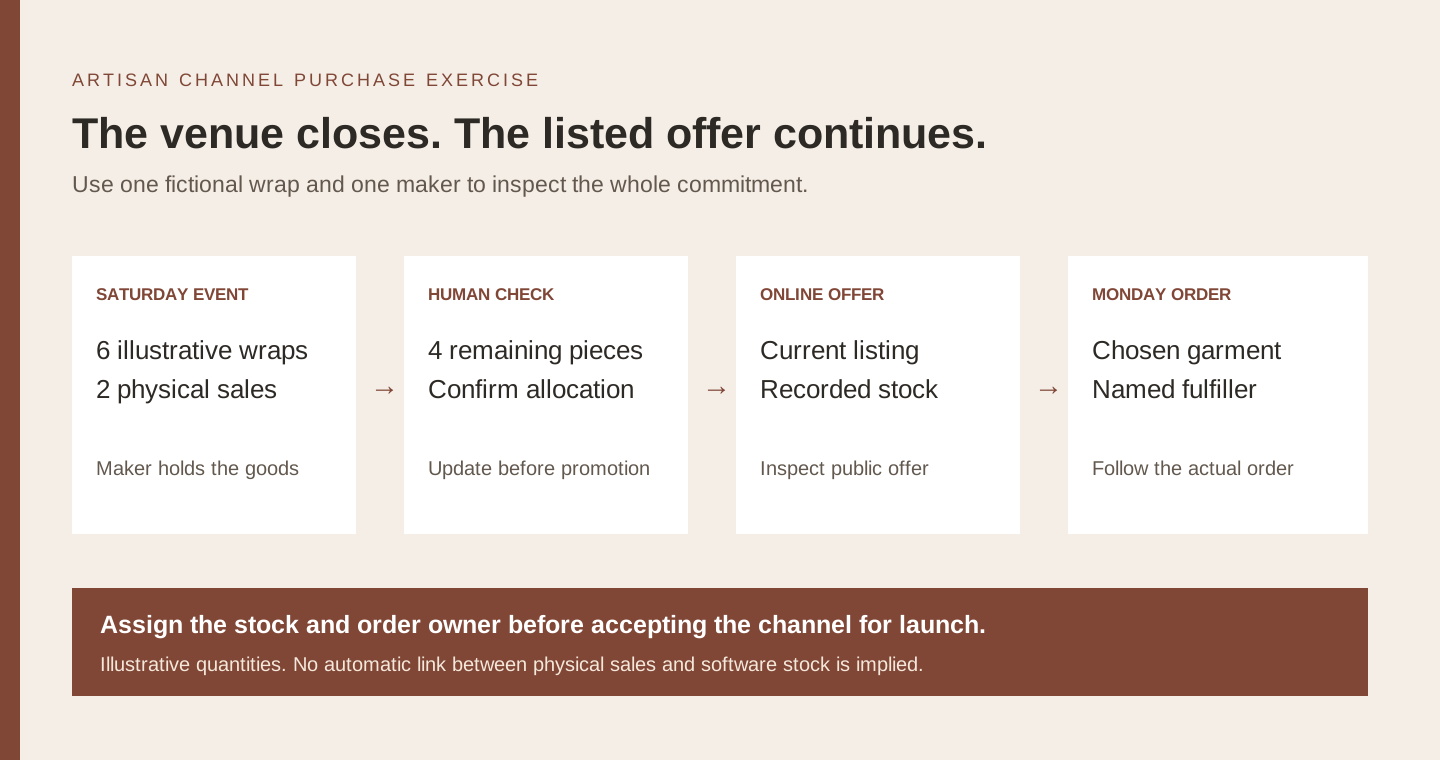
Use artificial names, products and quantities for the seller walkthrough. Suppose the first maker allocates six wraps to the exercise and sells two at the physical event. The organiser must establish which quantity can still be offered remotely and who is responsible for changing it. These numbers are test inputs, with no relationship to AfroZeal's actual sales or inventory.
The important acquisition outcome is one understandable customer promise after the event. A maker's attractive stall and an attractive website are different parts of that promise. The buyer needs the delivered software and a named person who can keep the listing, remaining stock and order response aligned.
Put the maker's continuing offer in the storefront brief
AfroZeal's storefront model gives a provider space for its store name, description, country, business story and products. A public storefront can present the maker's identity beyond a temporary event listing. Ask the seller to show the provider's editing view and the resulting public page.
For the fictional wrap, prepare an offer the maker can actually maintain: the garment name, material description, selected size, available quantity and image. The provider should know which account owns the record. The organiser should know whether it is helping the maker prepare content or accepting responsibility for the goods itself.
Bring permitted images and text to the purchase discussion, or use clearly artificial test material. Event participation alone does not establish permission to reuse every photograph or description indefinitely. An agreed content contribution makes the channel easier to operate because the maker and organiser can identify who supplies corrections after the event.
Inspect the publication gate before promising a launch date
The current source includes a storefront publication gate. It checks provider payout onboarding, an active or trialling plan state, required storefront details and at least one active product. These are concrete steps for the buyer to inspect with the seller before announcing that participating makers will be available online.
A demonstration storefront is useful interface evidence, while an actual maker needs its own appropriate account and payment readiness. Ask the seller to distinguish the demonstration environment from the buyer-controlled configuration. The organiser's first launch date should reflect the makers that can complete the required steps and maintain a real offer.
AfroZeal's documented Artisan Pro configuration currently includes a zero-price plan, with owner controls for plans. Treat a future paid provider offer as a commercial decision to configure and validate. The existence of subscription tools does not establish current paying artisans or a ready subscription audience transferring with the application.
Buy the product record your visitor can recognise at home
The visitor who remembers a wrap needs to recognise the listed item without standing beside the maker. AfroZeal's product controls include a name, description, images, category, price, sizes, stock and publication state. The buyer can ask the seller to create a representative listing, then inspect it through the public product page.
Use the same recognisable details in the event exercise and the online record. For example, the colour and selected size should distinguish the wrap from another piece in the collection. The maker's product story can add context, while the order still needs a sufficiently clear listed item.
Keep the purchase focused on that representation. Source fields for provenance or assisted content are not independent certification of an item's origin, authenticity or suitability. The responsible seller supplies accurate product information. The organiser is evaluating whether the delivered product record supports the particular offer its makers can stand behind.

Reconcile the Saturday sale before inviting Monday orders
Return to the six fictional wraps. Two were sold at the physical event, leaving four in the maker's stated allocation. The acquisition exercise should show the person responsible checking the actual remaining pieces and updating the online stock record before directing visitors to the listing.
AfroZeal has product stock controls, and its cart logic uses the current recorded quantity. That does not make a physical stall sale an automatic application event. If the organiser wants a stall point-of-sale system to change the online quantity, specify that integration as additional scope and request its own acceptance test.
For a smaller first offer, the parties might agree a practical manual reconciliation routine or a distinct online stock allocation. Write the chosen procedure in the operating brief. The acquisition decision is then grounded in a stock promise that the maker can maintain, rather than an assumed connection between two sales channels.
Use an event-close record with named responsibilities
| Moment | Record or decision | Responsible party to name |
|---|---|---|
| Before Saturday | One wrap, its provider account and permitted product material | The maker and the organiser's content contact |
| At event close | Six illustrative units less two physical sales leaves four to check | The person physically confirming the remaining allocation |
| Before Monday promotion | Current stock, public listing and storefront readiness | The provider account holder and channel operator |
| Remote checkout | Selected item, size, shipping address and payment evidence | The customer and configured payment operation |
| After payment confirmation | The maker's order and its fulfilment status | The provider responsible for the listed goods |
| After the venue team disperses | Open-order response and customer follow-up route | A continuing contact with authority to resolve the issue |
The record is useful when another team member can follow it without reconstructing the Saturday conversation. Add the agreed application references and observation dates during the seller walkthrough. Keep physical stock evidence and software evidence recognisable as separate parts of the same operating promise.
Follow the address and selected piece through remote checkout
The current checkout collects a shipping address and prepares payment through Stripe. The purchase exercise should follow the fictional Monday customer from the listed wrap into the cart and the configured checkout. Ask the seller to show where the selected quantity, item information and size are represented.
Then inspect what the customer is being offered about delivery. Address collection provides order information; it does not itself arrange a courier, establish an international service area or settle every shipping charge and tax question. Agree the organiser's intended customer promise and have the seller identify the current controls supporting it.
Use the appropriate test environment for the demonstration. The buyer should understand which accounts, onboarding and payment settings must be ready in its own operation. A completed software exercise can support acceptance of the delivered workflow without being presented as proof of a real customer purchase or bank settlement.
Keep each maker's order visible after a shared basket
AfroZeal's payment-confirmation path groups purchased items by provider when creating orders. That gives the buyer a specific multi-maker exercise to request: include one item from each fictional maker, then inspect the resulting provider order views and the consumer's order history.
The organiser should be able to explain the outcome to the visitor. A shared shopping experience can still create separate maker responsibilities. Confirm which provider sees which items, where the customer can recognise the seller, and which contact handles a question involving only one maker's garment.
Follow the actual payment and order state rather than interpreting a displayed total as completed distribution. The source includes payout status tracking and provider payment configuration. Ask the seller to show how pending or failed payout conditions appear and who responds. Actual external settlement remains dependent on the relevant provider and payment accounts.
Accept a status update as a record of work performed
The provider order interface includes processing, shipped, delivered and cancelled states. For the fictional wrap, ask the maker's operator to identify the paid order, prepare the parcel under its real procedure and update the relevant state. The customer and organiser should understand who supplied that update.
A useful acquisition demonstration also explains the evidence behind the status. If a maker marks an item shipped, its actual dispatch procedure should support the statement. A status selector is a software control; any carrier tracking, label production or automatic delivery confirmation that your offer requires should be separately demonstrated and agreed.
This distinction helps the organiser choose a support promise it can keep after the venue closes. It might direct garment-specific dispatch questions to the maker while handling access and platform questions itself. Those responsibilities become clearer when the purchase walkthrough includes the exact order and the people who act on it.
Choose who carries the remote-order promise
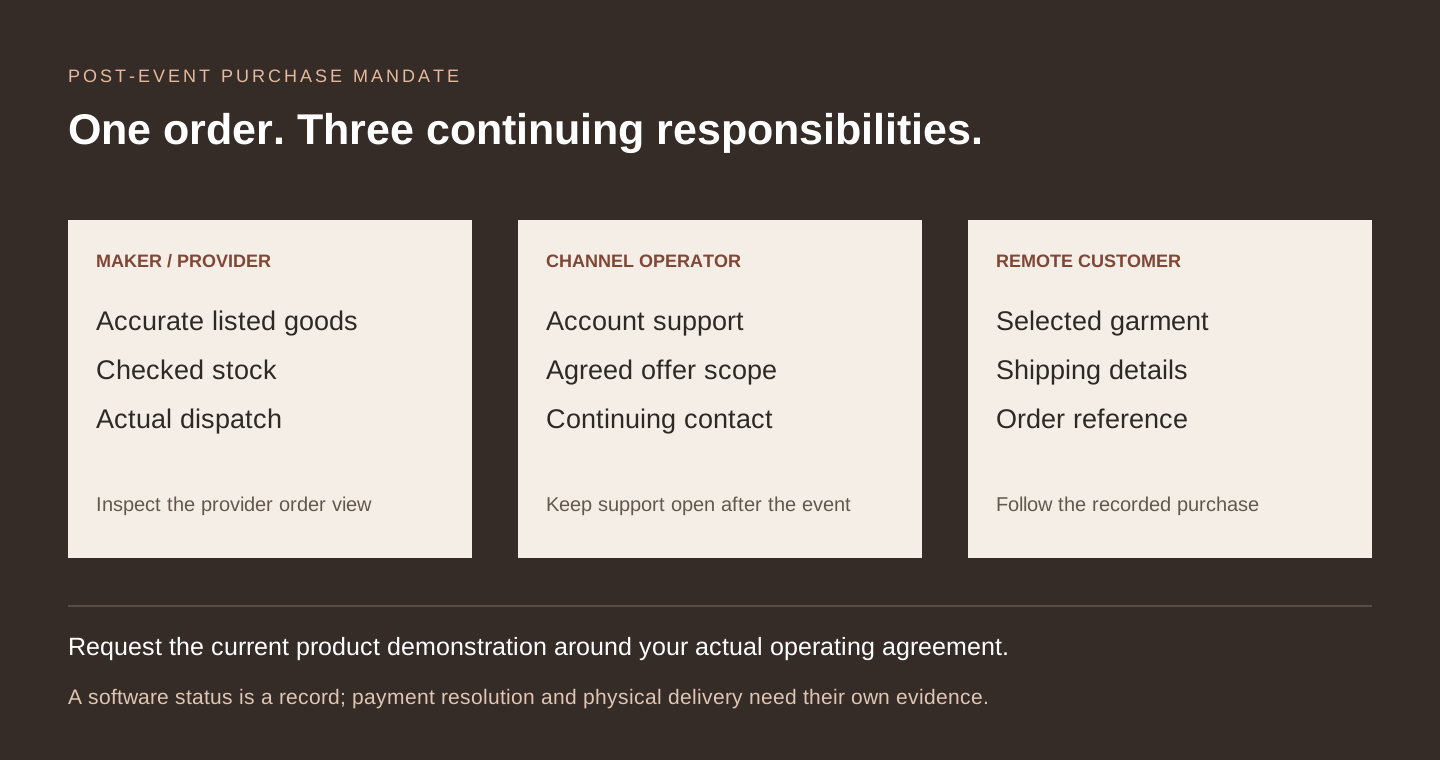
Use this selector to prepare the acquisition request. It identifies the next evidence you need for the continuing offer; it does not establish an agreement with makers or place an order.
Follow the wrap through the maker's storefront, checked stock, payment-confirmed order and actual dispatch procedure. Agree the organiser's continuing platform support separately.
Request the AfroZeal acquisition packageAsk the seller to map your proposed operation to the current provider-account and order model. Price any required additional fulfilment controls before committing to that service.
Inspect the delivered AfroZeal foundationName who maintains each listing, holds the stock and responds to the remote buyer. Use that written responsibility to request a relevant seller walkthrough and transfer scope.
Discuss the intended operation with CodeblixRehearse one cancellation without losing the customer question
Include a second artificial order in the purchase exercise and ask what happens if its maker cannot supply the selected garment. Inspect the actual provider cancellation control and the resulting order state. Then have the seller explain the separate financial and stock steps your operation must perform.
The current status update changes the order record. It should not be interpreted as a complete automatic refund and stock-restoration procedure. The buyer needs to see the financial resolution route and decide who can act through the relevant payment account, how the customer is informed and how any remaining stock is checked.
Keep the same order reference in the follow-up. This makes the exercise useful for the event organiser: when a visitor returns after the weekend with a problem, the continuing team can identify the maker, the recorded issue and the person authorised to resolve it. Accept the software and the human procedure together.
Agree the maker offer independently of the event stall fee
The organiser may already charge for a physical stall or operate a different arrangement with participating makers. The purchased application does not automatically translate that agreement into a continuing digital service. State what a maker receives from the new channel and what work the organiser will provide.
A first offer could centre on storefront preparation, an agreed listed collection and a defined platform support route. Base the offer on demonstrated functions and the people available to maintain it. Provider-plan configuration and any future price belong in that discussion, with actual current settings shown by the seller.
Keep the acquisition figures separate from the maker's garment sales and the organiser's event receipts. The starter asset does not supply a forecast for any of them. Ask for current financial evidence on Flippa where relevant, and evaluate the software package against the operation you can support with your own relationships.
Keep the next event from silently changing an existing order
A cultural programme can move on to another season while last weekend's orders are still being fulfilled. Give the seller a changed-content exercise: the organiser wants to promote a new collection, but a customer still needs the original wrap order explained. Ask to see the relevant order and current listing side by side.
AfroZeal's confirmed order stores item information, quantity, unit price and selected size. Inspect those records rather than relying on the current storefront alone to describe what was purchased. The maker's new product presentation and the existing customer's order are different records with different purposes.
The organiser should also name the person who checks open orders before the temporary event team finishes. Keep a continuing support contact and the relevant evidence references in the operating brief. The acquisition can then support an ongoing commerce offer, while the physical event retains its own schedule and responsibilities.
Put three controlled exercises in the asset acceptance schedule
- One maker and one listed wrap: inspect the provider account, public product, remaining stock, checkout and resulting order.
- Two makers in one purchasing exercise: inspect the provider-grouped orders, customer history and separate fulfilment responsibilities.
- One unavailable item after event close: inspect the cancellation record, financial resolution route, stock procedure and named customer contact.
Use fictional data and an agreed payment test setup. Ask the person receiving the handover to perform the relevant operator steps from the supplied instructions. Record where help is needed and resolve material questions while the seller can demonstrate the current implementation.
These exercises define a bounded acquisition. Any event ticketing, stall management, shared physical stock integration or central warehouse feature essential to your operation belongs in an additional written scope. The buyer can make an informed decision around the delivered artisan commerce foundation and the particular work its team intends to own.
Prepare the venue team's final handover sheet
Give the fictional Saturday event a clear closing routine. Before the stall is packed away, the maker confirms its remaining online allocation, the organiser records the continuing contact and both identify any unfinished customer question. The person maintaining the storefront can then check the public offer against that agreed position.
On Monday, the continuing operator should be able to receive the wrap question without needing the volunteer who happened to staff the venue. Ask that operator to use the listing and relevant order record to explain the customer's next step. If the garment has sold elsewhere, identify who changes the available offer. If it has already been ordered online, identify who follows up with its maker.
Use the same sheet during the seller's handover. The organiser's responsibilities are purchase requirements, while the demonstrated screens are evidence of the current application. Mark any task performed through an existing external procedure, and agree who maintains that procedure after transfer. This gives a small cultural organisation a practical way to receive the software without turning every volunteer into an application administrator.
Record who can cover the continuing contact when they are away. A published maker offer can receive attention outside event hours, so the first operating commitment should reflect a response routine the team can actually maintain. The software acquisition supports that routine; the buyer supplies the people and the agreed availability.
Choose the route from your event identity to the maker's offer
The organiser may already have an event website, printed programme or established audience channel. Bring one permitted visitor journey to the acquisition discussion: a person sees the event identity, follows an agreed link to the artisan channel, recognises the maker and opens the listed wrap. Request the actual destination pages rather than assuming the existing event website will be replaced.
AfroZeal includes whitelabel name and logo settings alongside provider storefront identities. Ask the seller to demonstrate the current owner controls and explain the included branding work. The organiser can then decide what the platform represents and how each maker remains recognisable within it. Confirm the use of event and maker materials with the people who supply them.
Keep the first linked journey small enough to inspect. Open the maker destination from a normal customer device, find the intended garment and check how a customer returns to the relevant account or order information. If your offer depends on automatic event-page imports, audience synchronisation or campaign email delivery, put those connections in an explicit additional scope.
This purchase decision concerns continuity of a commerce destination. The organiser's audience access and permission to contact it remain its own resources. A clear route from the event identity to an accurate maker offer gives the buyer a concrete launch exercise, without treating attendance at a physical event as proof that anyone will make a later online purchase.
Send a purchase enquiry built around the Monday customer
Read the AfroZeal user guide and technical handover, then request the current domain, source, documentation, rights and support inclusions. Identify the person who will maintain the application and the continuing contact for participating makers.
Tell Codeblix that your main purchase outcome is a listed-goods channel that remains operable after the cultural event. Include the fictional wrap, the physical stock change and the Monday order in your walkthrough request. Ask the seller to distinguish the existing product from any additional work needed for your custody, delivery or support arrangement.
When those responsibilities are clear, request AfroZeal's current sale terms or submit the appropriate offer enquiry. The online-business acquisition collection provides other asset offers if your intended operation requires a different foundation. Buy the package whose demonstrated records and agreed transfer support the continuing customer promise your organisation is prepared to make.
Explore the products discussed
Explore related acquisition offers