
Buy a software business around a defined automatic workflow
Inspect the rule-driven task and accept the human responsibility around it.
Request ThatQuis or Macro-Manage for an automatic workflow you can verify. Trace accepted answers or entered fee payments to an understandable result.
Buy a software business around an automatic workflow you can name and verify. Codeblix offers ThatQuis and Macro-Manage as separate application-and-domain acquisitions. If your search begins with an automated online business for sale, these assets give you concrete processes to inspect: an accepted questionnaire answer follows configured rules, while an entered fee payment contributes to the organisation's calculated fee record.
The purchase question is which automatic task you want to own and which human responsibilities you accept around it. This is different from asking whether an app uses AI or whether you have spare time for a side business. Neither offer promises autonomous company operations, money without work or verified recurring income. Each has its own listing, package, customer promise and transfer terms; no combined automation suite is implied.
Request the asset around the rule-driven task you want to purchase
- Request ThatQuis for its question-to-outcome workflow →
- Request Macro-Manage for its fee-record workflow →
The ThatQuis and Macro-Manage marketplace pages connect each current offer with its documents and preview. Confirm availability, price, represented financial history, included source and domain, service-account responsibilities and agreed assistance through the individual transaction. The examples below are artificial acceptance inputs, not evidence of existing customers or commercial activity.
Use the broad ThatQuis acquisition brief and Macro-Manage acquisition brief for the complete individual product inspection. This case concentrates on the boundary between a configured automatic result and the person responsible for its inputs, rules and exceptions. The buyer should leave the workshop able to explain that boundary in a single ordinary sentence.
Write an automation claim small enough to demonstrate
“The business runs itself” gives the seller and buyer no useful test. “A valid answer to this question chooses the next configured question” is specific. So is “a recorded amount contributes to the selected member's monthly total.” Both statements identify an input and a result. The person inspecting the application can trace what changed and decide whether that task is worth owning.
For the worked buyer, the first candidate is a simple questionnaire application. Its customer wants to publish a rule-defined result journey. The second candidate is a fee-record application whose customer wants a clear monthly status after entering received payments. These are two different businesses to consider individually. The buyer should choose the process it understands and can support, rather than count the number of automatic features on a sales page.
Give the claim an owner as well. Someone decides the questionnaire rules and result wording. Someone confirms that a received payment belongs to a particular member and period. Automatic processing can reduce repeated manual work after those decisions, while the owner still needs a procedure for changing them. That is a concrete operating commitment to accept with the software.
Use a trigger-to-exception purchase map
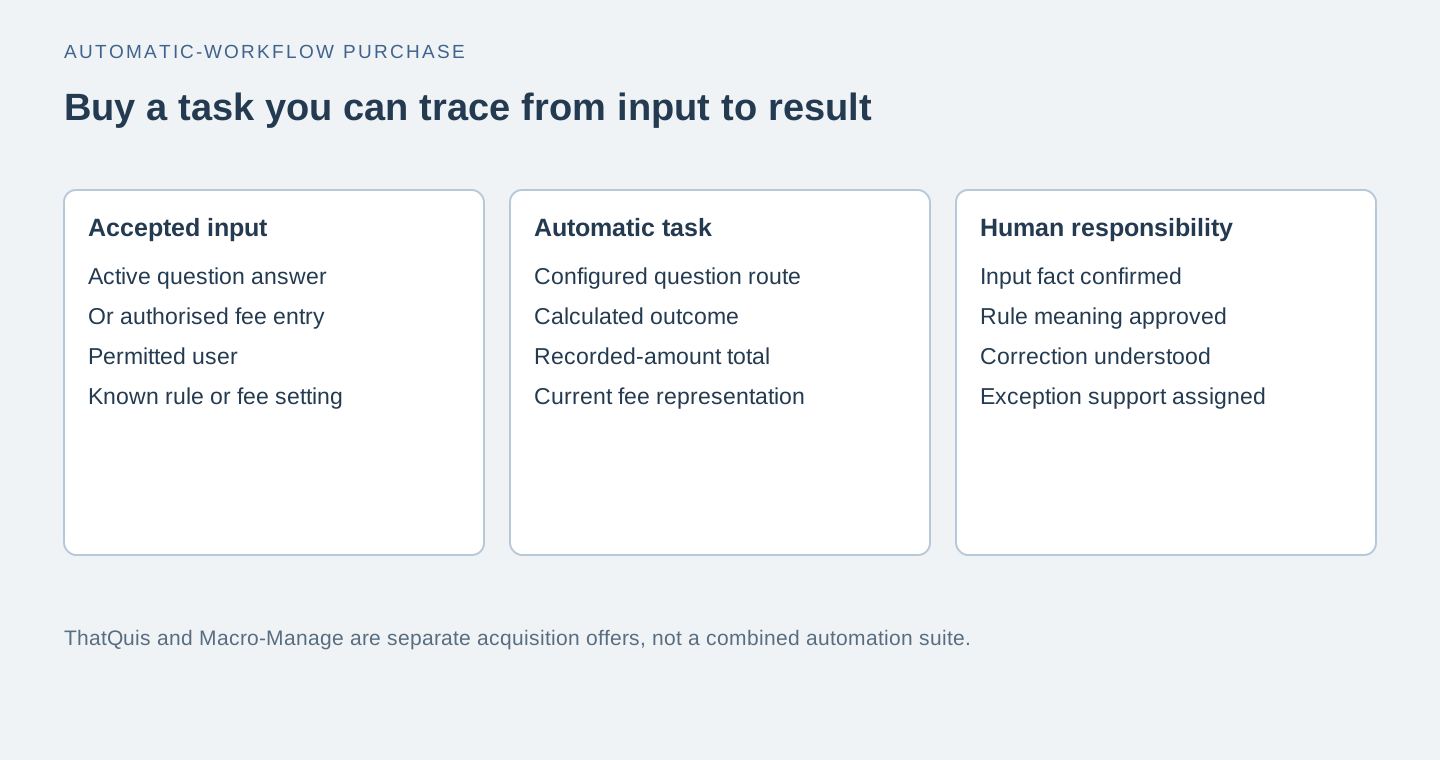
| Candidate process | Accepted input | Automatic behaviour to inspect | Human owner |
|---|---|---|---|
| ThatQuis question route | A response accepted for the active question | The configured next-question path | The creator who defines and checks the rule |
| ThatQuis result | A completed permitted response journey | The configured outcome calculation and result record | The person responsible for the result's meaning |
| Macro-Manage fee total | An authorised entry for a member, month and year | The recorded amounts contribute to the selected period's total | The staff member who confirms the real payment and correct period |
| Macro-Manage fee state | The selected fee setting and recorded total | The current paid, partial or unpaid representation | The organisation that defines the fee and handles discrepancies |
Ask the seller to complete the map against the release being demonstrated. An input accepted by one process may not be valid for another. The important purchase evidence is the connected path from that input to that result, with a named person responsible for its meaning. This is more useful than an isolated animated screen or a total that nobody can explain.
Use the map again when the example changes. If a creator changes a question rule, or an administrator corrects an entered amount, identify which result should change and which person checks it. The map is a buying tool for a bounded process. It should remain useful after the seller demonstration, when the new owner has to support the first ordinary customer question.
Buy the questionnaire process as a configured rule journey
ThatQuis documents editable quizzes, branching, scoring, outcomes, versioned publishing, resumable respondent flow, creator workspaces and software plans. The inspected public response source normalises an accepted answer, evaluates the configured next question and maintains the session's progress. Those are specific implementation foundations to inspect in a current seller walkthrough.
Create a fictional questionnaire with a clear fork. One answer leads to a second question; another follows a different defined route. Keep the subject ordinary and avoid making a professional or financial judgement through the example. The purpose is to inspect the rule path, not to claim that the application's result supplies expertise it does not possess.
Ask the seller to follow the first route as a normal respondent, then start an artificial second session and follow the other. Observe the displayed questions and result. The buyer should be able to explain why each path appeared from the configured rules. This gives it a concrete automatic customer task to purchase and support.
Keep the result's meaning under the creator's authority
A result can be calculated consistently while its wording is unsuitable for the creator's intended offer. The buyer therefore needs to inspect both the rule behaviour and the content the creator controls. Ask where the outcomes are configured, how the relevant scoring or routing rules connect to them, and what a respondent actually sees at the end.
For the fictional example, the creator uses simple preference categories. It can read the expected outcome directly from its own rule sheet. That keeps the purchase test understandable. A more specialised customer would need its own approved content and decision process, which the platform does not supply merely by calculating a result.
The acquired asset gives the owner a software product to operate for creators. Those creators still need to define their questions and promises. The new owner needs documentation and a support route that help customers distinguish a rule configuration question from a broader question about the advice they wish to publish.
Test the boundary where an answer is not accepted
Bring one deliberately incomplete or invalid answer to the workshop. Ask the seller to show the normal respondent experience and the relevant validation behaviour. The inspected source checks that an answer belongs to the active question and normalises accepted values before choosing the next path. Observe the actual result in the demonstrated release.
The buyer should record what the customer can do next. A useful automatic workflow includes an understandable response when the input is unsuitable, as well as a successful path. The human support owner needs to know whether to explain the expected format, inspect the creator's configuration or escalate an application problem.
This test makes the operating boundary practical. The owner is purchasing a rule-driven process with defined accepted inputs. It can describe that process accurately and help users recover when they have not supplied one. That is a stronger product promise than calling every response an automatically completed lead.
Separate the response result from consented lead capture
ThatQuis includes consented lead capture as part of its documented product. In the seller walkthrough, identify the relevant creator settings and the point at which a respondent provides contact information. Keep that information connected to the actual journey and account permissions the application uses.
The fictional buyer should inspect the result and the consent choice separately. It wants to understand which records are created under the chosen configuration and which customer promise the creator makes. A completed question route is one event; a permitted contact record is another aspect of the workflow.
For a purchase decision, ask who handles a creator's question about a missing lead or an unexpected result. The response map should let the support person locate the relevant stage. The new owner is buying both a useful automatic path and the responsibility to explain its actual boundaries to the customers using it.
Buy the fee process as calculated record work
Macro-Manage documents organisation-scoped rosters, a twelve-month fee grid, full and partial payment recording, histories, receipts, exports and reporting. Its source accepts authorised payment entries for a member, month and enrolment year, then calculates totals and balances from recorded amounts. Stripe software subscriptions are a different flow from the organisation's member fees.
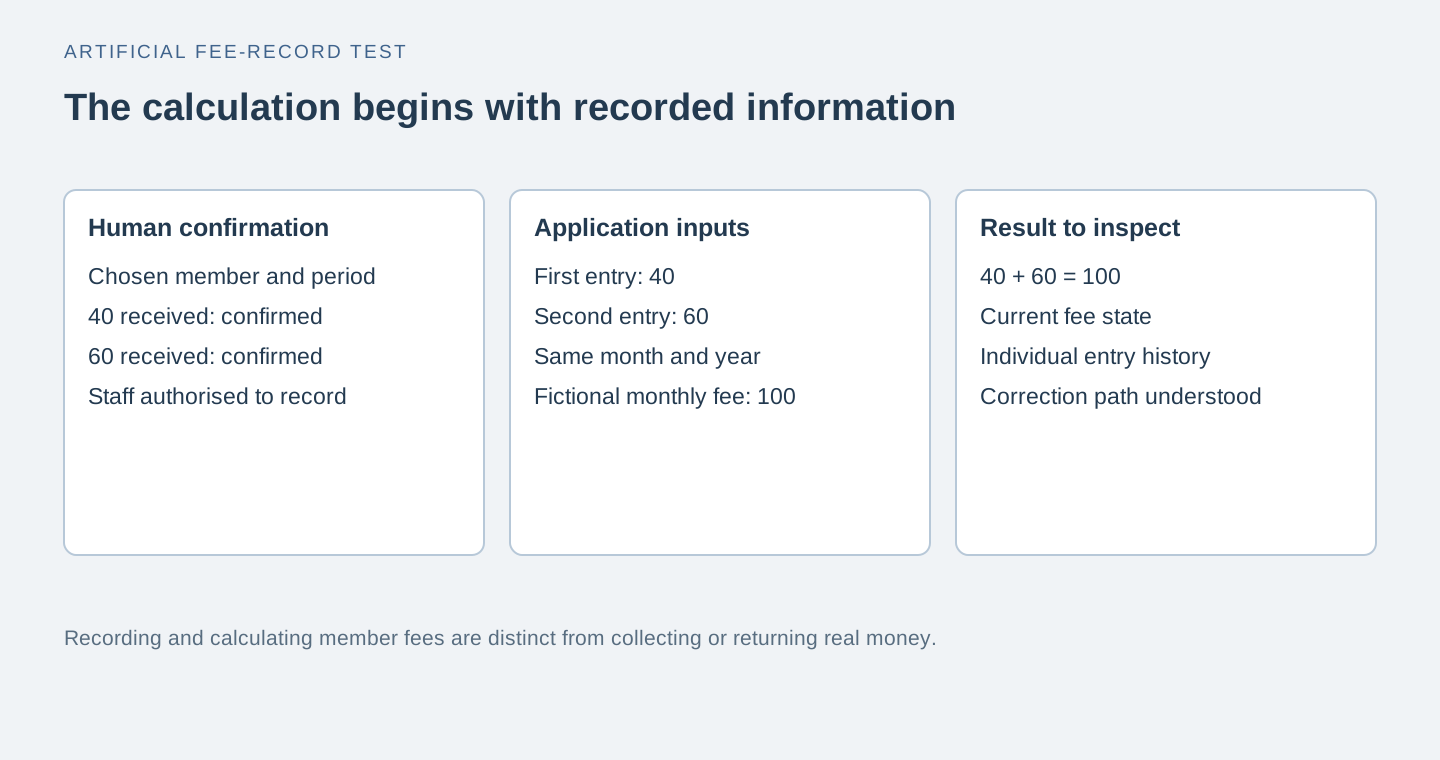
Use a fictional monthly amount of one hundred arbitrary units. The organisation first confirms receipt of forty and records that amount for the chosen member and period. Later it confirms receipt of sixty and records that entry. The purchase test should connect those two entries to the total and fee state shown in the current application.
The automatic work being inspected is calculation and representation. The organisation supplies the fact that money was received and the period it belongs to. Macro-Manage is not represented here as collecting those member payments, holding their funds or automatically reconciling a bank statement. That boundary lets the buyer purchase the actual fee-record product with a clear operating promise.
Check the fictional total through its individual entries
Ask the seller to begin with the selected member, month and year visible. Enter the forty-unit payment through the ordinary authorised operator route and inspect its history. Then enter sixty for the same period and inspect the updated total. These are artificial arithmetic inputs, not a statement about customer collections or business income.
Calculate the expected result independently: forty plus sixty equals one hundred. Identify the fee setting used by the demonstrated view, then compare the current state with the total. This gives the buyer a repeatable product test that can be explained to a future organisation customer without reference to a prepared dashboard screenshot.
Keep the period selection part of the explanation. The inspected source groups amounts by member and month, with year selection used for the relevant totals. A payment entered for another year should not be casually treated as an answer for this one. The organisation's human record remains responsible for assigning the received amount correctly.
Make a correction part of the automatic-workflow purchase
Use an intentional artificial entry mistake. For example, the operator selects a different permitted period while recording the first amount. Ask the seller to demonstrate the actual correction or removal procedure and observe the resulting history and calculated view. Keep the expected result written beside the test before anyone changes the record.
Macro-Manage's source includes authorised payment recording and deletion with related audit records. The buyer should inspect the current user-facing route and the information available to the organisation operator. It should describe those actual controls accurately rather than advertise a specialised accounting reversal or immutable ledger system.
The correction demonstrates why automatic calculation still needs a responsible person. A system can calculate from its current entries while one input represents the wrong real-world fact. The new owner needs to help organisation customers understand that distinction and use the delivered correction procedure consistently.
Define the person who may change the rules or fee setting
In ThatQuis, a creator's configured questions and outcomes determine the response journey. In Macro-Manage, the organisation's selected settings and recorded amounts determine the relevant fee view. A buyer should identify who can change those inputs and how the customer understands a deliberate change.
Ask the seller to demonstrate the actual creator, organisation and platform-owner boundaries for the selected asset. Choose one ordinary authorised user and one role that should have a different level of access. The purchase map should state the supported action, the account permitted to perform it and the evidence used to accept it.
If the buyer needs a new approval hierarchy, additional staff delegation or a specialised rule-review process, put that in a separate scope. The current acquisition can still be useful with a simple named owner and an agreed human procedure. Its automatic task should remain attached to the actual configuration authority it delivers.
Keep a changed rule connected to the result it produced
The ThatQuis source records a response session against a quiz version. This supports a concrete question for the workshop: which published rule set did the artificial respondent use? Ask the seller to show the current version relationship and the relevant result record, then explain it through the normal creator view available in the product.
For the fee example, record which period, fee setting and entered amounts the operator inspected. If the organisation plans to change its fee, it should test the observed effect on the views it uses and agree its own operating procedure. Keep that test tied to the actual current behaviour instead of promising a new historical-pricing system.
This is an ownership question, not merely an engineering detail. The future customer will ask why a result or balance appears. The buyer should know which rule, setting or entry answers that question. Purchasing a useful automatic process includes the ability to support an understandable explanation of its output.
Distinguish ordinary rule automation from AI assistance
The workflows in this purchase case are rule and record processes. ThatQuis follows configured question logic and calculates outcomes. Macro-Manage sums entered amounts and represents fee information. The buyer can inspect their accepted inputs and expected outputs using simple artificial cases.
Macro-Manage also documents an AI-assisted image-to-roster import, with operator checking of extracted information. That is a separate entry aid to inspect if relevant. It does not turn the recorded-payment calculation into an autonomous financial operation, and the buyer does not need to make that claim to explain the core product.
The acquisition decision here is which bounded automatic task the owner wants to sell and support. The separate question of whether a product depends on a model service has its own consequences. Keeping the two questions distinct helps the buyer request the right demonstration and avoid using the word AI as a substitute for an actual process description.
Retain a repeatable example of the automatic task you accepted
Keep a short worked record with the chosen asset's acquisition evidence. It should identify the artificial input, the relevant rule or setting, the observed output and the permitted operator. This gives the buyer's next maintainer or support person something precise to repeat. The record documents the particular accepted process; it is not proof that every possible input or operating condition has been tested.
| Run | Controlled input | Expected explanation |
|---|---|---|
| Questionnaire path A | The answer assigned to route A in the chosen published rules | The next question and result follow that identified rule set. |
| Questionnaire path B | The alternative accepted answer in the same controlled example | The different route can be explained from its configured condition. |
| First fee entry | 40 recorded against a fictional monthly fee of 100 | The recorded amount is partial for that selected period. |
| Second fee entry | 60 added for the same member, month and year | The entries total 100 for the selected fee. |
| Entry correction | The artificial 60 entry is removed through the current authorised route | The remaining recorded total is 40; removing a record does not itself return money. |
Ask the seller to connect each relevant row with the actual interface and record being demonstrated. Keep the questionnaire example deliberately simple so the rule is visible, and keep the fee example within one clearly selected period. The buyer can then verify the arithmetic and route without importing confidential customer material into the workshop.
This repeatable record also helps explain a later change. If the owner deliberately changes a rule or a customer changes its fee setup, the team can state how the new configuration differs from the accepted example. That is a useful maintenance starting point for a purchased automatic workflow and a concrete item to request as part of agreed handover assistance.
Prepare an exception response before presenting the business as ready
For each candidate, name one ordinary exception and the human owner who handles it. A ThatQuis creator may need help explaining an unexpected route. A Macro-Manage organisation may need help tracing a fee state to its entries. The new owner should be able to identify the relevant product stage before changing anything.
Use artificial records for a rehearsal with the person who will provide support. Ask them to explain the trigger, accepted input, current result and first question they would ask the customer. This turns the automation map into an operating record, while preserving the account and data boundaries of the chosen application.
Confirm the seller's agreed assistance and its finish point through the current listing. If additional training, configuration or development is needed, request a defined scope. The buyer should acquire an application whose ordinary process and exceptions it is prepared to own, with the remaining tasks visible before launch.
Complete the bounded-automation acquisition record
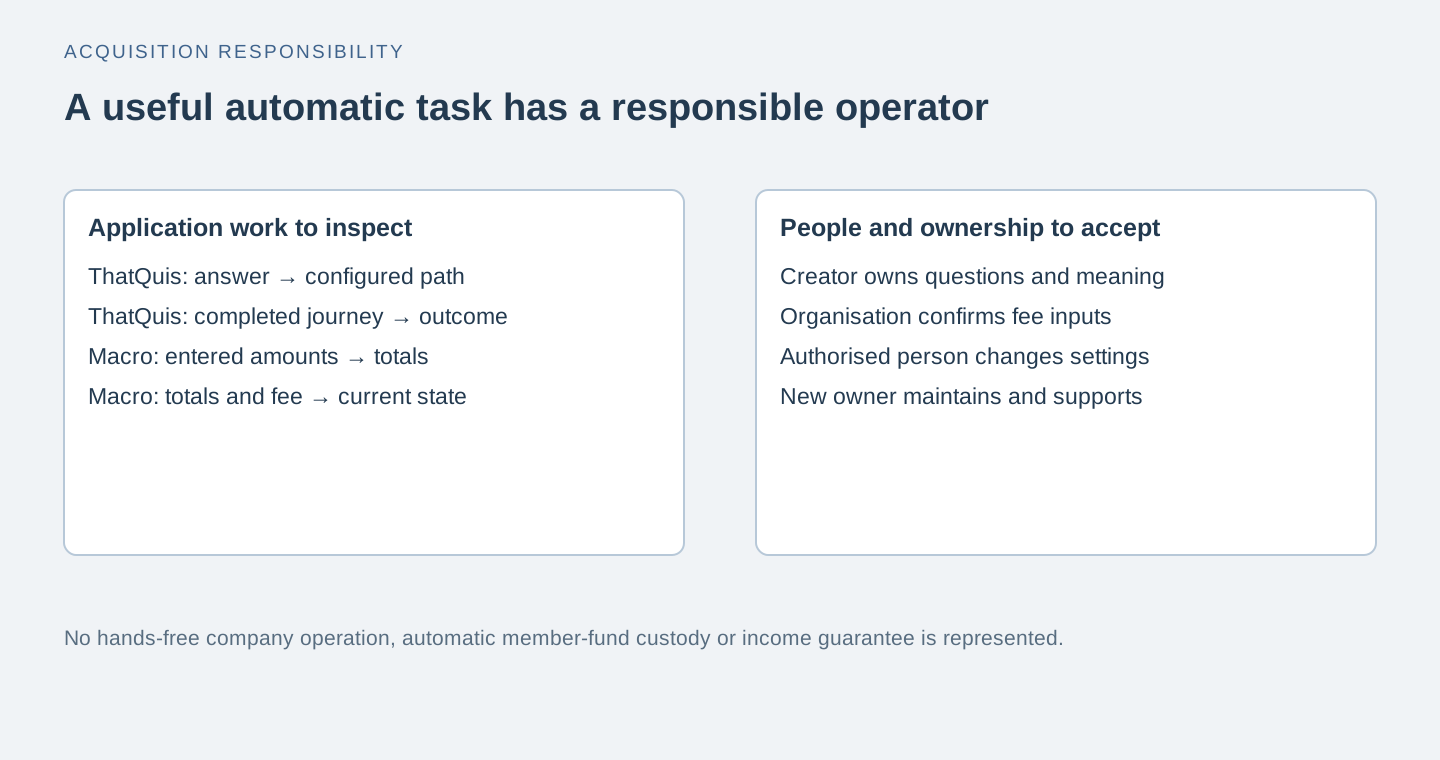
Use these answers to prepare the request for the selected application. Keep the rule sheet or fictional fee calculation beside the evidence, so another person can explain what was accepted. A completed record should make the next purchase action clear: request the current package, resolve a specific open condition or agree the separately scoped work the buyer actually needs.
- Choose the questionnaire task or fee-record task and open that asset's current individual offer.
- Bring simple artificial inputs and independently calculated expected results.
- Follow a complete successful path and one correction or exception through the current application.
- Agree the delivered package and assign the people who will own its inputs, rules and support.
Request ThatQuis for a defined question-to-outcome software business, or Macro-Manage for a defined organisation fee-record business. A credible automatic-workflow purchase names the work the software performs and the operating responsibility the buyer is ready to accept.
Explore the products discussed
Explore related acquisition offers