
Buy a pre-revenue SaaS asset with a defined launch mandate
Choose an existing product to take to market without mistaking it for evidenced operating cash flow.
Request ThatQuis, MemoSlide or Macro-Manage as an individual launch-stage acquisition. Define the customer job, represented trading conditions and commercial work you deliberately accept.
Buy a pre-revenue SaaS asset when you deliberately want a product you will take to market, rather than an established stream of customer payments. Codeblix has separate application-and-domain offers including ThatQuis, MemoSlide and Macro-Manage. Request the current seller package for the product whose customer job you want to own, then make the launch-stage scope explicit in your offer.
The phrase “pre-revenue” describes the acquisition class this buyer is seeking. It does not replace the seller's current financial representation. The linked Flippa listing is where you should inspect the actual asset's reported revenue, costs, trading history, availability and terms. Do not infer a figure from a demo, a price plan, a domain's age or the existence of a checkout screen.
Request a launch foundation with the customer job already chosen
- Request ThatQuis's domain and quiz application package if you want to launch a product for creators preparing quizzes, branches and outcomes.
- Contact Codeblix about buying MemoSlide if you want an owned memo-to-presentation planning application for individuals and teams.
- Request the Macro-Manage source and domain offer if the product you want to launch concerns organization fee records and rosters.
Each is an individual transaction. Asking about several products does not create a bundle, a combined customer base or an integrated application. Tell the seller which asset you are considering and what must be included for that purchase to make sense. A clear launch mandate helps the seller provide relevant evidence instead of responding to an undefined request for a passive business.
This article is for the buyer choosing the stage of the asset they want to acquire. The individual ThatQuis, MemoSlide and Macro-Manage pages own the product-specific package details. Use them alongside the current sale rather than treating this buying case as another product specification.
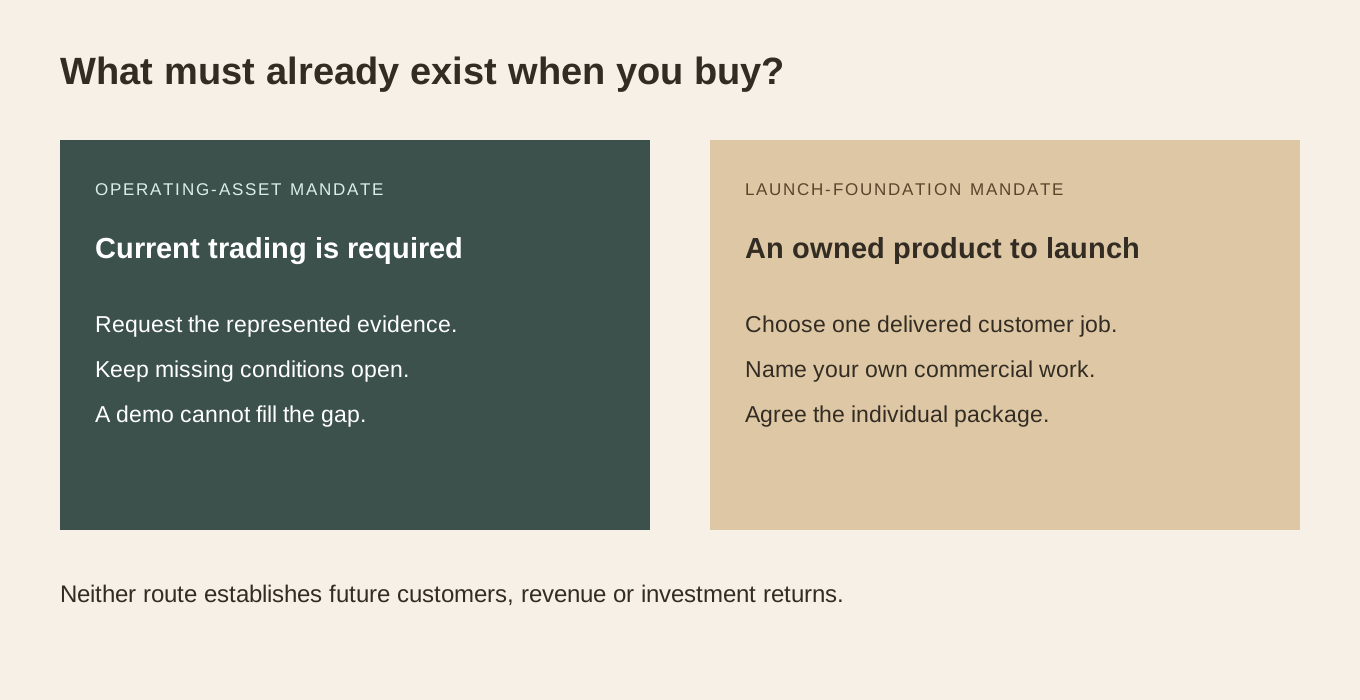
Write down whether current trading is a condition of your purchase
Consider two hypothetical buyers. The first needs an asset with an evidenced current customer relationship and income history. The second wants an existing software foundation so they can create and test their own offer. Both are buying businesses or digital assets, but they are asking for different things. A product walkthrough can answer many of the second buyer's questions while leaving the first buyer's central condition unanswered.
If current trading is essential, state precisely what you require the seller to represent and support. Do not quietly replace that condition with a polished interface or a proposed subscription price. If the relevant evidence is unavailable, the honest result is an unresolved purchase condition. None of the three products should be described as meeting a cash-flow requirement merely because it can display a plan or accept a user account.
If you are deliberately buying a launch foundation, make that equally clear. You may be willing to develop the first customer offer, recruit early users and operate the product after transfer. That willingness does not make every missing item irrelevant. You still need to know what is delivered and which commercial tasks remain yours. The purchase should exchange an understood asset for an agreed price, not exchange vague optimism for a future earnings promise.
Separate the product, any represented relationships and your first offer
A launch-stage purchase is easier to understand when its objects have separate names. The delivered product is the software and the expressly agreed assets around it. Any represented trading relationships are another object, requiring their own evidence and transfer scope. The first offer you create after purchase is your operating decision. Mixing these objects can make a starter product appear to include a proven market that has not been established.
| Object in the purchase discussion | Concrete question for the seller | What does not establish it |
|---|---|---|
| The existing application | Which source, domain, documents and delivered workflows belong to this individual offer? | A future feature list presented as current functionality. |
| Represented trading or customer relationships | What is actually represented, evidenced and included under the current sale terms? | Sample accounts, demo responses, proposed prices or a populated landing page. |
| The buyer's first commercial offer | Which customer job will I offer, to whom, and with what human work around the software? | An assumption that every potential user is already a buyer. |
| The buyer's launch distribution | Which channel or relationship will I bring, create or separately obtain? | The availability of a domain name or social sharing control. |
These distinctions are particularly useful when a seller uses the word “business” for a digital asset. Ask what that word includes in the specific transaction. A software foundation can be a deliberate purchase without being an established operating company. The important point is agreement about the object, rather than stretching a label until two parties think they have agreed to different things.
Keep the current financial documents separate from your launch notes. One describes what the seller represents about the asset; the other describes what you might do with it. A future plan should never be copied into a historical revenue field. Similarly, a demonstration account is useful for understanding a workflow, but it should not quietly become a claimed subscriber in public copy.
A single-user product gives one kind of first launch exercise
Suppose the hypothetical buyer is interested in MemoSlide. They want to offer a product that turns written material into an editable presentation plan. A sensible first commercial exercise is therefore a defined memo and a recipient who needs to shape it into a presentation. It is not a claim that the buyer already has paying teams or that every written document will become a finished, client-approved deck without editing.
Inspect the delivered customer job. MemoSlide accepts written memo material, structures a deck plan and provides editing and export tools. Its planning is deterministic and does not require an AI key. The buyer can ask the seller to demonstrate a complete example and then decide what their initial offer will include: access to the application, a preparation service around it, or another expressly scoped arrangement supported by the agreed ownership rights.
The launch mandate should name what the buyer is accepting. They may accept that initial distribution, positioning and customer support are still to be established. They should not assume that a test team in the demonstration represents a transferred customer. Nor should an exported presentation be treated as a guaranteed commercial result. The asset supplies a delivered workflow; the buyer is deciding whether to own and take that workflow to market.

Use the MemoSlide user guide to examine the delivered work, then request a seller walkthrough tied to your intended first offer. The relevant question is whether this application is the product you want to launch. It is different from asking whether a screenshot proves existing sales.
A creator product starts with a publishable experience, not an audience claim
Now suppose the buyer is considering ThatQuis. Their intended product concerns creators publishing quizzes with questions, branches and outcomes. Their first commercial exercise needs a creator, a defined audience use and a testable published experience. It does not begin with an assumption that the demonstration includes a mailing list, an established lead-generation agency or rights to someone else's campaign content.
The buyer can choose a narrow initial offer around the actual application: for example, a creator building one branching experience and checking the resulting records. ThatQuis has its own creator workspaces, consent controls, analytics and plan limits. It should not be turned into a promise of a complete CRM, an examination system or an external email campaign service merely because those would be useful future additions.
For a launch-stage acquisition, write the first offer in terms the buyer can deliver. Which kind of creator will the application serve? What will that creator publish? Who supplies the questions and claims? Which response or usage information is actually available? These are product and operating choices. A hypothetical answer can help define the acquisition without being presented as evidence that the market has already adopted it.
A cash-flow-dependent buyer would ask another set of questions about current trading and relationships. They should receive evidence relevant to those conditions, rather than the same fictional quiz. The same walkthrough can be useful to both parties, but it does not make their purchase mandates equivalent.
An organization product requires an adopting operator as well as a user
Macro-Manage offers a third launch shape. The product concerns organization rosters and fee records, including partial payments, history and reporting. A useful first exercise therefore includes someone who operates the organization records and a defined period of fees. The buyer is not simply inviting any individual to try an unrelated productivity tool.
Suppose the buyer's intended first offer is a fee-record service for a small organization. They need to identify who prepares the roster, who records payment information and who checks the resulting records. The current application can be inspected for that job. It should not be described as automatically moving fee money, reconciling every bank transaction or replacing a complete school-management system without source-backed functionality and specific evidence.
This difference changes the launch mandate. The buyer may need an organizational adoption conversation before a meaningful first trial. That is not automatically a flaw in the asset; it is a different route to operating it. The buyer should deliberately accept that route rather than assuming that an organizational subscription will be as simple as a single person opening a presentation plan.
The original Macro-Manage acquisition offer explains the product's fee-record boundaries. This case uses that product to show a different purchase-stage decision: whether the buyer wants to create the first organizational offer, or instead requires evidenced existing customers as a condition of buying.
Choose the mandate before selecting a preferred screenshot
Which acquisition condition describes your purchase?
The selector does not recommend an investment or establish a product's financial position. Its purpose is to stop a buyer from using a launch-stage walkthrough to answer a trading-history requirement. Use the result to prepare a precise seller request, then inspect the current individual transaction.
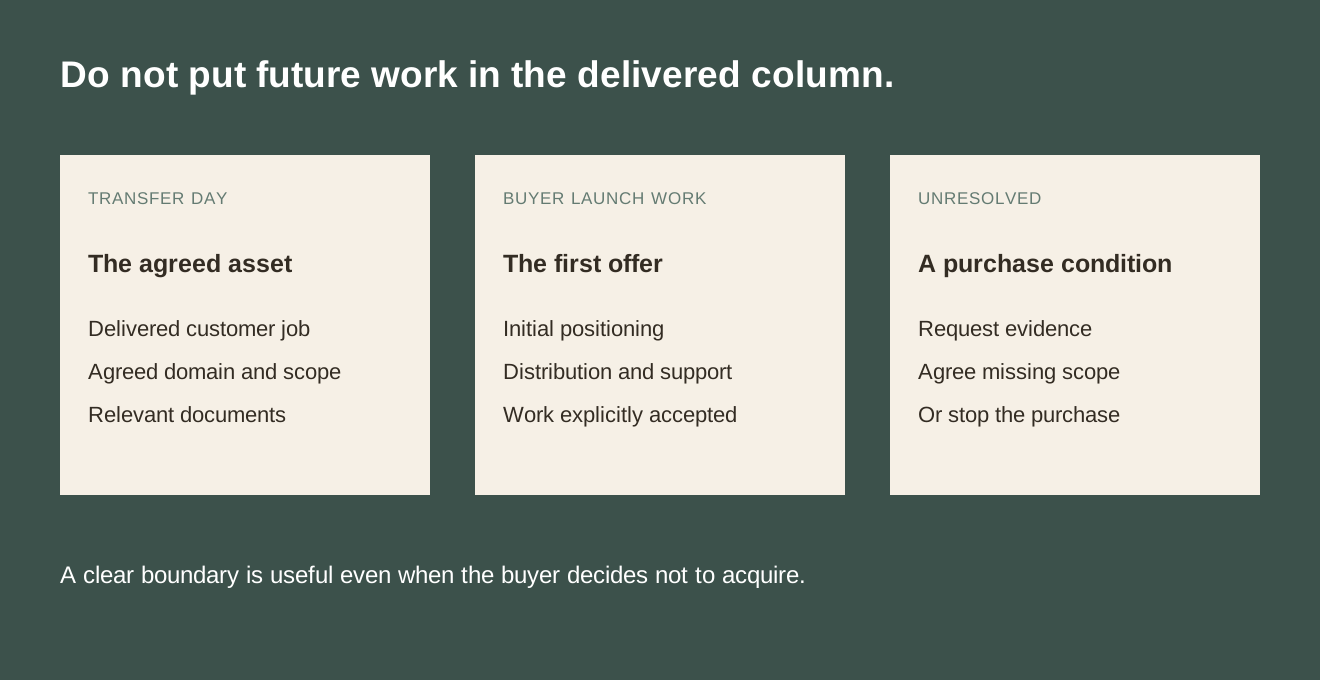
Put transfer-day conditions on a separate page from launch work
Consider the buyer who chooses the launch-foundation mandate. Their transfer-day conditions might include a particular delivered application, an agreed domain and the documents needed for the responsible technical person to understand it. Their launch work might include preparing initial content, defining the customer offer and arranging support. The actual allocation must be agreed with the seller; it should not be inferred from a general marketing phrase.
Write each item as a present requirement or a deliberately accepted future task. “A creator can publish the agreed quiz example” is a different statement from “I will recruit creators.” “The organization fee record can show the demonstrated partial-payment history” is different from “I will find organizations that want this service.” “The memo produces an editable plan” is different from “I will create a presentation consultancy.”
This approach can also reveal a poor fit before the purchase. If the business you want to operate requires an essential feature outside the delivered scope, make that visible. You can request a separately agreed change, choose a different existing asset or decline the purchase. Calling the application a starter does not make an essential missing requirement disappear.
Use a worked mandate to make the seller conversation specific
Here is an illustrative mandate, not a representation about any existing customer: “I want to acquire the MemoSlide application and agreed domain to launch a presentation-planning product. I will supply the first customer positioning and distribution. Before purchase, I need the seller to demonstrate the agreed memo-to-plan and export workflow, identify required services and confirm the transfer scope. I am not treating a demonstration workspace as an included paying team.”
The equivalent ThatQuis mandate would describe the quiz experience the buyer wants to offer and the creator-side work they will perform. The Macro-Manage mandate would identify the organization's fee-record job and who will operate it. The useful detail is the allocation of the commercial task, not a long list of impressive software terms.
Now change the mandate: “My purchase requires an evidenced current customer relationship and a stated trading history.” That condition calls for the relevant current sale evidence. If it cannot be supported, the buyer should not silently fall back to the first mandate while retaining the same expectations. The seller and buyer need to agree which transaction is actually being discussed.
A good request also identifies who will make the final choice. If one person evaluates the product while another requires current income, reconcile those conditions before negotiation. Otherwise a perfectly useful walkthrough may be followed by a disagreement that was present from the beginning. This is a purchase-scope problem, not something a new tagline can solve.
Resolve an attractive offer that answers a different mandate
Suppose a seller provides a thorough product demonstration, current documents and a source package. The prospective buyer likes the interface, but their original mandate required an established subscription relationship. The demonstration is useful evidence of the product; it does not automatically change the acquisition class. The buyer should return to the unresolved commercial condition rather than describe the software evidence as proof of it.
There are several honest outcomes. The seller might provide relevant current trading evidence. The buyer might explicitly decide that a launch foundation now suits their plans and revise the offer accordingly. Or the parties might stop because the offered asset does not meet the original requirement. None of those outcomes requires an invented earnings projection. The important step is making the change visible to everyone deciding the transaction.
This also works in the other direction. A buyer might initially be happy to launch a product, then discover that their intended first offer depends on an existing customer relationship they do not have. That does not make the seller responsible for an unagreed audience. It tells the buyer to reconsider the mandate and the commercial work they are accepting.
Define evidence of a first trial without calling it a sale
In a launch-foundation mandate, the buyer can specify what they want to learn from the first commercial exercise. For MemoSlide, a person might work through a memo and explain where the plan needs editing. For ThatQuis, a creator might publish a fictional quiz and inspect its response path. For Macro-Manage, an authorized organization operator might evaluate a small fictional roster and fee period. These examples concern understanding adoption and the customer job, not representing revenue.
Choose the evidence you want to collect without turning it into a forecast. A completed walkthrough, an expression of interest, a trial account and a paid customer are different events. The buyer should preserve those distinctions in their own launch records and future sale claims. The existence of one should not silently be reported as another.
Also identify what would make the chosen product a poor fit for your first offer. The intended user may need an essential workflow outside scope, the adopting organization may require an arrangement you cannot provide, or the buyer may not want the ongoing operating work. A deliberate launch mandate lets the buyer reach that conclusion before they assume that buying code commits them to every possible business model around it.
Ask the seller to support the delivered-product part of the exercise. Keep the buyer's proposed distribution, trial recruitment and final commercial terms in the buyer's own plan unless additional help is expressly agreed. This allocation gives the purchase a concrete purpose while leaving future market adoption honestly unresolved.
Keep stop conditions visible even when the product feels attractive
An acquisition mandate is useful only if it can produce a stop. The buyer who needs a particular represented asset should pause when that asset is absent or unclear. The buyer who wants a launch foundation should pause when the delivered customer job is materially different from the one they intend to sell. Neither condition is resolved by predicting that the business will become profitable later.
Use a short list of conditions that matter to this purchase. Do not turn every imaginable improvement into a blocker, and do not turn every gap into an automatic promise of future development. Ask the seller to distinguish delivered scope, agreed work and ideas. The buyer can then decide whether the individual asset fits their mandate.
- State the acquisition stage you want: evidenced operating relationships or a deliberate launch foundation.
- Name the delivered customer job that makes the product relevant.
- List any represented trading evidence required by your offer.
- Separate transfer-day requirements from your own launch tasks.
- Identify a missing requirement that would change or stop the purchase.
- Confirm the individual package and current terms through its Flippa listing.
Make an offer for an understood launch-stage asset
The buyer does not need to pretend that a launch foundation is an established operating company. They need to understand the existing product, choose the customer job they want to own and state which first commercial tasks remain theirs. That is a substantive acquisition decision. It can justify requesting a specific package without inventing customers, revenue or a guaranteed launch result.
Likewise, a buyer who requires existing trading should keep that requirement intact. If the current sale does not provide the evidence they need, the right outcome may be another asset or no transaction. A clearly stated requirement is more useful than enthusiasm followed by a silent change in the meaning of “business.”
Request the current individual ThatQuis, MemoSlide or Macro-Manage offer with your mandate attached. For other product foundations, browse the SaaS acquisition collection. Keep the seller's represented financials, the delivered asset and your own launch plan distinct throughout the purchase.
Explore the products discussed
Explore related acquisition offers