
Buy a beauty-enquiry platform for your wedding agency
Acquire HitByGlam around permitted inspiration, a changed client brief and an applicable professional response.
Request HitByGlam for a wedding agency. Follow an authorised style brief through a changed headcount, mobile-service request and professional proposal.
Buy HitByGlam's domain and application for your wedding agency's permitted beauty-enquiry channel. Request the individual package through the HitByGlam Flippa sale. The purchase gives an agency an owned foundation for portfolio discovery, private inspiration, structured Style Briefs, professional proposals and participant conversations. The agency brings its own client authority and professional relationships.
This worked acquisition follows a fictional wedding brief whose headcount, preferred look and service location change after the first professional response. The useful buying result is a clear handoff from permitted inspiration to a current, understandable service enquiry. Client service agreements, appointments, deposits and beauty-service payments remain outside HitByGlam's documented platform scope.
Request an owned channel around a real agency responsibility
Request the HitByGlam application acquisition offer →
Inspect the HitByGlam asset package, individual beauty-platform purchase page and technical handover document. Confirm current availability, asking terms, included source, domain, service accounts and assistance through the seller. The public preview currently includes a portfolio empty state; it is not evidence of a transferred professional network or trading client base.
For this buyer, the useful foundation is the enquiry journey. The agency already receives instructions from clients and introduces suitable professionals. It wants a channel it can own rather than leaving every visual reference and clarification scattered across unrelated conversations. Ownership makes it possible to shape that channel, while the acquisition schedule identifies which changes are actually included.
Give the fictional wedding one named source of instructions
The demonstration client, Ada, initially asks for hair and makeup for four people at a studio on an agreed fictional wedding date. An agency coordinator helps prepare the enquiry under a permission arrangement defined for the workshop. Use artificial identities and authorised sample photographs. The demonstration supplies no actual wedding customer, engagement or professional contract.
Decide who owns the client-side account and who is permitted to enter the instructions. The current source has client and professional functions; this purchase case does not assume a special wedding-agency staff hierarchy or delegated approval role. If the agency needs several coordinators to work under a shared client mandate, request the exact access arrangement and have it demonstrated or separately scoped.
The coordinator's first responsibility is to record Ada's instruction accurately. Ada remains the source of the requested style and circumstances. The selected professional remains responsible for explaining the service they are prepared to offer. The agency's channel should help those two sides understand each other without making a visual preference into a confirmed service booking.
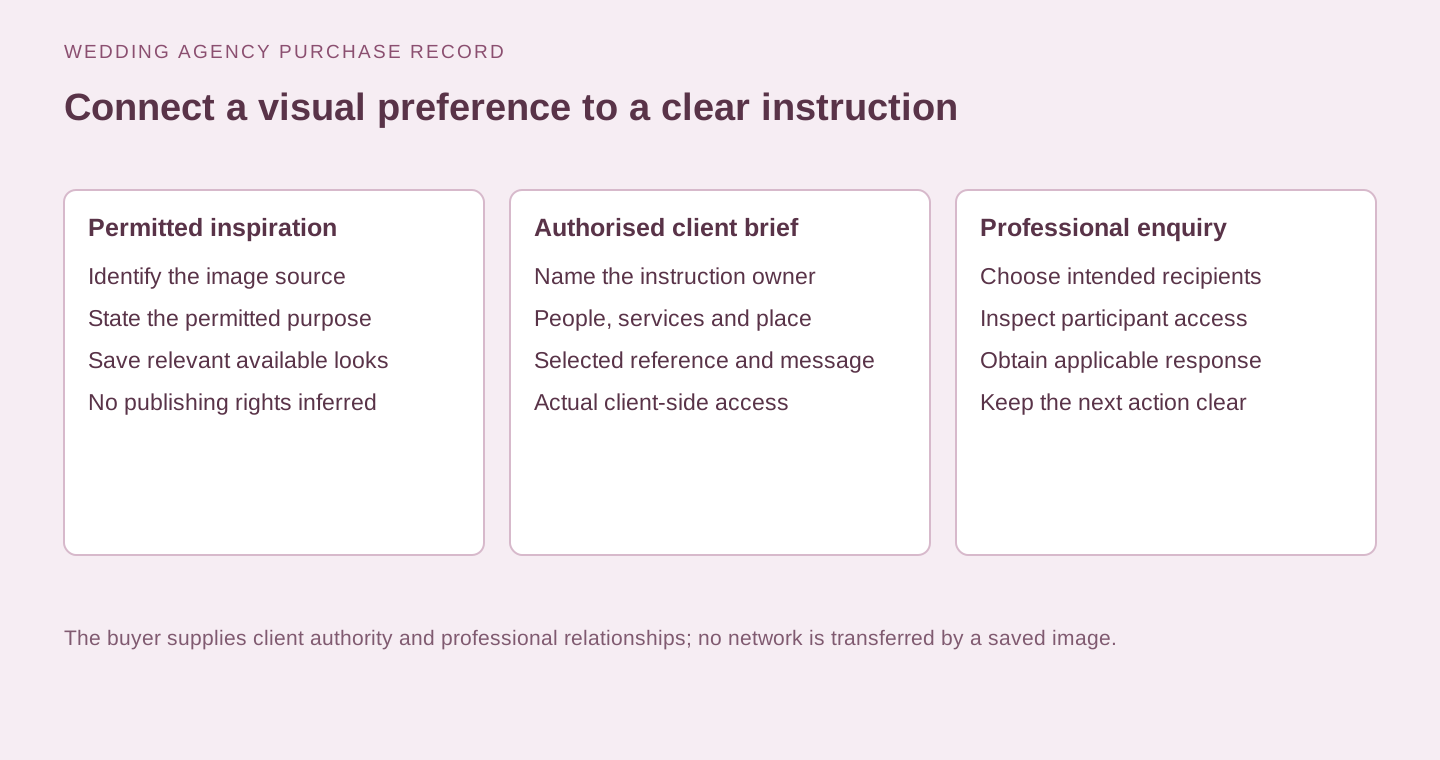
Separate permission to view an image from permission to publish it
Prepare a small set of permitted reference material for the workshop. One sample can be a professional's approved portfolio look; another can be an artificial client reference used only in the enquiry. Record who supplied each image and how the agency is allowed to use it. This authority record is a human purchase tool, not a claim that the application grants image rights.
HitByGlam's inspiration boards can save looks and professionals for the account owner. The buyer should inspect that private preparation route and the permitted selection of portfolio content. Saving a look helps someone explain a preference; it does not give the agency permission to republish a person's photograph in its own advertising.
Ask the seller to show the difference between an account's saved material and the information supplied to a selected professional through the actual brief and conversation. The agency can then define a short operating rule: collect only material it is authorised to use, state its purpose, and send it only through the accepted participant route. Any required shared review screen belongs in the agreed purchase scope.
Use an image-authority-to-enquiry handoff record
| Input or decision | Current application foundation | Agency confirmation |
|---|---|---|
| Portfolio inspiration | Save an available look or professional to a private board | Identify its source and permitted use |
| Client instruction | Style Brief fields and reference material | Name the authorised instruction and account owner |
| Professional selection | Approved published profiles and invitations | Choose who should receive this enquiry |
| First response | Proposal detail and participant conversation | Check which headcount, place and preference it addresses |
| Changed request | Current brief plus explicit follow-up communication | Identify what changed and obtain an applicable response |
| Service engagement | Recorded enquiry progress | Arrange the actual agreement and payment separately |
The record is deliberately organised around one client instruction. A beautiful collection of saved images is useful preparation, but the agency also needs to connect it to the people count, location and service request a professional receives. Put the demonstrated account and enquiry identities beside the schedule during purchase acceptance.
Ask a second authorised person to read the record without a verbal explanation. They should be able to locate the correct brief and tell which response still applies. That is the practical outcome this agency is acquiring. The application and the agency's human authority procedure should make the same request understandable.
Build the first Style Brief from actual requested facts
The current brief source includes event type and date, people count, requested services, location, mobile or studio preference, budget range, preferred looks and tags, reference material and a message. Use the normal interface to enter Ada's artificial initial request. Confirm that the saved record preserves the intended four people and studio setting.
The agency should describe the request clearly enough for a professional to answer. A preferred look expresses an intention; the brief also supplies practical context. For this purchase workshop, the coordinator can state that the client wants to discuss whether the selected look is suitable, rather than promising that every appearance can be reproduced exactly.
Ask to inspect the product's completeness feedback and its actual sending conditions. The source calculates a completeness result and requires sufficient detail before invitations. That supports a structured starting enquiry. The professional still interprets the request and discusses the actual service; a completed form is not professional acceptance of an engagement.
Select the recipients the client has authorised
Prepare two fictional professional profiles through the authorised demonstration. They should have permitted portfolio content and the current approval and publication state required by the application. Ask the seller to show how the client selects the recipients of the Style Brief and sees the resulting enquiry records.
The source works with approved published profiles and can rank matches from recorded information. Treat that information as a discovery aid. The agency chooses whom to contact and checks their actual response. A matching result does not establish a contract, guaranteed availability or a professional relationship transferred with the software.
The practical purchase test is simple: one selected professional receives the intended enquiry through the current participant route, and another unrelated account cannot use the same private conversation. Keep the workshop within authorised sample accounts. If the agency's operating model requires an additional recipient or client review step, specify that need directly.
Read the professional's first proposal as a response to a particular brief
Ask one fictional professional to send a proposal for the initial four-person studio request. The current proposal model includes services, people count, duration, travel information, inclusions, exclusions, total estimate, deposit-policy text and a validity date. The seller should demonstrate the current creation and participant viewing path.
These details help the agency understand what the professional is offering. The response should state which people and services it covers, what the client must provide and when the estimate stops applying. Deposit-policy text describes the proposal; HitByGlam is not represented as collecting that service deposit.
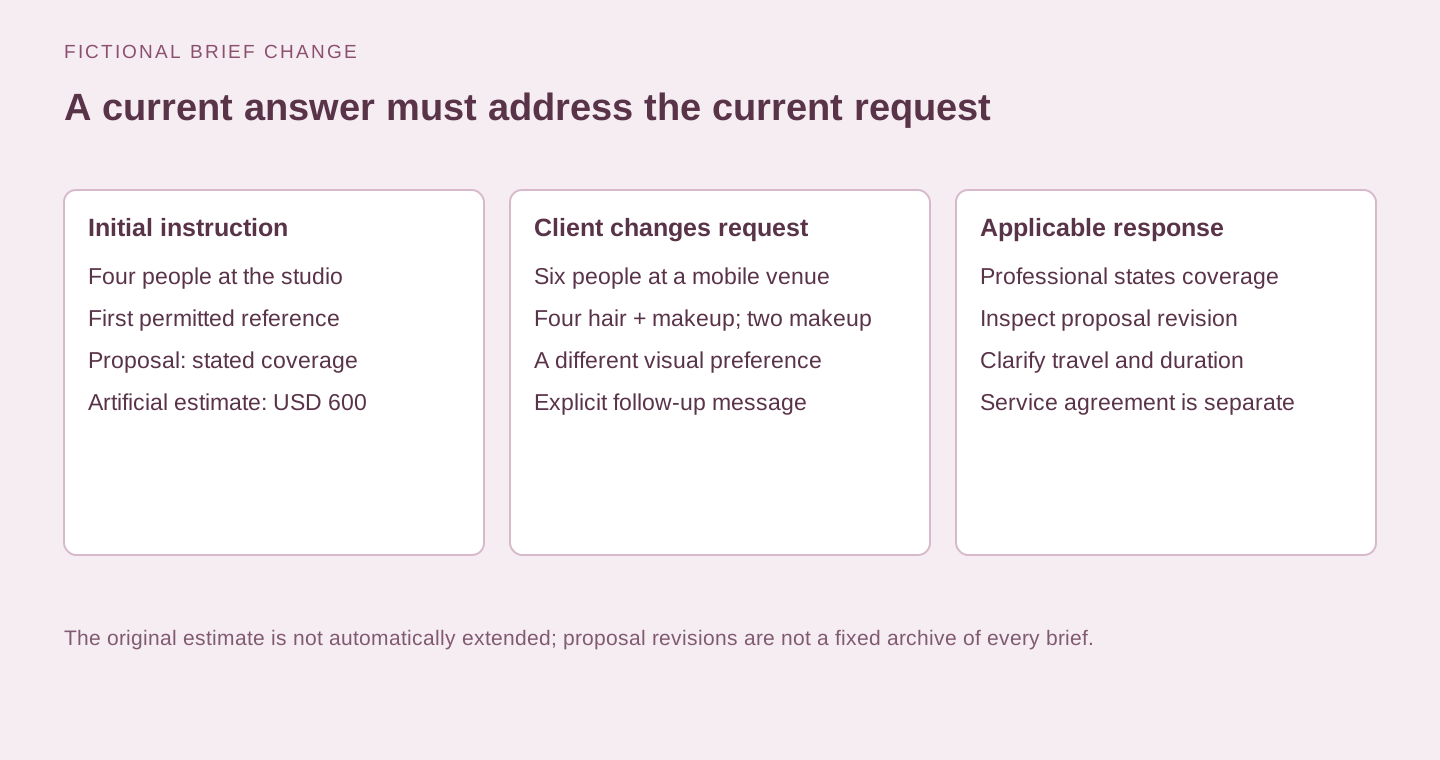
Use an artificial estimate of six hundred US dollars solely to make the later comparison concrete. It is not a real service price or forecast income. The workshop's initial proposal concerns four people at the studio under its stated conditions. The agency should be able to find that response and explain it in the client's terms before changing the request.
Change the headcount, location and preferred look together
Now Ada asks for six people, requests a mobile service at a fictional venue and chooses a softer reference look. This is the central acquisition case. The buyer wants to know whether its owned channel can support a clear follow-up rather than leaving the professional to guess whether the original proposal is still being considered.
Ask the seller to show the actual supported brief-editing and participant communication routes. The source updates the owned brief record. It does not establish an immutable archive of every earlier client instruction or an automatic acknowledgement of each later change. The agency should therefore send an explicit follow-up stating the three changed facts and requesting an applicable response.
Retain the professional's answer in the current conversation and proposal route. The buyer's acceptance result is that the client-side operator and professional can identify the current request, locate the original response and understand the new answer. Any requirement for formal client sign-off or automated change approval should be separately agreed.
Compare the response by its promised coverage
| Question | Initial instruction | Changed instruction to confirm |
|---|---|---|
| People | Four | Six |
| Service place | Professional's studio | Mobile service at an agreed sample venue |
| Visual preference | First permitted saved look | Second permitted softer reference |
| Artificial estimate | USD 600 for the first stated coverage | Professional must state applicable estimate and conditions |
| Agency responsibility | Record the original authorised request | Obtain and communicate a response to the changed request |
Do not calculate a new professional price by dividing six hundred by four and multiplying by six. The original proposal may include a studio arrangement, a particular duration or other conditions. Mobile travel and a different service promise need the professional's own response. The software supports recording that conversation; it does not set an appropriate beauty-service price.
The purchase workshop should end with a clear answer to the changed case, even if the answer is that the professional cannot offer it. A useful owned channel lets the agency distinguish a current proposal, an outstanding question and a declined arrangement. That is more valuable to this buyer than a demonstration that stops when an enquiry is first sent.
Ask which services the six people actually need
Add one clarification to the changed instruction. In the fictional case, four people want both hair and makeup, while two want makeup only. The total headcount is six, but the requested coverage is not six identical combined services. Have the coordinator state that distinction in the message and ask the professional to address it in the revised proposal's services, inclusions and exclusions.
This is a useful buying test because a people-count field cannot carry every detail of a wedding arrangement. The application supplies structured fields and space for explanation. The agency and professional supply the precise meaning of the requested work. The buyer should be able to point to the actual written clarification instead of relying on someone remembering a telephone conversation during the demonstration.
Ask the professional to explain whether the proposed duration and mobile arrangement cover that specific combination. The agency should communicate any remaining question to Ada before treating the response as the current service proposal. This is a human interpretation and confirmation step; the purchase does not include an automatic calculation of professional staffing, treatment suitability or the day's appointment schedule.
Retain the clarification beside the original handoff record. The next permitted coordinator can then tell the difference between the headcount and the service coverage without inventing a new estimate. A buyer that can follow this small but consequential detail has a concrete basis for accepting the enquiry channel. It knows how the owned application supports a real client instruction while the agency remains responsible for communicating it accurately.
Inspect the saved proposal revisions and current participant view
The inspected source saves proposal records with an incremented revision number and retrieves proposal detail for the enquiry. Ask the professional to demonstrate the normal revised-response route, then inspect what the client-side account sees. Identify the applicable revision by its actual content as well as its number.
The workshop should show the first four-person proposal and the professional's later response to the six-person request through the actual available interface. The agency's record can state which revision it has communicated to Ada and which point still needs an answer. A proposal revision does not create an immutable version of the entire client brief.
This distinction keeps the buying tool practical. The agency maintains its permitted instruction record; the application retains the proposal and conversation functions demonstrated. If a formal signed change schedule or fixed historical brief snapshot is essential, request that particular outcome instead of treating the revision label as proof that it already exists.
Make the conversation useful to both sides of the enquiry
Ask the seller to show a client-side message, the selected professional's response and the resulting participant views. In this worked case, a concise message can say that the headcount changed to six, the client now requests mobile service and the newer reference replaces the earlier preference. Use only authorised sample attachments.
The current conversation source checks client and professional-owner access to the conversation. The agency should inspect the access pattern it intends to use. A professional's existing team features do not by themselves establish a separate agency-coordinator permission model on the client side.
Keep the professional's actual questions visible in the handoff record. They may need to clarify the location, timing or requested coverage before responding. The acquisition is useful when the agency can follow that exchange and communicate the answer responsibly, rather than assuming that a sent message means the request has been accepted.
Recognise the endpoint before a service engagement is agreed
The current lead workflow can record preference and progress, including a booked-off-platform state. Ask the seller to demonstrate the relevant available action and explain who may use it. The agency should distinguish an enquiry record from the separate agreement under which a professional will actually provide a service.
In the worked case, Ada may prefer one professional after receiving an applicable revised proposal. The agency then follows its own permitted procedure for the service agreement, appointment arrangements and any deposit or payment. HitByGlam's documented Stripe use is for professional software plans and clearly labelled visibility products.
That boundary can suit an agency that already operates the engagement process. It is acquiring an owned discovery and enquiry channel around the work it knows how to perform. If it also wants in-application appointment capacity or service charging, that is a specific additional product request and should have separate demonstration and acceptance.
Carry an authorised instruction through a coordinator change
Before accepting the application, let a second permitted person review the artificial handoff record. They should identify the client instruction, its source, the selected professional, the changed headcount and location, and the applicable response. Use an access arrangement demonstrated by the seller; do not share live credentials to simulate a staff role.
The record should state the next action plainly. For example, the agency is waiting for the professional to confirm coverage of all six people at the venue. Another example is that the revised proposal has been explained to Ada and the agency is waiting for her instruction about the separate engagement.
This is continuity of responsibility, rather than an invented approval engine. The buyer can accept a human handoff around the existing account model if it fits the agency. It can also identify exactly which additional shared access or approval outcome it needs before purchase. The decision should follow the agency's real workflow.
Accept portfolio changes without confusing them with permission records
A professional may later remove or unpublish portfolio material. The inspiration-board source resolves available looks and approved published professionals when presenting saved material. Ask the seller to demonstrate the relevant current behaviour with an authorised artificial portfolio item.
The agency should understand whether a reference it used remains visible in the current journey and how it will retain any separate permitted instruction evidence it requires. A saved reference is not represented as a permanent historical content archive. The buyer's own permission and retention procedure should explain what it keeps and why.
For Ada's case, the central record can still name the professional response and the changed preference without promising permanent reuse of another person's photograph. This is a concrete source-to-service handoff question. It helps the buyer decide whether the current foundation fits, or whether a narrowly specified content-retention feature belongs in the transaction.
Acquire the technical package that supports the agency's channel
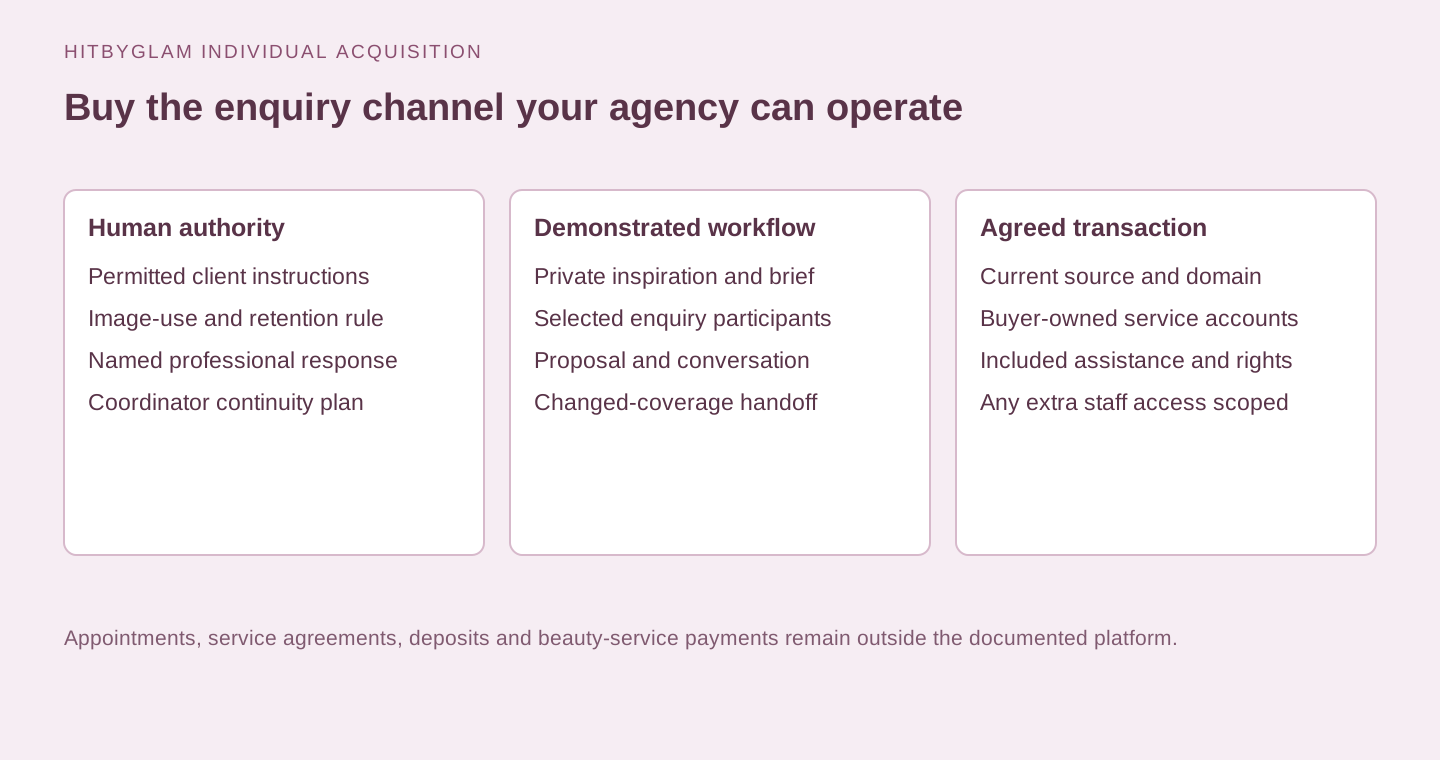
Use the current listing to identify the domain, source, design material, documentation and agreed technical assistance. Confirm ownership or permitted use of any delivered sample images and brand assets. The agency's own client photographs and professional agreements remain separate from the software inventory unless expressly and lawfully itemised.
The technical handover should identify buyer-owned hosting, identity, backend and software-billing requirements. Ask for a working release reference and repeat the agreed client/professional enquiry case in the accepted configuration. Keep account access and private configuration in the appropriate handover channel.
The buyer should also assign who maintains the application and who operates the enquiry service. One responsibility concerns releases and accounts; the other concerns permitted client instructions, professional responses and follow-up. The purchase is ready when those responsibilities and any additional work are understandable to both parties.
Complete the wedding-enquiry acquisition record
- Prepare the artificial initial wedding request and the client's changed instruction.
- Ask Codeblix to demonstrate permitted inspiration, the Style Brief, selected-professional response and participant conversation.
- Inspect the applicable revised proposal and the agency's next human action.
- Agree the individual application transfer and any required access or content additions before purchase.
Request the HitByGlam acquisition offer on Flippa with the completed handoff record. Buy an owned beauty-enquiry channel around instructions and professional relationships your agency is prepared to manage.
Explore the products discussed
Explore related acquisition offers