
Buy a grocery storefront with customer-reward ownership
Acquire account-linked points with a clear earning, redemption and ordinary reversal exercise.
A worked purchase case for an existing grocer buying TenBasket around explainable reward balances. Request the individual storefront package with a qualifying order, delivered award and cancellation tests.
Buy a grocery storefront with customer-reward ownership when you want an explainable account-linked programme around your own retail operation. Codeblix's TenBasket offer includes customer accounts, order records and rewards earning, redemption and reversal foundations. Request the source-and-domain package around the balance changes your customers and staff need to understand.
This worked acquisition case assumes a fictional grocer already supplies and fulfils its goods. Its customers, opening balances and basket amounts are illustrative test inputs, not assets or trading results included in the sale. The purchase outcome is an owned rewards operation with understandable records, rather than another demonstration of placing a grocery order.
Request TenBasket around a complete reward-balance exercise
Contact Codeblix to request TenBasket's current storefront source and domain package. Ask the seller to demonstrate a signed-in customer's points before an order, the redemption at order preparation, the delivered-order award and an ordinary cancellation reversal. Use authorized fictional data.
The current Flippa listing owns the asking price, availability, represented financials and agreed transfer terms. The TenBasket product page and individual grocery storefront acquisition offer remain the authoritative product owners. This case focuses on a grocer's specific decision to own customer-reward balances and the procedure for explaining them.
The supplied source supports the ordinary paths described below. A seller-led runtime demonstration should confirm the current implementation before the buyer publishes its own programme. Reward records describe points; they are not a promise of increased retention, repeat sales or a completed bank refund.
Give the customer balance a clear business meaning
The fictional grocer wants customers to see and use points through their store account. The owner needs to explain what earns points, when they appear, what can be redeemed and what happens when an order is cancelled. Those questions determine whether the application fits the programme they want to operate.
Start with the recorded account balance and the particular order. The useful support answer connects the two: an amount was redeemed from this balance, an award was attached to this delivered order, or a reversal followed this cancellation. A vague promise of rewards on every purchase is less useful than an actual rule and an understandable record.
- The customer account supplies the current points balance.
- The order identifies points used and the calculated eligible award.
- The delivered-order event supplies the ordinary account credit.
- The cancellation path determines the relevant point reversal.
The buyer can acquire the existing foundation and choose the operating policy it is prepared to support. Any desired change to the supplied rules should be expressly scoped. The acquisition should distinguish the current implementation from a future programme the buyer hopes to create.
Use the supplied reward rules as the starting purchase evidence
The current server source contains a specific reward model. Eligible Fruits and Vegetables contribute to the earning calculation. Redemption is account-linked and subject to minimums, the available balance and an order-value limit. These are the current source rules to inspect, not a promise that every future owner will keep the same programme.
| Current source behaviour | Rule to demonstrate | Buyer question |
|---|---|---|
| Earning basis. | One point per USD of eligible Fruits and Vegetables value, with the source's whole-point rounding. | Which items in the test basket contribute to the award? |
| Point value at redemption. | 100 points correspond to USD 1 of order discount. | Does the selected redemption match the recorded order amount? |
| Minimum redemption. | At least 500 points, alongside the order minimum and other checks. | Does the account and basket actually qualify? |
| Order checks. | A minimum USD 25 order and a maximum redemption of 10% of subtotal. | Do all conditions hold together for the particular basket? |
| Award timing. | The account award is settled when the order becomes Delivered. | Does the actual account balance match that event? |
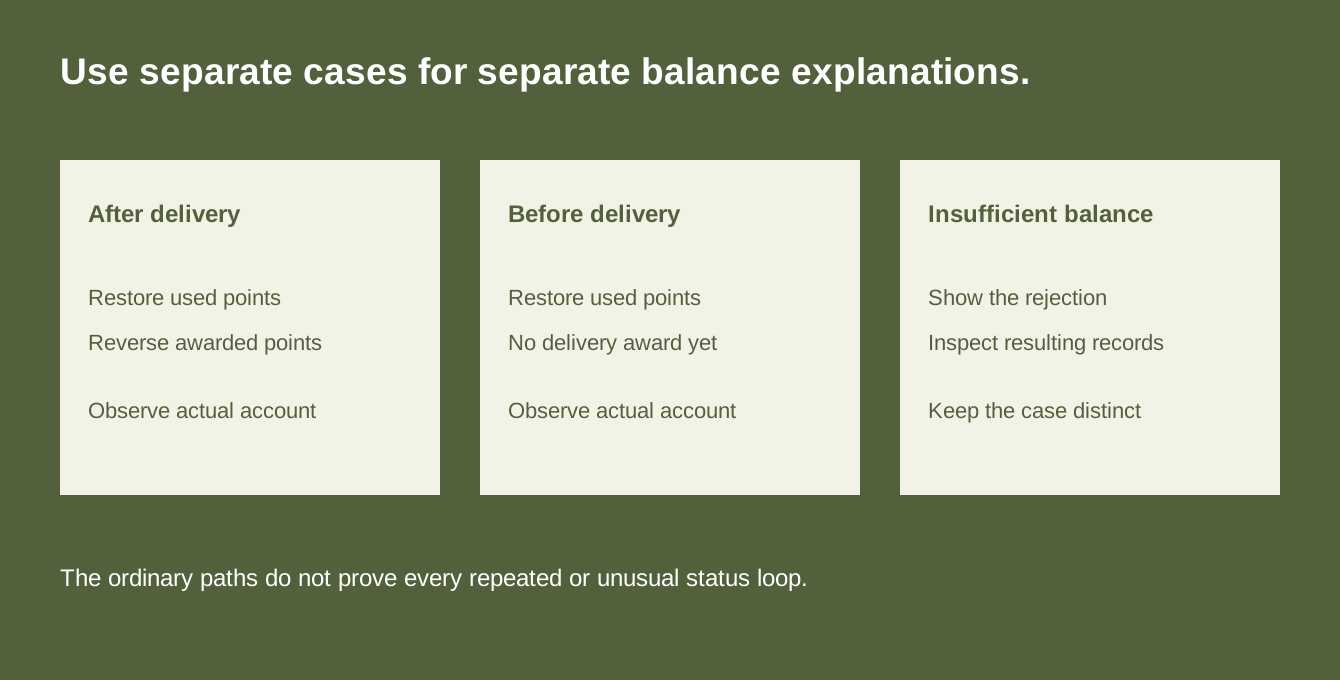
| Cancellation. | The ordinary reversal restores used points and reverses awarded points as applicable. | What balance results before or after delivery? |
Check the combination of rules, not just one headline. A nominal order minimum does not mean every basket at that amount can redeem the minimum points once the percentage limit is applied. The buyer should ask the seller to demonstrate the cases its customer wording will describe.
Prepare one fictional account and one qualifying basket
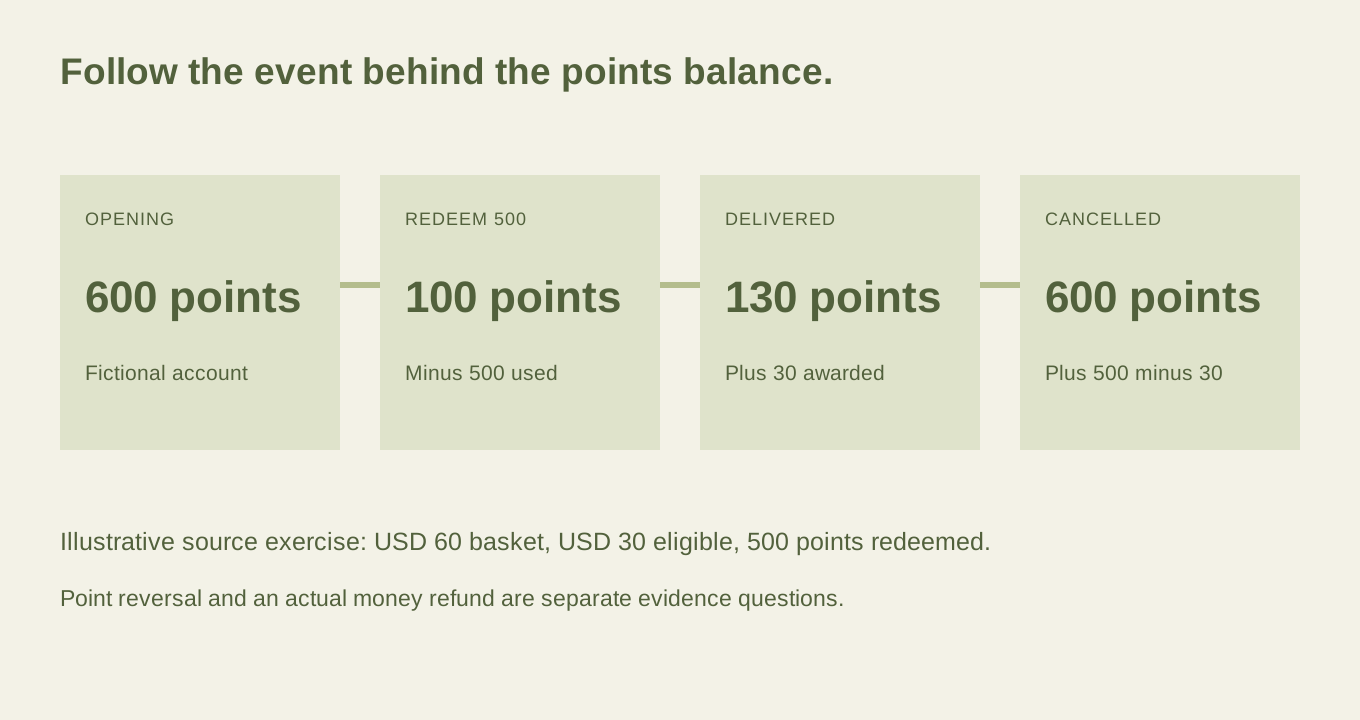
For illustration, use a test account with 600 points. Prepare a USD 60 basket containing USD 30 of eligible Fruits and Vegetables and USD 30 of other goods. The test customer chooses to redeem 500 points. These are exercise values, not an actual customer's balance or a current commercial order.
The selected redemption is worth USD 5 under the supplied ratio. It is within 10% of the USD 60 subtotal, and the account has enough points. The server-source order amount becomes USD 55 in this example. The eligible value contributes 30 points to the potential award under the current whole-point rule.
Ask the seller to show the starting account, selected redemption and actual prepared order. The buyer should see the record rather than rely on the page's promotional description. The point calculation and the payment-provider result are related parts of the purchase exercise, with each inspected through its actual evidence.
Follow the ordinary balance sequence through delivery and cancellation
| Illustrative event | Points movement in the ordinary source path | Illustrative account balance |
|---|---|---|
| Opening test account. | No order event yet. | 600. |
| Prepare the qualifying order with 500 points redeemed. | Deduct 500 points. | 100. |
| Mark that order Delivered through the authorized workflow. | Award 30 eligible points. | 130. |
| Cancel the same delivered test order through the ordinary reversal path. | Restore 500 redeemed points and reverse 30 awarded points: net plus 470. | 600. |
The arithmetic gives the grocer a concrete customer-service explanation. The account returns to its illustrative opening balance after that ordinary reversal because the redeemed and awarded amounts are both accounted for. It does not establish a cash refund or prove every possible repeated status loop.
Ask the seller to show the actual order and account before and after each step in a controlled environment. The buyer can then compare the observed result with the supplied source and identify any discrepancy that matters before acquisition.

Give the cancelled-before-delivery case its own result
Repeat the illustrative opening account and basket, but cancel before the order becomes Delivered. The redemption first reduces the account from 600 to 100 points. Because the delivered-order award has not occurred, the ordinary reversal restores the 500 redeemed points without subtracting the unawarded 30.
The expected illustrative result is therefore 600 points again. The buyer should ask the seller to demonstrate that specific path separately from the delivered-then-cancelled path. Both end at the same balance in this example, but they explain different events.
This distinction helps staff answer a customer who has seen a points preview while ordering. The programme needs to describe the actual award timing accurately. Compare current customer-facing messages with the account and order events, then agree any wording or implementation change required for the buyer's launch.
Use an insufficient balance to test a real rejection
For a separate fictional test, use an account with 400 points and attempt to redeem 500. The current server source checks the available account balance and rejects an insufficient balance. Ask the seller to show the rejection and the resulting records.
The buyer should inspect what the customer sees and whether any order or points movement occurred. A rejected request is a useful part of the acquisition exercise because it shows the boundary of the entitlement, rather than only a successful promotional demonstration.
Also distinguish a signed-in account from a guest. Redemption requires an authenticated customer under the source, and guest or manual orders are excluded from the account award routine. A grocer planning an account-linked programme should understand that boundary before describing the offer to every shopper.
Explain a qualifying basket without borrowing a retention forecast
The buyer's customer message should describe the actual programme and the next action. It can explain the eligible product categories, account requirement and relevant redemption conditions. The operator can use the worked basket to check that the wording matches the implementation.
Keep the business purpose separate from a result claim. A grocer may want to own a reward relationship with customers, but the application does not establish that people will return or spend more. Those outcomes depend on real trading and evidence that this source package does not supply.
A precise limited programme can still be useful. The customer can understand the balance and how to use it. The operator can explain the order event behind a change. That is the customer-reward operation the buyer is evaluating.
Choose the rewards mandate your purchase actually requires
Which account-balance requirement determines your acquisition?
The result helps the buyer request the relevant package and evidence. It does not authorize a live change to customer balances. Use fictional data for the acquisition demonstration and an expressly agreed process for real operational records.
Give the store's staff one balance question they can answer
Imagine a customer asks why their points are lower than yesterday. Staff should identify the account and relevant order, then explain whether points were redeemed, awarded or reversed. The buyer can ask the seller to demonstrate the actual available customer and administration views for that question.
Prepare a short explanation from the observed records. In the illustrative sequence, the opening 600 points become 100 when 500 are used, then 130 after the delivered-order award. The balance is understandable when the order events are visible and correctly described.
If a needed report or audit view is outside the delivered package, identify it during the purchase. The buyer can still evaluate the foundation while keeping essential operating questions open. A balance display alone is not a substitute for the evidence the operator intends to use.
Keep reward reversal separate from the money returned to a shopper
The ordinary points reversal concerns the account's recorded entitlement. A payment refund or a cash adjustment concerns actual money and its own provider or store process. The buyer should inspect both when a cancellation affects a paid order, rather than treat one successful balance change as proof of the other.
For the fictional grocer, the support procedure can name the relevant points record and the actual person responsible for the payment question. The customer gets a clear explanation, and the operator knows which evidence to check.
This keeps the acquisition focused. The buyer is requesting a rewards-enabled grocery foundation and the associated order behaviour. Any essential additional money-reconciliation or refund workflow should be demonstrated or expressly agreed under the individual offer.
Compare the supplied customer wording with the demonstrated events
The TenBasket interface includes rewards information and checkout messages. The buyer should compare those messages with the actual server events in the exercise. In particular, the supplied source awards account points at Delivered, so a message about points around order placement needs to be understood in that context.
Write the programme the buyer is actually prepared to operate. A precise description can say when points are expected to be awarded and what conditions apply to redemption. Additional interface labels such as referral or expiry features require their own source and runtime evidence before the buyer adopts them as promises.
This is a useful purchase condition, not a reason to invent a broader rewards system. Ask the seller to identify the delivered behaviour and any agreed wording changes. The buyer can then make an offer with the customer message and actual balance events aligned.
Use the ordinary test paths as the purchase attachment
My account-rewards acquisition evidence
Attach the chosen cases to the seller request and identify which result determines the purchase. Keep the current source rules, demonstrated behaviour and future changes in separate notes. That gives the acquisition a concrete business outcome: an account-linked programme the operator can explain.
Check every redemption condition on a smaller basket
Use another expressly fictional basket to make the rule combination visible. Suppose its subtotal is USD 25 and the test account has 600 points. The order meets the stated minimum subtotal, but 10% of USD 25 is USD 2.50, equivalent to 250 points under the supplied ratio. That is below the 500-point minimum redemption.
The buyer should therefore ask the seller to demonstrate how the current interface and server handle this case. A message describing only the order minimum would not explain every condition that matters. The programme needs to present the combination clearly enough for the customer to understand why a particular redemption is unavailable.
Under these current numerical rules, a USD 50 subtotal permits a maximum redemption of 500 points, provided the account and other conditions qualify. This is arithmetic for the supplied source, not a commercial recommendation to make customers spend a particular amount. The buyer can inspect that boundary and decide whether the delivered policy fits the programme it wants to own.
Give the pending award an honest state before delivery
Return to the main USD 60 illustration. After redeeming 500 points, the account balance is 100. The order can also contain the calculated 30-point potential award. Those are different values at this stage. The delivered-order routine is what adds the award to the account in the ordinary source path.
Ask the seller to show both records together. The operator should be able to explain why a customer sees information about points associated with an order while their current spendable account balance has not yet increased by that award. This is a useful acquisition test for the clarity of the customer message.
Keep units visible in the support explanation. In the main illustration, 500 points produce a USD 5 discount, while the source-order amount is USD 55. The later balance of 130 is a points balance, not USD 130. Staff should be able to name the quantity they are reading before discussing the customer's question.
The buyer can use the seller demonstration to prepare one sample explanation containing the opening points, selected discount, order event and resulting points. This becomes an ordinary operating aid for the first real programme. It is based on the current supplied rules and the controlled exercise, rather than an assumed monetary value or a broader loyalty-system promise.
The grocer can use that result to write its first programme description. The wording should follow the actual implemented event and any expressly agreed change. Keeping calculated points and awarded account points distinct gives staff a better answer than promising that all points are immediately available when an order is placed.
Bring existing customers into a defined opening-balance arrangement
The fictional buyer already has customers and may have a separate loyalty programme. Their real opening balances are not automatically part of the TenBasket sale. They should define what records they are authorized to use, which account each balance belongs to and what actual migration or entry process is included or separately agreed.
The current source contains an authorized administrator points-update function to inspect. That is an owner control, not evidence of automatic customer matching or a complete legacy programme migration. Ask the seller to demonstrate the actual control and the resulting customer view using fictional data. If the buyer needs more than that, identify the exact requirement.
For the worked test, the 600-point opening balance is deliberately prepared test data. Its purpose is to examine the redemption and reversal path. It should not be presented as a real customer's entitlement, a transferred customer account or a promise that every future shopper receives that balance.
This makes the purchase scope clearer. The buyer can acquire a reward-enabled storefront and separately establish its own real opening records through an agreed process. The application foundation and the buyer's existing customer obligations remain identifiable.
Run a new ordinary order after the restored test balance
After the main cancellation exercise restores the fictional account to 600 points, use a fresh order if another ordinary purchase path is needed. Keep its identity and records separate from the cancelled order. The buyer should be able to explain each account movement by the order that caused it.
The source has flags intended to control awarding and restoration in the ordinary routines. Demonstrate the paths required for this purchase and record the observed results. A successful new-order exercise should not be described as proof that every repeated or unusual status transition is robust. The buyer's requested acceptance cases can stay precise and useful.
Finish with the customer support question again: which order used points, which order awarded them and which cancellation reversed them? If the operator can answer from the demonstrated records, the acquisition has a concrete rewards outcome. If an essential view or record is missing for the intended operation, keep that requirement visible before making the offer.
Acquire the storefront for the reward relationship you will own
The buyer can deliberately choose TenBasket because it wants a direct grocery storefront with an account reward foundation. It brings the actual retail supply, fulfilment and customer relationships. The seller's individual asset provides the application package described in the current sale.
Request the source, domain and documents together with the balance exercise. The final offer should state what is delivered and any essential agreed change. Keep future trading, retention and income claims outside that evidence.
Request TenBasket's current acquisition package on Flippa. Explore the available online business collection if another delivered customer job is closer to the retail operation you want to own.
Explore the products discussed
Explore related acquisition offers