
Buy a low-cost online business within your ownership budget
Compare the individual asking amount with the actual scope you choose to fund.
Request an available software asset and test it against your own first-year ownership ceiling. Use explicit quotes and allowances, hold unresolved costs and keep future income out of the calculation.
Buy a low-cost online business against a defined ownership budget, rather than the asking price alone. Codeblix offers individual application-and-domain assets including MemoSlide, ThatQuis and Macro-Manage. Request the current package and price for the product you want, then decide whether the work and services you will own fit the cash ceiling you have chosen.
This worked purchase case uses a buyer-set first-year envelope. It does not predict revenue, profit, return or the resale value of any asset. Current asking prices, financial representations and transaction terms belong to the individual Flippa listings. Any example amounts below are expressly illustrative and do not represent the price or cost of a named Codeblix product.
Request the individual offer before assigning it a budget line
- Request MemoSlide's current domain and presentation-planning source offer if that is the customer job you want to operate.
- Contact Codeblix about buying ThatQuis if you want to own its quiz-building and creator software product.
- Request the Macro-Manage fee-record SaaS package if organization rosters and fee records fit your intended business.
Ask what the current price includes and which required services the buyer must own. These are separate asset purchases. A list of three candidates does not create a package price or imply they share one account, subscription or maintenance arrangement. Use each actual offer as its own starting point.
The MemoSlide, ThatQuis and Macro-Manage product pages explain their authoritative boundaries. The launch-stage acquisition mandate addresses what economic-stage asset a buyer wants. This case addresses a different decision: whether a particular agreed ownership scope fits an explicit spending ceiling.
Give the cash ceiling a meaning before comparing listings
Suppose a hypothetical buyer sets aside a fixed amount for acquiring and operating one application during the first twelve months. They want a product they can understand and are prepared to take responsibility for its operation. Their ceiling is a personal purchase constraint, not an estimate of what the business will earn or a statement that every buyer should spend the same amount.
The buyer needs to decide what belongs inside that envelope. Does it include only the acquisition? Does it include configuration work, required application services and an annual renewal? Are content preparation or outside technical help part of the same allowance? If the definition changes between listings, the comparison becomes unreliable even when every number is arithmetically correct.
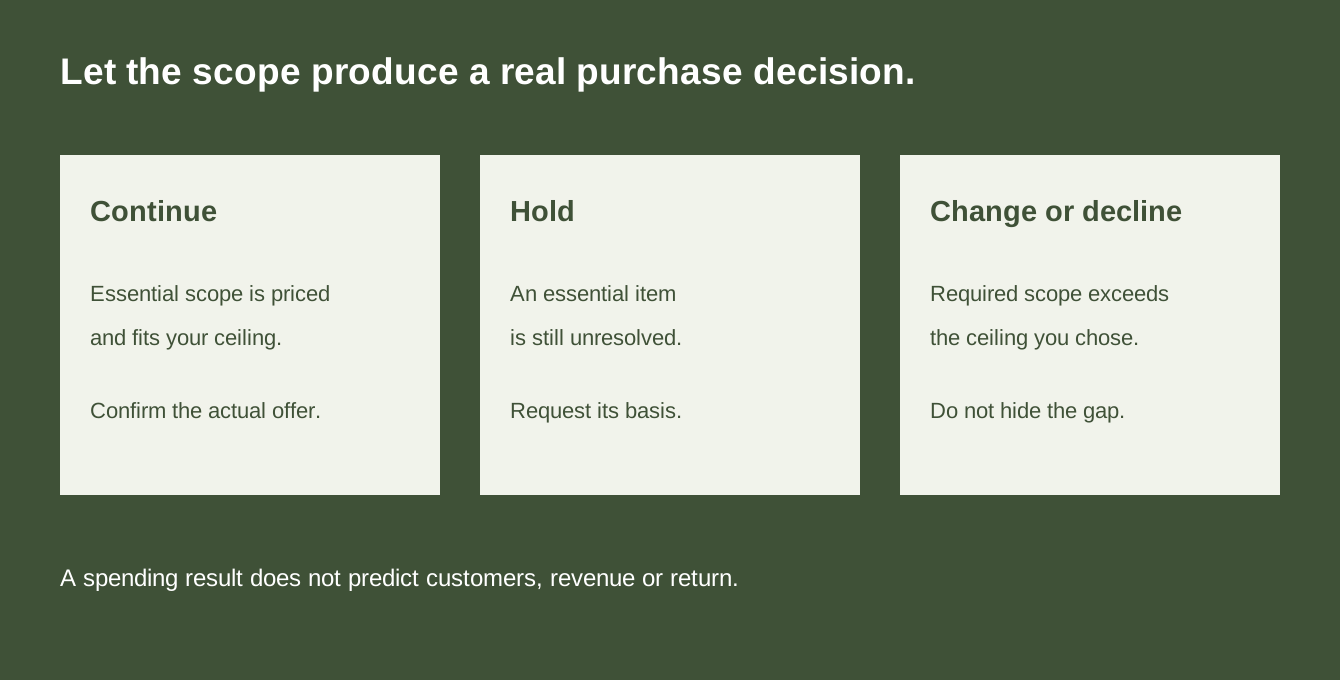
Write the definition before asking which asset is cheapest. A listing with a lower asking amount may still require an unpriced item that is essential to your intended operation. Another listing may provide a scope you understand but fail to fit your ceiling. The useful outcome is a concrete accept, hold or decline decision, rather than calling the lowest visible number affordable.
Separate quoted amounts from your estimates and unresolved items
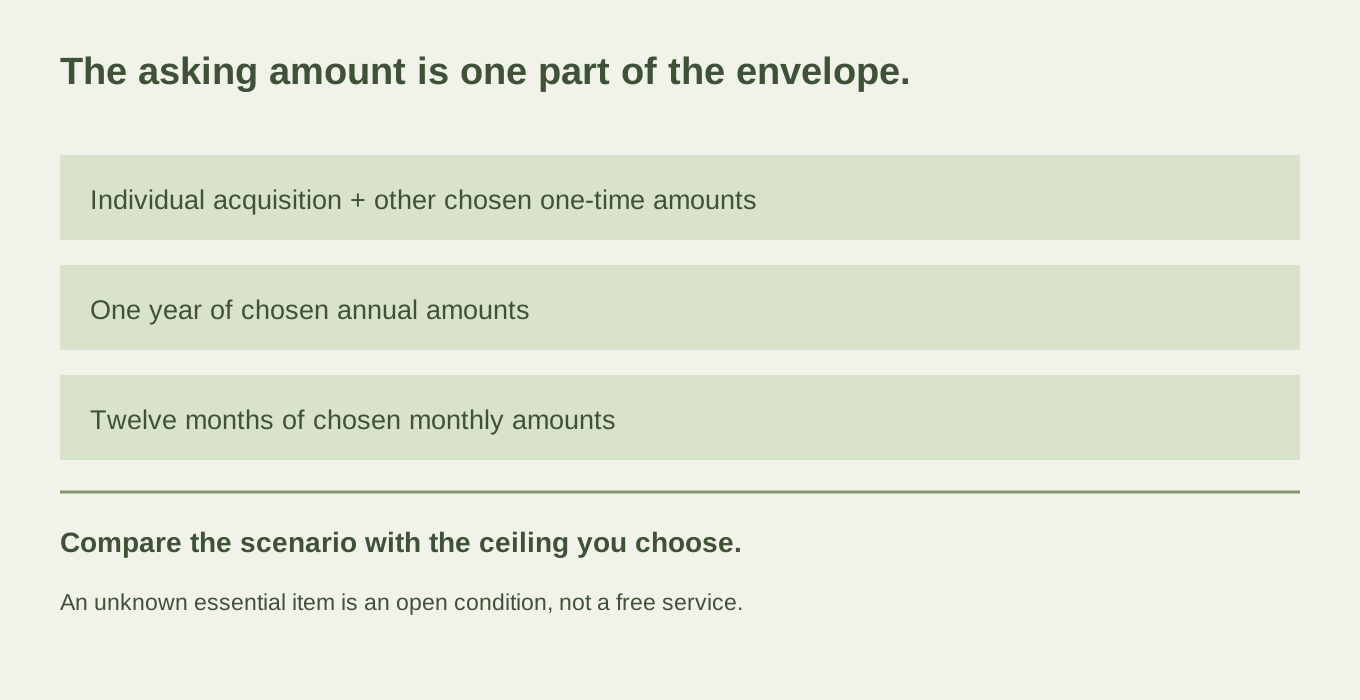
A useful budget has an evidence column. Some amounts come from the current seller offer or an actual service quote. Some are assumptions you choose for the worked plan. Others are unresolved. Do not turn the third category into zero merely because a calculator needs a number.
| Amount status | How to record it | What it means for the purchase |
|---|---|---|
| Current amount supported by an offer or quote. | Name the source, scope and period to which it applies. | Use it within its actual conditions, without assuming it covers other work. |
| Buyer assumption. | Label it as your allowance and state what it is meant to cover. | Test the affordability of your chosen scenario; do not call it the asset's historical cost. |
| Essential item not yet priced. | Keep a visible unresolved line rather than enter an implied free service. | Hold the relevant decision until the amount or acceptable scope is clear. |
| Optional work excluded from the initial offer. | Name the exclusion and make sure the first customer promise does not require it. | Do not budget it as delivered or quietly rely on it for launch. |
This evidence discipline is especially important for inexpensive assets. A small asking amount can make it tempting to fill the rest of the sheet with optimism. The buyer should instead keep a short, accurate model of the ownership they intend to fund. A visible unknown is more useful than an apparently precise total built from missing information.
Use one illustrative calculation without attaching it to a product
Here is a purely illustrative example. A fictional buyer chooses a first-year cash ceiling of USD 1,500. Their fictional acquisition amount is USD 300, separately agreed initial work is USD 150, an annual service amount is USD 60 and their monthly service allowance is USD 25. These numbers are examples only. They are not seller quotes, product costs or a suggested budget.
| Illustrative item | Illustrative amount | First-year treatment |
|---|---|---|
| Acquisition. | USD 300 once. | USD 300. |
| Separately agreed initial work. | USD 150 once. | USD 150. |
| Annual service. | USD 60 for the year. | USD 60. |
| Monthly service allowance. | USD 25 each month. | USD 300 for twelve months. |
| Illustrative first-year total. | No revenue assumed. | USD 810 against the fictional USD 1,500 ceiling. |
The arithmetic leaves USD 690 within that fictional ceiling. It does not establish that the buyer will make money, that an unknown cost is covered or that a particular asset can be operated for those amounts. It only shows how a consistent envelope can make a spending decision explicit.
Now suppose an essential additional requirement is not priced. The fictional total remains a partial scenario, even if it appears comfortably below the ceiling. The buyer should mark a hold, obtain an actual quote or change the intended scope. An unresolved requirement cannot become affordable simply by disappearing from the sheet.
Make the chosen customer job determine which costs are essential
MemoSlide, ThatQuis and Macro-Manage serve different customers and workflows. Buying whichever has the most attractive asking amount would not solve a mismatch between the product and the business you want to operate. Start with the customer job, then price the scope required to provide it.
For MemoSlide, inspect the delivered deterministic memo-to-plan work, editing and exports. No AI key is required for that planning. That specific boundary can matter to an operating budget, but it does not mean hosting or other application services are unnecessary. Do not add a speculative AI allowance as if it were required, and do not remove all service lines because the product is deterministic.
For ThatQuis, inspect the rules-based quiz workflow, creator controls and actual plan limits. For Macro-Manage, inspect the roster and fee-record work, keeping optional photo-to-roster assistance separate from manual roster entry and CSV reporting exports. The essential budget should follow the feature and offer you choose, rather than a general assumption that every SaaS has the same operating dependence.

Turn a required change into a named purchase condition
The buyer may identify a feature or configuration they consider essential. Ask whether it is delivered, included work, a separately priced change or outside the seller's offer. Keep the answer in the budget beside the requirement. A future idea should not be funded at zero and then advertised as part of the acquired product.
For example, the buyer might want a particular presentation-service arrangement around MemoSlide, a campaign process around ThatQuis or an organization import arrangement around Macro-Manage. The actual application should be inspected for that scope. If additional work is needed, obtain an explicit agreement rather than treating source ownership as proof that the change is free or trivial.
The buyer can also choose a smaller first offer. That is reasonable when the delivered product still supports the customer promise they intend to make. It is not reasonable to remove a requirement from the cost sheet while leaving it in the advertised offer. A controlled scope reduction changes both the budget and what the customer will receive.
Calculate the first-year scenario with your own numbers
My chosen ownership envelope
All starting values are zero for entry, not a claim that any item is free. The calculator totals one-time amounts, one year of annual amounts and twelve months of monthly amounts. Compare that result with the cash ceiling in your own purchase notes. It does not include an unentered cost or predict revenue.
Give every entered amount a source or an assumption label in your notes. If an essential item is unknown, record the unknown beside the result. The tool should help you inspect a purchase scenario; it should not hide uncertainty behind a clean total.
Choose accept, hold or decline from the actual scope
What does your current envelope actually establish?
The decision belongs to the buyer. A seller can clarify the current asset and agree work, but the existence of an inexpensive listing does not determine what you can afford to operate. A hold is a useful result when it prevents a commitment made from incomplete information.
Keep twelve months of arithmetic separate from twelve months of trading
The ownership envelope is a spending model. It says nothing about how many users will arrive, whether they will pay or how much service work the business will require. Do not label the difference between the ceiling and the entered total as profit. It is simply money not assigned inside that hypothetical spending boundary.
Similarly, a plan price in the application is not revenue. A model-call allowance is not a usage forecast. A domain renewal is not an appraisal. Keep those categories clear when comparing the current sale with your own proposed operation. The financial position represented by the seller should be evaluated through the actual Flippa evidence.
If your purchase depends on existing cash flow, use an explicit trading-evidence condition as well as the spending envelope. An affordable launch foundation can still fail that condition. The pre-revenue acquisition case explains that distinction; this calculator does not replace it.
Run a second scenario when one assumption changes
A useful budget exercise changes one assumption deliberately. Suppose the fictional buyer learns that a necessary service arrangement differs from the allowance. They should update that line and compare the resulting scope with the same ceiling. The goal is to see what the purchase now requires, not to preserve the original answer.
Another change might concern the initial customer offer. If the buyer drops an optional feature from the first launch, they should identify which associated work or service amount actually changes. Do not assume that hiding a feature removes an external service or that a smaller audience automatically eliminates a fixed account cost. Ask for the relevant implementation and provider information.
Keep the original and revised scenario in your purchase notes. A short explanation of the changed assumption is more useful than a sheet whose numbers quietly shift every time the purchase feels less affordable. This makes the final offer easier for the buyer and seller to understand.
Include your own operating work without inventing a wage forecast
The buyer will perform or arrange work around the application. They may prepare content, answer customer questions, manage service accounts or coordinate technical help. Decide which externally paid work belongs in the spending envelope and which tasks you intend to perform yourself. Keep unpaid work visible in the operating notes even when it has no cash line.
This is different from assigning an invented commercial value to every hour and calling it a current asset cost. You can record responsibility and capacity without predicting sales or presenting a hypothetical wage as a seller expense. If your intended operation requires outside help, ask for an actual scope and quote rather than assume it will be available at a chosen number.
The side-business acquisition case addresses service hours and response obligations. Use that owner for the time decision. Here, keep the budget focused on what you choose to fund and the evidence behind those amounts.
Make the final offer match the envelope you actually evaluated
Before proceeding, compare the written purchase scope with the calculator inputs. Is the asset the same one? Are the agreed inclusions and exclusions the same? Have new requirements appeared since the first walkthrough? If the scope changes, update the budget rather than assume the earlier affordability result still applies.
A short offer note can name the selected asset, the agreed acquisition amount, expressly included work and separately funded items. It should also identify any essential unresolved condition. This is not a substitute for the transaction terms; it helps prevent the buyer from budgeting one package while negotiating another.
- Choose the delivered product and the customer job you intend to own.
- Define which first-year amounts belong inside your cash ceiling.
- Separate actual quotes, buyer allowances and unresolved items.
- Enter a consistent scenario without assuming unpriced work is free.
- Resolve a required gap, reduce the real offer scope or decline.
- Confirm the individual purchase against the envelope you evaluated.
Watch one monthly assumption cross the fictional ceiling
Return to the expressly illustrative USD 1,500 ceiling and USD 810 first-year scenario. Keep the fictional acquisition, initial work and annual amount unchanged, but change the monthly service allowance from USD 25 to USD 85. Twelve months of that allowance become USD 1,020. The resulting illustrative total is USD 1,530, which is USD 30 above the fictional ceiling.
Neither monthly amount is a quote or a statement about any named product. The example shows why a recurring line matters to this purchase decision. The buyer should not justify the excess by inserting an assumed future sale. They can change their chosen ceiling, find a genuinely acceptable scope with a supported cost basis, or decline the purchase. Each is a different decision from pretending the extra amount is absent.
If the buyer reduces scope, update the customer promise as well. Removing a service allowance without establishing that the delivered workflow can operate without that service does not solve the budget problem. Ask the seller which path is actually supported and keep any new configuration or work explicitly priced or unresolved.
Check the period covered by a seller's included service
A seller might include some service, support or existing arrangement in the offer. Ask what period and scope the inclusion actually covers. Do not assume it lasts the whole first year, automatically transfers to a buyer-owned account or includes every future customer request. Use the agreed terms as the basis for the relevant line.
The same discipline applies to a renewal or prepaid amount. Establish what is included before entering a recurring allowance or treating an item as already funded. The point is not to prescribe a particular provider arrangement; it is to avoid counting the same included period twice or assuming that an unagreed future period is free.
Keep essential service continuity visible in the notes. If the proposed operation depends on a buyer-owned account or separately arranged help, obtain the relevant information before treating the first-year scenario as complete. A named amount with the wrong period can be as misleading as an amount with no basis.
Do not negotiate the product you budgeted into a different product
A buyer may begin with a focused existing application and then add a new audience, integration or service arrangement during discussion. That can change the required work even if the asking amount for the original source package stays the same. Compare the final offer with the scope that produced the affordability result.
For the fictional cash-ceiling buyer, this creates a useful stop point. If the new requirement is essential, price it or hold the decision. If it is optional, exclude it honestly from the initial customer offer. The acquisition should remain an understood existing-asset purchase with any agreed changes stated clearly, rather than an open-ended development request hidden inside a low-cost listing.
Check when the money is needed as well as the annual total
The calculator compares a chosen first-year envelope, but it does not schedule payments. A one-time acquisition or annual amount may be needed at a different point from a monthly service allowance. Keep the actual due dates and agreed payment terms in the purchase notes rather than assume that every cost is evenly spread across twelve months.
For the fictional buyer, an annual total below the ceiling does not automatically establish that every required payment can be made at the required time. They should inspect the current transaction and service arrangements, then decide whether the funded scope still fits. This is a spending constraint, not a reason to insert projected revenue into the calculator.
If the timing is unresolved, mark it as unresolved. The buyer can continue asking factual questions about the individual offer without claiming they have approved the whole ownership envelope. A smaller, clearly understood purchase is more concrete than an apparently affordable total whose essential payment conditions have not been agreed.
Buy an affordable scope rather than an attractive label
A buyer can deliberately acquire a low-cost software asset and take responsibility for operating it. The useful standard is an understood scope that fits the buyer's own ceiling, not a promise that cheap means automatic or that a small asking amount produces free money.
The seller's role is to describe the actual package and terms accurately. The buyer's role is to decide what they want to fund, resolve essential unknowns and keep future trading assumptions separate. That gives the purchase a concrete basis even when the final answer is a hold or a decision to choose another asset.
Request the current individual MemoSlide, ThatQuis or Macro-Manage offer. Compare other foundations in the SaaS business collection if a different delivered job better fits the scope you are prepared to own.
Explore the products discussed
Explore related acquisition offers