
Buy a planning application for your secretariat board-pack cycle
Acquire MemoSlide around source authority, editorial review and an identifiable export.
Request MemoSlide for an internal recurring board-pack preparation cycle. Follow the source memo, changed fact, reviewer question and accepted export.
Buy MemoSlide's domain and application for an internal company secretariat's recurring memo-to-board-pack preparation. Request the current individual package through the MemoSlide Flippa listing. The buyer is acquiring an owned planning application and agreeing its internal use, account arrangement and assistance in the transaction.
This worked case is for a company that already writes its own decision papers and wants control of the preparation workflow. It concerns the source memo, reviewer comments, selected slide plan and export recipient. MemoSlide is not represented as a board portal, voting system, statutory record archive or meeting-management service. The company supplies its own governance and approval decisions; the application helps prepare and review the presentation material.
Request MemoSlide for a specific recurring preparation cycle
Request the MemoSlide source-and-domain acquisition offer →
Inspect the MemoSlide asset page and individual product acquisition brief. Read the user guide and technical handover document. Confirm availability, price, represented financial history, included source and domain, service ownership and agreed assistance through the current transaction.
MemoSlide's documented workflow includes plain-text and Markdown memo import, deterministic structure analysis, narrative frameworks, editable slide planning, comments, approvals, versions, sharing and exports. It requires no generative AI key for that planning process. The secretariat's purchase question is whether those existing controls fit a repeatable internal preparation mandate and the people authorised to carry it out.
The fictional secretariat is buying continuity of authorship
Imagine a fictional company whose department lead writes a quarterly memo about a small training-room pilot. A secretariat editor turns the memo into a presentation plan, a reviewer questions one factual statement, and an authorised recipient receives the accepted export. The people, company and pilot are artificial purchase examples, not customers or records included in MemoSlide's sale.
The company already knows who may approve its material. It wants the written source to remain visible while the plan is refined, so an editor can explain where a slide's assertion came from. Its objective is an owned preparation process across repeated quarters, with a clear handover when a colleague prepares the next pack.
This is different from an agency buying an application to sell separate client presentations. The company is procuring an internal operating asset for its own recurring papers. The transaction should agree the source-and-domain package and intended internal arrangement, while the worked cycle demonstrates the specific responsibility the buyer wants to control.
Give the source memo an author before it becomes a slide plan
Begin with a short artificial memo supplied by the fictional department lead. It describes the pilot's purpose, a few observed facts and the decision the company wants to discuss. Name the person responsible for confirming those facts. The editor should know which material is the source and which material will be created during planning.
Ask the seller to demonstrate the actual plain-text or Markdown import route. Inspect the original memo and the detected sections in the current application. The source supports memo versions and section records, giving the buyer a concrete relationship to investigate between the imported writing and the developing plan.
Keep the memo small enough to read during the workshop. A prepared document with a purpose, evidence and a proposed next action is more useful than a large confidential paper. The buyer should be able to identify every section and confirm that the planner has retained the source context needed for its internal preparation procedure.
Use a source-to-export authority record
| Preparation stage | Human authority | Current record to inspect |
|---|---|---|
| Source memo | Department lead confirms the permitted artificial facts. | Imported memo and its relevant version |
| Slide planning | Secretariat editor prepares an understandable argument. | Editable slide purposes, content and source references |
| Challenge | Reviewer identifies a factual question or unclear claim. | Actual comment and review controls |
| Correction | Source author confirms the amended fact; editor updates the plan. | Current memo/slide change procedure and approval state |
| Accepted pack | The company's authorised person approves the prepared material. | Identified application version and relevant status |
| Distribution | Secretariat names the permitted recipient and format. | Actual export record, file and chosen share settings |
The application has its own workspace and project roles; the company has its own authority to approve a paper. Map those two deliberately. A slide status can record an editorial stage without becoming a board resolution. The buyer should be able to explain the actual meaning of each stage before relying on it in an internal procedure.
Keep the schedule attached to one artificial project. The seller can then demonstrate the existing controls, and the buyer can state which person is responsible for each action. Any additional formal approval route or integration with another company system should have its own specific scope.
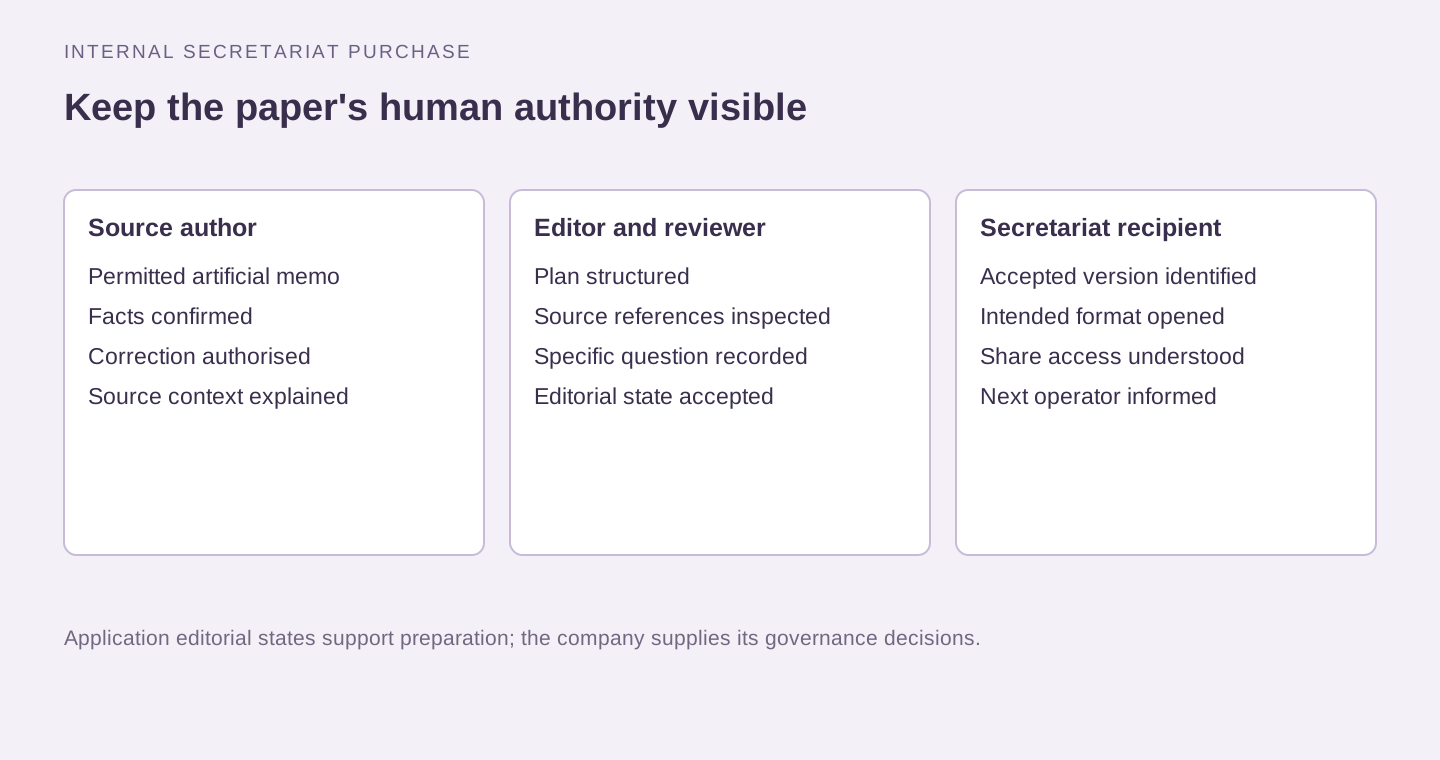
Choose the argument before polishing the pack
The fictional training-room memo contains observations, a proposed next action and supporting detail. Ask the editor to identify the decision the presentation should make understandable. MemoSlide's narrative frameworks and editable plan are relevant because the written paper needs an order that an audience can follow.
Use the actual planner to place the memo sections into the chosen structure. Inspect slide purposes, headlines, notes and source references. The buyer should observe how an editor changes a plan and checks its connection to the written source. The goal is an argument the company's people can explain, rather than a claim that the software makes the business decision.
Then inspect one piece of important information that was initially left out. Ask the editor to find its source section and decide where it belongs in the plan. This provides a practical purchase example for source coverage and editorial judgement, using current product controls and a human owner for the resulting presentation.
Read the artificial paper through a source-to-slide crosswalk
Give the workshop a short permitted example everyone can read. The fictional memo says that the pilot uses two training rooms, describes the purpose of the sessions and proposes continuing the pilot for another quarter. The source author later corrects the room count to one. The purchase test concerns how the editor keeps the factual description and the proposed action clear while making that change.
| Source element | Planning job | Buyer question |
|---|---|---|
| Description of the current pilot | Explain the current situation | Which memo section and slide reference contain the room count? |
| Purpose of the sessions | Explain why the audience is discussing the pilot | Where does the plan preserve that purpose? |
| Proposed next quarter | Make the requested discussion or action explicit | Can the editor distinguish the proposal from an already completed decision? |
| Corrected room count | Update the permitted factual statement | Which current source and slide controls record the correction? |
Ask the seller to locate each element in the actual application. The editor should be able to open the relevant source section, identify its place in the plan and explain any changes in presentation. This makes the acquisition evidence more useful than a polished deck alone: the buyer can see how its staff will maintain the argument when an ordinary factual correction arrives.
Keep the crosswalk with the secretariat's authority record. A second editor can then recognise which parts of the document describe observations and which parts request a decision. The application supplies editable planning records and source references; the company's author and editor supply the meaning of the paper they are preparing.
Make the reviewer challenge a specific fact
Give the fictional reviewer one clear question: the memo describes two pilot rooms, while the department lead has since confirmed that only one was used. Ask the seller to demonstrate how the reviewer records that concern through the current comment or review interface and how the editor recognises the relevant slide.
Inspect the actual role needed for the action. The source includes project access checks and collaboration controls, with different permissions for editing and commenting. The buyer should test the ordinary authorised role it intends to use instead of giving every reviewer unrestricted owner access for convenience.
The useful outcome is a traceable question that reaches the person responsible for the source. A comment can identify the issue; the department lead confirms the corrected fact through the company's own procedure. The editor then makes the permitted change in the application and retains an understandable record for the next preparation stage.
Correct the source and the plan as two linked decisions
Ask the seller to show the current supported way to maintain the memo and the affected slide information. The inspected source includes memo versions, editable sections and slide source references. The buyer should observe which record is current after the change and how the editor follows the relationship.
Keep the fictional correction precise. The fact changes from two rooms to one. The intended next action may remain the same, or the author may revise it separately. The editor should be able to explain that distinction when updating the plan, preserving the company's ownership of the reasoning behind the pack.
If the buyer wants automatic bidirectional synchronisation with an external document system, that is additional work to specify. The existing application accepts its documented source formats and provides its own planning workflow. The secretariat can operate a deliberate import and correction procedure if that fits its accepted scope.
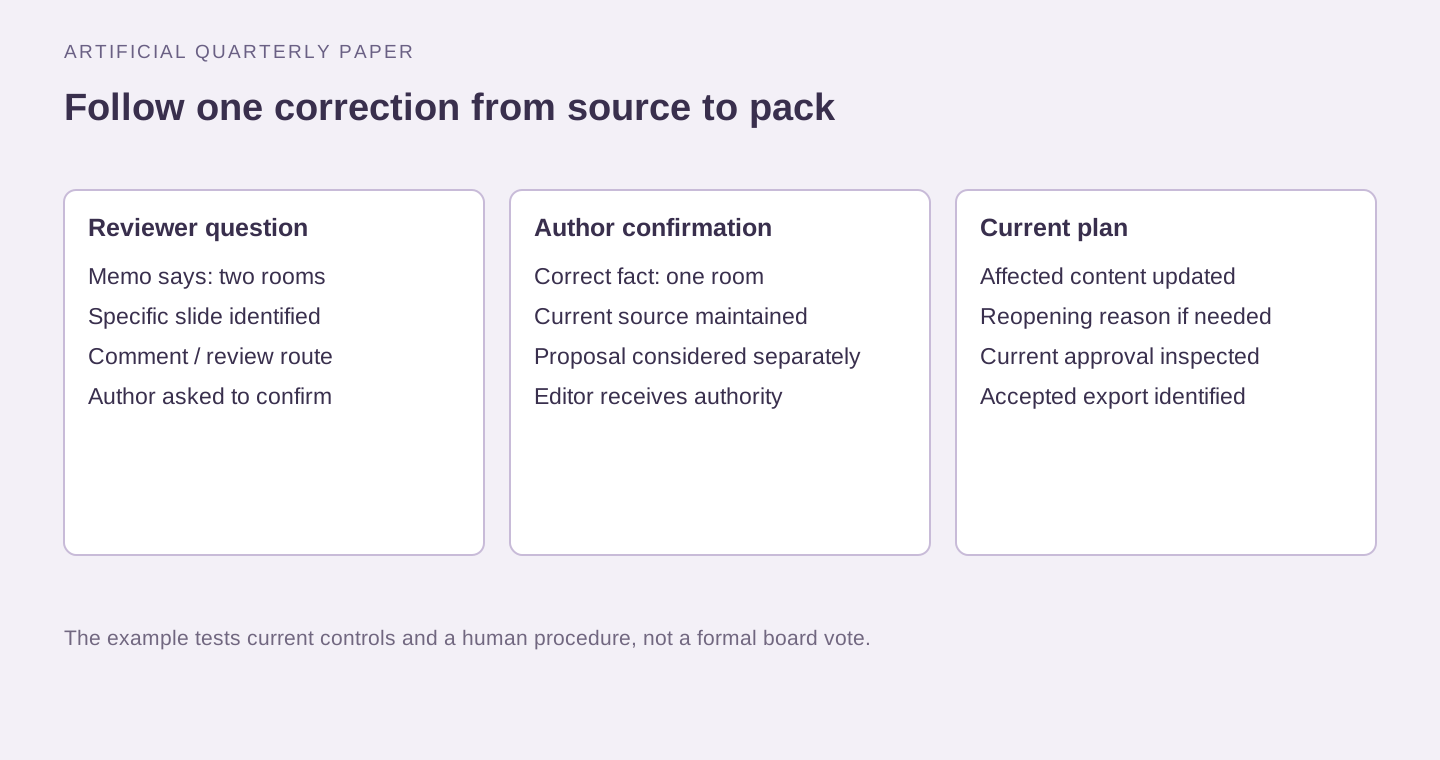
Use the actual approval state for editorial acceptance
The inspected slide controls include draft, review and approved states. They also require a reason when an approved slide is reopened. Ask the seller to demonstrate that current behaviour on the artificial project, using the appropriate authorised role and a clear reason tied to the factual correction.
The secretariat can use this to establish a practical editorial procedure. The responsible editor identifies what changed, returns the slide to the appropriate stage and obtains the company's required confirmation before distribution. The buyer should define what an approved application state means for its preparation process.
Use a precise artificial reopening reason, such as the author correcting the room count before distribution. Ask the second operator to connect that reason with the reviewer's question and the current source information. After the edit, inspect the slide's actual state and use the appropriate authorised approval route. The buyer should be able to describe both why the earlier editorial acceptance was reopened and which content is now being prepared for export. This turns a status control into a practical staff procedure the company can teach and repeat.
Keep the company's formal governance outside that label unless separately supported and agreed. The application helps organise and approve presentation content; the company supplies any actual decision or resolution through its own authorised procedure. This gives the buyer a useful current workflow with a clear meaning, without selling a different board-management product.
Check a simultaneous edit before two colleagues overwrite their work
The secretariat may have more than one authorised editor. Use the artificial project to inspect a simple concurrent-edit case: one editor updates the corrected room statement while another has an older version of the same slide open and changes its headline. Ask the seller to demonstrate the actual experience with the appropriate current roles.
The inspected slide-update source checks an expected version against the current record and rejects a mismatched save with a request to reload the latest version. That is a concrete maintenance behaviour to verify. The buyer should observe the current interface response and the procedure its editors will follow to preserve the accepted fact while deciding how to apply the second person's intended wording.
The useful outcome is an understandable recovery route, with a named person deciding the final content. The application is not represented as automatically merging every competing edit. Record what the staff member sees, how they return to the current plan and which corrected information remains. This gives the company a practical collaboration procedure for the workflow it wants to acquire.
Choose the export the recipient can actually use
MemoSlide documents Markdown, JSON, editable PPTX and print exports. Ask the secretariat to select the format its fictional recipient needs and request a seller demonstration with the corrected plan. Open the resulting file in the intended viewer and inspect the headline, evidence, notes and source context relevant to the worked case.
The buyer should identify the exported version and the actual export record the application retains. This connects the accepted planning work to a file the recipient can recognise. An editable presentation and a print-ready document can serve different preparation jobs, so the buyer should accept the route it intends to operate.
Keep later editing responsibility clear. A recipient who changes an exported file may create another working copy outside the application. The secretariat needs a human procedure for identifying which file is the accepted pack. The acquisition does not promise automatic synchronisation between every external copy and the current MemoSlide project.
Set share access around the actual preparation task
The product documents scoped share links and revocation. Ask the seller to demonstrate the current options with the artificial project. The secretariat should decide whether a reviewer needs a permitted share route, an application account or only the accepted export, based on the actual delivered controls.
Use the fictional recipient to inspect the chosen view. Confirm what they can read, whether the selected route permits comments and what happens when the owner revokes the link. Keep those observations attached to the authority record so a future operator understands the access granted for the preparation cycle.
A revoked link changes the application's access route. It cannot remove a file already downloaded to someone else's device. The buyer's distribution procedure should identify authorised recipients and the form of the accepted pack, with any stronger document-control requirement separately scoped.
Carry the preparation method into the following quarter
The fictional company appoints another secretariat editor for the next quarterly memo. Give that person the source-to-export record from the purchase workshop. They should be able to identify who supplies the source, who checks facts, which application roles perform the work and how the final recipient receives the accepted version.
Ask the seller to demonstrate the actual current project-creation and framework controls relevant to the next cycle. The buyer can then choose a human preparation procedure using those controls. Automatic recurring board-pack creation or integration with a meeting calendar should remain an additional requirement if the company needs it.
This is the continuity outcome the internal buyer is procuring. It wants an owned, explainable preparation operation across people and periods. The application need not make the company's decisions to provide value; it needs to support a source, an editable plan, a review record and an export the operator can identify.
Accept internal operation separately from a public software launch
MemoSlide includes software-plan foundations for individuals and teams. The company buying the entire asset for its own use should ask how its intended internal workspace will operate under the delivered configuration. Agree the actual account, entitlement and service arrangement as part of the transaction.
The buyer should also identify the person maintaining the application. The secretariat editor may understand the paper-preparation job while another person handles deployment and service accounts. Source ownership and daily content authority are connected responsibilities, and both need a clear owner.
No customer revenue or active team subscriber base is established by this fictional case. Confirm financial representation through the current sale. The internal buyer's reason to acquire is control of its own preparation process, with any future sale of software access considered separately from this accepted company workflow.
Rehearse the file question after the pack has been distributed
Give the fictional recipient a later question: does the file they opened include the corrected one-room statement? Ask the second secretariat operator to identify the accepted export, the associated application record and the source correction. This tests the continuity of the preparation record without requiring genuine board material.
The operator should be able to explain the answer using the actual version and export information observed in the seller workshop. If it needs an additional external file register, the company can assign that human procedure explicitly. The buyer's acceptance should focus on a traceable route it is prepared to maintain.
Use any unresolved gap to refine the purchase scope. A company needing a formal archival or meeting system may require more than the delivered planner. A company needing an owned source-to-plan preparation workspace may find this bounded workflow suitable. The transaction should make the accepted result and any further work clear before the company adopts it.
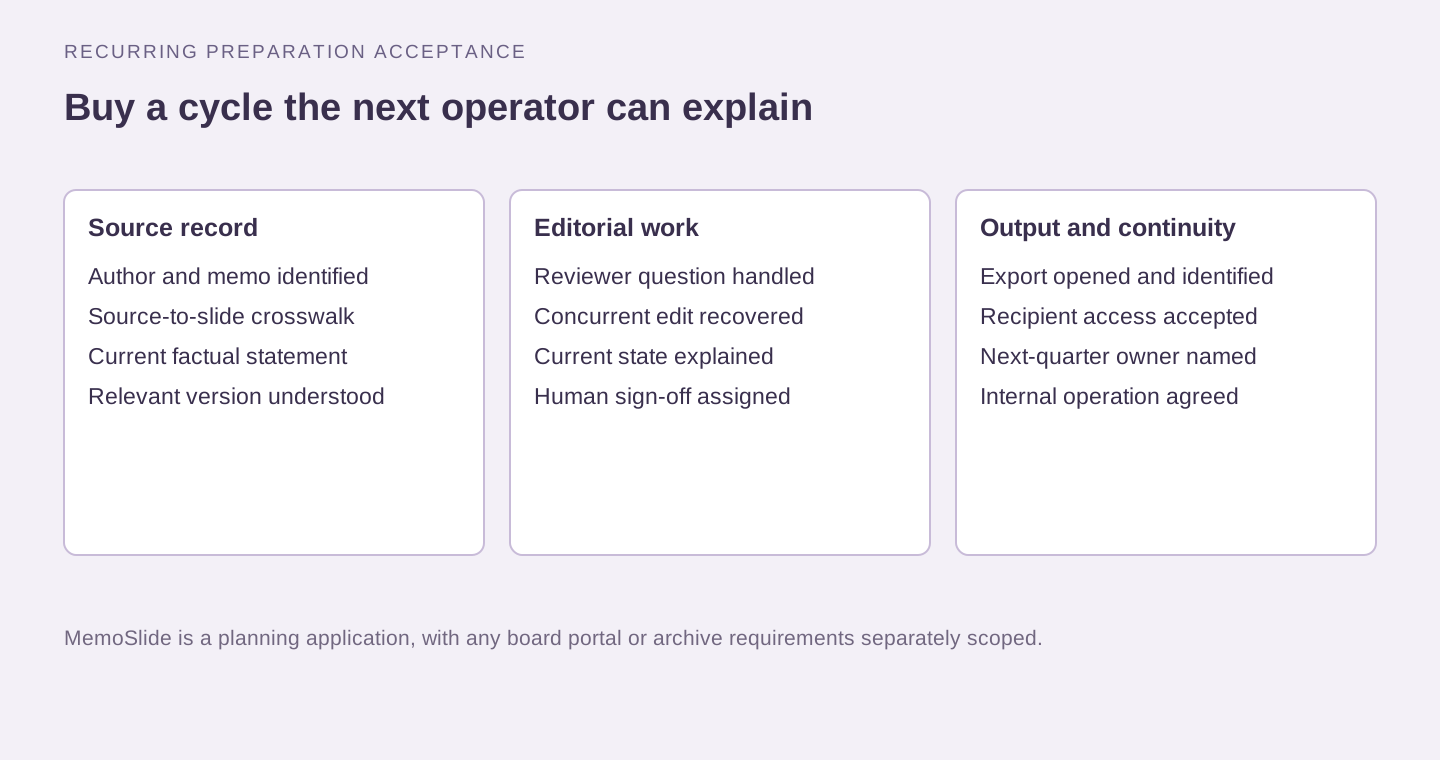
Complete the secretariat's planning-application purchase record
Keep the artificial memo, crosswalk and final export reference beside these answers. Together they give the buyer a compact preparation example another staff member can repeat. A completed answer should identify a current demonstrated control or an agreed human responsibility; any unresolved item gives Codeblix a specific question to address in the acquisition conversation.
- Prepare a short artificial memo and name the source author, editor, reviewer and recipient.
- Ask Codeblix to demonstrate a factual challenge and correction through the actual planning controls.
- Open the accepted export and trace it back to the source and editorial state.
- Agree the individual asset transfer and the internal operation your company will maintain.
Request the MemoSlide acquisition offer on Flippa with the completed source-to-export record. The purchase concerns an owned preparation workflow your secretariat can explain, repeat and maintain across its own quarterly papers.
Explore the products discussed
Explore related acquisition offers