
Buy produce-sourcing software for your purchasing desk
Acquire FruitKiwi around your owned requirements, comparable replies and external settlement.
Request FruitKiwi for an existing purchasing desk. Work a changed produce requirement through supplier replies, current quote comparison and a clear selection record.
Buy FruitKiwi's domain and application for an existing produce purchasing operation. Request the individual asset through the FruitKiwi Flippa listing. This case concerns a restaurant group acquiring its own sourcing software, with a central buyer comparing permitted suppliers. The offer is for the digital product package, with its source, domain, documents and assistance confirmed in the transaction.
FruitKiwi's documented workflow is produce discovery, multi-supplier requests for quotation, quote comparison and supplier messaging. Produce invoices are settled outside the application. Its intended platform model charges suppliers for software plans and visibility. The purchasing group in this example wants to use the application for its own demand-side desk, so the acquisition decision includes whether its delivered public marketplace and account model suit that internal mandate.
Request the whole application for a named purchasing desk
Request the FruitKiwi source-and-domain acquisition package →
Inspect the FruitKiwi asset page and the broad produce marketplace purchase brief. Explain that the buyer already purchases produce and wants to own a sourcing channel for that work. Ask Codeblix to demonstrate one complete artificial requirement through the buyer, invited supplier, comparison and selected-quote views.
The existing application includes a public catalogue and supplier storefronts alongside signed-in sourcing records. It is not represented here as a delivered private procurement suite with group approval hierarchies, budgets, purchase orders or ERP synchronisation. Keep those requirements in one additional-work schedule. The group can accept the current public/account model, agree an adaptation or decide it needs a different foundation.
The buyer's mandate begins with its own kitchen requirements
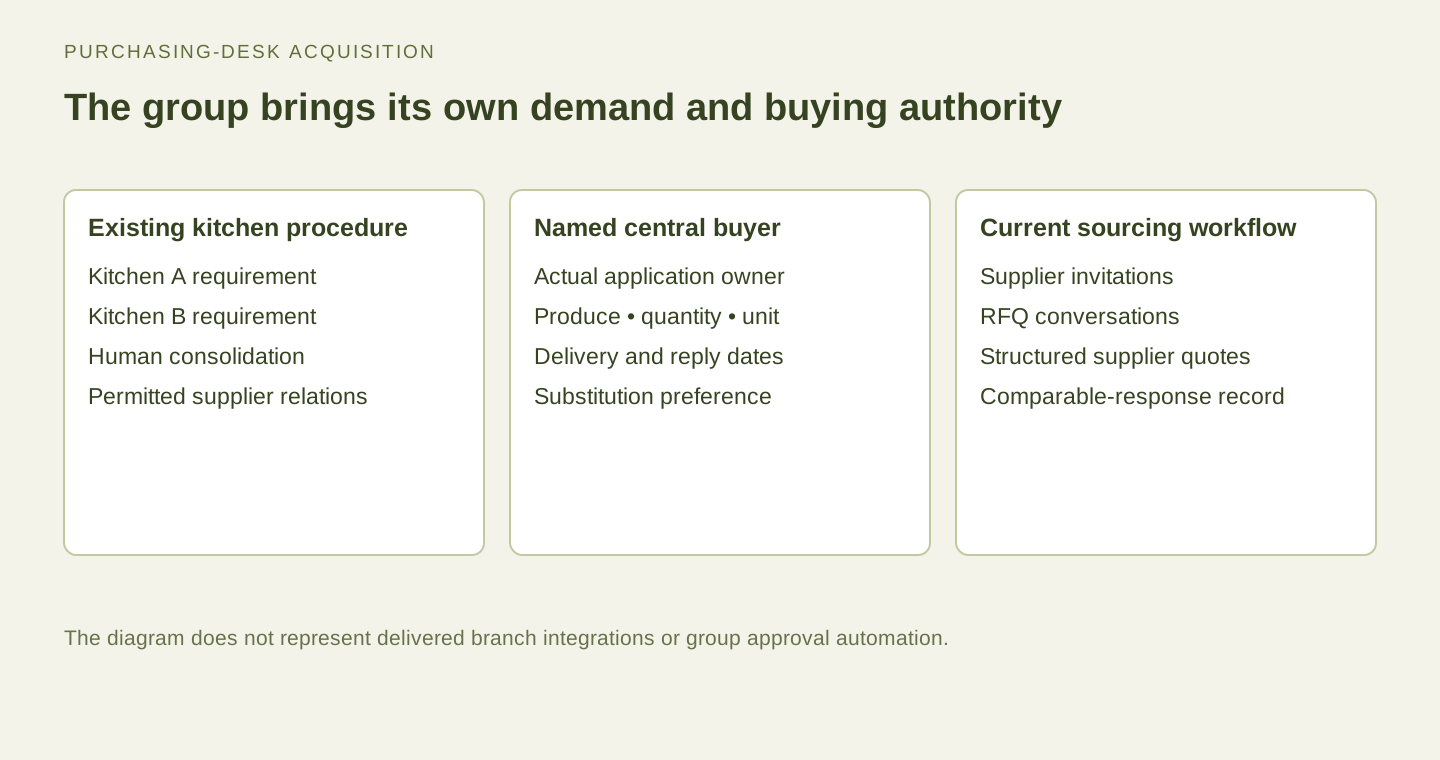
Imagine a fictional restaurant group whose central buyer receives produce needs from two kitchens. It already has permission to contact its chosen suppliers and knows who accepts the resulting commercial commitments. The group wants a clearer place to issue a requirement, receive comparable replies and identify the selected sourcing intent. No restaurant, purchasing contract or supplier relationship is included with FruitKiwi's sale.
For the worked purchase test, the central buyer initially needs twenty kilograms of tomatoes for a defined delivery date. A kitchen later increases that need to thirty kilograms. The quantities are fictional test inputs, not live stock or order history. The change gives the buyer a useful acquisition question: can its staff keep the requirement, current supplier responses and eventual external invoice understandable as the need changes?
The group is buying for an owned operating desk, rather than opening a public supplier-plan business. It therefore evaluates the delivered model against the authority it already has. The relevant outcome is a maintainable demand record and a clear supplier handoff. Attracting unrelated suppliers and selling them software subscriptions is a different launch mandate covered by the broader asset offer.
Choose a central application owner before collecting branch input
The restaurant group may have several people requesting produce, but the application has its own buyer identity and organisation rules. Ask the seller to show who creates the buyer organisation, who can issue an RFQ and who can select a quote. Map the group's actual purchasing authority to those delivered actions.
For the fictional case, one central buyer owns the application request. The two kitchens supply requirements through the group's existing permitted procedure. This keeps the first purchase example within an understandable account boundary. If the group needs several staff to share an approval queue or approve spending in stages, it should specify and agree that separately.
Keep application authority visible in the sourcing record. A chef providing a desired delivery date and a buyer selecting a supplier may have different responsibilities. A platform administrator is another role again. The acquisition workshop should leave the group able to name the person behind each current action and the person responsible for any required external approval.
Translate the kitchen request into the current RFQ fields
FruitKiwi's source represents produce lines with a name, quantity, unit and optional notes, together with a required-by date, delivery information, substitution preference and response deadline. Those are useful fields for turning a kitchen request into a supplier question. Ask the seller to create the fictional tomato requirement through the normal buyer interface.
Read the resulting request as a supplier would. Is the unit explicit? Is the required date different from the deadline for replying? Is the delivery place clear? Does the buyer's substitution preference describe what the kitchen can accept? A complete requirement helps the purchasing desk compare responses because the supplier is answering a recognisable question.
The current source checks important request inputs, including positive quantities and deadlines. Treat those checks as a foundation for the walkthrough. The group's own buyer remains responsible for confirming that the requirement is appropriate for the kitchens. A completed form is the beginning of sourcing, while the commercial buying decision still needs the group's authority and judgement.
Use a requirement-to-response purchase record
| Purchasing question | Fictional requirement | Evidence to inspect |
|---|---|---|
| What do the kitchens need? | Twenty kilograms of tomatoes for the agreed date | Current produce lines, unit, required-by date and delivery details |
| Who may answer? | Suppliers the group is permitted to approach | Actual approved profiles, selected invitations and supplier inbox |
| What is being compared? | Quantity, unit, fulfilment terms, validity and delivery charge | Current quote lines and comparison view |
| What changes? | The kitchens now need thirty kilograms | Current request/response controls and the buyer's amendment record |
| Who makes the selection? | The named central buyer under the group's authority | Actual selected quote and sourced-intent state |
| Where is money settled? | The group's external supplier invoice procedure | Separate commercial confirmation and settlement evidence |
Use the same artificial requirement throughout the demonstration. Record the relevant application identifiers or other agreed evidence references so the group can connect the buyer view with the supplier response. The record is most useful when a second operator can explain why those responses answer the same purchasing question.
The final column also gives the seller a precise scope to address. Each answer can identify current behaviour, a configuration choice or additional work. Keep that distinction clear while making an offer for the existing application. The group's internal purchasing mandate should remain the centre of the case, rather than expanding into every possible procurement feature.
Invite permitted suppliers through the delivered sourcing route
The source includes RFQ invitations to approved supplier profiles and conversations associated with the request. Ask the seller to show the buyer selecting the fictional suppliers, then open the corresponding supplier inbox and conversation. Follow the same requirement across those views so the group can see how an invited party recognises the requested work.
The group brings its own supplier relationships. It should obtain the required agreement and information before creating live profiles or publishing catalogue material. During the purchase test, use artificial supplier identities and produce listings. The sample suppliers in a product preview illustrate the software; they do not supply the group's future sourcing capacity.
Inspect the current supplier plan and reply entitlement as part of this route. The delivered platform includes software plans, so the group needs to understand the configuration its permitted suppliers would encounter. If it wants a different arrangement for an owner-operated purchasing desk, request that specific configuration or adaptation in the transaction.
Compare units before comparing the quoted totals
FruitKiwi represents quote lines, quantities, units, unit prices, delivery charges, currency, fulfilment terms and validity. This gives the purchasing desk several useful dimensions to inspect. Ask the seller to prepare two fictional responses with an obvious difference in unit presentation, such as kilograms in one response and boxes in another.
The buyer should make the quantities comparable before relying on the total. The inspected comparison source returns the quoted unit-price values; it should not be advertised as an automatic physical-unit conversion service. Ask the supplier to clarify or revise its response where necessary, using the current quote and conversation controls.
Then inspect the delivery charge and validity alongside the line price. A response may answer the requested quantity but apply to a different fulfilment arrangement. The central desk should be able to explain why its chosen comparison is meaningful. That human buying judgement remains useful even when the software provides a structured side-by-side view.
Work the quantity change with transparent fictional arithmetic
Give the seller a small comparison the group can calculate independently. The table uses arbitrary currency units and fictional supplier terms purely to test the purchasing record. Supplier A quotes by kilogram. Supplier B quotes a box that it confirms contains ten kilograms. The delivered total combines the line amount and delivery. None of these figures represents current produce prices, supplier stock or commercial transactions.
| Response | Quantity basis | Line amount | Delivery | Total |
|---|---|---|---|---|
| A, original need | 20 kg × 2 | 40 | 8 | 48 |
| B, original need | 2 confirmed 10 kg boxes × 18 | 36 | 14 | 50 |
| A, changed need | 30 kg × 2 | 60 | 8 | 68 |
| B, changed need | 3 confirmed 10 kg boxes × 18 | 54 | 14 | 68 |
The original delivered totals differ, while the changed totals are equal in this fictional example. That makes a useful purchasing test: the central buyer needs to recognise that the larger requirement changes the comparison. It also needs the supplier's confirmed box size before treating the quantities as equivalent. The group performs that interpretation; the application records the actual quoted units and values.
Ask the seller to enter the relevant permitted artificial response through the current supplier interface, then find it in the comparison view. Compare the line quantity, unit, line amount, delivery charge and total with the desk record. The purchasing coordinator should be able to point to the exact field supporting each figure. This makes the acquisition demonstration independently understandable rather than dependent on a prepared total.
Next inspect the current response's validity and fulfilment terms. Equal totals still leave those terms to consider. The buyer might need a revised valid offer or a confirmed delivery arrangement before selecting either response. The worked record should say which answer is current and who obtained the clarification, using the actual supported conversation and quote controls.
Bring the completed arithmetic example to the acquisition discussion as a test input. It gives Codeblix a precise workflow to demonstrate and the restaurant group a way to judge fit. The value being assessed is ownership of an understandable sourcing process; the table is neither a savings forecast nor a recommendation to purchase produce from a particular supplier.
Keep the buyer's selection reason beside the final response. The kitchens may care about a confirmed delivery time or an acceptable variety as well as the total. A short human explanation lets the next purchasing coordinator understand the decision without reconstructing the conversation from prices alone. Ask where the group will retain that explanation and which current application record it references. This makes the worked purchase record useful after the software demonstration has ended.
Make substitution preference part of the purchasing decision
The fictional kitchen may permit an alternative tomato variety, or it may require the original specification. FruitKiwi records a substitution preference in the RFQ and can identify a quoted substitution conflicting with that preference in its comparison logic. Ask the seller to demonstrate this using the artificial request.
The application record gives the buyer a clear place to recognise the issue. The kitchen's actual acceptance remains a purchasing decision. The central buyer can clarify the response with the supplier and obtain the required internal answer through the group's existing process. Keep the final agreed requirement understandable before selecting a quote.
Use this part of the workshop to test how the group would operate the desk in ordinary circumstances. It is purchasing software to improve a sourcing conversation it already understands. A useful outcome is a visible requirement, an identifiable supplier response and a named person who can decide whether an offered alternative is acceptable.
Handle the thirty-kilogram change as a new decision point
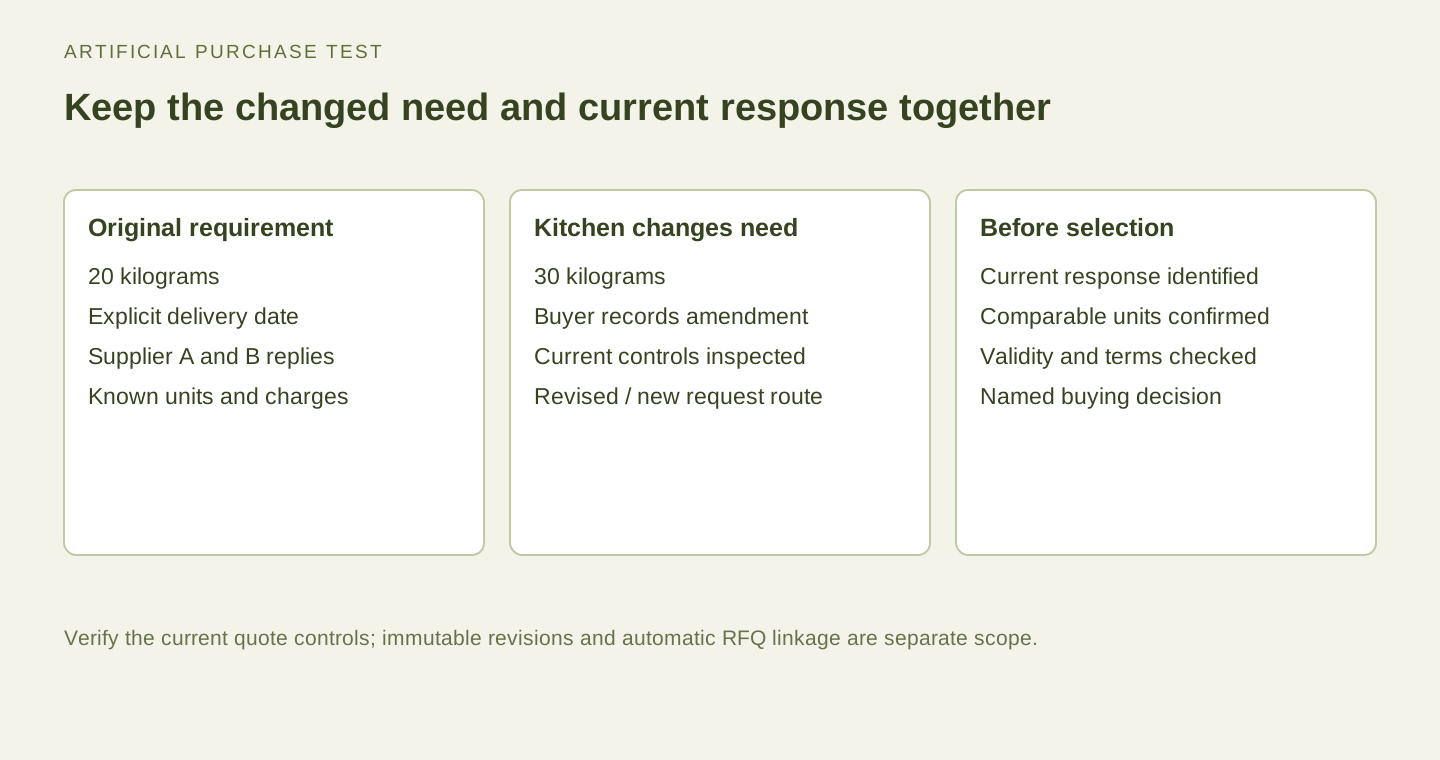
Now increase the fictional requirement from twenty to thirty kilograms. The central buyer should pause the selection while it identifies which responses still answer the current need. The acquisition workshop should demonstrate the actual current request and quote controls, including supplier messages and revised responses where supported.
The source includes a supplier quote revision route, with the existing quote updated to a revised state. That is useful current behaviour to inspect. A complete immutable quote-version archive or a general editable RFQ change-order system is not represented here. Where the requirement itself needs replacement, the group can evaluate closing the earlier request and creating another through the delivered controls, with a human amendment record connecting its own decision.
Ask the seller to demonstrate the chosen procedure rather than promise a particular screen from a future design. The purchasing desk needs a clear answer to three questions: which requirement is current, which supplier response answers it, and which record the buyer will select. Any required automated linkage or additional approval behaviour belongs in the separate-work schedule.
Let quote validity determine whether the desk needs a fresh answer
A quote has a validity date, while the request has a required-by date and response deadline. Those dates serve different jobs. The purchasing desk should inspect all three in the current demonstration. The source comparison includes a conflict when a quote expires before the required-by date, giving the buyer a specific current check to investigate.
Use a fictional response that expires too early. Ask the central buyer to explain the next permitted action. It may request a revised valid response through the current supplier route or follow another agreed sourcing procedure. The important result is an answer the desk can trace to a current supplier commitment, rather than treating an old total as continuously available.
The group's operator should be able to repeat that explanation after the demonstration. It needs to know where to inspect the dates, how to contact the supplier in the relevant conversation and which actual response is under consideration. That operational clarity is part of the software purchase case.
Accept the selected quote as sourcing intent, then settle externally
The inspected source allows the authorised buyer to select an available quote. It records the selected response and marks the RFQ as sourced, with corresponding supplier information. Ask the seller to show that transition for the same fictional requirement after its comparability and validity questions have been resolved.
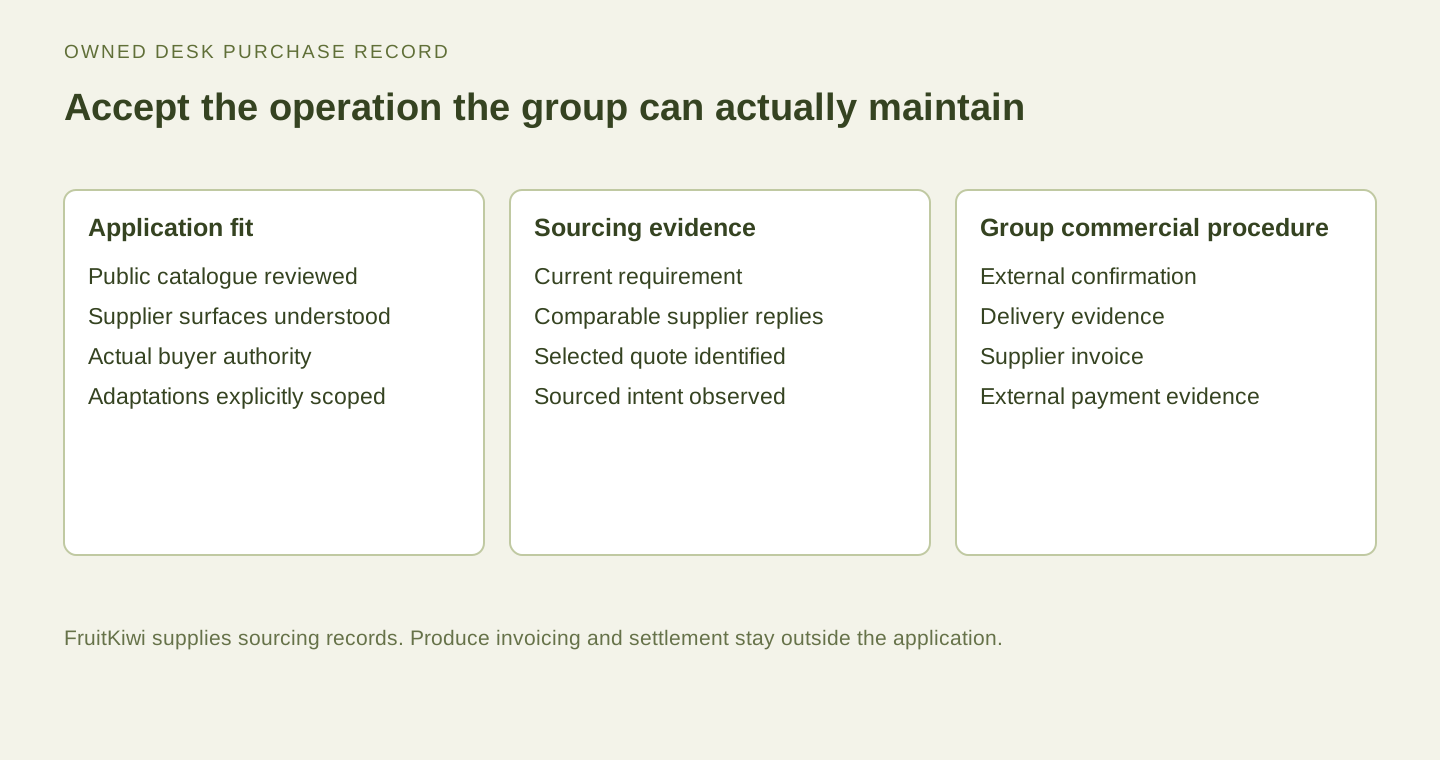
The project documents describe this as an order intent. Produce invoices are settled outside FruitKiwi. The group should keep its own external commercial confirmation, receipt and settlement procedure attached to the decision. This is a useful separation for a buyer who already has a supplier payment process and wants to acquire the sourcing application around it.
Record the external settlement owner in the desk schedule. The application's sourced state tells the team which quote was selected; the group's external evidence tells it what was invoiced, delivered and paid. Keeping those records connected in the human procedure makes the purchasing operation understandable without misrepresenting the asset as a produce checkout or banking system.
Evaluate the public surfaces as part of internal ownership
The restaurant group is acquiring the entire application, including the public catalogue and supplier storefront model. Ask the seller to demonstrate those surfaces with the artificial suppliers and identify what information becomes public. The group should decide whether that is suitable for its existing supplier relationships and intended desk.
Some buyers may welcome public discovery alongside their own sourcing accounts. Others may require a private-only route or a restricted supplier set. Write the actual visibility requirement in the purchase record. If an adaptation is necessary, specify the expected public and signed-in behaviour and agree who will deliver it.
This is one of the central differences from buying a platform to recruit a new supplier audience. The group is assessing an application as an owned operating asset against its existing purchasing mandate. It should choose the delivered model deliberately, with any required change clearly accepted, before moving real supplier information into it.
Rehearse a second operator explaining the amended purchase
Ask a second authorised person to read the group's human desk record after the workshop. They should be able to identify the kitchens' current requirement, the source of the quantity change, the comparable supplier response and the person authorised to select it. Use the same fictional records, with the actual application controls demonstrated by the seller.
Where application access belongs to the central buyer, keep that boundary explicit. The second person can explain the operating record without assuming a delivered multi-person approval queue or a shared buyer permission. If the group requires wider in-application access, document the precise role and action it needs in the additional-work schedule.
This gives the buyer a concrete stop condition. If it cannot keep current requirements and responses understandable using the delivered model and an acceptable human procedure, resolve that before accepting the asset for its desk. If it can, the group has a specific workflow to own, maintain and improve.
Complete the demand-side application purchase record
Use the checklist to prepare an offer for FruitKiwi as a whole existing application. A checked answer records what the group has resolved; it does not reserve the asset or create an unagreed private procurement package. Keep the current listing and the seller's agreed transfer scope with the worked desk record.
- Bring one permitted artificial requirement and a named central buying authority.
- Demonstrate the complete current request, supplier reply, comparison and selection path.
- Change the quantity and agree a traceable procedure for obtaining current comparable responses.
- Confirm the whole application transfer and any separate adaptation before adopting it for real sourcing.
Contact Codeblix for the FruitKiwi acquisition offer with the requirement-to-response schedule. The buyer is acquiring a concrete sourcing workflow for an operation it already controls, with the public/account model, supplier replies and external settlement boundary understood before purchase.
Explore the products discussed
Explore related acquisition offers