
Plant business for sale: acquire HerJungle marketplace software
Software asset acquisition, included scope and transaction acceptance.
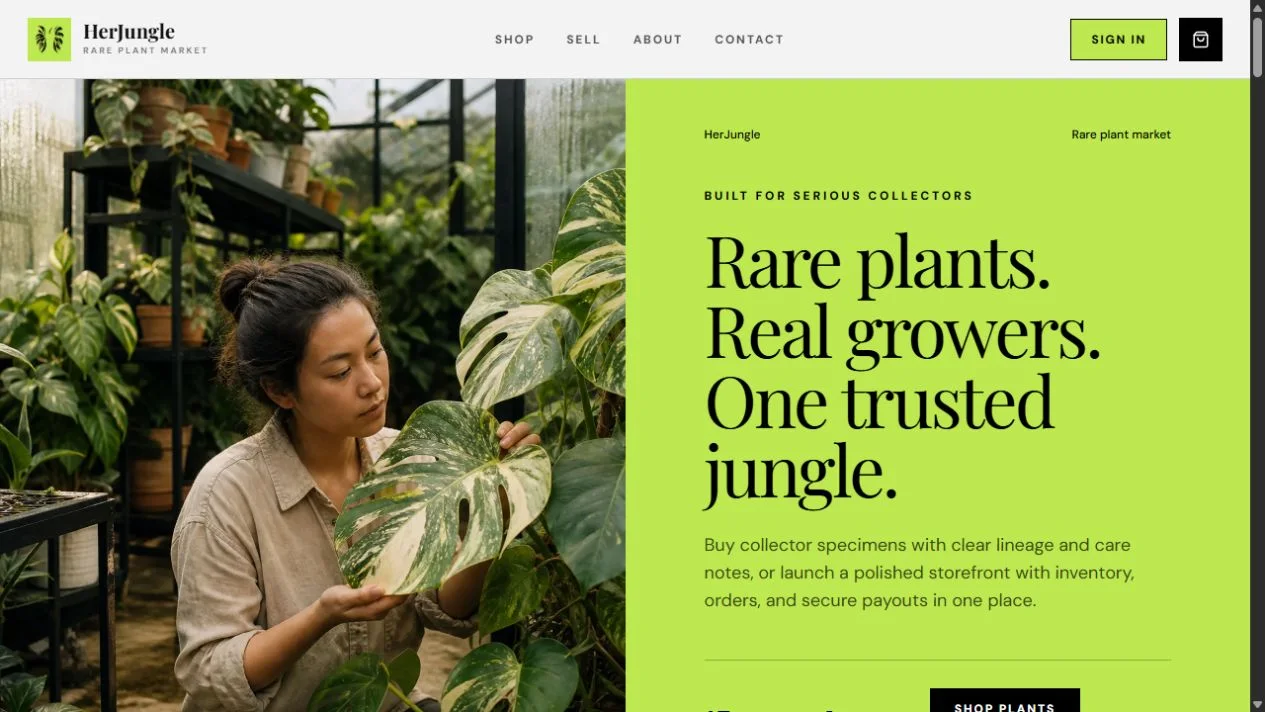
Acquire the HerJungle plant marketplace software asset. Check grower storefronts, stock, checkout, source ownership and the agreed transfer scope.
Acquire HerJungle as a rare-plant marketplace software asset. The application provides grower storefronts, catalogue and inventory controls, single-grower checkout, order records and seller-plan foundations. The sale concerns a digital product. Physical plants, a production nursery and signed grower relationships are separate assets and are included only when expressly agreed.
View the HerJungle listing and discuss an offer with the seller on Flippa. Check the current software asset package and technical handover document when preparing the purchase scope.
HerJungle is presented as a starter product without represented verified revenue, paying customers or completed commercial trading history. Demonstration plants and orders show how the interface works. They do not establish available commercial inventory. Review the current Flippa listing for availability, asking terms and the agreed transfer package.
The purchase scope below connects the application deliverables with the acceptance checks for a buyer who wants to own and operate the marketplace. Use it to prepare an offer, resolve included rights and record the launch work that remains after the software transfer.
The grower marketplace included in the software purchase
A single plant store sells one operator's stock. The operator controls product information, prices, packaging and customer service. Its software needs to make those tasks manageable. A grower marketplace adds independent sellers, separate storefronts and payment destinations. The owner also needs a policy for approving growers and handling problems that involve more than one business.
Nursery operations software serves another scope. A buyer might need production planning, propagation records, greenhouse locations, purchasing and wholesale workflows. Those functions should be demonstrated individually. A marketplace catalogue and an order page do not establish that a full nursery-management system is included.
HerJungle is relevant to the grower-marketplace decision. It gives independent sellers a public storefront and inventory/order tools, while the platform owner controls the brand and seller-plan configuration. That can be a useful foundation for an operator with access to a plant community. It still requires genuine sellers, accurate listings and a launch process suited to the intended market.
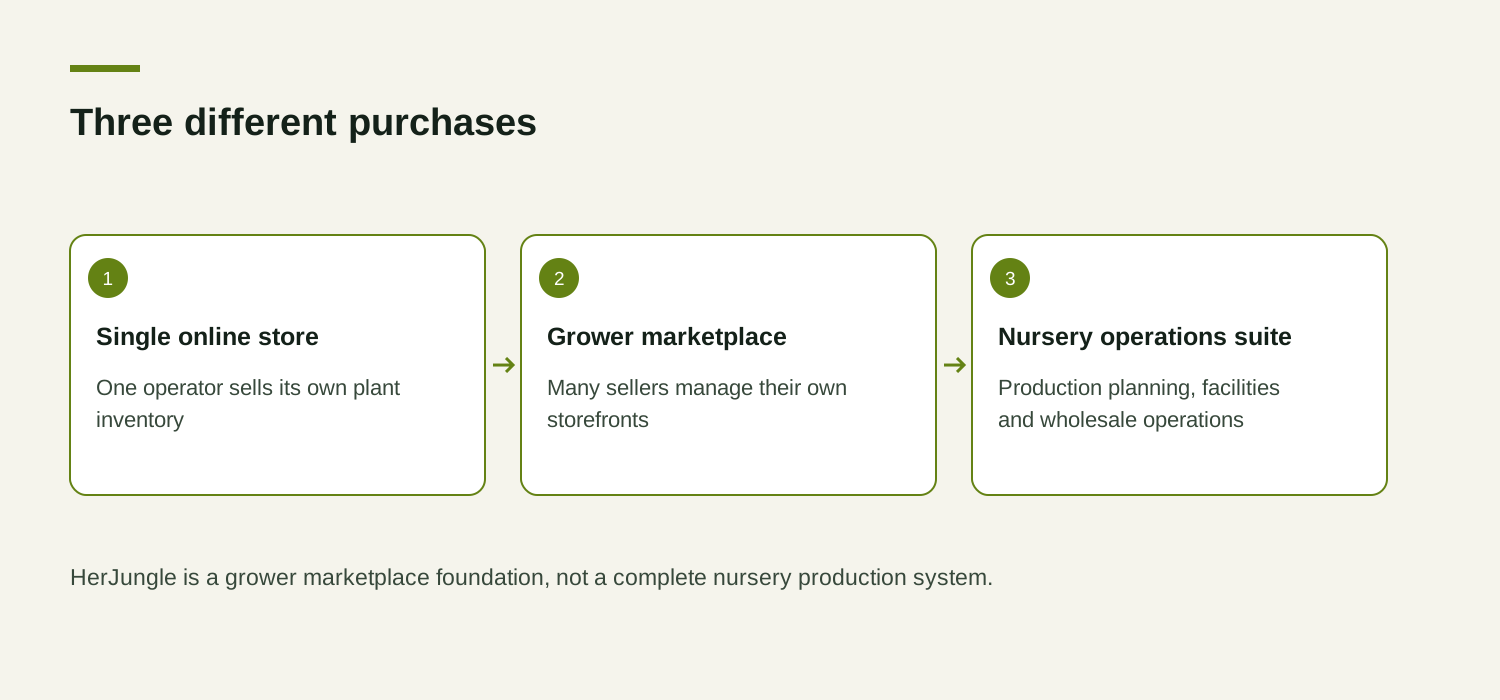
| Business model | Primary operator | Buying priority | Separate operating work |
|---|---|---|---|
| Single plant shop | The store owner | Stock, checkout and order handling | Buying or growing inventory and fulfilling every order |
| Grower marketplace | Independent sellers plus platform owner | Seller isolation, storefronts, plans and order settlement | Grower recruitment, approval and marketplace support |
| Nursery production business | Growing and operations team | Demonstrated production and inventory workflows | Plant care, facilities, labour and fulfilment |
Inspect the plant listing as a commercial promise
A plant photograph can describe an exact specimen or illustrate a product type. The distinction matters to the customer. Decide whether your intended catalogue sells individual specimens, groups of similar plants or items described by size and variety. Then ask whether the current fields and stock rules can express that choice clearly.
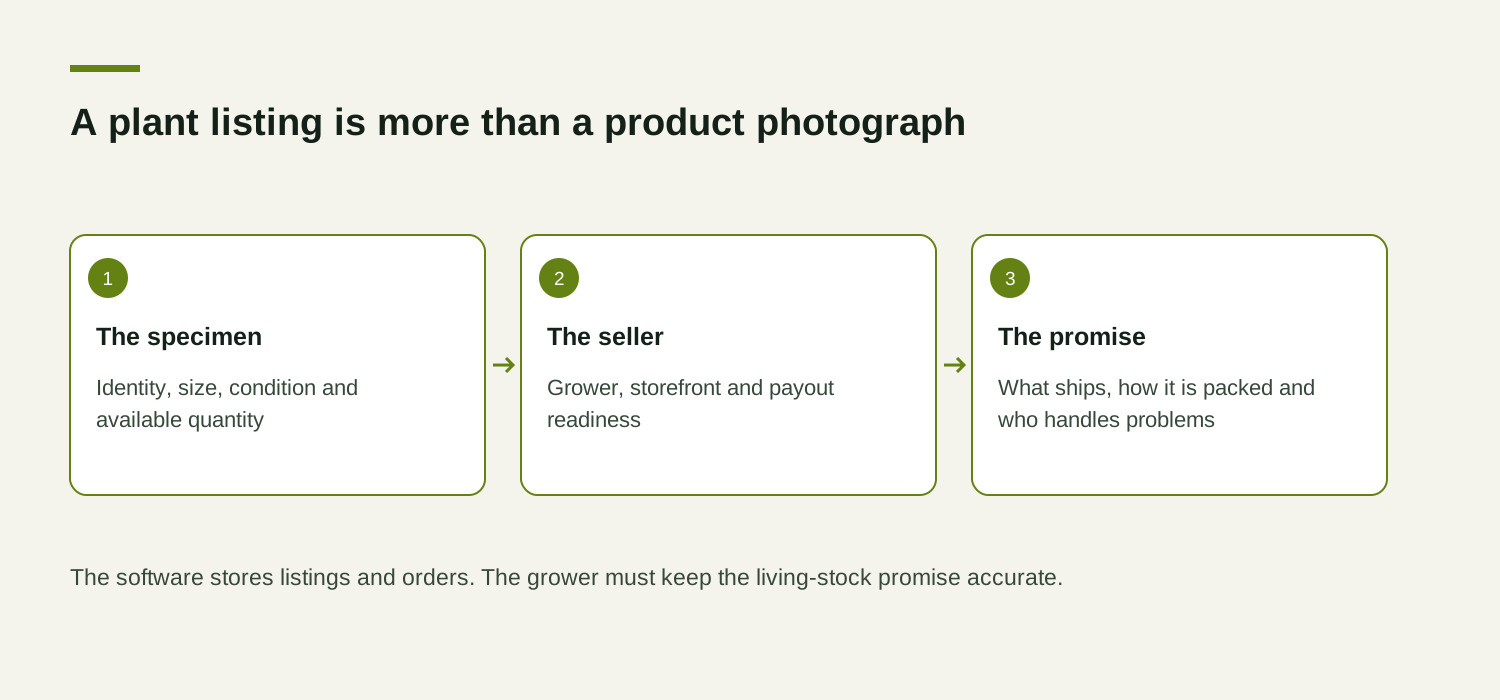
Review the available product details, care information, stock and optional lineage fields in HerJungle. A field for lineage allows a grower to provide information; it does not independently authenticate the claim. Decide what the marketplace owner will review, what the grower must supply and how a buyer can question an inaccurate listing.
Use a representative plant during the demonstration. Check its name, available quantity, price, image and storefront. Then change a detail from the grower account and inspect the public result. This shows whether the current product supports the catalogue workflow you need, without turning an attractive demonstration into a claim about plant authenticity or commercial stock.
Treat stock as a time-sensitive record
Living inventory changes. A grower may sell the final specimen elsewhere, hold a plant back or discover damage before dispatch. Your operating process needs a way to keep the public listing aligned with what can be supplied. Ask who edits quantity, when a product becomes unavailable and what the buyer sees at checkout.
HerJungle includes inventory controls and server-validated price and stock checks in its documented checkout foundation. Ask the seller to demonstrate the current behaviour with a small sample quantity. Make two requests for the last available item in an agreed test and inspect the records. The acceptance result should describe what happened, including any payment or reservation state.
Also identify the limit of the inventory model. A marketplace stock field may suit a small grower's storefront while leaving production, batch tracking or multi-location operations to another system. That can be an acceptable commercial boundary. Write it into the buying decision so a later nursery expansion does not reveal an assumed capability that was never included.
Follow one order through a single-grower checkout
HerJungle's shopping flow uses a single-grower checkout. This keeps the selected plants, seller and connected payment destination within one supplier order. If your proposed marketplace needs a combined basket from several growers, identify that as a separate requirement and request an implementation scope. Multiple storefronts alone do not establish a shared delivery or settlement workflow.
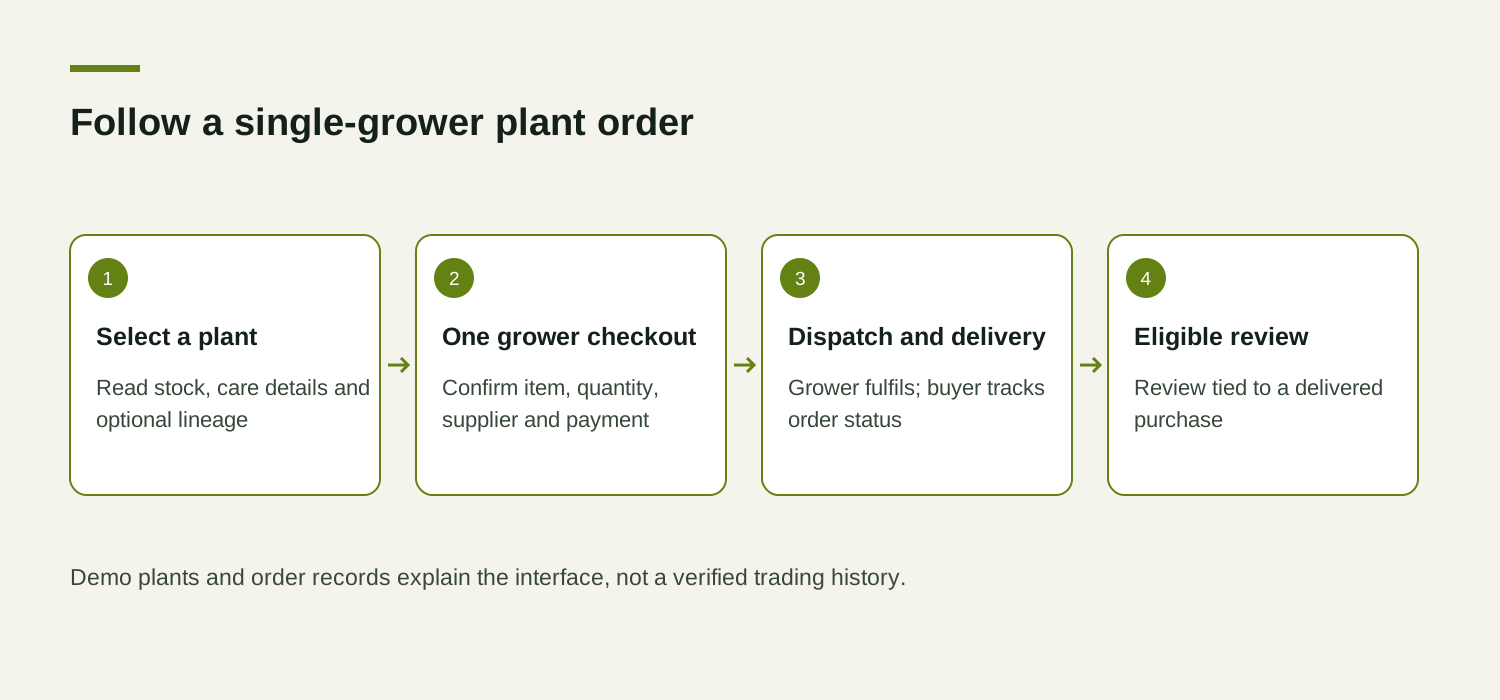
During the demonstration, select a plant, review its details and complete an agreed test checkout. Inspect the resulting order in the buyer history and seller account. Keep the item, quantity, amount and order identifier visible in your acceptance notes. Then refresh both views so you understand how the product behaves after the checkout session ends.
Try an item from a second grower and observe the cart response. A clear single-grower boundary can be useful when each seller packs and dispatches independently. The buyer should understand that boundary before paying. If the public offer promises a combined order, the software and operating arrangement must support that promise throughout fulfilment and exceptions.
| Check | Demonstrate | Record |
|---|---|---|
| Plant identity | Same specimen or product description through checkout | Item reference, quantity and seller |
| Stock conflict | Competing request for the final available quantity | Availability result and payment state |
| Different grower | Add another storefront's item | Cart boundary and customer explanation |
| Abandoned payment | Leave checkout without completion | Order state and any stock reservation rule |
| Delivery and review | Advance an eligible sample order | Who can update it and who can review |
Separate seller plans from plant-sale proceeds
The platform owner can configure seller subscription plans. Growers use the platform's storefront and selling tools, while plant payments use the connected-commerce foundation. These are separate money relationships. Review the current plan configuration and the actual payment routing rather than assuming the platform owner keeps the whole value of a plant order.
A configurable plan is a commercial option. It does not mean growers are currently paying for it. Ask for independent evidence before valuing an asset on subscription income or completed sales. For a starter product such as HerJungle, evaluate the delivered software, domain and remaining launch work without presenting demonstration records as operating results.
Test the plan lifecycle in a suitable payment environment: selection, successful payment, cancellation and failure handling. Then inspect what happens to the seller's access and public storefront. If the policy for unpaid plans is undecided, resolve it before launch. The buyer needs both a working billing path and a clear explanation for the growers who will use it.
Check grower ownership and platform-owner permissions
Ask for two demonstration grower accounts. Each should see and manage its own storefront, catalogue and relevant orders. A sample public page cannot demonstrate this account boundary by itself. Change a plant price or publishing state as one grower, then inspect the other account and the public catalogue.
The owner area should support the oversight you plan to provide without confusing it with ordinary grower access. HerJungle's documented foundation includes separate administration, user management, plan controls, platform settings and support messages. Inspect the current tools and ask who may change them. Use sample records rather than private customer information.
Also review administrative credential changes during transfer. The buyer should know how the private owner area is secured and how access is removed from former operators. The practical goal is clear control of the business after purchase: the buyer operates the platform, while growers manage their assigned storefronts. Record any additional staff or moderation roles that require future work.
Make payment readiness visible before publishing growers
A connected payment-account identifier is only one configuration detail. Ask how the application knows whether the grower can accept the intended payment and receive funds. Verify the required account readiness in the buyer's chosen environment. Public visibility, subscription status and payout readiness are related states that should remain understandable to the operator.
Use appropriate payment tests during acceptance and repeat them after buyer-owned services are configured. Trace the order amount, supplier destination and resulting application state. A checkout success screen is useful, but it does not establish a real bank payout or a history of commercial transactions. Keep those claims separate in the sale review.
If your planned growers operate in different countries, check the exact account and payment arrangement for those markets. Do not generalise from one demonstration account. International website access and international settlement support are different questions. Limit the launch offer to the configuration and supplier process you can verify before accepting real orders.
Plan packing, dispatch and arrival problems
The software can record orders and statuses, while the grower must prepare the living item for delivery. Before buying, write down the information a grower needs to fulfil an order and what the customer expects to receive. Decide which messages and instructions must be present in the application and which are handled through a documented operating process.
Plant quality and delivery conditions can create disputes. Define how the buyer reports a problem, what evidence is requested and who responds. Confirm the available order and support records in the current product. Do not assume an automatic claims or refund engine exists because checkout and order history are present.
Shipping arrangements, weather-related holds and permitted service areas may vary by seller and destination. Identify the rules for your chosen launch rather than publishing a universal delivery promise. The marketplace buyer should understand the required work and obtain suitable specialist advice for the markets served. An owned website gives you room to implement the chosen policy; it does not choose it for you.
Ownership and account deliverables to include in the offer
Identify the domain, source repository, current product design and buyer-facing documentation in the acquisition schedule. Confirm the rights needed to operate and modify the application. Brand material and plant imagery should have a clear inclusion and rights statement, including any content that should be replaced before trading.
The buyer also needs control of the services that run the product. List the hosting, identity, backend and payment accounts required. Agree which will transfer through their supported account processes and which the buyer will configure afresh. Administrative access and private credentials should be reviewed during the handover, with the accepted application release recorded.
A genuine grower network, physical inventory or historical sales would be additional commercial assets. Request evidence and transfer terms if any are represented in the agreement. HerJungle's starter description does not represent those trading results. The offer should value the delivered product scope and explicitly identify the work needed to recruit sellers and launch real orders.
| Asset or deliverable | Evidence before acceptance | Buyer responsibility |
|---|---|---|
| Code and installation material | Repository access and a reproducible deployment | Maintain the owned application |
| Domain and visual identity | Agreed transfer and content rights inventory | Operate the purchased brand accurately |
| Marketplace workflows | Grower isolation, stock and checkout acceptance tests | Recruit genuine growers and prepare the catalogue |
| Payment and plan foundations | Buyer-account configuration and appropriate test evidence | Complete approval and set the commercial offer |
Interview a grower using the actual listing workflow
Before buying for a broad plant audience, speak with a grower whose business resembles your intended seller. Ask them to prepare one representative product listing. Observe which information they already have, which photographs they can provide and what would make maintaining the listing difficult. This produces a more useful buying requirement than a generic feature wish list.
Ask how the grower currently handles sales from other channels. If the marketplace has no verified stock integration, someone must keep quantities aligned. A small agreed catalogue or manual update process may be suitable for an initial launch, provided it is understood. Record the constraint instead of promising inventory synchronisation that has not been implemented.
Then discuss the seller-plan offer. A grower may value a branded storefront, order tools, access to collectors or a managed service. Identify which of those benefits the current software provides and which depend on future marketing. This keeps the proposed subscription price connected to a real offer rather than treating every registered account as predictable recurring income.
Review content rights and demonstration records
Check the rights to the brand, plant photography and product descriptions included with the application. A starter catalogue may use images created for the product and sample grower profiles. Ask what you can retain, what should be replaced and what does not represent a real commercial relationship. Keep that distinction visible in the launch plan.
For genuine growers joining after purchase, define the permissions needed to publish their photos, descriptions and business information. Decide who can correct an inaccurate item and how a removed seller's catalogue is handled. These are operating questions to resolve around the software's current controls, rather than assumptions that can be inferred from a public preview.
Remove or clearly manage demonstration records before accepting real orders. A complete-looking marketplace can create the wrong expectation if sample stock is offered as available inventory. The buyer should be able to show a catalogue whose seller, quantity and fulfilment promise are accurate. Include this preparation in the acceptance and launch schedule.
Calculate the launch budget without inventing sales
Separate acquisition cost from ongoing operating costs. Your budget may include hosting, application services, payment fees, maintenance, catalogue preparation, support and grower recruitment. Use the actual technical documentation and the chosen providers' account terms to obtain inputs. A universal monthly cost estimate would hide choices that the buyer still has to make.
Keep planned seller subscriptions separate from verified income. A price configured in the owner area is an input you can test with growers; it is not evidence of accepted demand. Likewise, a sample order does not establish plant-sale revenue. A realistic purchase review can still recognise the value of completed product work without turning a starter application into a profitable trading business on paper.
Write a limited launch scenario with a manageable catalogue and defined service area. Identify who answers buyer questions, who checks grower listings and how order problems are escalated. This exposes the required staffing and support work. Use it to decide whether the purchase fits your capacity, then expand only when the operating process works.
Specify the handover you need to own the product
HerJungle's documented package includes the domain, application source, product design and buyer-facing guides, with up to thirty days of reasonable technical handover support in the stored sales material. Confirm the current agreement, availability and exact scope. The support period should have a clear start date and practical delivery conditions.
Identify every service required to operate the application. Configure buyer-owned hosting, authentication, backend and payment accounts through their normal account processes. Rotate private credentials and review any existing connected seller accounts. A source repository alone does not establish that the buyer controls the running service or its payment environment.
Ask for a reproducible build and deployment using the delivered instructions. Verify the public marketplace, one grower account, the buyer's order view and private owner settings. Retain the release reference and accepted checklist. If additional import, delivery or reporting work is needed, record a specific scope so the purchase decision includes the cost and responsibility for completing it.
Steps for purchasing the plant marketplace asset
- Confirm the current listing is available and identify the software, domain and documentation offered.
- Choose representative demonstration plants and record whether they represent specimens or product types.
- Accept the observed stock, single-grower checkout, order and seller-access workflows in writing.
- Resolve image rights and identify the demonstration catalogue that will be replaced before trading.
- Agree buyer-owned hosting, identity, backend and payment-account setup.
- Complete the source and domain handover against the recorded acceptance conditions and support scope.
Interactive grower-marketplace buyer checklist
Use this checklist during the demonstration and scope review.
Make the final comparison with a written purchase scope
Use a short scope sheet for each platform you shortlist. Record whether it serves a single seller or independent growers, how its stock model works, which payment paths were demonstrated and what the operator must do manually. Add the included source, domain, documentation and support terms. Compare those entries rather than comparing the number of promotional feature labels.
Give unresolved requirements a concrete test. For an import, specify the fields and a sample file. For an order exception, specify the buyer action, seller response and final record. For payment readiness, specify the service environment and the state you need to observe. This keeps a development estimate connected to a real launch requirement.
A buyer may reasonably accept a focused first release with some manual operations. The decision becomes clear when the public offer matches that scope and someone owns each remaining task. Retain the accepted release reference and scope sheet after handover so later improvements build on a documented starting point.
Questions to settle before making an offer
Does the purchase include plants or signed growers?
Only items expressly included in the transaction should be treated as acquired assets. The software catalogue and demonstration profiles do not establish physical inventory or supplier contracts. Ask the seller to itemise any commercial relationships separately and confirm what can transfer. HerJungle's starter-product description does not represent an established trading network.
Can the product run a production nursery?
Its documented focus is grower storefronts, stock, orders and marketplace operations. If you need propagation schedules, greenhouse tracking or other production controls, request demonstrations of those exact requirements. You may decide to use another system alongside the marketplace or commission specific changes. Keep those decisions visible in the purchase scope.
What would make this a good acquisition?
The current product should fit your intended seller model, the required transaction should be demonstrated and the transfer should give you the accounts and rights needed to operate it. The remaining work should fit your budget and skills. Review the current product entry below and compare the documentation with your acceptance notes before making a commercial offer.
Browse the Codeblix marketplace if you want to compare other owned ecommerce and marketplace products. Different catalogues can share a visual style while requiring very different stock, payment and supplier workflows. Use the operating model as the starting point for your purchase.
Explore the products discussed
Explore related acquisition offers