
Bike rental business for sale: acquire FunRideBikes software
Software asset acquisition, included scope and transaction acceptance.
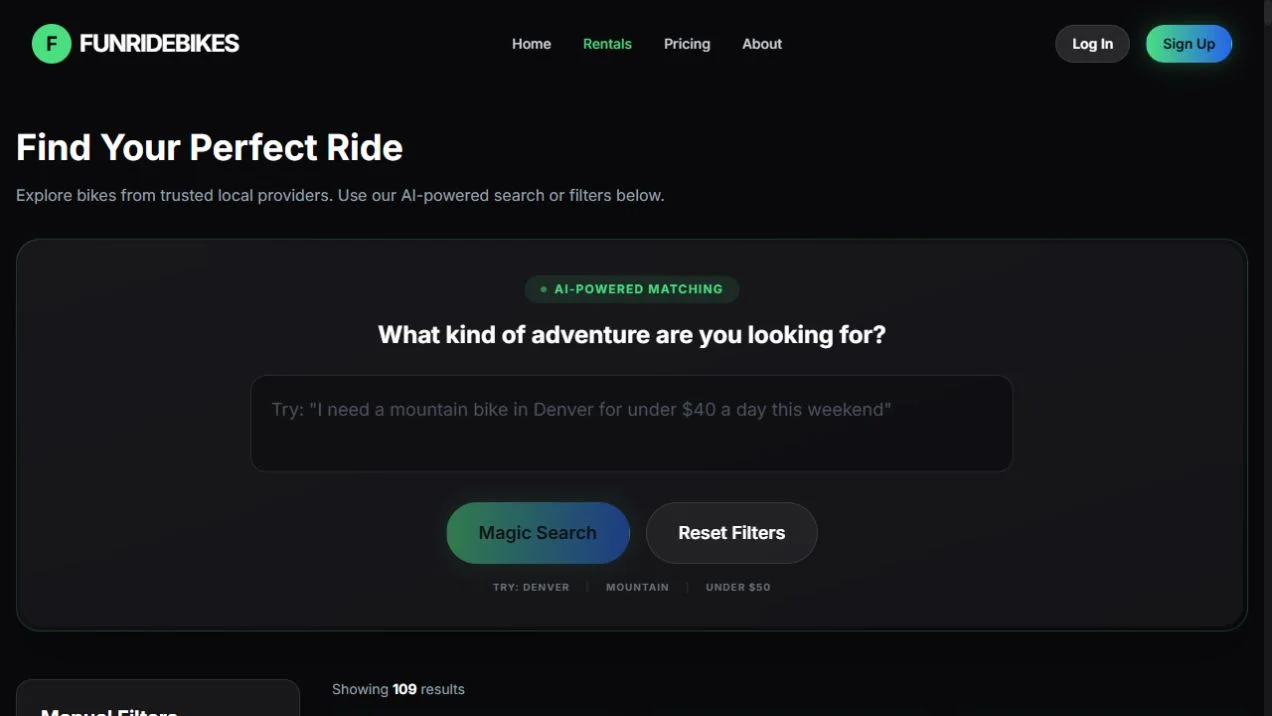
Acquire the FunRideBikes software business asset. Check the domain, source, provider storefronts, booking scope and agreed transfer before making an offer.
Acquire FunRideBikes as a bicycle-rental marketplace software asset. The proposed purchase covers a product foundation with provider storefronts, bicycle listings, search and payment integration code. It is a software-business acquisition. Physical bicycles, rental premises and a contracted operator network are separate assets and must be expressly included if they form part of an agreement.
View the current FunRideBikes sale and make an offer on Flippa. Inspect the software asset package and technical handover document before agreeing the transfer.
Review the current Flippa listing for the asking terms, availability and financial disclosures. FunRideBikes is presented as a starter asset; demonstration inventory does not establish commercial bookings, paying providers or income. Use the purchase scope and acceptance checks below to prepare a concrete offer for the application, domain and agreed handover.
The software business offered for acquisition
Start with a simple question: whose bicycles will your customer rent? If you own a fleet, your software purchase should help staff know where each bike is, which dates are available and whether it can safely go out again. Your operating work includes maintenance, pickup, returns and rider support. A useful booking system should fit that work without adding a second catalogue that staff must update manually.
If independent shops own the bicycles, you are buying a different business. The platform helps riders find a supplier and gives that supplier tools to present and manage its offering. Your work includes selecting a market, recruiting shops, explaining subscription value and checking that their listings remain accurate. An attractive directory does not supply a dependable network automatically.
A third option is a development purchase. You acquire source code and the matching domain, then adapt the product for an existing audience or rental operator. Here the strongest benefit may be saved product-development work. The purchase should be evaluated against the remaining implementation work and account setup, rather than an assumed monthly income. Each model can be sensible when the responsibilities are clear.
| Buyer | Main purchase | Evidence to request | Work the owner retains |
|---|---|---|---|
| One rental shop | A tool for its own fleet and reservations | Availability conflicts, staff workflow, pickup and return records | Bike condition, customer service and fulfilment |
| Marketplace operator | Provider storefronts, rider discovery and platform billing | Provider isolation, booking states, subscription rules and payouts | Supplier recruitment, moderation and market development |
| Product buyer or agency | Code, brand, domain and a transferable application | Repository access, account setup, documentation and a reproducible build | Configuration, changes, positioning and launch |
Keep three commercial relationships separate
A rental marketplace can involve three agreements. The rider arranges a rental with a bike provider. The provider may pay the platform for software or visibility. The platform buyer purchases the application from its seller. Treating these as one transaction causes confusion about who earns what and who must deliver the service.
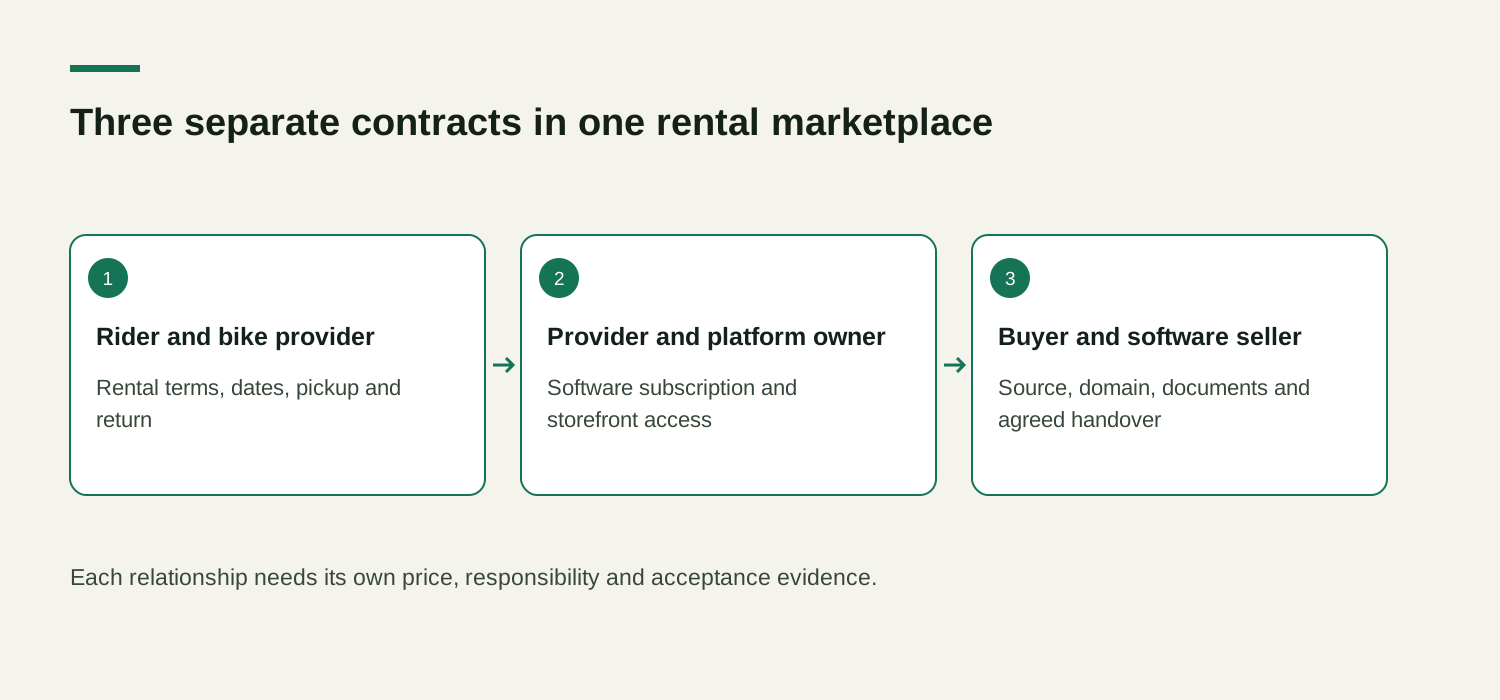
For FunRideBikes, the intended platform model includes recurring provider software fees. Rental checkout and provider payment setup are separate parts of the product. The presence of those payment paths does not prove that either has collected commercial revenue. Ask the seller to identify the current environment, the configured prices and the transaction evidence you may inspect.
Also decide what the rider sees when something goes wrong. A wrong pickup location, damaged bike or unavailable size creates a service problem, even if checkout worked correctly. Agree who handles the complaint and how the relevant records reach them. Software ownership gives you control over the product. It also places you in charge of defining this operating policy.
What the FunRideBikes example actually includes
The current product foundation connects provider profiles and bicycle listings with public rental discovery. A provider can present a storefront and rental offering; riders can search by relevant details and use a natural-language search interface. The source includes Stripe rental checkout, provider account onboarding and subscription code. The buyer must verify the current configuration and complete appropriate transaction checks in buyer-owned accounts.
The search assistant has a specific purpose. It turns a request into structured filters such as location, category, dates and budget. A sentence asking for a mountain bike within a budget can become a search request. This is a convenient input method. It does not independently verify bike condition, confirm a supplier's stock or guarantee a better booking conversion rate.
Evaluate the product as a starter software asset. Demo bikes, ratings and dashboard records should be identified as sample material. A result count on a public demonstration page tells you that the interface can display records. It does not tell you how many shops have agreed to work with a future owner or how many riders will pay for rentals in a chosen city.
Run a booking trace from search to completion
Ask for one complete demonstration with a written acceptance sheet. Choose a sample provider, a bike and a rental period. Follow the same booking from the public search result through checkout and into the relevant account views. Keep the provider, dates, amount and booking identifier consistent throughout the demonstration so that disconnected screens are easy to spot.
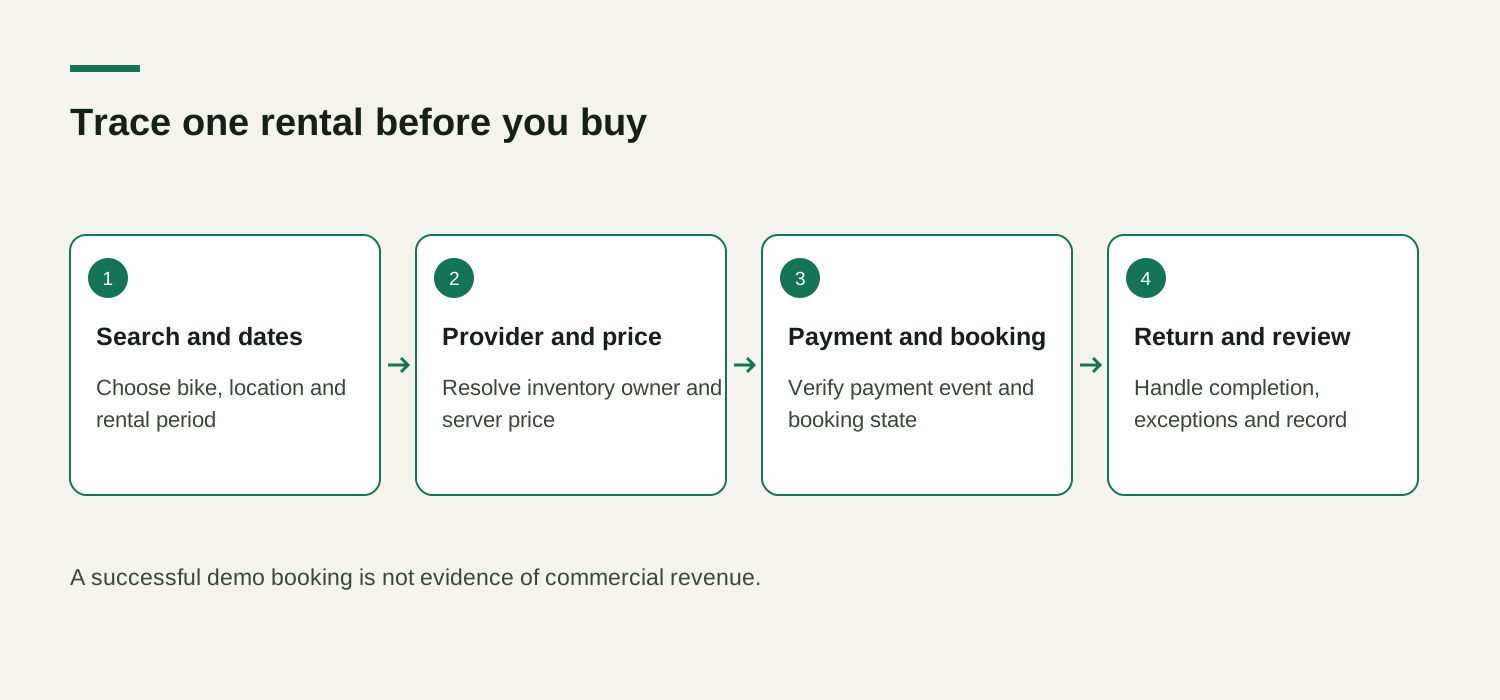
Then change one condition. Use another date, cancel a payment attempt or make a second request against the same bike. Ask the seller to explain the observed result. The objective is to understand the software's current boundary before purchase. If a needed rule is absent, record it as a specific change with an owner and acceptance condition.
Do not make a real charge merely to produce a screenshot. Use an agreed test environment and suitable payment test details. Once the buyer's accounts are configured, repeat the relevant tests there. A successful transaction in a seller's account is useful context, but your launch depends on the buyer's payment approval, account configuration and connected provider readiness.
| Scenario | Question | Useful result |
|---|---|---|
| Two requests overlap | Can both reserve the same unit or quantity? | An explained availability rule and consistent records |
| Payment is abandoned | Does the platform keep an unpaid booking or hold stock? | A visible state with a defined expiry or recovery path |
| Price changes after browsing | Which amount does checkout use? | Server-confirmed price and clear confirmation |
| Provider cannot fulfil | Who can cancel and what happens to the payment? | Defined permissions, customer communication and settlement handling |
| Rental completes | Who may record completion and review it? | Consistent terminal state and purchase-related review rules |
Availability needs a business rule, not just a calendar
Rental inventory is sensitive to time and quantity. A shop may list one specific e-bike or a group of similar city bikes. Those inventory models require different rules. Ask whether a listing represents a physical unit, a capacity pool or a provider's offer that still needs confirmation. Make the distinction visible in the rider experience.
Also write down when availability changes. Is stock reserved before payment, after a verified payment event or after provider acceptance? What happens when someone closes checkout and returns later? These questions matter more than whether a date picker looks polished. They determine whether staff can trust the booking list during a busy rental period.
Physical operations introduce further needs: late returns, maintenance days, damaged equipment and bikes moved between locations. Do not assume that a marketplace catalogue implements workshop scheduling or asset inspection. If your operation depends on those functions, demonstrate them or budget for a separate system. A focused marketplace can still be useful when its inventory boundary matches your process.
Inspect the payment paths independently
Provider subscription billing and rider rental payments should have separate acceptance checks. A provider may pay to access storefront tools while rental money goes to the connected rental business. Decide whether the platform charges a transaction fee, a software fee or both. The implemented configuration and the proposed future commercial model should be written separately.
For the subscription path, inspect plan selection, checkout completion, failed payment and cancellation. For the rental path, inspect the selected provider, item amount, booking record and payment destination. A checkout success screen is only one part of the evidence. Ask how the backend confirms a payment and how repeated payment notifications are handled.
For payouts, verify the provider account state in the intended payment environment. A provider profile containing a payment-account identifier is not proof that the provider can receive funds. Payment onboarding and geographic availability depend on the buyer's and provider's service accounts. Plan those checks before recruiting a real fleet, so the commercial promise matches what you can actually settle.
Source ownership and operating access in the purchase
Request the application source, its build instructions and the domain transfer details as named deliverables. Confirm that the buyer receives the rights needed to operate and modify the sold product. Any code, media or service with separate terms should be identified before acceptance so the transfer scope is clear.
The operating accounts are another deliverable to resolve. A buyer needs suitable hosting, backend, identity and payment configuration under its own control. Ask which accounts will transfer through provider-supported processes and which will be created afresh. List required credentials and integrations privately in the agreed handover material.
Keep the offer tied to the demonstrated product. Provider storefronts, rental search and payment foundations describe software capability; genuine customer relationships, physical inventory and verified earnings need separate evidence. The purchase can still be valuable for completed product work, but the agreement should state exactly which assets and obligations change hands.
| Deliverable | Acceptance evidence | Buyer control after transfer |
|---|---|---|
| Application source | Repository and reproducible build instructions | Operate and modify within the acquired rights |
| Domain and brand | Agreed domain process and asset inventory | Manage the purchased identity and DNS |
| Operating configuration | Frontend, backend, identity and payment checks | Administer the buyer-owned services |
| Documentation and support | Named guides and written support scope | Maintain the delivered release and request agreed handover help |
Build a launch budget with observable inputs
Separate the asset purchase from the launch budget. The acquisition price is one line. Other lines can include hosting, application services, payment fees, AI usage, support time, implementation changes and provider recruitment. Request actual service requirements from the technical documentation instead of guessing a universal monthly operating cost.
Use a worksheet with a source beside every figure. A provider subscription price is a proposed commercial input until customers agree to it. An email or infrastructure quote is an operating-cost input. Demonstrated transaction fees should come from the selected provider's current account terms. Keep estimates labelled so a planning spreadsheet cannot be mistaken for historical profit.
Then test a small operating scenario: a limited city area, a narrow set of bicycle types and a manageable number of suppliers. Write down how you would answer rider questions and resolve unavailable listings. This exercise reveals whether you are buying the right software scope. It does not require inventing an earnings forecast or promising passive operation.
Make the handover a sequence you can verify
Request the domain, source repository, installation instructions and the agreed product documentation. Confirm which visual assets and brand materials are included and what rights accompany them. Service accounts should be created or transferred through the providers' normal processes. Keep private keys and payment credentials out of public website files and documentation.
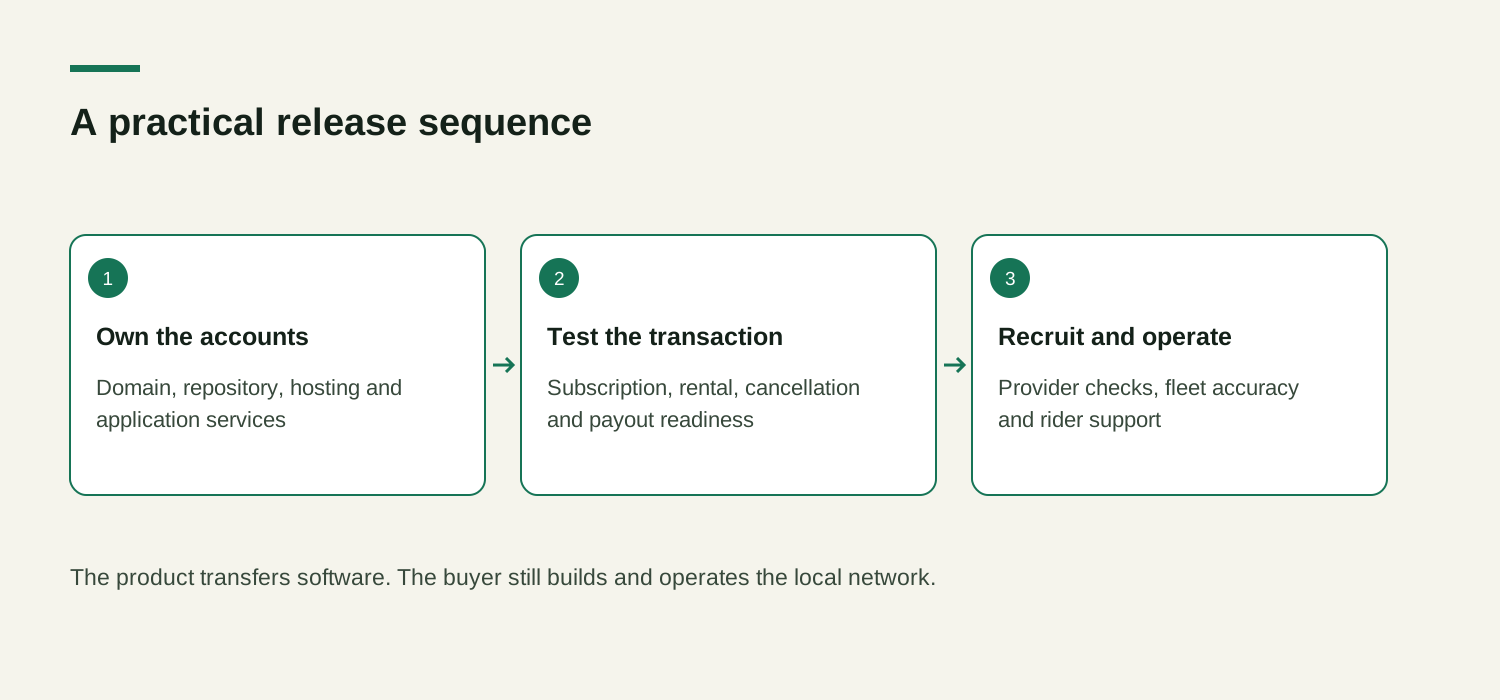
Use a fresh build in the intended environment as an acceptance step. The buyer should know how the frontend reaches the backend, how sign-in is configured and where owner settings are changed. After account configuration, confirm that branding, a sample provider listing and a test booking appear in the deployed application. Retain the agreed checklist and release reference for later maintenance.
The stored FunRideBikes sales material describes thirty days of hands-on technical support. Confirm the current written scope and start date in the sale agreement. Specify the setup help and corrections covered, the channels used and any agreed additions. A precise handover plan helps both sides finish the transfer without relying on a vague promise that everything is already automatic.
Interview a provider before buying for a whole market
Choose a rental operator who resembles the suppliers you hope to recruit. Ask them to describe a recent busy day: how bookings arrived, where they recorded availability and what caused confusion. Use their actual workflow to prepare the software demonstration. A platform can be technically functional while asking a shop to do extra work that it will not accept.
For example, a provider may already take reservations through a shop counter and another website. If your marketplace has no proven connection to that booking source, someone must keep availability aligned. Decide whether your launch uses request-to-confirm bookings, an agreed stock allocation or a separately implemented integration. Do not call the problem solved because both systems display calendars.
Ask what would make the provider pay a recurring software fee. It might be a useful storefront, easier request handling or access to a relevant rider audience. Those are different value propositions. Record which existing product functions support each promise and which depend on the network you have yet to build. This helps you choose a price and sales message you can support honestly.
Keep the first supplier onboarding simple enough to repeat. Define the required business details, pickup instructions, bike information and payment setup. Then time the work with the demonstration account, without presenting the result as an industry benchmark. Your own small acceptance exercise is a more useful purchase input than a generic promise that shops can join instantly.
Check access and exports using two provider accounts
Use two separate provider accounts during an agreed test. Each provider should manage its own storefront and relevant records. Opening a second account is a practical way to expose assumptions hidden by a seller's single demonstration account. Ask which actions require an owner, which belong to a provider and which the rider may perform.
Test a change to a service price, a profile image and a booking state. Confirm that the intended account sees the update and that the other provider cannot edit it. Avoid using genuine private customer records for this demonstration. Sample accounts and records are sufficient to understand whether the current permissions match the proposed marketplace model.
Also inspect the available exports and documentation. An operator needs to know how to retrieve booking records, provider details and essential business information if an account is suspended or the hosting arrangement changes. If a needed export is absent, describe the desired fields and schedule it as a bounded implementation task. Source ownership makes changes possible, but it does not make every operational tool present on the day of purchase.
Decide how the business will handle exceptions
Before an offer, choose several awkward cases: a rider arrives late, a bicycle is unavailable, a provider changes pickup instructions, and a payment is disputed. Ask which records the application keeps and which staff member would answer the customer. You are checking whether the product and the proposed operating policy can work together.
Some rental operators require deposits, identity checks or rental waivers. Do not assume that a checkout screen includes those processes. Identify the exact requirement for your chosen market, get suitable local advice where needed and define how it will fit the rider journey. Any additional provider approval or integration should be included in the launch plan before you promise it publicly.
Finally, keep a record of the accepted limitations. A buyer may reasonably launch with a narrow geography, a small number of providers or manual handling for unusual cases. That is a commercial choice. It becomes risky when the public offer describes automatic global operation while staff are relying on an undocumented manual workaround. Buy the scope you can explain, demonstrate and operate.
Prepare a specific acquisition offer
- Request the current source, domain and documentation inventory from the seller through the listed transaction channel.
- Record the demonstrated release and the provider, rider and owner acceptance results.
- Identify required changes separately, with an owner and an observable completion condition.
- Confirm buyer-owned service accounts, payment configuration and any transfer restrictions.
- Write the agreed price, included digital assets and handover support scope into the purchase process.
- Complete the agreed transfer and acceptance checks before presenting the software as a launched rental network.
Use this buyer checklist before making an offer
Tick an item only when you have seen the evidence or recorded an agreed condition of purchase.
Keep a short decision record after the demonstration
Finish the review with four entries: the operating model you chose, the workflow you observed, the remaining work you accepted and the accounts or rights that must transfer. Give each unresolved item a clear acceptance condition. This makes the offer easier to assess and gives the handover a practical finish point.
Keep that record alongside the current listing and the agreed documents. If the product changes before transfer, review the affected item again. A purchase decision based on a specific demonstrated release is easier to support than one based on general impressions from a sales page.
Questions to resolve during a seller conversation
Can I operate the marketplace in several countries?
The software's public website can be viewed internationally, but the operating decision needs more detail. Check currencies, payment-account support, provider onboarding, pickup information and the policies needed for each market. Start with the countries you actually plan to serve. A global-looking homepage is not evidence that every local payment and rental process has been configured.
Does AI search remove the need for accurate provider listings?
No. The search feature translates a rider's request into filters. It still depends on the underlying listing information and available search results. Ask how missing or ambiguous information is handled and whether the rider can adjust the filters. Provider data quality, current availability and clear pricing remain operating responsibilities.
Am I buying a running rental company?
Review the actual transaction scope. A software asset purchase does not automatically include bicycles, premises, insurance, supplier contracts or a rider audience. FunRideBikes is presented as a starter application, and its demonstration records are not commercial trading evidence. Any physical assets, contracts or verified income included in a purchase should be itemised separately.
What would justify proceeding with the purchase?
A good fit means the current product supports the intended operating model, the gaps are understood and the buyer can complete the remaining launch work. Keep the decision concrete: the demonstrated booking flow, the accounts you will control, the rights you receive and the cost of the next changes. Use the current marketplace entry to inspect the available documentation and listing terms.
For other models, compare the Codeblix marketplace and the individual product documentation. A direct grocery store, a quote-led produce marketplace and a bicycle rental network share some screens, but they create different responsibilities. Choose the business you can operate before choosing the software you can buy.
Explore the products discussed
Explore related acquisition offers